French Military Watches: The Mostra Collector’s Atlas
From Type 20 chronographs and Marine Nationale dive watches to the Jacques Bianchi JB200, Commando Hubert RALF TECH watches and CNES space watches, Mostra traces the history, references and authentication criteria of French military watches.
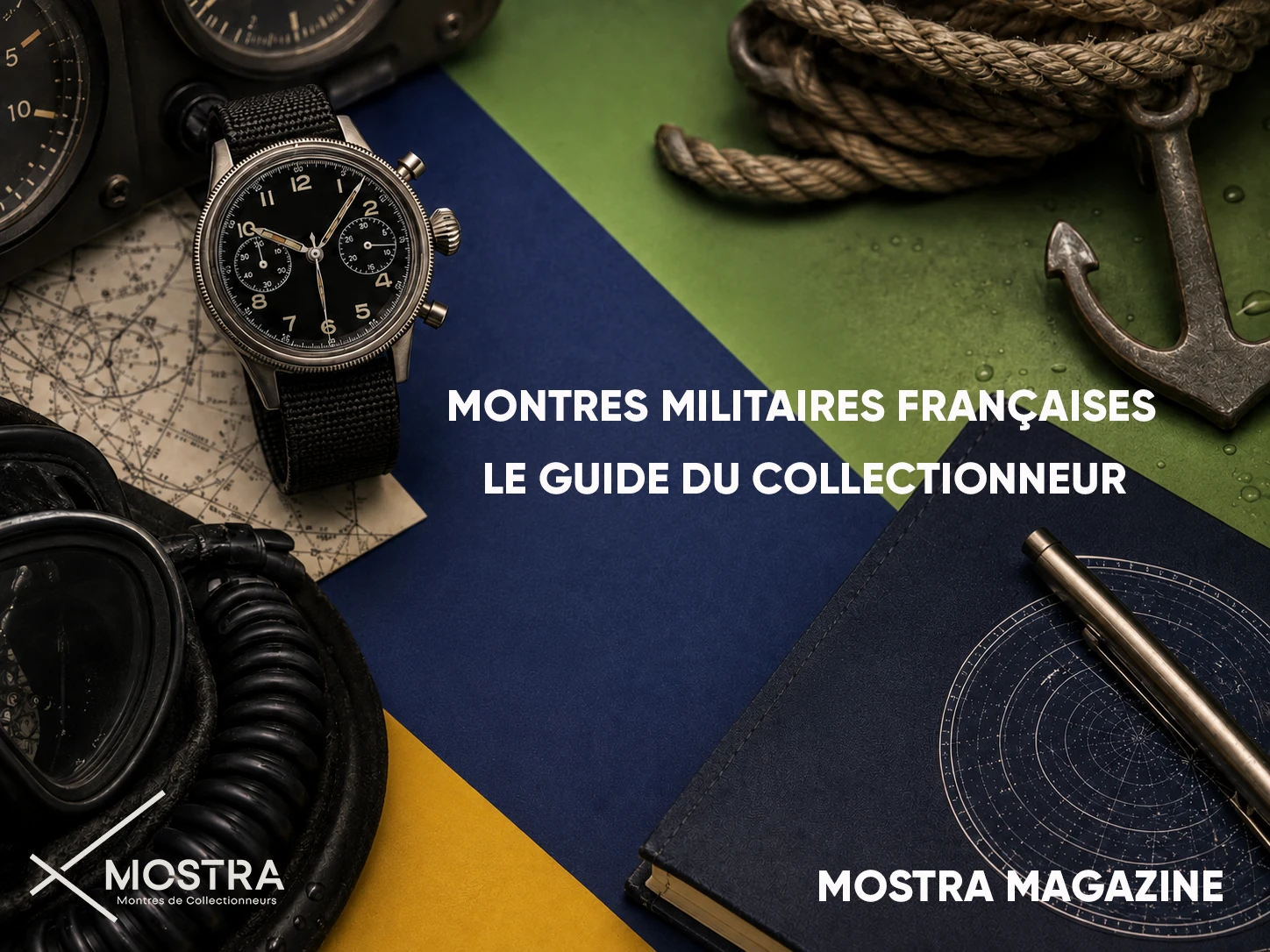
From the 1947 Longines Marine Nationale and the Stowa “Armée Française” watches associated with Indochina, to Type 20 chronographs, Toulon diving watches, the Jacques Bianchi JB200, the RALF TECH watches linked to Commando Hubert and the space watches of CNES, this Mostra Atlas retraces more than seventy years of French mission watchmaking. It distinguishes models, programmes, military issues, unit series, contemporary partnerships and watches merely inspired by this world, helping collectors understand what they are looking at before attributing a history to it.
By Thierry Serna and Jean-Baptiste Contini
Historical, heritage and market analysis: Thierry Serna
Technical analysis and workshop methodology: Jean-Baptiste Contini
THE MOSTRA ESSENTIAL
From the watches of reconstruction to contemporary mission instruments
This feature is intended for readers who do not immediately have the time required to explore the entire Atlas. It may also be read as a preface, designed to establish the principal reference points before entering into the details of the references, markings, movements and levels of evidence. The history of the French military watch does not begin with a single manufacture, or even with a single programme. It takes shape in the aftermath of the Second World War through Swiss purchases, American equipment, French production, German watches received as war reparations and instruments adapted to the new missions of the French Air Force, the French Navy, French Naval Aviation and the French Expeditionary Corps.
The Longines Marine Nationale reference 5774, manufactured in 1947, represents this first generation of wrist-worn navigation watches. Compact, mechanical, equipped with a white dial that remained legible under intense reflected light and a crown adapted for use with gloves, it accompanied the reconstruction of the French Navy and the opening years of the Indochina War. During the same period, Stowa “Armée Française” watches were delivered to France as war reparations. Their black dials, red central seconds hands and numbered case backs engraved “ARMEE FRANCAISE” form an identity that can only be authenticated by comparing the case, movement, engraving and provenance. The general association of these watches with Indochina can never, on its own, prove the individual career of a particular example.
From the 1950s onwards, the Type 20 chronograph established the flyback function as the French response to the requirements of pilots. Breguet, Auricoste, Airain, Dodane and Vixa produced watches whose dials, movements, bezels and markings varied according to contracts and institutions. Beneath the sea, watches intended for combat swimmers, the Tudor models tested by the GERS, ZRC watches with crowns at six o’clock, Aquastar Benthos, Triton, Auricoste and Jacques Bianchi all expressed the same principle: form was determined by an operational constraint before becoming an aesthetic signature.
The contemporary period introduces new statuses. The RALF TECH WRX was developed from feedback provided by Commando Hubert operators, but not every WRX is a military watch. Yema Spationaute watches accompanied French space missions without belonging to a conventional military-issue system. The Space Millenium x CNES belongs to an official institutional partnership, which is different from a watch individually issued to an astronaut. In every case, the name of a unit, a logo or the colour of a dial can never replace the study of the reference, serial number, movement, case back, documents and known history.
This Atlas therefore follows a simple method: distinguishing the general history of a model from the provenance of an individual example. Mostra formalises this approach through a five-level evidence scale, ranging from the historical association of the model to uninterrupted individual provenance. A watch may be rare without being documented; a more common piece may become exceptional when it can be connected to a user, unit, vessel or mission through a coherent chain of archives.
Watchmaking professionals, collectors and readers with an eye for detail who wish to go beyond this initial overview will find a far more in-depth analysis in the article. The following sections examine each family, attribution errors, service components, acceptable restoration, value criteria, the questions that should be asked before a purchase and the documents capable of transforming a story into demonstrated provenance. We invite you to continue reading before any appraisal, restoration or acquisition of a French military watch.
Enter the Atlas Discover the evidence scale View Mostra military watches
In this article
- Act I — Understanding the different statuses of a military watch
- What distinguishes the French military tradition
- The five-level Mostra evidence scale
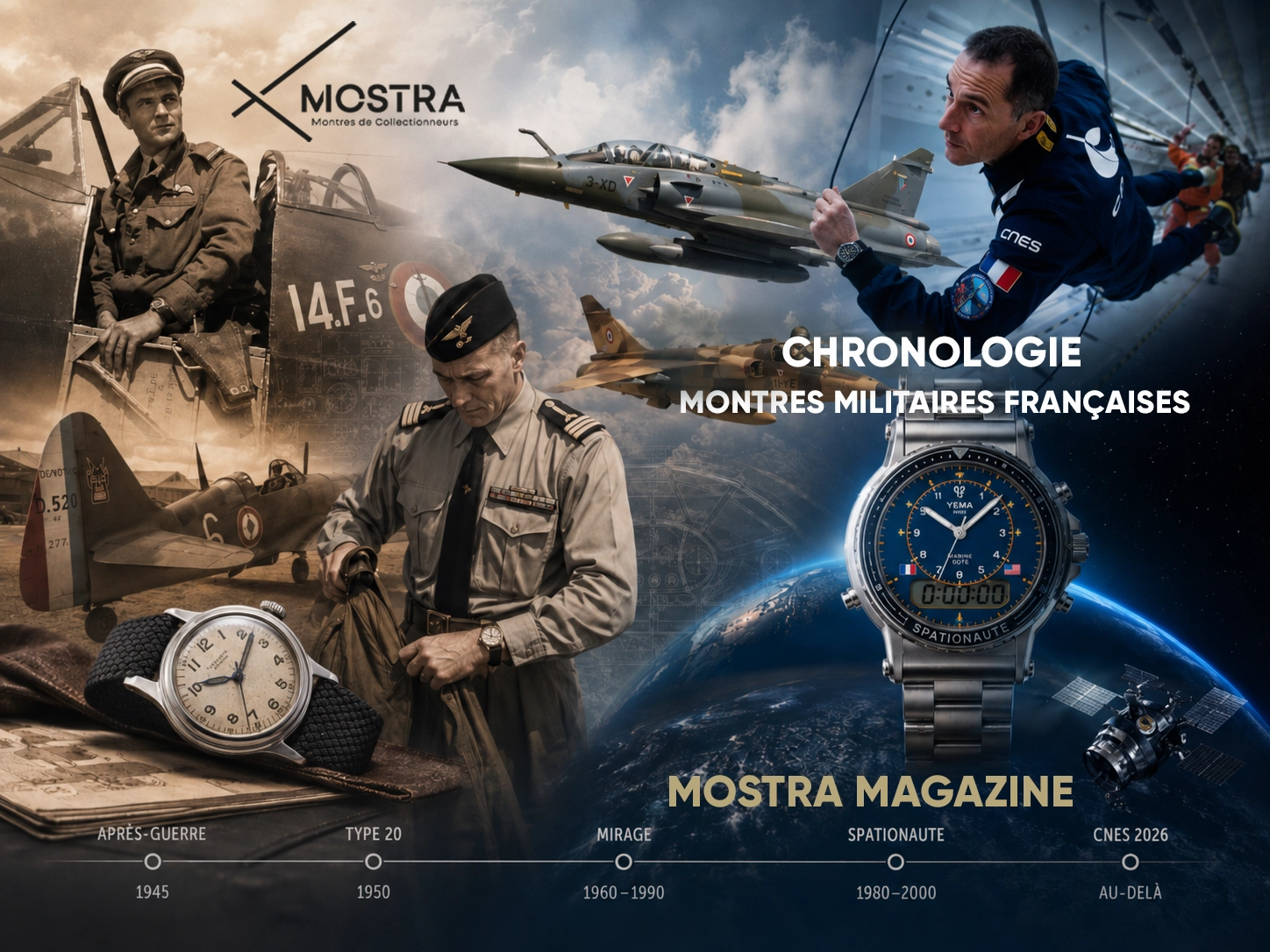
- The general timeline
- Prologue — Longines, Stowa and French post-war watches
- Act II — In the air: Type 20, Type XX, Type 21 and Yema Superman
- Act III — Beneath the sea: Tudor, ZRC, Aquastar, Triton, Auricoste and JB200
- Act IV — Special forces and space: RALF TECH, Yema and CNES
- Civilian or military: six essential comparisons
- Three Mostra case studies for understanding evidence through the object
- Restoring a military watch without erasing its history
- The factors that create value
- Ten questions to ask before buying
- French glossary for international collectors
- The Mostra doctrine
- FAQ
“Some watches tell the story of a manufacture. Others preserve the memory of an institution, a unit, a vessel or a mission. They do not become historical because a commercial narrative describes them as such. They become historical because use, archives and the men who wore them left traces that time has not erased.”
There are watches designed to evoke adventure. Then there are watches whose shape, movement, dial and sometimes even bracelet were determined by necessity: timing a flight, navigating underwater, measuring an operational sequence, remaining legible inside a cockpit, resisting a diving suit or accompanying a man beyond the Earth’s atmosphere.
French watchmaking history largely belongs to this second family. It cannot be reduced to a single manufacture, or even to a strictly national industrial origin. It forms a broader territory in which chronographs developed in response to a French programme meet Swiss watches tested and then adopted by the French Navy, German production received as war reparations, diving watches born in French workshops, contemporary instruments developed with combat swimmers and watches worn during CNES space missions.
The Longines 5774, Stowa “Armée Française”, Breguet Type 20, Tudor Marine Nationale, ZRC Grands Fonds, Aquastar Benthos, Triton, Auricoste Spirotechnique, Jacques Bianchi JB200, RALF TECH WRX and Yema Spationaute belong neither to the same period, nor to the same issuing system, nor to the same production logic. Yet together they form a French history of military, issued and mission watches.
It is a history that frequently passes through Provence. Toulon, with its naval base, divers and technical services. Saint-Mandrier, with its diving school and the environment of Commando Hubert. Marseille, with its port, professional divers and Jacques Bianchi’s workshop. Then Aix-en-Provence, where Mostra now brings together its boutique, appraisal services, documentation, selection and workshop around watches that have become collectors’ pieces.
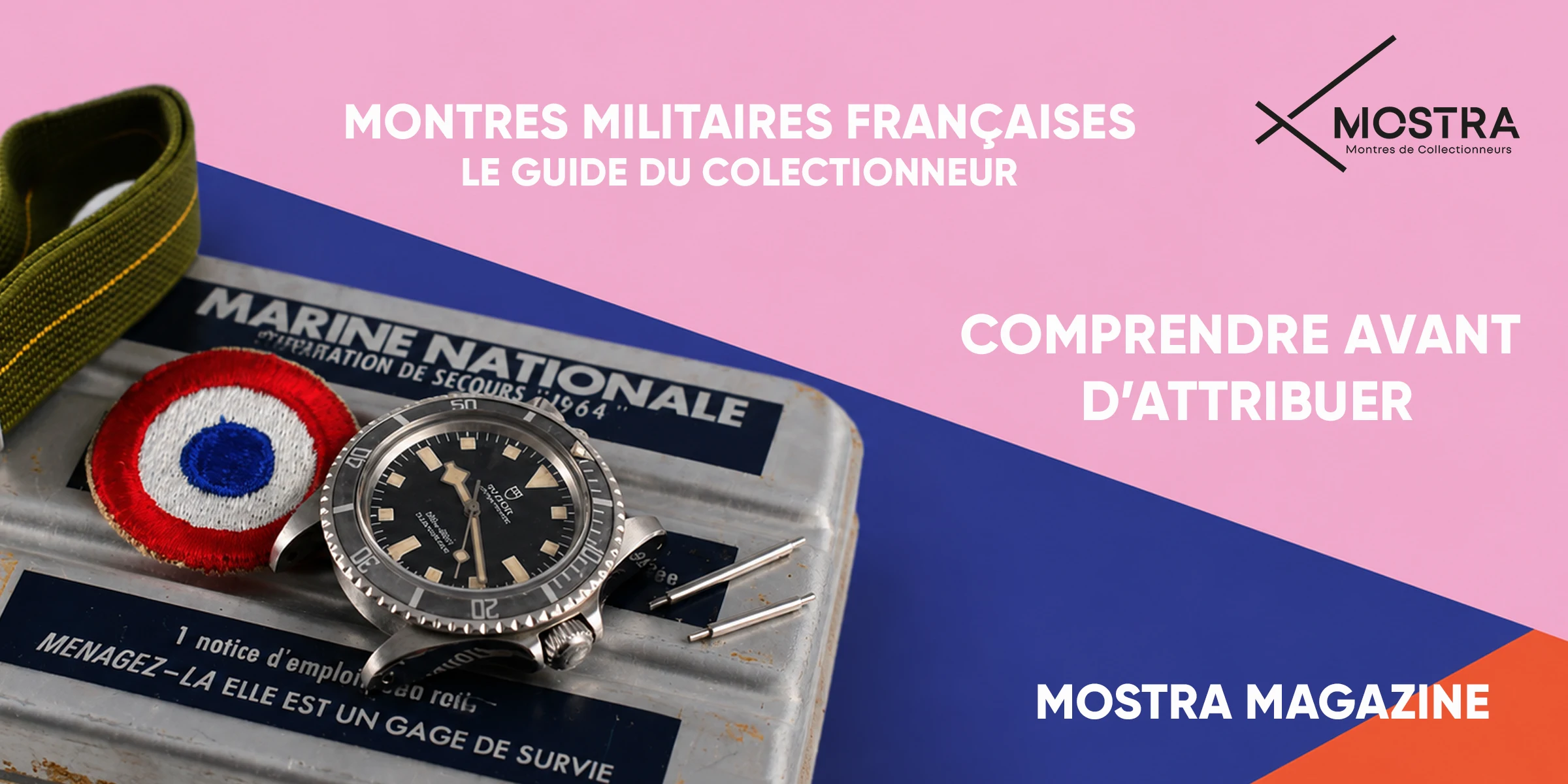
Act I — Understanding before attributing
A watch manufactured in France is not necessarily military
The expression French military watch appears simple. It nevertheless covers several realities. A watch may have been manufactured in France without ever having been worn by a serviceman. Conversely, a Swiss, German or American watch may have been tested, purchased, issued and maintained by a French institution for several decades.
In this Atlas, we therefore use a broad but demanding definition. A watch belongs to the French history of mission equipment when it meets at least one of the following criteria: it was developed according to a French programme or French requirements; it was officially purchased, tested or issued by a French force or institution; it was created with the documented participation of a unit; it was worn during an identifiable national mission; or it resulted from an official institutional partnership that is clearly described.
This definition immediately imposes a second rule: the historical association between a model and an institution does not prove the military provenance of every individual example. Not every Tudor Submariner is Marine Nationale. Not every Jacques Bianchi JB200 is military. Not every black RALF TECH is a Commando Hubert series. Not every old Stowa is “Armée Française”. Not every watch carrying an institutional logo was individually issued.
Precision of language removes nothing from desirability. It prevents desirability from resting upon confusion.
What Distinguishes the French Military Tradition
Anglo-Saxon collectors are familiar with British specifications, Broad Arrow markings and American military nomenclature. Italy readily associates its history with Panerai and combat swimmers. Germany possesses its aviation chronographs, B-Uhr watches and Bundeswehr models.
France presents a less centralised history. It is constructed around specifications, multiple suppliers, Swiss purchases, war reparations, instruments delivered with aircraft, trials conducted in Toulon, contracts awarded by different administrations, service registers, annual engravings, occasionally limited batches and personally owned watches worn during missions.
This fragmentation makes French history more difficult to summarise, but also more compelling to document. It requires a distinction between what relates to the model, the order, the individual watch and its user. A Longines 5774 may belong to a family supplied to the French Navy while still requiring examination of its case back and serial numbers. A Stowa may carry an “ARMEE FRANCAISE” engraving without its individual presence in Indochina being demonstrated. A Type 20 belongs first to a functional programme. A Tudor 7922 entrusted to the GERS belongs to a testing phase. A Tudor Snowflake that is engraved and recorded in archives may belong to an issue. A JB200 recorded in a French Navy watchmaker’s register possesses institutional traceability. A Yema Spationaute worn by Jean-Loup Chrétien belongs to an identified mission without being part of a conventional military issue.
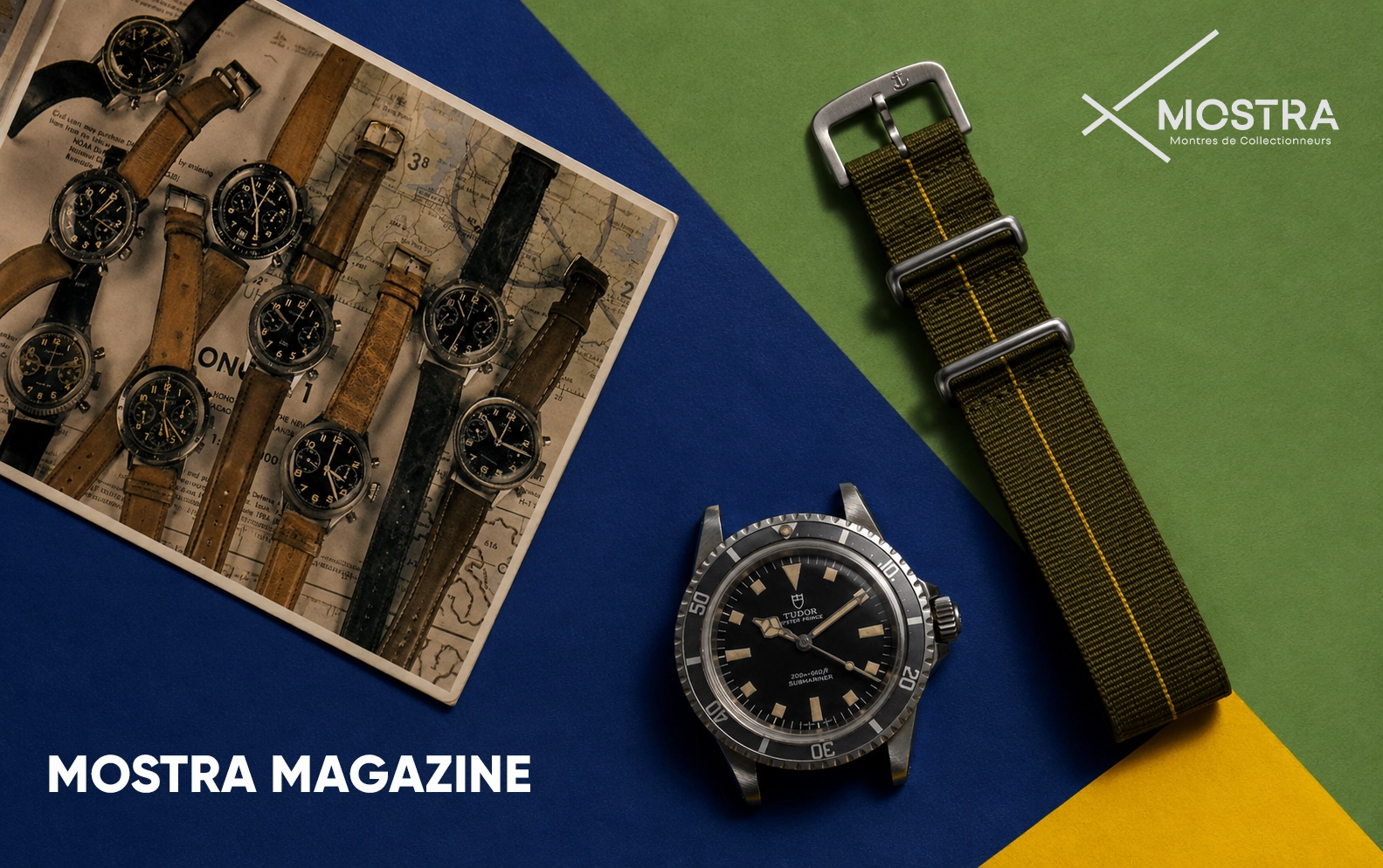
The eight statuses that should never be confused
| Status | Definition | Example of interpretation |
|---|---|---|
| Programme or specification | Watch meeting defined institutional requirements. | Type 20 chronographs created for the requirements of French military aviation. |
| Prototype or tested watch | Example evaluated before possible adoption. | Tudor 7922 and 7923 watches entrusted to the GERS in 1956. |
| Purchased or issued watch | Piece inventoried and entrusted to a department, vessel or user. | Longines Marine Nationale, Tudor MN, Aquastar Benthos or JB200 documented in a register. |
| Watch developed with a unit | Model modified following operational feedback. | RALF TECH WRX or Tudor Pelagos FXD. |
| Personally owned mission watch | Watch chosen by its wearer and used during a documented mission. | Watches personally purchased by pilots, servicemen or astronauts and used on mission. |
| Unit series | Small series reserved for or offered to members of an identified group. | Personalised or numbered watch accompanied by unit documentation. |
| Institutional partnership | Civilian product developed with an institution and offered to the public. | Yema Marine Nationale or RALF TECH x CNES. |
| Military inspiration | Watch adopting military codes without institutional provenance. | Civilian tool watch with a black dial, textile strap or tactical aesthetic. |
These statuses do not form an absolute hierarchy. A personally owned watch worn during an exceptional mission may be historically more moving than an anonymous issued piece. A rare civilian series may be more desirable than a military model produced in quantity. The table is therefore not intended to decide what is most worthy of collection. It is intended to establish what one is looking at.

The five-level Mostra evidence scale
To avoid confusing the general history of a model with the provenance of an individual watch, Mostra proposes a five-level interpretation. This scale is not an external administrative standard: it formalises the method used by the company to qualify the degree of documentation attached to a military or mission watch.
Level 1 — Historical association of the model
The model is known to have been tested, purchased, worn or used by a French institution, but no evidence yet connects the individual watch under examination to that institution. A Tudor Submariner from the correct family, a Stowa comparable to a French series or an authentic civilian JB200 may fall within this level.
Level 2 — Compatible configuration
The reference, period, movement, dial, hands, case and other components are consistent with watches known to have existed in that environment. The piece is compatible with the claimed history, but its individual issue has not yet been demonstrated.
Level 3 — Coherent marking or serial number
The watch possesses an engraving, number, year or institutional feature consistent with documented examples. This stage substantially strengthens the presumption, but the marking must still be compared with the typography, period, ageing and archives.
Level 4 — Archive or register
The number appears in a register, inventory, service document, administrative invoice, brand archive or issue record. The connection with an institution, base, department or vessel can be established.
Level 5 — Continuous individual provenance
The watch can be connected to a user, unit, mission and period through a documentary chain: issue form, photographs, diving log, service papers, corroborated testimony, family history or decommissioning document.
The rarity of a watch and the quality of its evidence are two separate dimensions. A very rare reference may remain poorly documented. A more common watch may, by contrast, become exceptional through complete individual provenance. On a military watch, value therefore increases not only with the rarity of the model, but also with the precision of the history that can be demonstrated.
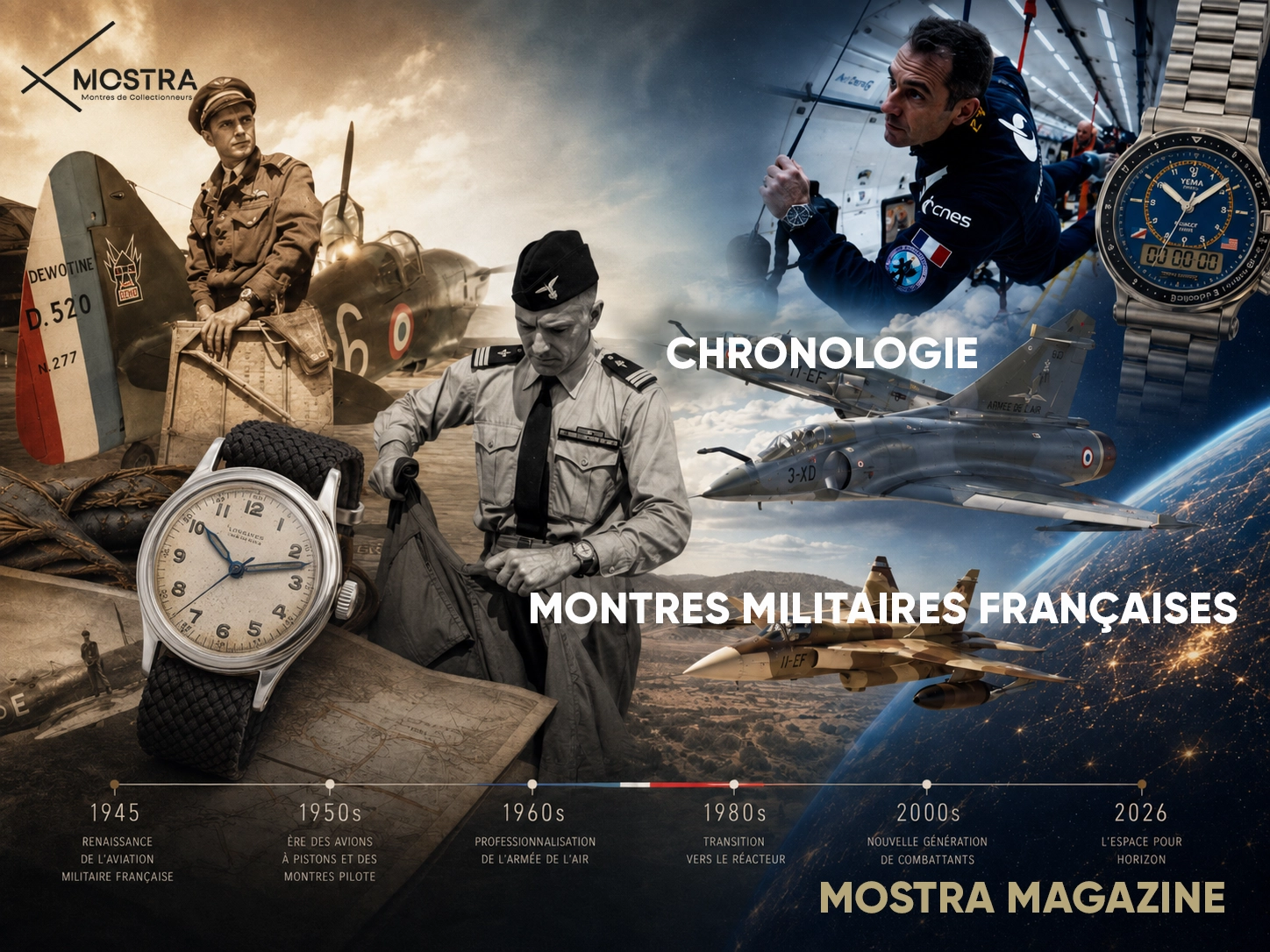
Timeline of French Military Watches: From 1945 to CNES
| Period | Watch or family | French association |
|---|---|---|
| 1947–early 1950s | Longines Marine Nationale reference 5774 | Wrist-worn navigation watches supplied to the French Navy and French Naval Aviation during the reconstruction period and the Indochina War. |
| Late 1940s–early 1950s | Stowa “Armée Française” | Watches delivered to France as war reparations, marked and numbered “ARMEE FRANCAISE”, and notably associated with the French Expeditionary Corps in Indochina. |
| Post-war period | Hanhart FFA and master watches | Artillery pocket chronographs, French Navy and Naval Aviation navigation instruments, and French and American production. |
| Early 1950s | Type 20, Type XX and Type 21 | Flyback chronographs developed for the French Air Force, French Naval Aviation and French flight-test centres. |
| 1953 | First combat-swimmer watches | Equipment for the combat swimmers’ school and definition of the requirements of modern military diving. |
| 1956 | Tudor Submariner 7922 and 7923 | Evaluation by the GERS in Toulon. |
| 1959–1966 | ZRC Grands Fonds | Response to French Navy requirements, validation and subsequent development of the crown at six o’clock. |
| 1962–1963 | Triton Spirotechnique | French diving watch designed for the environment of La Spirotechnique. |
| 1970s | Yema Superman | Selected for the French Air Force’s helicopter-borne rescue divers. |
| 1979–1984 | Aquastar Benthos Marine Nationale | Approximately 3,200 third-generation diving watches supplied through the Toulon procurement chain. |
| 1982 | Auricoste Spirotechnique, Jacques Bianchi JB200 and Yema Spationaute I | Military diving watch, birth of the Marseille-made JB200 and first French watch worn in space. |
| Late 1980s | Jacques Bianchi JB200 French Navy | Entry of certain examples into military procurement and maintenance systems. |
| 2008–2011 | RALF TECH WRX | Pre-series watches, trials and feedback from Commando Hubert operators. |
| 2021 | Tudor Pelagos FXD and Yema Marine Nationale | Renewal of contemporary institutional partnerships. |
| 2024 | RALF TECH Space Millenium x CNES | Extension of the French mission watch into the space environment. |
Prologue — 1945–1954: Longines, Stowa and Post-War Military Watches
Before the Type 20 chronograph gave post-war French military watchmaking its most famous architecture, the French armed forces were already using a far more discreet array of wristwatches, navigation watches and pocket chronographs. France emerged from the conflict with considerable requirements, armed forces deployed across several theatres of operations, and supply channels that did not depend upon a single industrial system. Watches came from purchases made from Swiss manufactures, long-established French suppliers, and above all from American and British equipment used by the Free French Forces during the Second World War, generally delivered together with military equipment or aircraft, as well as from numerous German-made watches received as part of war reparations.
This diversity confirms one of the fundamental principles of this Atlas: a watch belonging to French military history was not necessarily manufactured in France. What matters is the convergence between the model, the order, the markings, the military assignment and, whenever surviving documentation makes it possible, the individual who wore it or the mission during which it was used.
Longines reference 5774: the French Navy’s navigation watch
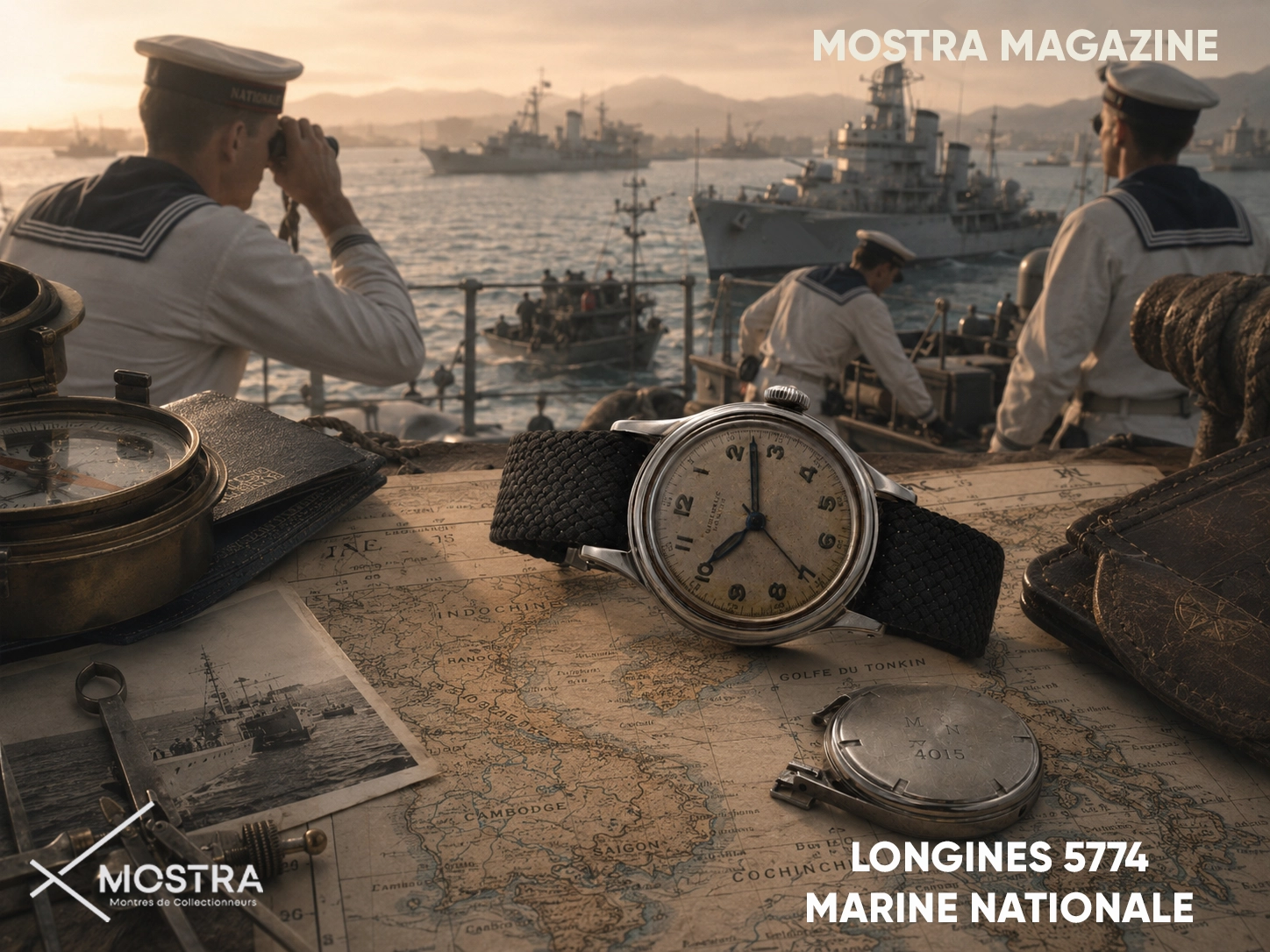
The Longines Marine Nationale reference 5774 preserved in the Mostra archives perfectly illustrates this transitional period. Its product record dates it to 1947 and associates it with a contract covering approximately four thousand watches, together with batches of components intended for servicing. It accompanied the French Navy, French Naval Aviation and forces engaged during the opening years of the Indochina War, before Type 20 chronographs gradually took over among aircrew.
Its stainless-steel case measures 33.5 mm. The screw-down case back carries the markings and numbers required for identification, while the slightly oversized crown facilitates handling while wearing gloves. The hand-wound Longines calibre 12.68N contains 17 jewels, runs at 18,000 vibrations per hour and provides approximately 42 hours of power reserve after a complete winding. It is a robust, repairable movement suited to an environment in which ease of maintenance remained essential.
The original white dial has acquired a champagne tone over time. This light colour was not an element of civilian elegance added retrospectively. It improves legibility during twilight phases and under intense reflected light above the sea. Blued hands and luminous elements increase the contrast. Depending upon assignment, these watches could be fitted with sand-coloured textile straps, black nylon straps or, more rarely, leather straps.
The Longines case nevertheless requires the distinction between the history of a family and the provenance of an individual watch to be maintained. A reference compatible with French Navy supply is never sufficient, on its own, to establish individual issue. The collector must examine case and movement numbers, dial coherence, crown, case back, strap, markings, manufacture archives and the known history of the watch. A patinated white dial, large crown or an aesthetic close to navigation watches are compatible elements; they do not replace a document, an inventory or continuous provenance.
Stowa “Armée Française”: War reparations on the wrist
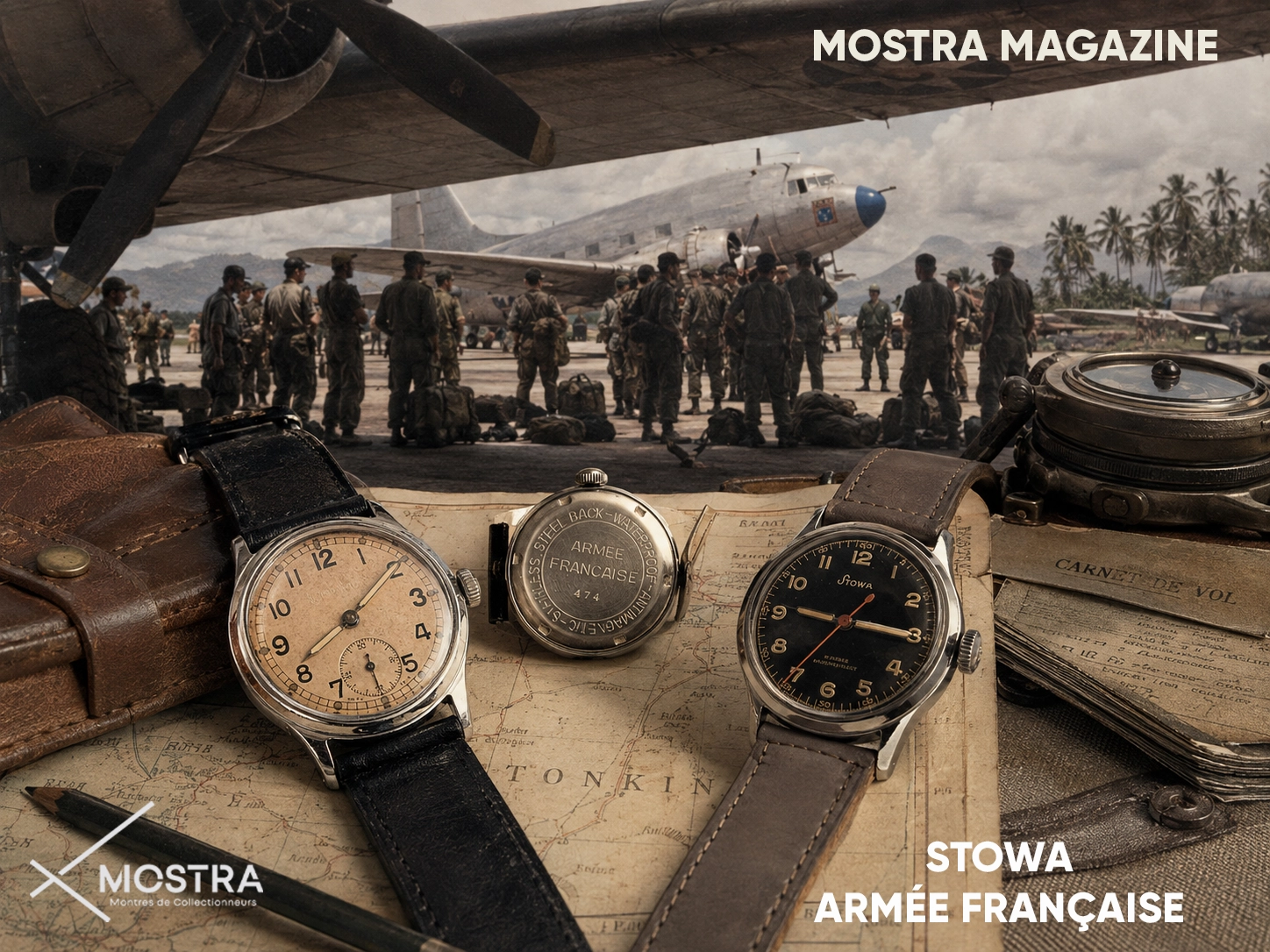
In a more terrestrial register, the Stowa “Armée Française” belongs to one of the most unusual episodes of post-war reconstruction. At the end of the 1940s, German watches were delivered to France as war reparations. Stowa’s historical museum states that approximately two thousand dials were produced for this series and confirms that the corresponding watches were intended for France in this context.
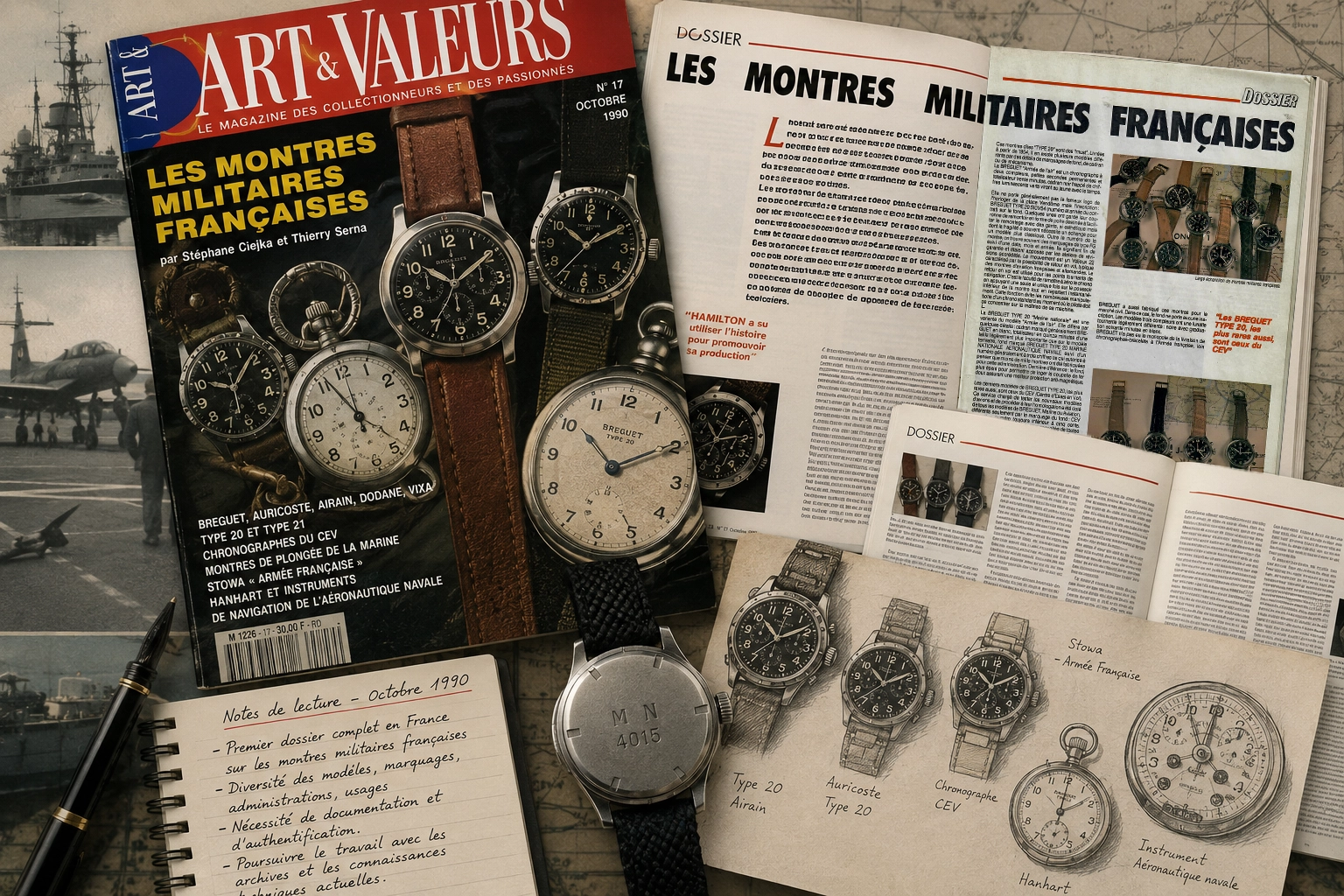
The feature published in 1990 by Stéphan Ciejka and Thierry Serna describes a watch with a black dial, luminous Arabic numerals, central seconds and a red seconds hand. Its screw-down case back carries the inscription “ARMEE FRANCAISE”, accompanied by a number. These watches are understood to have been principally intended for the French Expeditionary Corps in Indochina, which may explain the later presence of certain examples on markets in Saigon or Hanoi.
The object is modest in its dimensions and finishing, but its historical interest is considerable. It directly connects the industrial consequences of the Second World War with French post-war military commitments. It also demonstrates that a watch may become French through its issue, marking and use without being French in its industrial origin.
Black dials form the “Armée Française” configuration directly documented by the 1990 feature. The photograph published at the time shows a light-dialled watch beside it, but the caption identifies that piece as a British equivalent, not as a second French version of the Stowa. Stowa watches or related pieces with white or cream dials now occasionally appear with claims of French military use. Their colour alone can never establish an attribution. A light-dialled example should only be connected to the French Army or Indochina after examination of the case back, engraving, number, calibre, typography, case and provenance.
The Stowa also demonstrates why an institutional marking must be read in context. A case back engraved “ARMEE FRANCAISE” and numbered constitutes a far more significant indication than a military-style dial alone, but it must still be compared with the known construction of watches from this series. The depth of the engraving, its typography, the position of the number, the movement, case diameter and dial coherence must all converge.
The general connection between the model and Indochina does not prove that every Stowa from this family actually served there. Strong individual provenance would require a period photograph, service document, corroborated family history, military record or any other item capable of connecting the watch to its wearer and unit.
Hanhart, FFA and pocket chronographs
Post-war French military watchmaking was not confined to wristwatches. The 1990 feature recalls that the artillery also used Hanhart pocket chronographs, particularly within regiments of the Forces Françaises en Allemagne, or French Forces in Germany.
These instruments, with two registers and a thirty-minute totaliser, could possess one or two pushers; certain versions even featured a flyback function. Their case backs received the inscriptions “FFA”, for Forces Françaises en Allemagne, or “ARMEE FRANCAISE”, followed by a serial number. Here again, the German origin of the instrument removes nothing from its place in French military history: its issue, marking and documentation determine its status.
The master watches of the French Navy and Naval Aviation
The French Navy and Naval Aviation also used pocket watches and master watches intended for navigation aboard aircraft. French-made instruments came notably from Breguet, Auricoste or Foucher and could carry the inscriptions “MARINE NATIONALE” or “AERONAUTIQUE NAVALE”.
These high-quality chronometers were often graduated over twenty-four hours and stored in wooden transport boxes bearing the manufacturer’s name and the instrument’s number. Depending upon their period, their dials could be black or white. Other instruments were American-made, notably by Elgin or Hamilton, and accompanied American aircraft acquired by the French Navy.
This diverse landscape demonstrates that the French history of the mission watch is also a history of procurement, technology transfers and rapid adaptation to operational requirements. These discreet watches form the true prelude to the Type 20. They establish several principles that the French military chronograph would subsequently adopt and systematise: immediate legibility, robustness, operation with gloves, repairable movements, administrative markings, numbering, workshop control and adaptation to a precise environment.
A pioneering feature published in 1990
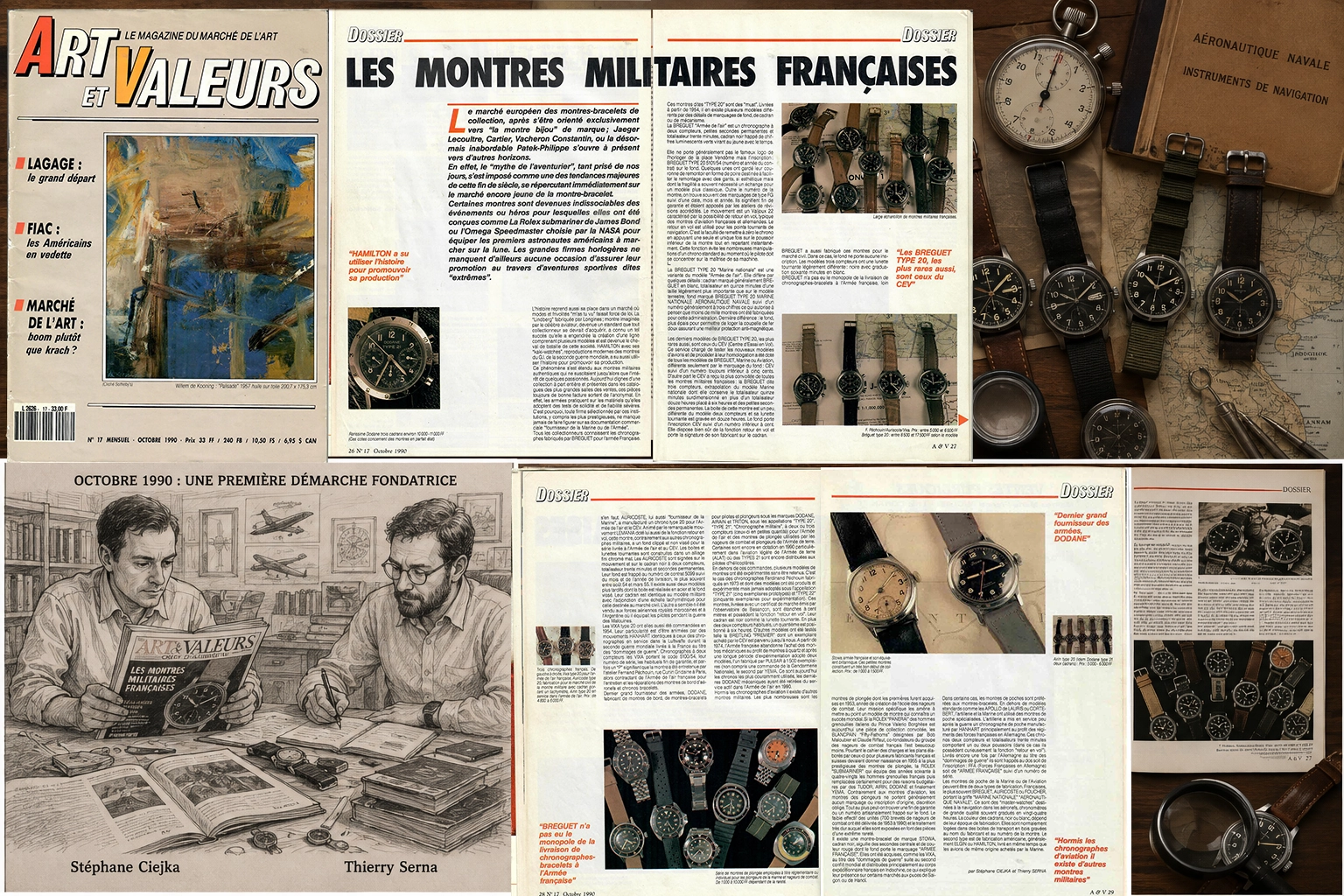
In October 1990, issue 17 of the magazine Art et Valeurs published the feature “Les montres militaires françaises” — “French Military Watches”, written by Stéphan Ciejka and Thierry Serna. To the knowledge of its authors, it was the first major French press feature devoted specifically to this field.
Across four pages, the article already presented Breguet, Auricoste, Airain, Dodane and Vixa Type 20 or Type 21 watches, end-of-warranty markings, CEV chronographs, French Navy diving watches, Stowa “Armée Française” models, Hanhart pocket chronographs and French Naval Aviation navigation instruments. It also emphasised the diversity of suppliers and the need to distinguish between models, administrations and uses.
More than thirty-five years later, this Mostra Atlas continues that pioneering approach with the archives, technical knowledge and authentication standards now available. The purpose is not to rewrite the 1990 feature retrospectively, but to extend its central insight: French military watches constitute an autonomous, complex field deserving genuine documentary research.
Reference: Stéphan Ciejka and Thierry Serna, “Les montres militaires françaises”, Art et Valeurs, issue 17, October 1990, pages 26 to 29.
Atlas record — French post-war military watches
Principal period: from 1945 to the mid-1950s, with later continuity according to departments and equipment.
Institutions and environments: French Army, French Expeditionary Corps in Indochina, French Forces in Germany, French Navy, French Naval Aviation, artillery and navigation services.
Principal examples: Longines Marine Nationale reference 5774, Stowa “Armée Française”, Hanhart FFA pocket chronographs, Breguet, Auricoste or Foucher master watches, and American Elgin and Hamilton instruments.
Possible statuses: purchased or issued watch, equipment received as war reparations, instrument delivered with an aircraft, navigation watch, service pocket chronograph or personally owned watch used on operations.
Determining elements: reference, calibre, case number, movement number, case back, engraving, typography, dial, hands, crown, transport box, military documents, manufacture archives and family provenance.
Recommended level of evidence: Level 3 when the marking and number are coherent; Level 4 with an archive or inventory; Level 5 to attribute an individual watch with certainty to a wearer, unit or campaign in Indochina.
Frequent errors: considering every navigation Longines to be a French Navy watch; automatically attributing every old Stowa to the French Army; presenting a light dial as evidence of issue; or transforming a model’s general association with Indochina into individual provenance.
Discover Mostra’s archive entry for the Longines Marine Nationale reference 5774

Act II — In the Air: The French Chronograph Becomes an Instrument
Type 20, Type XX and Type 21: a function before a form
At the beginning of the 1950s, French military aviation sought a wrist chronograph that was legible, robust and capable of rapidly chaining together several measurements, following the functional precedent of the Hanhart chronographs used by German pilots during the Second World War. The central function of this architecture was the retour en vol, or flyback: a single press stopped, reset and restarted the chronograph, whereas a conventional chronograph required several operations.
Inside a cockpit, this function was not a refinement. It allowed the immediate restarting of a navigation calculation, approach phase, test sequence or fuel-consumption measurement. The black dial, contrasting hands, rotating bezel, easily read registers and general construction all resulted from that requirement.
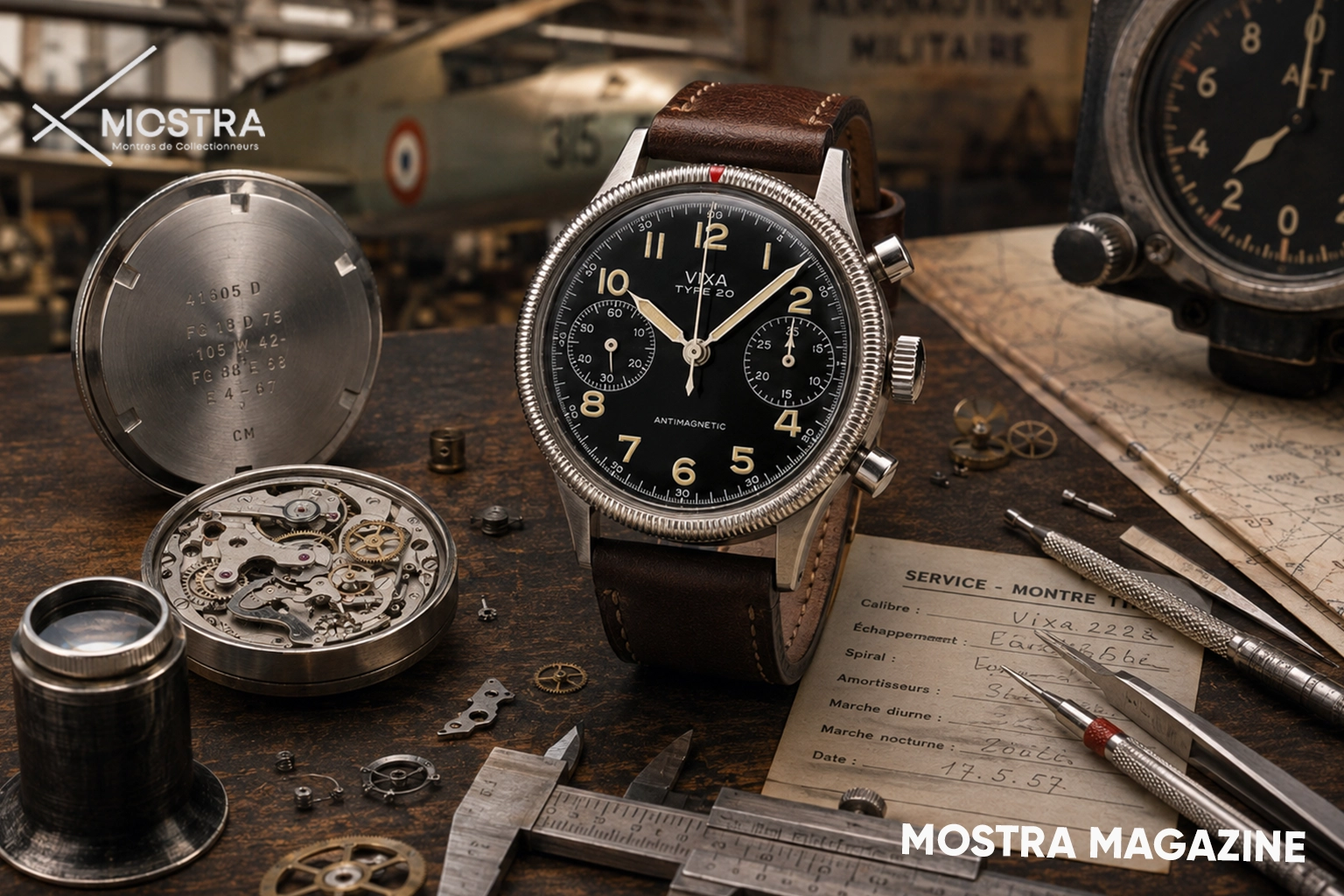
Several houses are associated with the French Type 20 and Type 21: Breguet, Auricoste, Airain, Dodane and Vixa. There is therefore no single Type 20, but rather a family of chronographs sharing a functional programme. Movements, cases, pushers, bezels, dials and markings varied according to suppliers, contracts and periods.
To discover the watches currently available, browse our selection of pre-owned military and aviation watches.
Breguet: French Air Force, CEV and French Naval Aviation
Breguet’s detailed archives make it possible to follow the birth of the family with unusual precision. After several prototypes and small series, the house received an order for 1,100 Type 20 watches intended for the French Air Force. Deliveries took place between 1955 and 1959. Dials were generally unsigned, bezels ungraduated and case backs carried regulatory inscriptions.
The Centre d’Essais en Vol, or French Flight Test Centre, received a further 80 Type XX watches between 1956 and 1957, in two- or three-register configurations depending upon the series. These pieces carried numbered CEV markings. They were associated with an environment in which watchmaking had to accompany the testing of aircraft, parachutes, ejection seats, radar and new equipment.
French Naval Aviation finally ordered 500 Type XX watches, assembled between 1958 and 1959 and delivered in January 1960. They were distinguished in particular by a large fifteen-minute register, a signed dial and regulatory case-back markings.
A common simplification opposes the military Type 20 to the civilian Type XX. It remains useful within Breguet terminology, but should not become an absolute rule across every period and manufacturer. The earliest registers reveal occasional hesitation in the use of the two designations, while the French Naval Aviation order clearly belongs to the Type XX family.
The historical Breguet movement notably used the Valjoux 22 and its derivatives, with manual winding, column wheel and flyback function. Later versions employed modernised calibres without immediately transforming the external appearance of the watch.
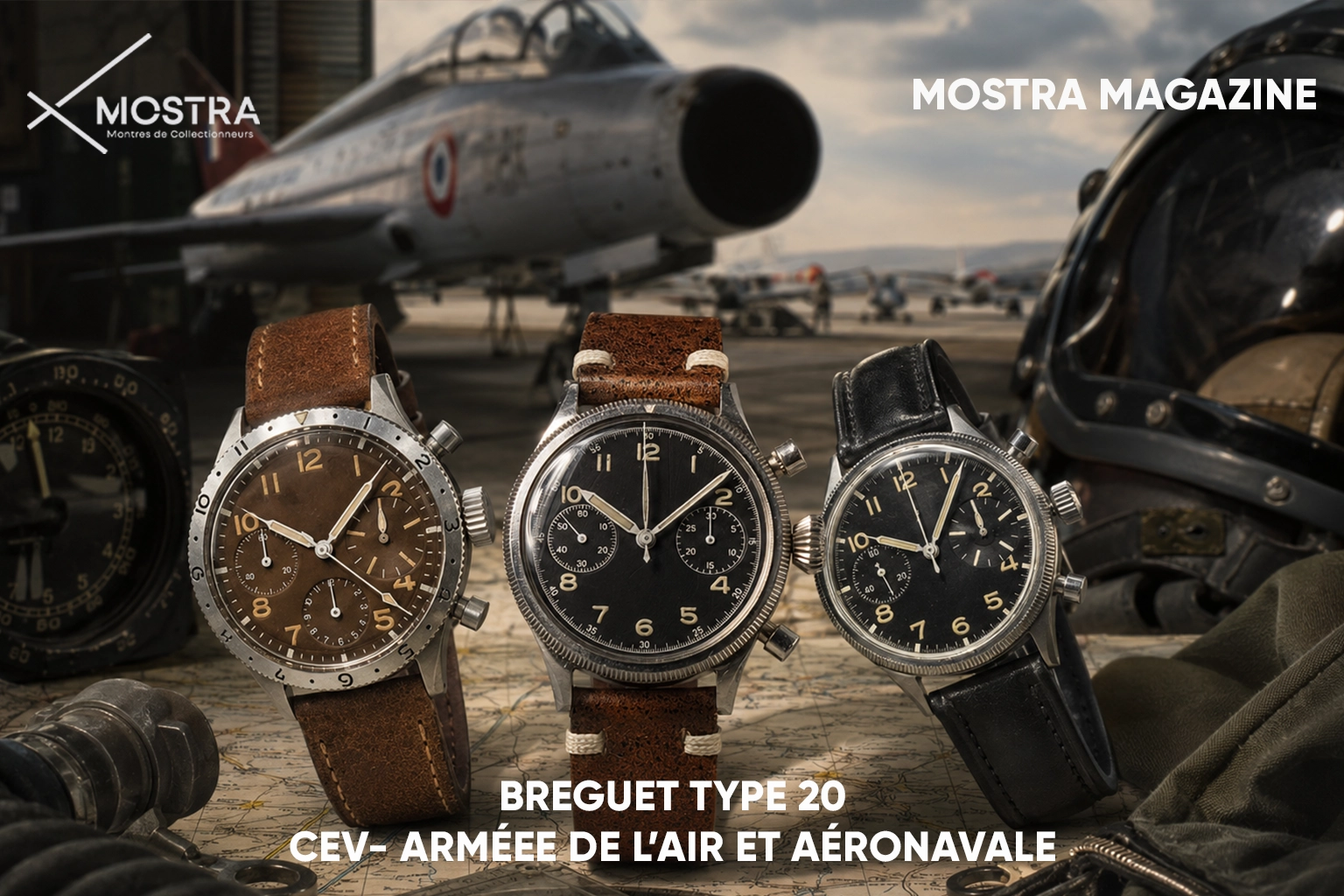
Atlas record — Breguet Type 20 and Type XX
Principal military period: 1955–1960 for the major first-generation French orders.
Institutions: French Air Force, French Flight Test Centre, French Naval Aviation.
Status: state-issued equipment, owned by the administration and maintained until decommissioning.
Historical movements: Valjoux 22, 222, 225 and subsequently the 230 and 720 families depending upon the version.
Determining elements: dial, register layout, case back, markings, number, crown, bezel, movement and service history.
Frequent error: presenting every civilian Type XX or every modern reissue as a military-issue watch.
Mostra regularly presents pre-owned Breguet Type XX and Type XXI watches. These civilian pieces inherit a military architecture and memory without being confused with issued examples from the 1950s and 1960s.
Auricoste: more than two thousand Type 20 watches and continuity with the French Navy
Auricoste has a long-standing connection with the French state, aviation and the Navy. The company states that in 1954 the Ministry of War ordered more than two thousand Type 20 flyback chronographs. This production positioned Auricoste among the principal players in the French programme, beyond Breguet’s more immediate international reputation.
Auricoste’s singularity also lies in the continuity of its work with the French Navy: on-board clocks, time networks, ships, submarines, aircraft carriers and, later, Spirotechnique diving watches. Within its history, the aviation chronograph and the diving watch are therefore not separate universes. They extend the same relationship with mission instruments.
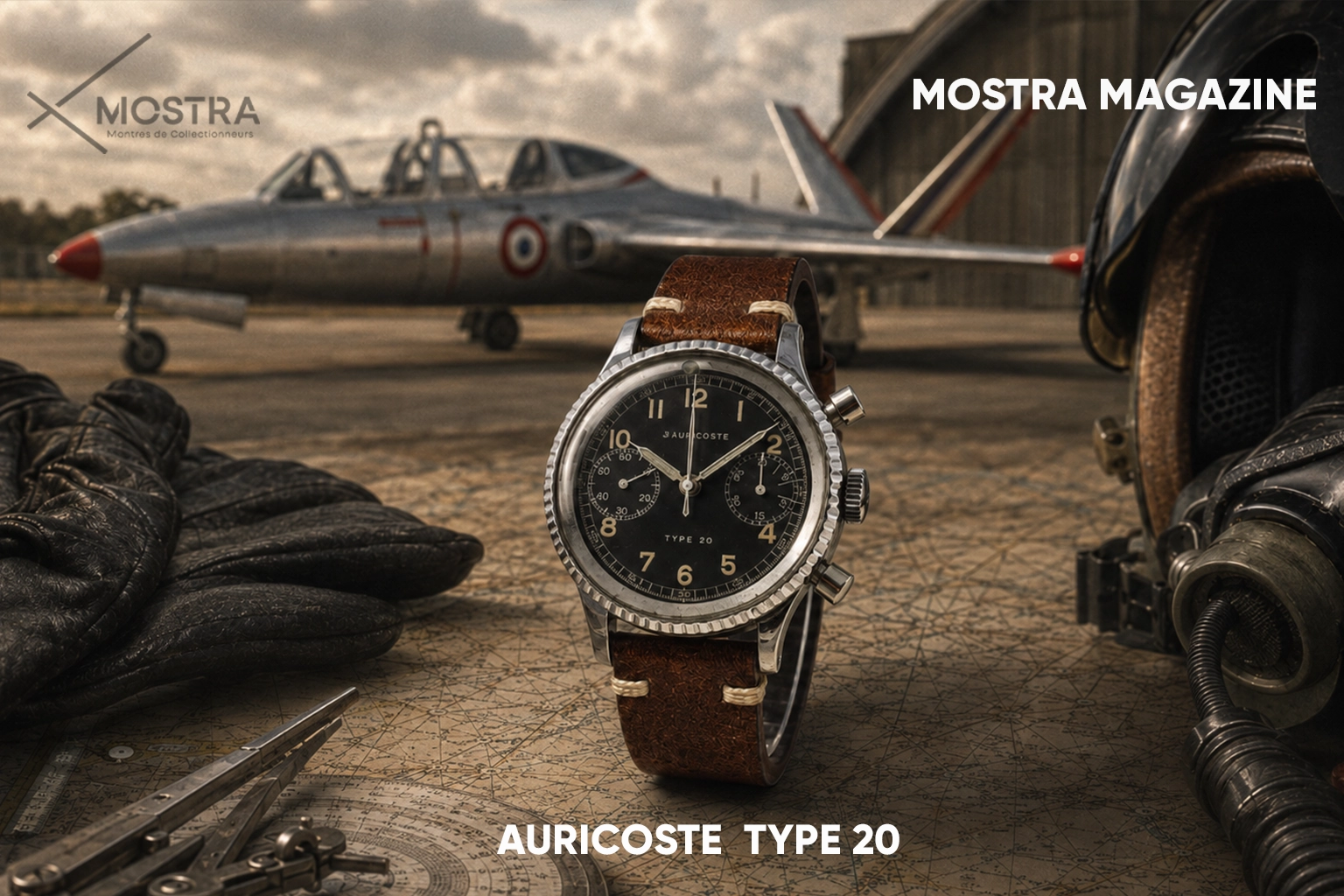
Atlas record — Auricoste Type 20
Period: from 1954 for the major Type 20 order.
Institution: French forces and the Ministry of War.
Status: historical supplier of timing instruments and military chronographs.
Elements to examine: case, dial, flyback function, movement, case back, inscriptions and coherence of service components.
Frequent error: reducing Auricoste to a contemporary reissue without considering its historical military and naval production.
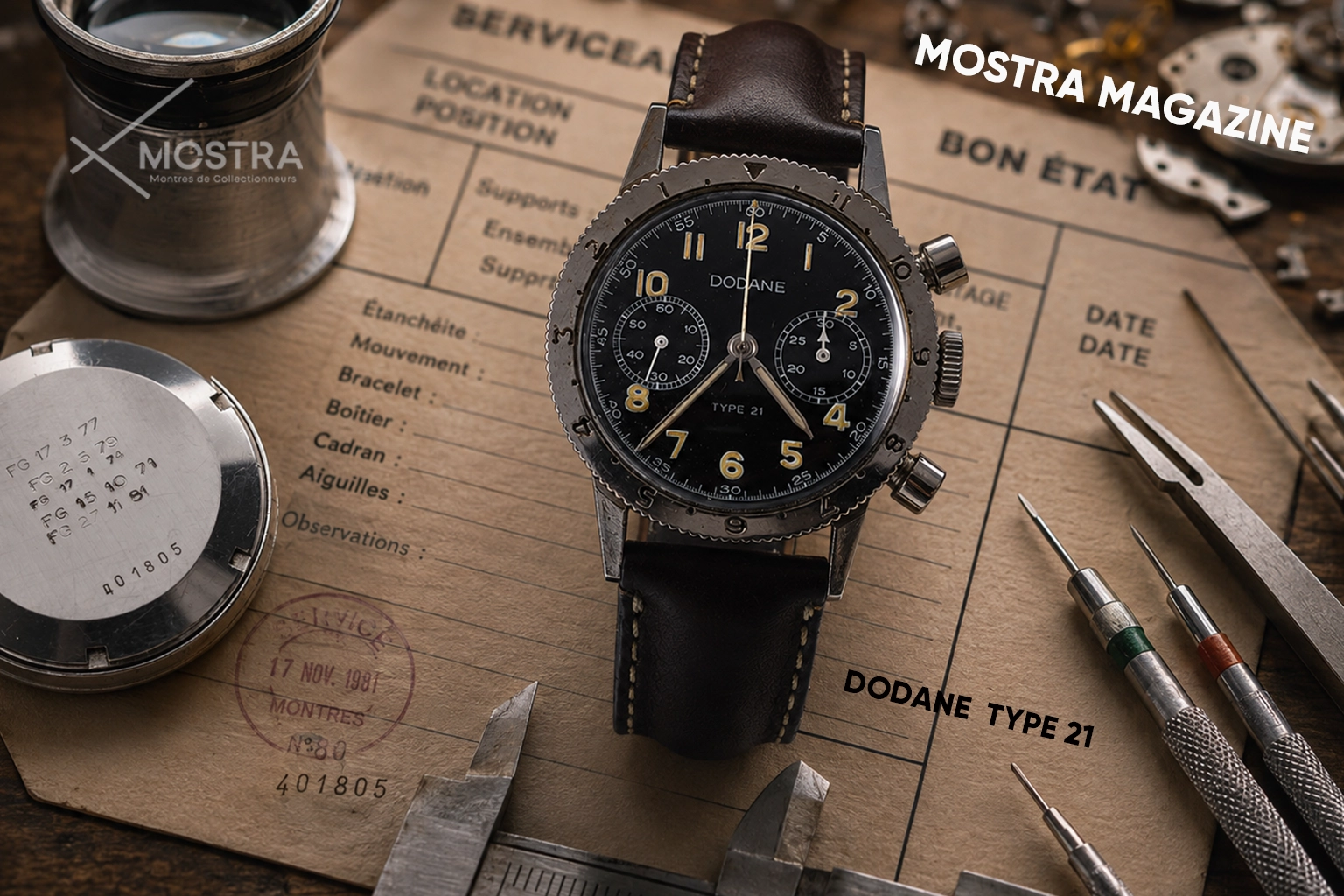
Dodane, Airain, Chronofixe and the Type 21: robustness and maintenance become priorities
Airain was one of the suppliers associated with the French Type 20. The brand also highlights the official Type 21 programme dated April 1956, conceived to improve durability, shock resistance and ease of maintenance for chronographs used in flight.
The transition from Type 20 to Type 21 was therefore not merely a change of style. It reflected an evolution in requirements. The instrument had to withstand more and be serviced more efficiently by military departments. This distinction is particularly important for the collector, because certain watches may present closely related architectures while belonging to different programmes. The name on the dial replaces neither the study of the movement nor that of the case back or production context.
Dodane and Vixa: two essential branches of the family
Dodane and Vixa occupy central positions in the history of the French military chronograph. Their watches present differences in cases, movements, dials and markings that should be treated as distinct identities, rather than merely as variations of a Breguet.
The Vixa Type 20 occupies a particular place within this post-war history. Ordered from 1954 onwards, these watches used Hanhart movements derived from German production and related to the chronographs used by the Luftwaffe during the Second World War. These assemblies were transferred to France as war damages and reparations before being integrated into watches intended for the French Air Force.
Case backs may carry the contract code 5100/54, a serial number and successive end-of-warranty markings. Certain pieces were maintained by the Paris workshop of Fernand Péchouin, a contractor to the French Air Force for the servicing of cockpit clocks and wrist chronographs. A Vixa should therefore not be presented as a simple German imitation: it constitutes one of the most revealing examples of how France transformed the industrial consequences of the conflict into operational aviation equipment.
Dodane watches, widely associated with Type 21, possess a history of production, supply and maintenance that deserves analysis by reference and calibre. The 1990 feature already recalled Dodane’s position as one of the last major suppliers to the armed forces, for both pilots and divers.
On these watches, repainted dials, replaced hands, modified pushers and polished case backs are frequent. Authentication must therefore consider the entire watch, rather than simply the brand name.
The Mostra selection regularly includes pre-owned Vixa watches, together with military and aviation chronographs from other historical suppliers.
Yema Superman and the French Air Force’s rescue divers
Yema’s military history did not begin solely with contemporary partnerships. During the 1970s, the Superman was selected by the French Air Force to equip its helicopter-borne rescue divers, specialists in air-sea rescue in environments where civilian resources were absent, unsuitable or unavailable.
This use positioned the Superman at the intersection of three worlds: aviation, maritime rescue and diving. Its bezel-locking system, water resistance and legibility answered a mission in which a man left a helicopter to enter the water.
The collector must nevertheless distinguish the historical Superman, contemporary French Air Force series, commemorative reissues and watches carrying a modern institutional emblem. Each possesses a different status.
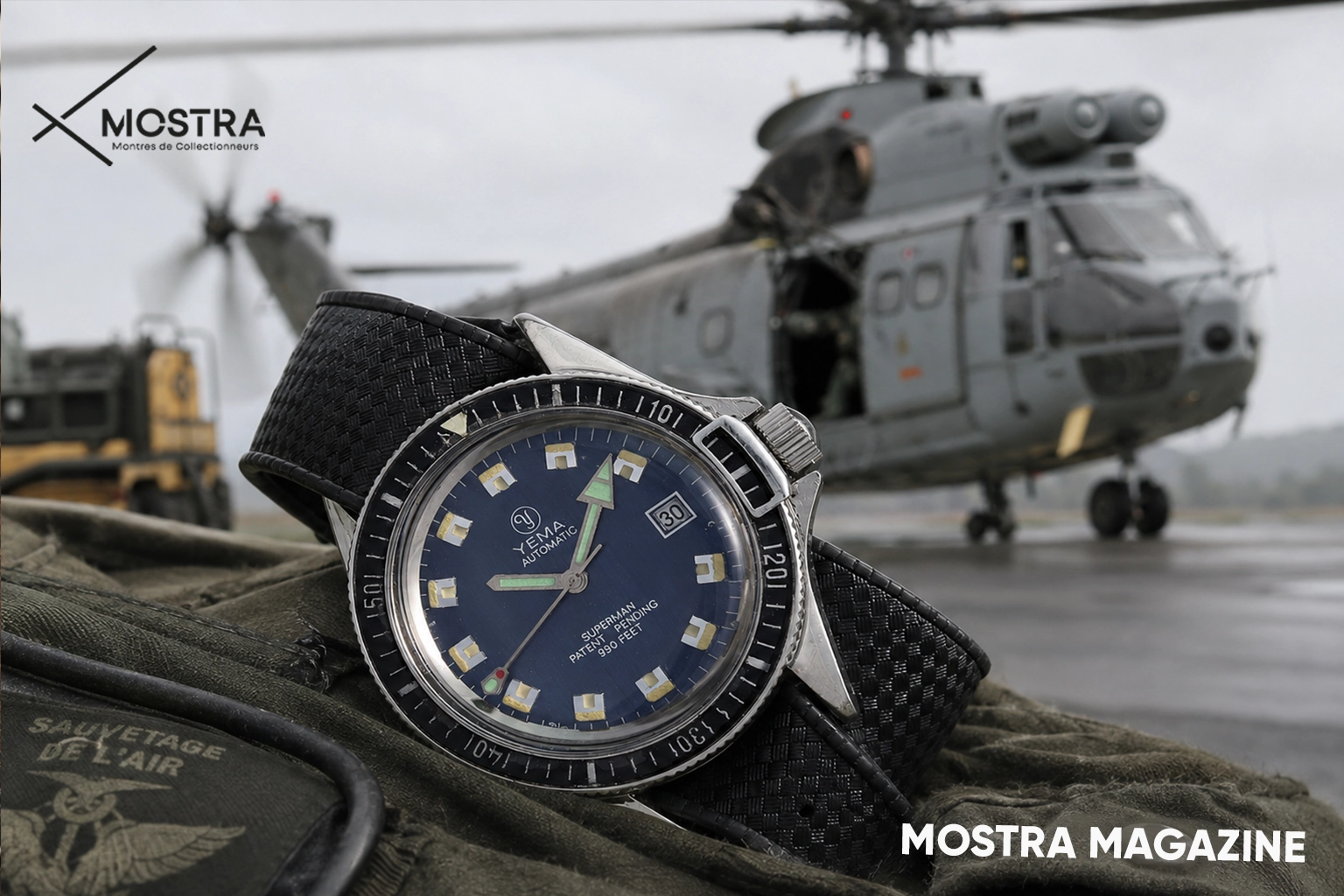
Atlas record — Yema Superman French Air Force
Historical period: 1970s.
Unit: helicopter-borne rescue divers.
Status: watch selected for military air-sea rescue use.
Elements to examine: reference, period, dial, movement, case, bezel-locking system and provenance.
Frequent error: confusing the historically used watch with a contemporary edition carrying the French Air Force emblem.
Mostra has presented several old and contemporary Yema Superman watches, including French Air Force editions and early vintage series.
Do you own a Type 20 chronograph, a Vixa or a military Yema?
Mostra can examine its reference, movement, components, markings, operation and the coherence of any claimed institutional provenance.

Act III — Beneath the Sea: Marine Nationale, Divers and Great Tool Watches
The French history of the military diving watch predates the Tudor trials of 1956. The feature published by Stéphan Ciejka and Thierry Serna in 1990 recalled that the first watches intended for combat swimmers had been acquired as early as 1953, the year their school was established, and highlighted the roles of Bob Maloubier and Claude Riffaud in defining the operational requirements that accompanied the birth of the Blancpain Fifty Fathoms.
This initial period already established the requirements that would structure the following decades: strong legibility, an elapsed-time bezel, genuine water resistance, resistance to shocks and the ability to be manipulated while wearing diving equipment. It must nevertheless be distinguished from the individual provenance of watches: the historical importance of a model in the birth of French military diving never proves, on its own, that every example was issued to a combat swimmer.
To discover currently available models, browse our selection of pre-owned diving watches.

Tudor and the French Navy: from the GERS trials to the Snowflake
The modern history of Tudor and the French Navy begins in Toulon. At the beginning of 1956, the Groupement d’Études et de Recherches Sous-Marines, or GERS, received several Tudor Oyster Prince Submariner watches for evaluation.
The watches concerned were references 7922 and 7923, both advertised as water-resistant to 100 metres. The first was automatic. The second was hand-wound. The GERS observations judged their water resistance and operation satisfactory, opening the way to a lasting relationship between Tudor and the French Navy.
Reference 7924, now known as the Big Crown, subsequently increased the announced water resistance to 200 metres. Over the years, references 7928, 7016/0, 7021/0, 9401/0 and 9411/0 appeared, with Snowflake dials and hands that would become one of Tudor’s strongest signatures.
These watches were instruments first. They were maintained, repaired, fitted with appropriate straps and sometimes modified by military departments. A replaced crown, crystal, bezel or set of hands may therefore belong to their operational career.
This historical flexibility nevertheless permits neither every approximation nor every reconstruction. A vintage Tudor Submariner is not automatically a Tudor MN. An isolated engraving, textile strap or oral history is insufficient. The reference, number, period, case back, dial, hands and archives must converge.
To explore the references, generations and Marine Nationale configurations in greater detail, read our complete guide to the Tudor Submariner.

Atlas record — Tudor Submariner Marine Nationale
Period: from 1956 for trials, followed by several decades of use.
Institution: GERS, followed by the French Navy.
Principal references: 7922, 7923, 7924, 7928, 7016/0, 7021/0, 9401/0, 9411/0 and related generations.
Determining elements: reference, case back, engraving, number, dial, hands, movement, period and archives.
Recommended level of evidence: Level 3 minimum, Levels 4 or 5 for strong provenance.
Frequent error: treating every Tudor Snowflake or every textile strap as evidence of issue.
Mostra’s pre-owned Tudor Submariner category allows different civilian and military generations to be compared. The company notably presents a Tudor Submariner 94010 Marine Nationale engraved MN 82, whose interest lies in the convergence between reference, configuration, year and marking.
In 2021, Tudor officially revived its relationship with the French Navy through the Pelagos FXD. Fixed bars integrated into the case, a bezel intended for underwater navigation and a textile strap refer to a contemporary professional development. This watch should not be confused with an old issued Submariner: it opens another chapter, that of the modern partnership.
ZRC Grands Fonds: when safety determines form
The ZRC Grands Fonds was born at the end of the 1950s in response to a requirement expressed by the French Navy. An initial version was approved at the beginning of the 1960s. The traditional crown position at three o’clock was then considered vulnerable during underwater operations.
ZRC developed a radical solution: placing the crown at six o’clock, between the lower lugs. This architecture protected the crown, reduced discomfort on the wrist and formed part of a system in which the bracelet could not be correctly closed if the crown had not been screwed down.
According to the timeline published by the brand, the generation with its crown at six o’clock was tested by the GERS between 1964 and 1966, before ZRC became a French Navy supplier for a long period.
The ZRC reminds us that a genuine tool watch often possesses a silhouette that marketing alone would never have invented. The crown at six o’clock, like the fixed bars of the Pelagos FXD or the left-hand crown of the JB200, arose from a constraint before becoming an aesthetic signature.

Atlas record — ZRC Grands Fonds
Period: development from 1959, with trials and adoption during the 1960s.
Institution: French Navy and mine-clearance divers.
Status: watch developed in response to a military requirement and subsequently supplied to the French Navy.
Distinctive elements: crown at six o’clock, bracelet architecture, case, dial, markings and generation.
Frequent error: treating a Heritage reissue as an old issued military watch.
Aquastar Benthos: the textbook case of an almost identical civilian version
Between 1979 and 1984, the French Navy received approximately 3,200 third-generation Aquastar Benthos watches through the Toulon procurement chain. The watch possessed a professional construction water-resistant to 500 metres and a decompression bezel adapted to divers’ requirements.
The Benthos is particularly instructive. The civilian and military versions of the same generation used the same dial, bezel and movement. The principal visible difference lay in the Marine Nationale engraving on the case back, followed by the year of procurement.
This closeness demands a methodical approach. The marking must be coherent in typography, position and ageing. The number must be capable of being compared with the archives preserved by the Aquastar workshop in Biel. A civilian Benthos remains a remarkable historical diving watch. It should simply not be transformed into a military watch through the addition of an engraving.

Atlas record — Aquastar Benthos Marine Nationale
Period: 1979–1984.
Institution: French Navy, divers based in Toulon.
Status: watch issued under a documented contract.
Particularity: dial and bezel identical to the civilian version; the case back and number become determining elements.
Recommended level of evidence: Level 4 with archival confirmation.
Frequent error: authenticating the watch from its general appearance without checking the number.
Triton Spirotechnique: the crown at twelve o’clock
The Triton was designed in 1962 by Jean-René Parmentier for the environment of La Spirotechnique, before the brand appeared in 1963. Its crown placed at twelve o’clock, protected by the architecture of the case and bracelet, gives it an immediately recognisable identity.
This position protects the crown, prevents accidental operation and clears the sides of the case. As so often in the history of the professional diving watch, visual singularity came from a response to use.
Old Triton watches must be studied according to their dial, movement, crown, case, bracelet and any documentary association with the French Navy. A historical civilian Triton retains considerable interest even when no military issue has been established.
Auricoste Spirotechnique: the diving watch of the 1980s
In 1982, Auricoste equipped French Navy combat swimmers and mine-clearance divers with its Spirotechnique. The watch formed part of the continuity of a company already present in aviation instruments, naval time networks and military chronographs.
The Spirotechnique was characterised by a robust case, an offset crown, a strongly distinctive dial and case-back markings depending upon the series. Watches that genuinely served may feature replacement components installed to preserve their operation.
The collector must therefore distinguish the military example, the period civilian watch, reissues and contemporary models inspired by this history.

Atlas record — Auricoste Spirotechnique
Period: from 1982.
Users: combat swimmers and mine-clearance divers.
Status: issued military diving watch.
Elements to examine: case back, marking, dial, crown, movement and service interventions.
Frequent error: confusing the military Spirotechnique of 1982 with its contemporary successors.
Jacques Bianchi: From the JB200 and the French Navy to the B-300 and the French Army
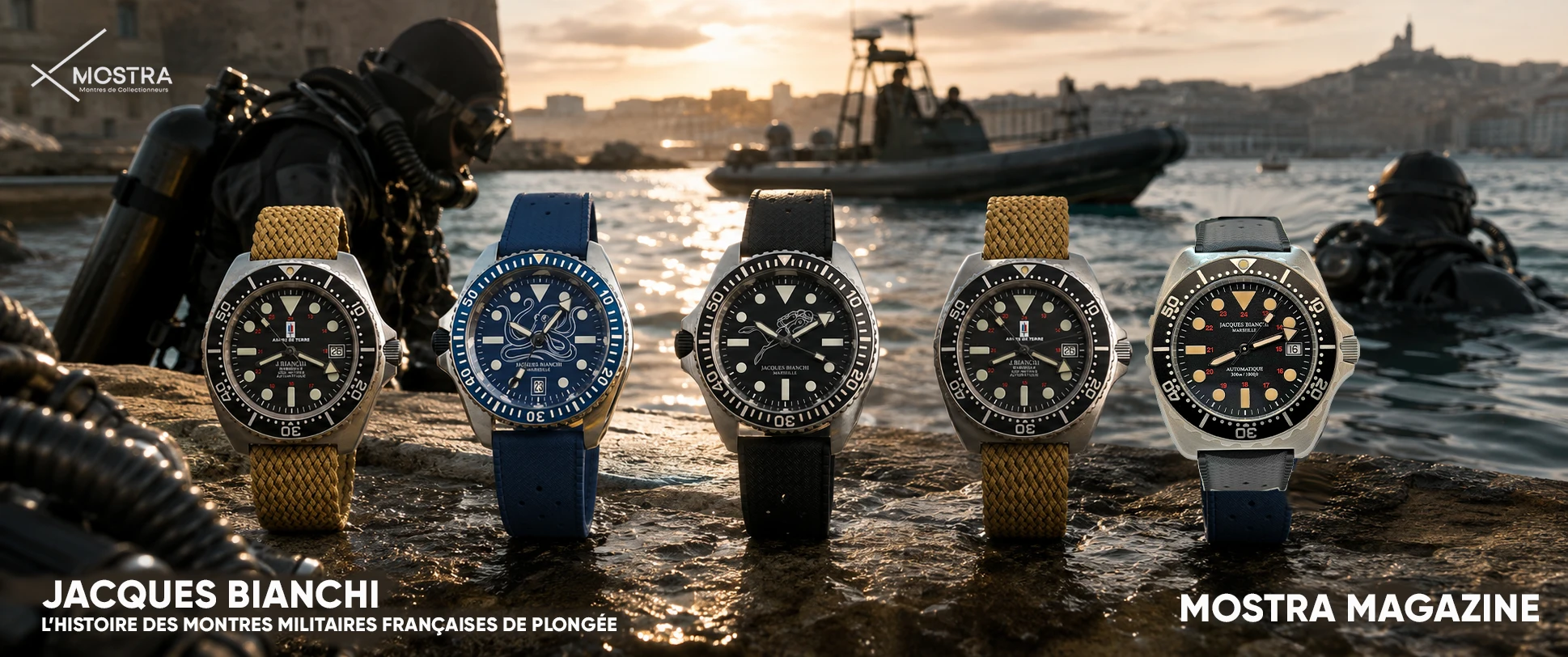
The Jacques Bianchi JB200 occupies a distinctive place in the history of French mission watches. Unlike models developed by a major manufacture, its story began in the Marseille workshop of Jacques Bianchi, a watchmaker and repairer working in direct contact with professional divers, maritime companies and water-resistant watches.
Introduced in 1982, the JB200 combines an approximately 42 mm stainless-steel case, a crown positioned on the left and an immediately recognisable dial featuring a large diver. The earliest series notably used the French-made France Ébauches FE 7121 quartz movement, chosen in a context where precision, reliability and ease of use were essential qualities for a professional watch.
The JB200 was not originally created as a general-issue French Navy watch. It began as a civilian and professional model. Only several years later did certain documented examples enter military procurement, maintenance or equipment-management systems.
Research based on registers kept by the French Navy watchmaker in Toulon has made it possible to connect certain serial numbers with naval air stations, supply departments, a minehunter and mine-clearance divers. This documentation is essential: it can establish the status of an individual watch, but it does not make every vintage JB200 a military watch, nor does an association with Saint-Mandrier automatically make a watch the personal equipment of a combat swimmer.
Atlas Record — Jacques Bianchi JB200
Birth of the model: 1982 in Marseille.
Original status: civilian and professional watch.
Military career: certain documented examples entered different military services in the late 1980s.
Movement in the earliest series: France Ébauches FE 7121 quartz.
Determining elements: serial number, register, movement, dial, caseback, allocation and service history.
Common mistake: presenting every vintage JB200 as a military or Commando Hubert watch.
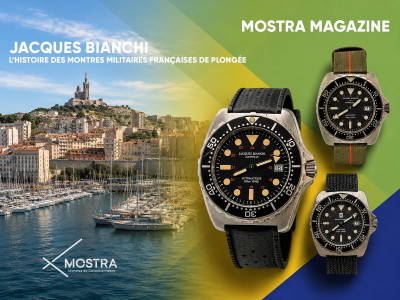
To explore the origins of the JB200, Jacques Bianchi’s story, the different versions, French Navy registers and the various roles performed by military divers, read our dedicated feature Jacques Bianchi: The History of French Military Dive Watches .
Bianchi B-300 French Army: A Genuine Military-Issue Dive Watch
In the early 1990s, the military history of Jacques Bianchi entered a new phase with the Bianchi B-300. Its status differs from that of the JB200: rather than being a civilian watch of which certain examples later entered a military environment, the B-300 was produced in identified batches intended for French Army divers and military swimmers.
Two principal batches are documented: 300 watches delivered in 1993 with tritium luminous material, followed by 500 watches delivered in 1994 with LumiNova. Together, these two batches represent 800 military-issue Bianchi B-300 watches and provide a much more direct production framework than that of the earlier JB200.
Production Benchmark
1993: 300 Bianchi B-300 watches with tritium.
1994: 500 Bianchi B-300 watches with LumiNova.
Two documented batches representing 800 military-issue watches.
The B-300 features an approximately 42 mm stainless-steel case, a deeply notched dive bezel, a protected crown and an original stated water resistance of 300 metres. Its black dial bears the French Army emblem and a red twenty-four-hour inner scale. Inside, the proven ETA 2824-2 automatic calibre provides a robust mechanical architecture suited to a professional tool watch.
For collectors, however, identifying a B-300 should never stop at the military emblem. The production year, issue number, caseback, dial, luminous material, movement and overall coherence of the watch must be examined together. A 1993 example should notably be assessed within the context of the first tritium batch, while a 1994 watch should be compared with the second LumiNova batch.

Atlas Record — Bianchi B-300 French Army
Period: 1993–1994.
Status: military-issue watch intended for the French Army.
Documented production: 300 examples in 1993 followed by 500 examples in 1994.
Main difference: tritium on the first batch, LumiNova on the second.
Case: stainless steel, approximately 42 mm, original stated water resistance of 300 metres.
Movement: automatic ETA 2824-2.
Determining elements: year, issue number, caseback, dial, luminous material, movement and provenance.
Common mistake: authenticating a B-300 from the French Army emblem alone, or interpreting its luminous material without considering its production year.
The distinction between the JB200 and the B-300 illustrates one of the central principles of this Atlas: a model historically associated with a military institution does not necessarily have the same status as a watch produced within a clearly identified military-issue batch. Only the combined study of the object, its numbers, its configuration and the available archives can move an individual watch from general historical association to documented provenance.
Our complete feature Jacques Bianchi: The History of French Military Dive Watches explores the JB200, the B-300, military registers, the different configurations and the history of the divers associated with these watches in greater detail.
See a Bianchi B-300 Handled by Mostra
Vintage military watches are offered according to availability. This example provides a concrete view of the characteristics of a military-issue Bianchi B-300.
Discover the 1993 Bianchi B-300
If this individual watch is no longer available, browse our selection of pre-owned military and aviation watches .
Do you own a Jacques Bianchi or a French military dive watch?
Before polishing, replacing a dial, reluming or attempting to restore water resistance, Mostra can examine the reference, markings, component coherence, provenance and the elements that should be preserved.
Have my watch appraised | Consult the Mostra workshop | Read the Jacques Bianchi feature
Act IV — Special Forces, Contemporary Missions and Space

RALF TECH WRX: from operational feedback to Commando Hubert
RALF TECH entered the watch world through diving equipment, not through fashion. The brand was already equipping professionals before designing its first major tool watch.
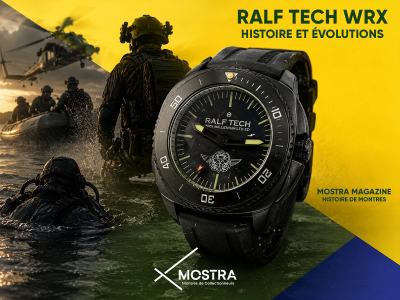
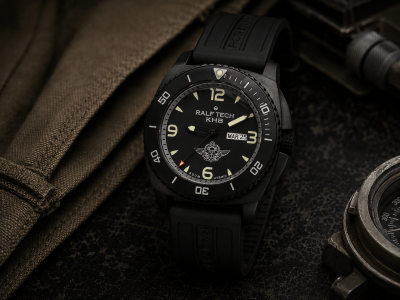
The WRX was conceived at the end of the 2000s. A pre-series appeared in 2008, followed by the operational use of several examples by members of the French special forces. Feedback from Commando Hubert led to modifications and improvements in the definitive series.
This approach follows a familiar logic in the history of military instruments: initial design, pre-series, field use, operational feedback and final version. The substantial case, bezel, protective elements and high legibility of the WRX express this origin.
The success of this story nevertheless creates a frequent confusion. A civilian WRX, Black Operator, Hybrid, MIL 2, unit watch and series inspired by the military world do not automatically possess the same status.
Recognition of a documented military RALF TECH depends upon the reference, movement, dial, engraving, number, packaging, documents and provenance.

Atlas record — RALF TECH WRX
Design: end of the 2000s, with a pre-series in 2008.
Development: feedback from Commando Hubert operators from 2010 onwards.
Possible statuses: civilian model, professional series, unit series or documented military series.
Determining elements: reference, movement, dial, case back, engraving, number, presentation case and documents.
Frequent error: considering every black WRX to be a Commando Hubert watch.
To identify the principal series and distinguish military examples from civilian versions, read our guide RALF TECH Commando Hubert: How to Identify Military and Civilian Series.
Since 2025, Mostra has been the first RALF TECH Certified Technical Centre dedicated to pre-owned watches. The company can therefore bring together the selection, identification, inspection, servicing and support of the brand’s watches in one location.
To explore the collection’s history, military series and position on the pre-owned market, read our guide RALF TECH WRX: The French Military Watch to Buy or Sell with Mostra.
You can also discover the RALF TECH watches currently available at Mostra.
Yema Spationaute: the French watches for early missions in Space
A French mission watch is not necessarily military. It may be developed for an astronaut, agency, scientific programme or expedition.
On 24 June 1982, Jean-Loup Chrétien departed from Baikonur for the Soyuz T-6 mission wearing a Yema Spationaute I. It became the first French watch and, according to Yema’s timeline, the first Western European watch worn in space.
In 1985, Patrick Baudry took a Spationaute II aboard the Space Shuttle Discovery during mission STS-51G. In 1988, the Spationaute III, powered by the Seiko 7A38 calibre, accompanied Jean-Loup Chrétien to the Mir space station during the Aragatz mission.
These watches did not belong to a military-issue system. They nevertheless brought together every element of a mission watch: an institution, an identified user, a programme, a date and an operational environment.
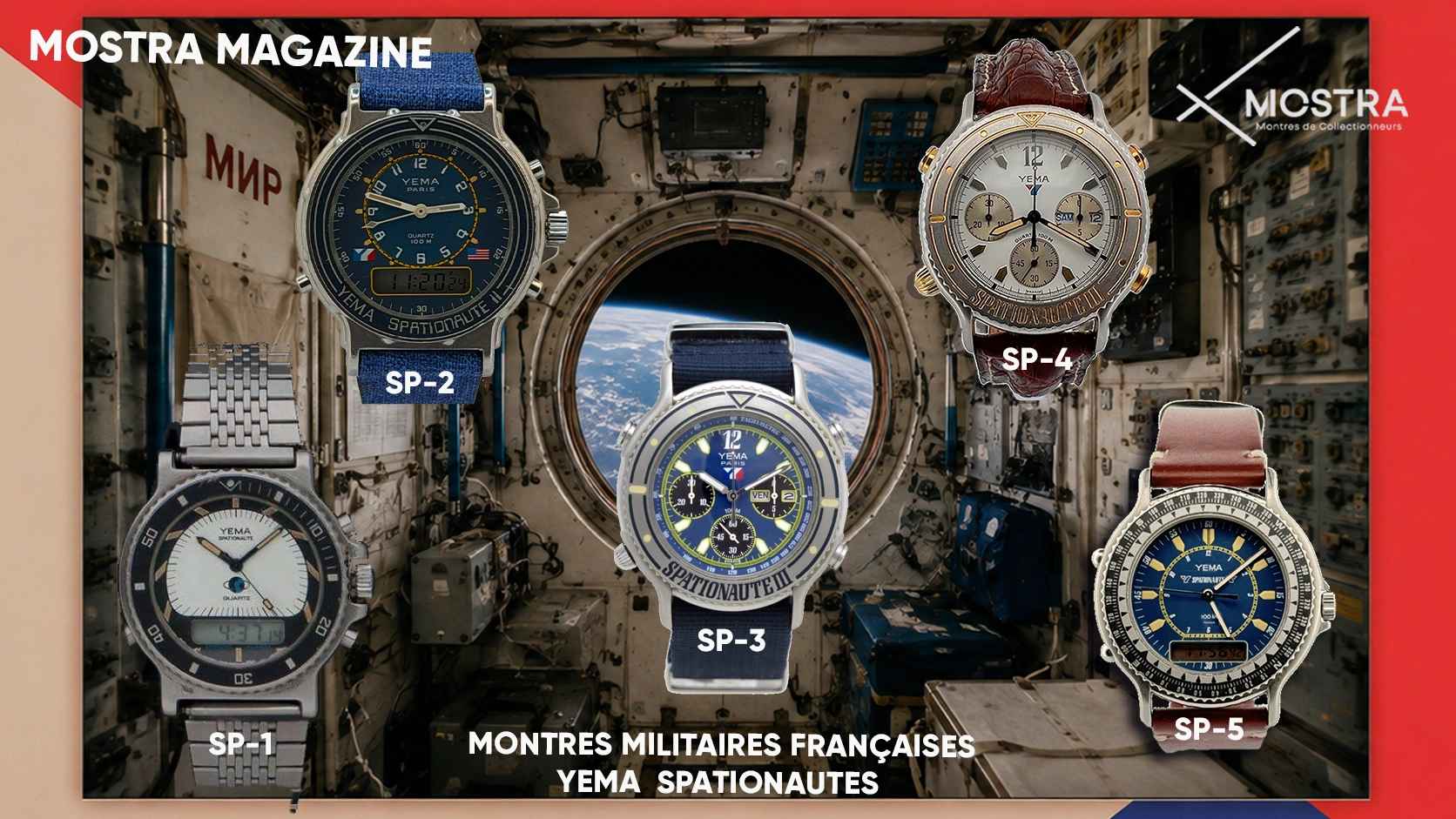
Atlas record — Yema Spationaute
Spationaute I: Soyuz T-6 mission, Jean-Loup Chrétien, 1982.
Spationaute II: STS-51G mission, Patrick Baudry, 1985.
Spationaute III: Aragatz mission and Mir space station, Jean-Loup Chrétien, 1988.
Status: documented space-mission watches.
Frequent error: confusing a later commemorative edition with the watch that actually took part in a mission.
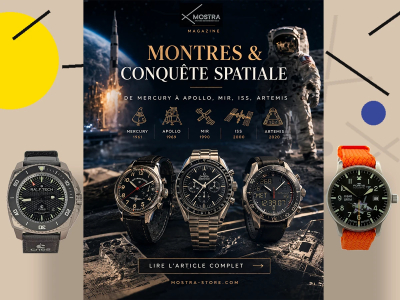
Mostra has long followed pre-owned Yema Spationaute watches and their place in French space history. The major feature Watches of space exploration: from Mercury to Artemis places these models within a broader international timeline.
RALF TECH Space Millenium x CNES: the ocean meets space
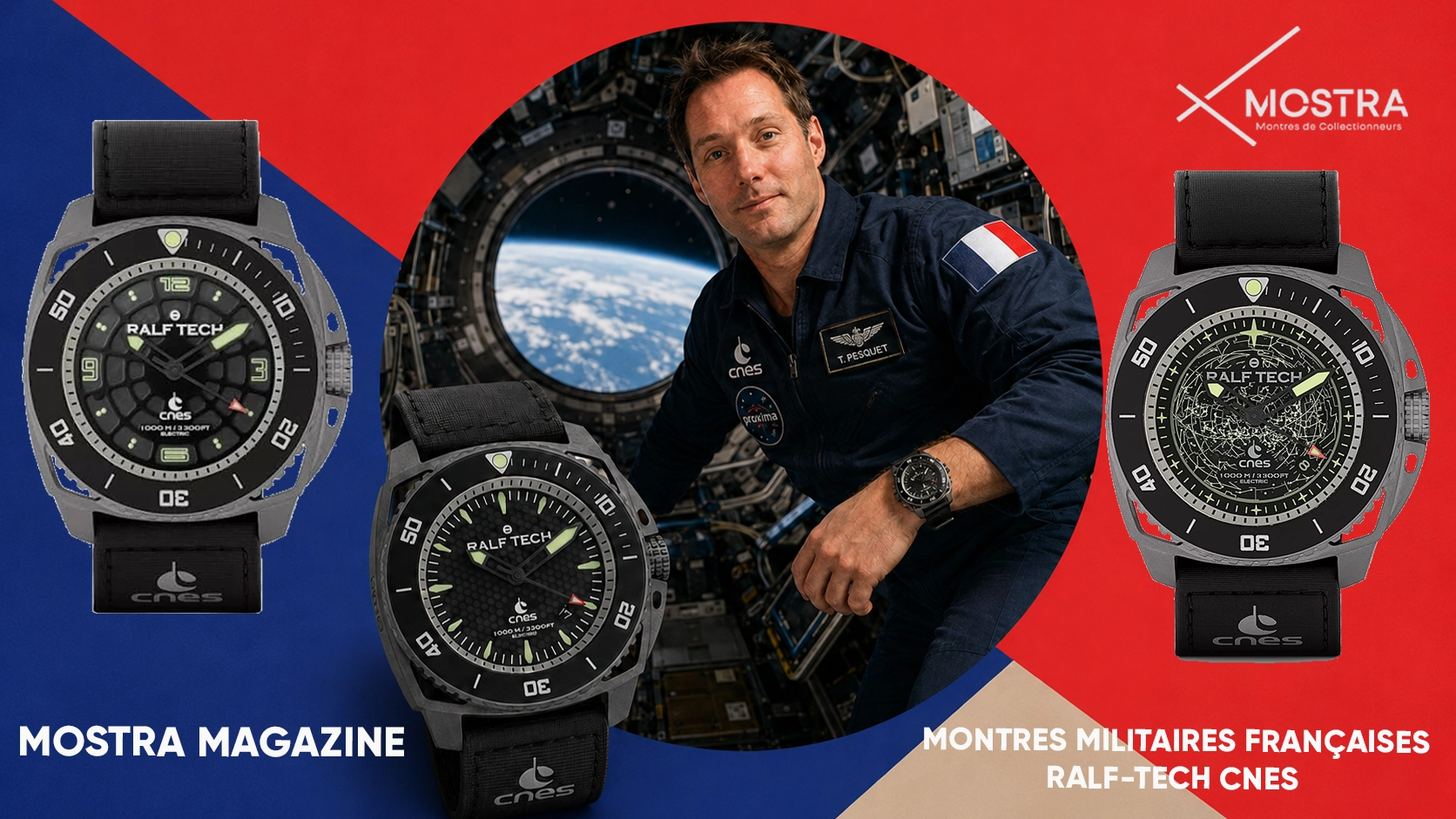
In 2024, RALF TECH and CNES launched the Space Millenium. The partnership connects two extreme environments: deep-sea diving and space.
The watch does not constitute a general issue to French astronauts. It belongs to an official partnership with the French space agency, built around shared values of exploration, reliability and commitment.
The Space Millenium, Galaxy Millenium and Supernova Millenium now form a family of contemporary French mission watches. Their future interest will depend upon their reference, series, movement, production volume, documentation and the position they eventually occupy within the history of the partnership.
Mostra regularly presents RALF TECH watches associated with CNES, subject to availability.
To place the French missions within the broader history of space-related watchmaking, read our feature Watches of the Space Conquest: From Mercury to Artemis.
Civilian or military: six essential comparisons
Civilian navigation Longines versus Longines Marine Nationale
An old Longines with a light dial, large crown and stainless-steel case may present an aesthetic consistent with navigation watches without ever having been issued to the French Navy. The distinction rests upon the reference, numbers, case back, markings, movement, manufacturing period, archives and provenance.
Patina or a textile strap can never constitute sufficient evidence. A coherent civilian Longines remains a remarkable historical watch; it should simply not be given an unproven military issue.
Civilian Stowa versus Stowa “Armée Française”
A military or military-inspired Stowa with a black dial does not automatically become a French watch. The documented “Armée Française” series combines a coherent configuration with a screw-down case back engraved “ARMEE FRANCAISE” and numbered.
A light dial is no more conclusive. In the 1990 feature, the white-dialled watch photographed beside the black Stowa is identified as a British equivalent. The connection with Indochina must likewise be established separately for each individual example.
Civilian Tudor Submariner versus Tudor Marine Nationale
The civilian and military versions may share the same reference, movement and dial. The difference then rests upon the case back, engraving, year, number, provenance and archives.
A contemporary textile strap does not transform a civilian Tudor into an issued watch. Conversely, a Tudor MN may have lost its original strap and retain strong provenance through its number and documents.
Civilian Aquastar Benthos versus Benthos Marine Nationale
The dial, bezel and movement are identical on the civilian and military versions of the third generation. The engraved case back and confirmation of the number within the archives become the principal distinguishing elements.
This is one of the most instructive comparisons in the Atlas: two watches can be visually almost identical while possessing very different histories and heritage values.
Civilian JB200 versus a JB200 documented by the French Navy
A first-generation civilian JB200 is already a rare and coherent French watch. The military version is not necessarily distinguished by a different appearance. It is the number, compared with the registers and issue information, that changes the status of an individual example.
An undocumented watch should not receive a military history by deduction. It retains its own interest as a professional Marseille diving watch.
Civilian RALF TECH versus military or unit series
Two WRX watches may share a closely related case and identical visual language. The difference may lie in the Hybrid movement, dial, case back, inscriptions, series, presentation case or documents.
A civilian Black Operator inherits the architecture and history of the WRX. A documented MIL 2 may add a precise connection with a unit. Both are authentic; they simply do not tell the same story.
Three Mostra case studies: evidence through the object
Case study 1 — A Tudor Submariner 94010 engraved MN 82
A Tudor Submariner Marine Nationale cannot be reduced to the word Snowflake. The example presented by Mostra under reference 94010 combines an MN 82 engraved case back, blue tritium dial, patinated blue bezel, an approximately 39 mm case and an automatic ETA-based calibre.
The interest of the piece arises from the convergence between its generation, configuration and marking. Appraisal does not consist of stopping at the engraving, but of verifying that the engraving appears on a watch whose every element speaks the same language.
Discover the Tudor Submariner Marine Nationale MN 82 presented by Mostra.
Discover the pre-owned Tudor Submariner watches currently available and read our complete Tudor Submariner guide.
Case study 2 — The Jacques Bianchi whose number appears in a register
On a JB200, the passage from a general history to individual provenance often depends upon the number. A watch may be perfectly authentic, coherent and old without its presence in the French Navy being demonstrated.
When its number appears in a French Navy watchmaker’s register, a new reading becomes possible: date of entry, department, vessel, base or repair. The object then ceases merely to be compatible with a history; it enters that history directly.
This case study demonstrates why Mostra distinguishes a historically military watch from a model merely associated with the institution.
Case study 3 — RALF TECH MIL 2 or Black Operator: the case is not enough
At first sight, several WRX watches may share a very similar architecture. Yet the Hybrid movement, dial, case back, inscriptions, series, presentation case and documents can establish different statuses.
The comparison between a MIL 2 and a civilian Black Operator demonstrates that military authentication does not rest upon the colour black or case diameter. It rests upon a configuration and documentation.
For a more detailed identification of unit-issued and civilian series, read our RALF TECH Commando Hubert guide.
Restoring a military watch: intervening without erasing
A military watch has often been worn, opened, repaired and adapted. It may present a marked case, scratched Plexiglas crystal, patinated dial, replaced crown or service hands. Restoration should therefore begin with one question: what still belongs to the history of the watch?
When mechanical maintenance is required, our workshop can provide watch servicing in Aix-en-Provence while taking the age, configuration and heritage significance of the watch into account.
When a specific malfunction has been identified, discover our watch repair service in Aix-en-Provence.
On a vintage military watch, every intervention should take account of patina, original components and possible service parts. Read our guidance for vintage and antique watches before workshop intervention.
What should be preserved whenever possible
- case-back engravings and serial numbers;
- dials coherent with the period;
- historical or documented service hands;
- service and workshop markings;
- original straps and buckles, even if they are no longer used;
- replaced components retained with the watch;
- documents, packaging and archives.
What should be addressed as a priority
- active corrosion;
- a dry or mechanically fatigued movement;
- a dangerous crown or damaged tube;
- a crystal that prevents the dial from being read;
- a strap or spring bar capable of causing the watch to fall;
- a water-resistance problem when aquatic use is still intended.
What must be decided case by case
- polishing of the case;
- reluming;
- replacement of the hands;
- restoration of a dial;
- replacement of a bezel;
- restoration of water resistance on a fragile heritage piece.
The role of the workshop is therefore not to make every trace disappear. It is to make the watch mechanically sound without removing what still allows it to be understood.
This doctrine follows the same principles as the Mostra Watch Health Assessment: explaining what has been inspected, what should be treated and what deserves to be preserved.
What truly creates the value of a military watch
The value of a military watch depends not only on its reference but also on provenance, consistency, condition and the quality of the evidence accompanying it. For an individual assessment, discover our pre-owned and collector watch appraisal service.
A price guide ages quickly. The factors that create value remain.
- The rarity of the model and the known number of examples.
- The rarity of the configuration: dial, movement, series or year.
- The historical status: trial, issue, unit series, mission or partnership.
- The level of evidence according to the available documentary chain.
- Individual provenance and the possible identity of the wearer.
- The condition of the dial and coherence of the luminous materials.
- The geometry of the case and quality of previous interventions.
- The movement, its originality, condition and service history.
- Service components and the transparency with which they are described.
- Documents, accessories, straps and retained replaced components.
- The actual mechanical condition and work required.
- The cultural desirability of the brand, unit or mission.
An engraving without archives may attract attention. An archive without a coherent watch is equally insufficient. The strongest value arises from the convergence between the object, its condition and its history.
To understand the wider factors that determine value on the pre-owned market, read our guide What Is My Watch Really Worth?.
Ten questions to ask before buying a military watch
- Is this reference historically connected to the claimed institution?
- Does the individual watch possess a coherent number or marking?
- Does the engraving correspond to the period and documented examples?
- Is there a register, archive or issue document?
- Do the case, dial, hands and movement form a logical whole?
- Which components have been replaced, and why?
- Has the watch been polished, relumed or restored?
- Does its movement correspond to the reference and period?
- Have its mechanical condition, power reserve and strap been inspected?
- Is the provenance demonstrated, or merely recounted?
These ten questions do not replace an appraisal. They help prevent the emotion of the story from preceding an understanding of the watch too quickly.
To discover watches currently available, browse our selection of pre-owned military and aviation watches. If the history, markings or provenance of a particular watch require further analysis, Mostra also offers a watch appraisal service.
French glossary for international collectors
| Term | Definition |
|---|---|
| Aéronautique navale | French Naval Aviation, the aviation branch of the French Navy. |
| Armée Française | French Army; institutional marking notably encountered on Stowa watches and post-war pocket chronographs. |
| FFA | Forces Françaises en Allemagne, or French Forces in Germany. |
| FG | Fin de garantie, or end of warranty; service marking applied to certain military chronograph case backs. |
| Retour en vol | Flyback function allowing the chronograph to be stopped, reset and restarted with a single press. |
| GERS | Groupement d’Études et de Recherches Sous-Marines, a Toulon-based organisation that evaluated diving equipment. |
| Marine nationale / MN | The official name of the French Navy. |
| FUSCO | French naval riflemen and commandos. |
| Plongeur démineur | Mine-clearance diver specialising in the identification and neutralisation of underwater explosive devices. |
| Nageur de combat | Special-forces operator trained in underwater infiltration and action. |
| Commando Hubert | French unit specialising in underwater and amphibious operations. |
| Dotation | Equipment owned by the institution and entrusted or issued to personnel or a department. |
| Réforme | Removal of equipment from state inventories or decommissioning. |
| CNES | Centre National d’Études Spatiales, the French space agency. |

The Mostra doctrine: history, material, mechanics and provenance
At Mostra, the examination of a military or mission watch rests upon four approaches that cannot be separated.
The historical approach determines whether the reference genuinely belongs to the claimed period and institution. Was the model tested, purchased, issued, developed with a unit or merely inspired by that world?
The material approach compares the case, dial, hands, movement, crown, bezel, strap and case back. It distinguishes original, compliant, replaced and service components.
The documentary approach searches for the number within registers, archives, release documents, photographs, invoices and usable testimony.
The mechanical approach, carried out by the workshop, measures precision, amplitude when relevant, power reserve after a complete winding, operation of the controls, strap security and water resistance when the protocol can be performed without risk.
This method follows the lessons of the Mostra Observatory 2026 and the Mostra Watch Health Assessment: a pre-owned watch cannot be reduced to its appearance or a reassuring expression. It must be understood, described and supported according to its true condition.
Mostra, between Aix-en-Provence, Marseille and Toulon
Today in Aix-en-Provence, Mostra brings together a boutique specialising in pre-owned and collector watches and a watchmaking workshop where these pieces can be inspected, documented and maintained.
Mostra’s Provençal roots are not merely geographical. They give the company a direct relationship with the environment in which part of this history was written.
Marseille saw the birth of the Jacques Bianchi and remains one of France’s principal territories for professional diving. Toulon concentrates the naval base, technical departments and archives that make it possible to document certain military careers. Saint-Mandrier remains inseparable from French military diving and Commando Hubert.
In Aix-en-Provence, Mostra now brings together the boutique, appraisal services, magazine and workshop. For more than forty years, the company has accompanied collectors of military, diving, aviation and mission watches. It can identify, document, inspect, service, research, purchase or sell these pieces while respecting the essential difference between attested history and an added narrative.
This position allows the military watch to be approached as an instrument, document, mechanical object, heritage asset, market piece and watch that is still intended to be worn.
A military watch does not need an added legend
Military watches fascinate because they appear to open a door into closed worlds: the cockpit, submarine, commando unit, naval base, theatre of operations or space station. This fascination must nevertheless remain in the service of truth.
A watch issued to a base did not necessarily belong to a combat swimmer. A unit series is not a general issue. A service component is not a counterfeit. A civilian watch is not less interesting because it was never military. Oral provenance may be moving without becoming documentary certainty. Restoration may make a watch more enjoyable to wear while reducing its historical interest.
The collector therefore does not need every watch to be transformed into a legendary object. The collector needs to know what it is.
The Longines 5774 tells the story of the reconstruction of the French Navy and the opening years of Indochina. The Stowa “Armée Française” tells the story of war reparations and the circulation of equipment after 1945. The Type 20 recounts the French response to pilots’ requirements. The Tudor Marine Nationale recounts the evaluation and adoption of a Swiss diving watch in contact with Toulon. The ZRC tells of an architecture born from safety. The Aquastar Benthos demonstrates how a few letters on a case back can distinguish an issued watch from an almost identical civilian version. The Triton and Auricoste tell the story of France’s diving pioneers.
The Jacques Bianchi tells the story of Marseille, the workbench and the possibility that a small French production might enter French Navy inventories. RALF TECH tells the story of operational feedback. Yema and CNES finally remind us that the French mission does not end at the maritime horizon.
This plurality gives French military and mission watchmaking its strength. It does not form a single legend. It forms a territory.
Have a military watch appraised, serviced, researched or sold through Mostra
Do you own a Longines Marine Nationale, a Stowa “Armée Française”, a Type 20, a Tudor Marine Nationale, a ZRC, an Aquastar, an Auricoste, a Triton, a Jacques Bianchi, a RALF TECH, a Yema Spationaute or another watch associated with a French institution? Mostra can assist with its identification, inspection, preservation, restoration or sale.
Have my watch appraised | Entrust my watch to the workshop | Offer my watch for sale | View Mostra military watches
Collectors interested in military dive watches can also browse our selection of pre-owned diving watches.
FAQ — French military and mission watches
What is a French military watch?
It may be a watch designed in France, a watch produced in response to a French programme, a foreign watch tested or issued by a French institution, a watch developed with a unit or a model worn during a documented French national mission.
Which French military watches were used immediately after the Second World War?
French forces used watches from very different origins: Longines pieces intended for the French Navy or Naval Aviation, Stowa watches received as war reparations, Hanhart pocket chronographs for the French Forces in Germany, Breguet, Auricoste or Foucher navigation instruments and American Elgin or Hamilton watches delivered with certain aircraft. Their status must be established through the markings, numbers, archives and provenance of each individual example.
How can a Longines Marine Nationale reference 5774 be identified?
Identification rests upon the reference, Longines calibre 12.68N, case and movement numbers, white dial, crown, screw-down case back, military markings and coherence of the period. An old navigation Longines without a marking or documentation should not automatically be presented as an issued watch.
How can an authentic Stowa “Armée Française” be identified?
The directly documented configuration notably comprises a small case, mechanical movement, black dial with luminous Arabic numerals, red central seconds hand and a screw-down case back engraved “ARMEE FRANCAISE” accompanied by a number. Typography, calibre, dial, case back and ageing must be coherent. A military dial or story associated with Indochina is insufficient on its own.
Do Stowa “Armée Française” watches exist with white dials?
The 1990 feature explicitly documents a French Stowa with a black dial. The light-dialled watch photographed beside it is identified as a British equivalent. Light-dialled examples are occasionally attributed to the French Army on the market, but the colour cannot constitute evidence without a coherent case back, number, movement and provenance.
Does a Stowa “Armée Française” prove service in Indochina?
No. The family is historically associated with watches notably intended for the French Expeditionary Corps in Indochina, but this general connection does not demonstrate the career of an individual example. To establish individual provenance, military documents, period photographs, a corroborated family history or any other archive connecting the watch with a user and unit are ideally required.
What is the difference between Type 20, Type XX and Type 21?
Type 20 originally designates a programme for a pilot’s chronograph with a flyback function. Type 21 corresponds to an evolution in requirements for robustness and maintenance. The Type XX designation is notably used by Breguet for certain naval and civilian production, but the reference, period and actual recipient remain the priority.
How can an authentic Tudor Marine Nationale be identified?
Authentication rests upon the reference, number, case back, engravings, period, configuration of the dial and hands, and the available archives. An MN engraving or textile strap is never sufficient on its own to establish provenance.
To explore references and configurations in greater detail, read our complete Tudor Submariner guide.
Are all old Jacques Bianchi JB200 watches military?
No. The JB200 was launched in 1982 as a civilian and professional watch. Certain examples subsequently entered different French Navy departments. Only numbers, registers and documents can establish the status of an individual watch.
Are all RALF TECH WRX watches Commando Hubert watches?
No. The WRX was developed using feedback from operators, but many versions are civilian. Documented military series must be distinguished through their reference, movement, dial, engraving, number and documents.
To distinguish military, professional and civilian series more precisely, read our guide RALF TECH Commando Hubert: How to Identify Military and Civilian Series.
Is a modern Marine Nationale watch an issued watch?
Not necessarily. It may result from an official partnership, a series intended for a unit, an edition offered to the public or an institutional purchase. Each status must be described precisely.
Does a service component always reduce the value of a military watch?
No. Military watches were often maintained in order to remain operational. An authentic service component may belong to the history of the watch. Its influence depends upon the rarity of the model, the nature of the component and the transparency of the description.
Should a military watch be restored before it is sold?
Not before an appraisal. Polishing, a change of dial, reluming or replacement of a case back can erase determining elements. The watch should first be examined in its current condition.
Before carrying out work on an older piece, read our guidance for vintage and antique watches.
Can a vintage military watch still be worn in water?
Only if its condition and water resistance have been inspected according to an appropriate protocol. A historically announced depth never guarantees current water resistance. Certain heritage pieces should no longer be immersed.
Before wearing a vintage military watch in water, its condition and current water resistance should be assessed. Our watchmaking workshop in Aix-en-Provence can inspect the watch before aquatic use.
Where can a French military watch be appraised?
Mostra offers a pre-owned and collector watch appraisal service in Aix-en-Provence, with particular attention paid to reference, markings, provenance, component consistency and condition.
Explore the Mostra Atlas by Watch Family
- Type 20, Type XX and Type 21 — military and aviation chronographs.
- Tudor Marine Nationale — Submariner, Snowflake and their contemporary successors.
- Jacques Bianchi and Bianchi B-300 — French military diving and the French Army.
- Military RALF TECH Watches — WRX, unit series, Marine Nationale and CNES.
- Military and Space-Related Yema Watches — Superman, Spationaute and institutional partnerships.
- Mostra Watch Appraisal — identification, provenance, condition and heritage value.
Further reading in Mostra Magazine
- Tudor Submariner: History, Marine Nationale References and Collector’s Guide
- Jacques Bianchi: The History of French Military Dive Watches
- RALF TECH WRX: The French Military Watch
- RALF TECH Commando Hubert: Military and Civilian Series
- Watches of the Space Conquest: From Mercury to Artemis
- Pre-Owned Watch Health Record: The 12 Essential Checks
- What Is My Watch Really Worth?
Principal Documentary Sources
- Breguet — archives and chronology of the Type 20 and Type XX watches supplied to the French Air Force, the CEV and French Naval Aviation.
- Tudor — history of the GERS trials and the brand’s relationship with the Marine Nationale.
- ZRC — development and history of the Grands Fonds.
- Aquastar — archives of the Benthos watches supplied to the Marine Nationale between 1979 and 1984.
- Auricoste and Airain — chronologies of the Type 20, Type 21 and Spirotechnique programmes.
- Yema — history of the military Superman and the Spationaute watches.
- RALF TECH — chronology of the WRX, military series and the relationship with Commando Hubert.
- CNES — Space Millenium partnership with RALF TECH.
- Stéphane Ciejka and Thierry Serna — “Les montres militaires françaises”, Art et Valeurs, no. 17, October 1990, pages 26 to 29.
- Mostra Magazine and the Mostra workshop — Jacques Bianchi and RALF TECH dossiers, the Mostra Observatory and the Mostra Watch Health Report.
These products might interest you
spationaute international space station

WRX Electric Space Millenium CNES
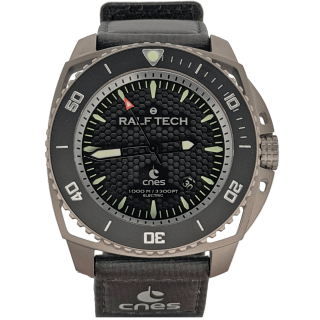
armée de terre 1994 luminova

type 20 ouragan flyback

Chronofixe Type 21 French Air Force Fighter pilot
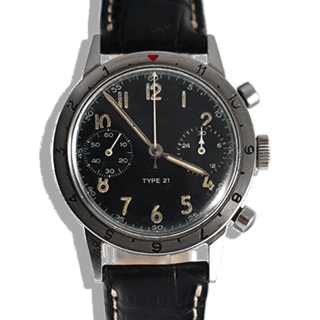
Spationaute II Patrick Baudry NASA Space Shuttle
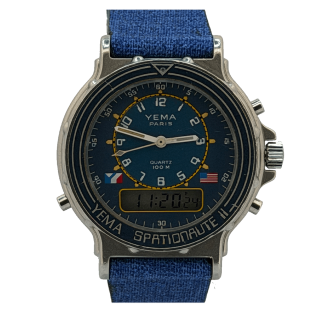
marine nationale indochine
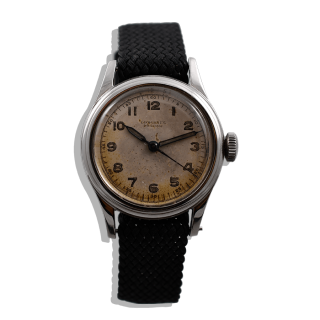
marine nationale submariner snowflake

WRV Electric 4e RHFS Special Forces ALAT
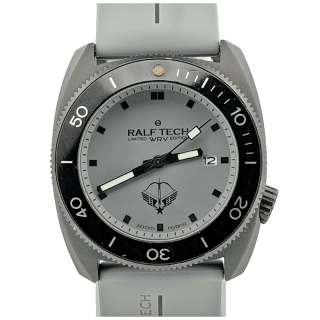
Share this content