Jacques Bianchi: The history of French military dive watches
Born in Marseille and adopted by the French Navy, the Jacques Bianchi JB200 embodies a distinctly French vision of the military dive watch. Blending watchmaking expertise, operational use and rarity, its story deserves to be rediscovered.
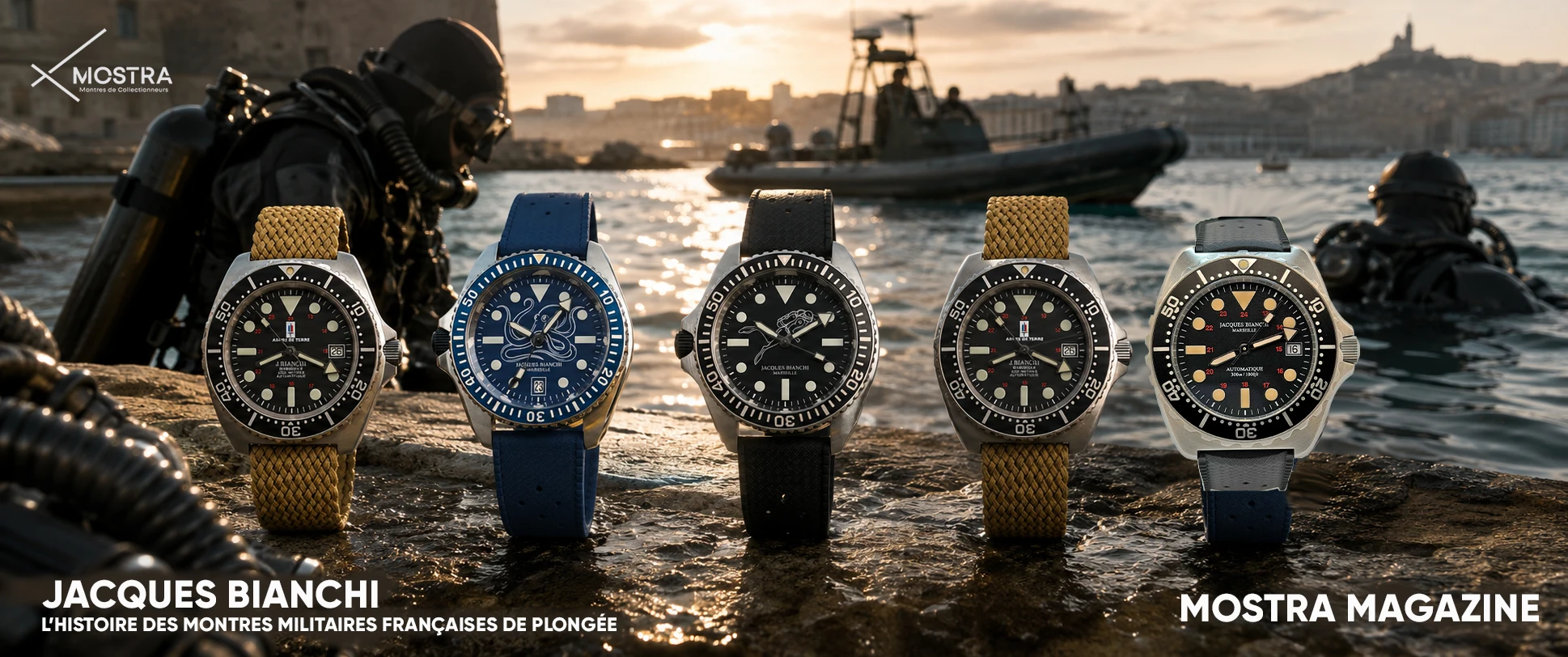
From the quays of Marseille’s Old Port to the wrists of certain French Navy divers, few French watches have a history as closely bound to the city as the Jacques Bianchi JB200. Long known to maritime professionals, a handful of servicemen and a small circle of collectors, this dive watch is now being rediscovered as one of the most distinctive witnesses to French military watchmaking in the late twentieth century.
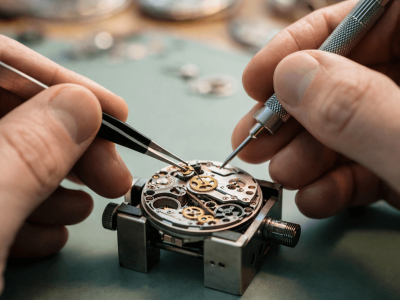
Its story did not begin in the design department of a major Swiss manufacture. It took shape at the workbench of a Marseille-based watchmaker and repairer, surrounded by water-resistant watches, Comex divers, harbour professionals and a city that looks towards the Mediterranean as its natural territory.
Before becoming the name printed on the dial of a French military watch, Jacques Bianchi was first and foremost a craftsman. A man who dismantled, observed, repaired and returned to service the instruments entrusted to his workshop. That practical knowledge would give rise, in 1982, to an immediately recognisable watch: the Jacques Bianchi JB200.
Discover the pre-owned Jacques Bianchi watches available at Mostra, together with our wider selection of pre-owned and vintage dive watches.
A watchmaking story born in Marseille
“Some watches tell the story of their manufacturer. Others still carry the memory of the people who used them. Jacques Bianchi watches belong to this second family: instruments born from direct contact with reality.”
When the great military dive watches are discussed, the same names naturally return. The Blancpain Fifty Fathoms, the Rolex Submariner and the Tudor Submariner Marine Nationale occupy a central place in specialist books, collections and auction rooms.
Their histories are extensively documented. Their references are classified, their variations catalogued and the details of their dials examined with almost archaeological precision.
Alongside those major houses, however, there is another story: more local, more artisanal and unmistakably French. It is the story of Jacques Bianchi Marseille.
For several decades, its watches remained relatively confidential. They circulated among divers, watchmakers, former servicemen and enthusiasts of purpose-built watches, far from the international reputation achieved by Swiss diving models.
This discretion did not reflect a lack of interest. It was the natural consequence of limited production, regional distribution and a company more concerned with function than communication.
The Jacques Bianchi JB200 was not imagined for display in a luxury showcase. It was designed as a legible, water-resistant and robust dive watch, capable of accompanying maritime professionals in their everyday work.
That sincerity is precisely what attracts collectors today. The JB200 does not attempt to reproduce the codes of a former military watch: it genuinely belongs to that history.
This local and artisanal history explains why Jacques Bianchi now occupies a distinctive place in French dive-watchmaking.
France and the birth of modern diving
The story of Jacques Bianchi cannot be understood without returning to the role played by France in the development of autonomous diving.
In the aftermath of the Second World War, the work of Jacques-Yves Cousteau and Émile Gagnan profoundly transformed underwater exploration. The self-contained underwater breathing apparatus gradually freed divers from the heavy equipment connected to the surface and opened new territories to the military, scientists, archaeologists and specialist companies.
The sea ceased to be observed only from the deck of a ship. It became a place of work, exploration and intervention.
This change created new technical needs. Regulators, diving suits, depth gauges, decompression instruments and watches capable of working reliably underwater all had to be designed.
Before dive computers became widespread, the watch was one of the diver’s principal reference instruments. It made it possible to monitor immersion time, organise an operation and track the duration elapsed since descent.
The watch was therefore not merely an addition to the equipment. It played a direct role in managing time underwater.
This function explains the particular design of the first great dive watches: dark dials, strongly luminescent markers, instantly recognisable hands, water-resistant cases and bezels used to mark the start of a dive.
The Rolex Submariner would become one of the most famous expressions of this new form of professional watchmaking. Yet it was never alone. In France, several brands, workshops and suppliers developed their own answers to the needs of divers.
This diversity can now be explored through Mostra’s selection of pre-owned and vintage dive watches.
The French Navy and measuring time underwater
The French Navy was naturally among the institutions to take an early interest in water-resistant watches and instruments intended for underwater operations.
Its divers worked in very different environments: hull inspections, maintenance of harbour installations, underwater work, rescue, mine clearance and specialised missions. In every one of these situations, legibility and equipment reliability remained essential.
Contrary to a commonly held idea, the history of French Navy watches cannot be reduced to a single brand or one unique reference. Equipment changed according to period, procurement contracts, availability and the needs of different units.
The Tudor Submariner naturally occupies a major place in this history. Its Oyster case, legibility and proven construction enabled it to accompany several generations of French military divers.
For collectors, examples with documented military provenance now rank among the most sought after. They embody a lasting relationship between a production Swiss watch and a French institution that used it as genuine equipment.
The Jacques Bianchi JB200 would later answer a different philosophy. It was not the product of a large foreign industrial organisation, but of a Marseille watchmaker whose experience had been built through direct contact with water-resistant watches and the people who used them.
The two watches should therefore not be opposed too quickly. The Tudor Marine Nationale represents the strength of a proven industrial architecture. The Jacques Bianchi expresses an independent French response, created on a far more confidential scale.
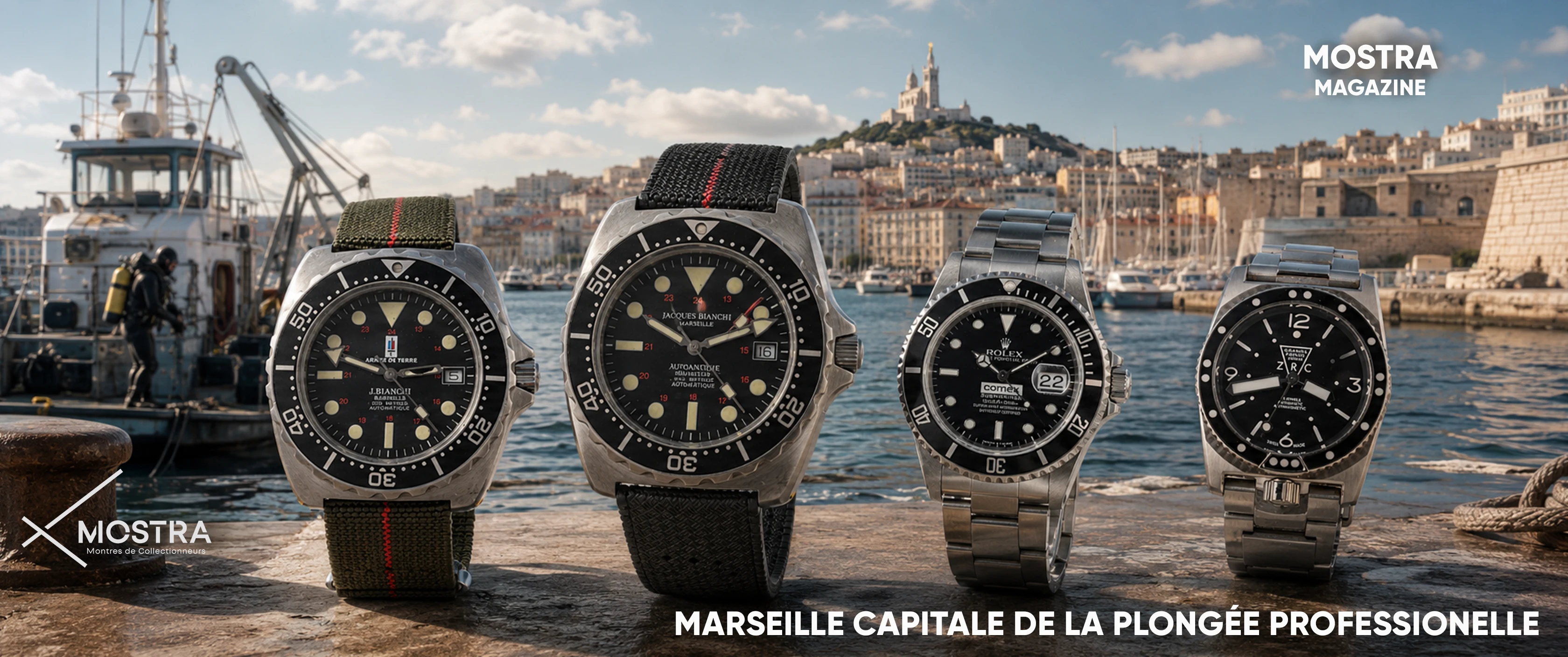
Marseille, the French capital of professional diving
In this story, Marseille is not a simple backdrop. The city is one of the very reasons Jacques Bianchi watches came into existence.
Its port, shipyards, maritime companies, clubs, divers and immediate access to significant underwater depths formed a unique environment. The Mediterranean was at once a horizon, an economic resource and a field of experimentation.
The presence of Comex, founded in Marseille in the early 1960s, further strengthened this culture of professional diving. Saturation divers, technicians and intervention teams used instruments subjected to particularly severe conditions.
Salt water, pressure, impacts, temperature variations and repeated immersions tested cases, crowns, crystals and gaskets. A watch that was theoretically water-resistant could quickly reveal its weaknesses when used every day.
For a watchmaker based in Marseille, dive watches were therefore not abstract objects. They returned to the workshop bearing the concrete marks of their use.
A crown had suffered an impact. A crystal had cracked. A gasket had deteriorated. Moisture had appeared beneath the dial. A movement had been contaminated after seawater entered the case.
Every repair became a lesson in watch construction.
By observing these open watches on his bench, Jacques Bianchi learned what resisted, what aged and what needed to be improved. He also understood that a professional watch had to be serviceable without unnecessary difficulty.
His proximity to Comex divers, maritime professionals and several major Marseille figures from the underwater world nourished this experience. It gave his workshop a natural specialisation in water-resistant watches.
Jacques Bianchi, a watchmaker before becoming a brand
Long before the JB200, Jacques Bianchi learned his trade at the Marseille School of Watchmaking. His career began in jewellery-store repair departments, at a time when the watchmaker often worked out of sight, at the back of a workshop.
This first period was essential. It allowed him to acquire the gestures of the profession, but above all to understand the diversity of the watches entrusted to him.
He did not work only on prestigious pieces. He repaired everyday watches, chronographs, alarm clocks, clocks and instruments whose owners expected, above all, that they should work correctly.
Around the beginning of the 1970s, Jacques Bianchi set up on his own. His workshop developed rapidly and earned the trust of several watch brands.
He notably took responsibility for Lip’s regional after-sales service in the Aix-Marseille area, at a time when the Besançon house still occupied a considerable place in French watchmaking.
The workshop also obtained approvals enabling it to work on watches from many houses. Jacques Bianchi became a Rolex-authorised watchmaker in 1974, an important recognition for an independent repairer.
This expertise naturally attracted professionals who owned Rolex watches used for diving. Comex divers entrusted him with their Submariners and Sea-Dwellers, models designed to withstand great depths but which, like all professional instruments, required regular checks and servicing.
To discover the history of the model developed for saturation diving, read our feature on the Rolex Sea-Dweller.
A workshop dedicated to water-resistant watches
Over the years, water-resistant watches became one of Jacques Bianchi’s specialities.
Repairing them required more than simply cleaning the movement. The construction of the case had to be understood, contact surfaces checked, gaskets inspected, the crown examined and the watch tested after closing.
A poorly conducted intervention could make even the best dive watch useless. Conversely, a watch serviced methodically could continue its career for many years.
Jacques Bianchi thus developed a practical understanding of different waterproofing systems. This experience was nourished by watches used in the real world, not merely by data printed in catalogues.
He also met several figures connected with the sea and underwater exploration. His workshop stood at the crossroads of different worlds: traditional watchmaking, professional diving, technical research and Marseille’s maritime culture.
This situation explains the philosophy that would later guide his own creations.
Jacques Bianchi would not try to develop an in-house movement or produce a complicated watch. His approach rested on more pragmatic choices: a suitable case, good legibility, coherent water resistance and a movement that could be serviced.
The watch had to remain a tool. Its value was measured first by its operation, legibility and the confidence it inspired in its user.
This philosophy would reappear several decades later in other contemporary French military watches.
From the workbench to the birth of the JB200
By the beginning of the 1980s, Jacques Bianchi therefore possessed a particular body of experience. He knew Swiss dive watches, the constraints of repair, the problems of water resistance and the expectations of a professional clientele.
This accumulation of observations eventually took the form of a personal project.
In 1982, the Jacques Bianchi JB200 appeared. Its name combined the initials of its creator with its stated water resistance of 200 metres.
The watch was immediately identifiable by its 42 mm stainless-steel case, its crown placed on the left and, above all, the silhouette of a diver drawn across its black dial.
This human figure, apparently moving across the dial beneath the hands, gave the JB200 a personality unlike any other dive watch of the period.
The historical model was powered by a French quartz movement, notably the France Ébauches FE 7121 calibre in the early series. This choice must be understood in the context of its time.
In the early 1980s, quartz was not an inferior solution reserved for inexpensive watches. For a professional instrument, it offered good precision, simple operation and useful resistance to everyday constraints.
Initial production remained limited. The JB200 was distributed mainly through chandlers and diving-equipment shops in south-eastern France.
It was not yet the icon sought after by collectors that it would become several decades later. It was a watch intended to be worn, submerged, knocked, serviced and returned to use.
A few years after its launch, several batches would be acquired by French Navy departments. These watches would join different units and permanently inscribe the name Jacques Bianchi in the history of French military dive watches.
Contemporary models continue this Marseille identity today. Discover the Jacques Bianchi watches available at Mostra.
Part Two – The birth of the Jacques Bianchi JB200
“A military watch is not born from a trend. It appears when a use, an era and one individual finally meet. In 1982, behind a black dial crossed by the silhouette of a diver, Jacques Bianchi gave watchmaking form to everything he had learned on the quays and in his Marseille workshop.”
By the beginning of the 1980s, Jacques Bianchi already had extensive experience with professional dive watches. He knew the strengths of the great water-resistant cases, the weaknesses of overly exposed crowns, the effects of seawater on components and the consequences of an ingress that had not been detected in time.
He had seen Rolex Submariners and Sea-Dwellers used by Comex divers pass across his workbench. He had serviced watches subjected to conditions that most timepieces would never encounter. Above all, he knew that a genuine dive watch could not be judged solely by the depth printed on its dial.
It was judged by the confidence it inspired before the descent.
From this experience came the Jacques Bianchi JB200, a French watch created in Marseille, launched in 1982 and designed to withstand immersion to 200 metres.
The JB200, a French watch launched in 1982
The JB200 collection appeared in 1982. Its name possesses an almost military simplicity: the letters JB reproduce Jacques Bianchi’s initials, while the number 200 indicates its stated water resistance of 200 metres.
There was not yet any question of writing a watchmaking legend. Jacques Bianchi wanted to offer a solid, instantly legible watch suited to professional divers as well as demanding enthusiasts.
Initial production remained extremely limited. The house refers to approximately one hundred examples in the first series, distributed without a genuine national network and mainly through chandlers and specialist diving shops in south-eastern France.
This distribution partly explains the watch’s present rarity. The JB200 benefited neither from the volumes of a major manufacture nor from the commercial power of Swiss brands. It appeared where it could naturally find its users: close to harbours, boats and diving centres.
It was not sold as an outward sign of success.
It was offered as equipment.
A 42 mm case designed for legibility
With its 42 mm stainless-steel case, the JB200 possessed substantial dimensions for the early 1980s.
At that time, most civilian watches remained noticeably smaller. Yet this diameter did not answer any desire for display. It simply offered more space for the dial, hour markers and hands.
Underwater, immediate legibility mattered more than the discretion of the case.
The general form belongs to the broad family of watches that collectors now describe as “skin divers”. Their architecture combines a relatively broad case, contained lugs, a functional bezel and a strongly contrasted dial.
The JB200 did not, however, copy any particular model. Its balance, the crown moved to the left and, above all, the drawing of the diver gave it an immediately recognisable identity.
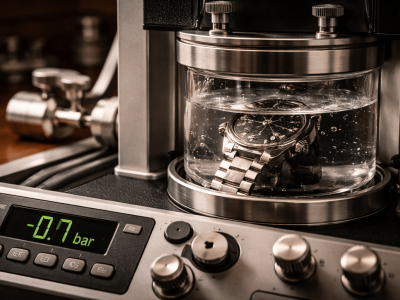
Its stated water resistance of 200 metres placed it among the genuine professional dive watches of its period. This indication does not mean that every surviving example can still be submerged today. After more than forty years, water resistance depends on the condition of the case, crystal, crown and gaskets, as well as the quality of the work carried out throughout the watch’s life.
Before returning any vintage watch to the water, a workshop test remains essential. Our article on watch water resistance and pressure testing explains this indispensable precaution in greater detail.
The left-hand crown: the JB200’s “destro” signature
The case’s most visible peculiarity appears on its left side.
The time-setting crown is not placed at 3 o’clock, as on most watches, but at 9 o’clock. This configuration is now frequently described by the Italian term “destro”.
On a watch worn on the left wrist, this position moves the crown away from the back of the hand. It therefore limits contact and uncomfortable pressure when the wrist bends, notably while handling diving equipment.
This arrangement also contributes visually to protecting the most exposed side of the case. Finally, it gives the JB200 an asymmetrical silhouette that immediately distinguishes it from the great Swiss dive watches of the same period.
The left-hand crown is therefore not a simple styling effect. It contributes to the watch’s overall ergonomics and, together with the diver on the dial, became one of the most enduring signs of the Jacques Bianchi identity.
Forty years later, contemporary reissues would preserve this arrangement. Not through decorative nostalgia, but because it belongs to the very architecture of the model.
The diver crossing the dial
One glance at a JB200 is enough to understand what makes it different.
Across its black dial stretches the pale silhouette of a frogman in action. The figure appears to swim inside the case, beneath the hands, as though the watch contained an underwater scene frozen in time.
This drawing might have been no more than a decorative element. Yet it became the brand’s true signature.
At a time when military-watch dials generally sought to remove all unnecessary information, the presence of this silhouette was a bold choice. The diver does not, however, disturb the reading of the time. Its design integrates into the dial’s overall contrast and immediately recalls the watch’s intended purpose.
The markers and hands of the historical models used tritium luminescent material. Over the decades, it may develop cream, beige or slightly orange tones. This natural transformation now contributes to the character of vintage examples.
The historical dial also features a date window at 6 o’clock. This opening sits beneath the diver’s silhouette and reinforces the vertical symmetry of the composition.
Reading the hours and minutes relies on hands of different shapes. This distinction makes it possible to recognise the essential information quickly, including when light levels fall.
The seconds hand, visibly in motion, provides an immediate indication that the watch is operating. On a dive watch, this is not a minor detail: it allows the wearer to confirm that the movement is still driving the hands.
The French France Ébauches FE 7121 quartz calibre
One of the most common errors is to present the historical JB200 as an automatic watch fitted with a Swiss movement.
The model launched in 1982 was powered, in its early series, by a French France Ébauches FE 7121 quartz calibre.
This choice must be placed in the context of its time.
In the early 1980s, quartz represented a modern, precise technology perfectly suited to a purpose-built watch. It offered good rate stability, resisted positional variation and required less daily handling than a hand-wound mechanical movement.
For Jacques Bianchi, the use of quartz was therefore not a cost-cutting measure intended to reduce the watch’s price artificially. It answered a logic of efficiency.
The JB200 had to display the time accurately, withstand sustained use and remain serviceable by a competent workshop. The France Ébauches movement fulfilled this mission while reinforcing the model’s French identity.
This architecture profoundly distinguishes the JB200 from the Tudor Submariner Marine Nationale, whose Swiss automatic mechanical movements answered another watchmaking tradition.
Opposing quartz and mechanical watchmaking according to present-day criteria would obscure the original function of these watches. For a professional instrument, the best technology is not necessarily the most prestigious. It is the one that answers the intended use most accurately.
Our guide to automatic and quartz watches examines the differences in operation, servicing and use between these two architectures.
A bezel designed to measure immersion time
Around the dial, the JB200 features a diving bezel graduated over sixty minutes.
Its principle is simple. Before descending, the diver places the bezel marker opposite the minute hand. The scale then directly indicates the time elapsed since the start of the dive.
In the 1980s, this function retained considerable importance. Dive computers had not yet become the omnipresent instruments they would be a few years later.
The watch and its bezel therefore helped monitor the time spent underwater.
The JB200’s graduation favours clear reading. The numerals are sufficiently prominent to be identified quickly, while the notched edge makes the bezel easier to handle.
The construction did not seek to multiply spectacular devices. Available historical documents describe a functional diving bezel, not a specific patented locking mechanism.
This clarification matters. The strength of the JB200 does not lie in an invention artificially added to its history. It rests on the coherence of the whole: a contrasted dial, a 42 mm case, a left-hand crown, 200-metre water resistance, a French movement and a bezel intended to mark elapsed time.
This architecture remains one of the fundamental principles of pre-owned dive watches, even though standards, materials and movements have evolved.
Confidential distribution in southern France
At launch, the JB200 did not benefit from a national campaign.
The first watches were distributed sparingly through chandlers and specialist diving shops in south-eastern France.
This positioning reveals much about Jacques Bianchi’s philosophy.
The watch was placed where its natural users were to be found. It sat alongside diving suits, regulators, depth gauges, fins and equipment intended for boats.
It was not yet seeking entry into the hushed showcases of high-end watchmaking.
The initial production, estimated by the house at approximately one hundred pieces, remained too small to create genuine commercial distribution. It was nevertheless sufficient to make the model known within the Mediterranean maritime world.
Divers wore it. Professionals used it. The watch circulated and sometimes returned to the workshop, where its creator could directly observe how it behaved.
This proximity between design, use and maintenance is one of the great singularities of Jacques Bianchi. The man whose name appeared on the dial was also the person able to open the case and understand the marks left by the watch’s life.
French Navy orders in the late 1980s
The JB200’s military career did not begin precisely at the moment of its commercial launch.
According to information published by the house, several batches were acquired towards the end of the 1980s by French Navy departments in Toulon, through the Approvisionnements de la Flotte, or Fleet Supply Service.
Available sources refer to a few dozen watches, probably around sixty.
This figure must be presented with caution. The known archives establish the presence of JB200 watches within the French Navy, but they do not necessarily constitute an exhaustive inventory of every watch purchased, issued, repaired, lost or withdrawn from service.
It would also be inaccurate to claim that all these examples were issued to combat swimmers or mine-clearance divers.
Watches purchased by a military institution can meet several needs. They may be assigned to specialist divers, ship’s divers, personnel at a naval air station, a school, a vessel or a department responsible for maritime safety.
The JB200 thus appears in several French Navy environments. This diversity does not lessen its military interest. On the contrary, it helps clarify its function: a water-resistant instrument that could be used by different personnel working in direct contact with the sea.
What the records of the French Navy Watchmaker reveal
The military history of a watch should never rest solely on a legend repeated from one advertisement to another.
In the case of the JB200, several traces appear in the police and repair registers of the French Navy Watchmaker at the Toulon Arsenal.
These documents mention watches identified by number and sent for commissioning, repair or servicing. They are particularly valuable because they allow certain examples to be associated with a unit or vessel.
The documented careers of these examples, the known numbers and the limits of their attribution are examined in detail in the section devoted to the JB200 in French Navy service.
Issue, assignment and provenance: using the right words
On the military-watch market, the term “issued” is sometimes used too freely.
A watch may have been purchased by the French Navy without the precise user being known. It may have been assigned to a base, department, vessel or specialist unit. It may also have changed assignment during its career.
Collectors must therefore distinguish several levels of evidence:
- the model is historically known to have been purchased by the institution;
- the individual watch number appears in a military register;
- an assignment to a unit or vessel is documented;
- the user’s name is known;
- personal documents, photographs or service records establish continuity of provenance.
The more complete the documentary chain, the stronger the provenance.
A simple resemblance to a military watch is not enough. An isolated engraving does not replace a register. An oral history, however attractive, must always be presented as such when it cannot be confirmed.
This method applies to the Jacques Bianchi JB200 just as it does to a Tudor Marine Nationale, an Auricoste, a Triton, a ZRC or any other watch associated with the armed forces.
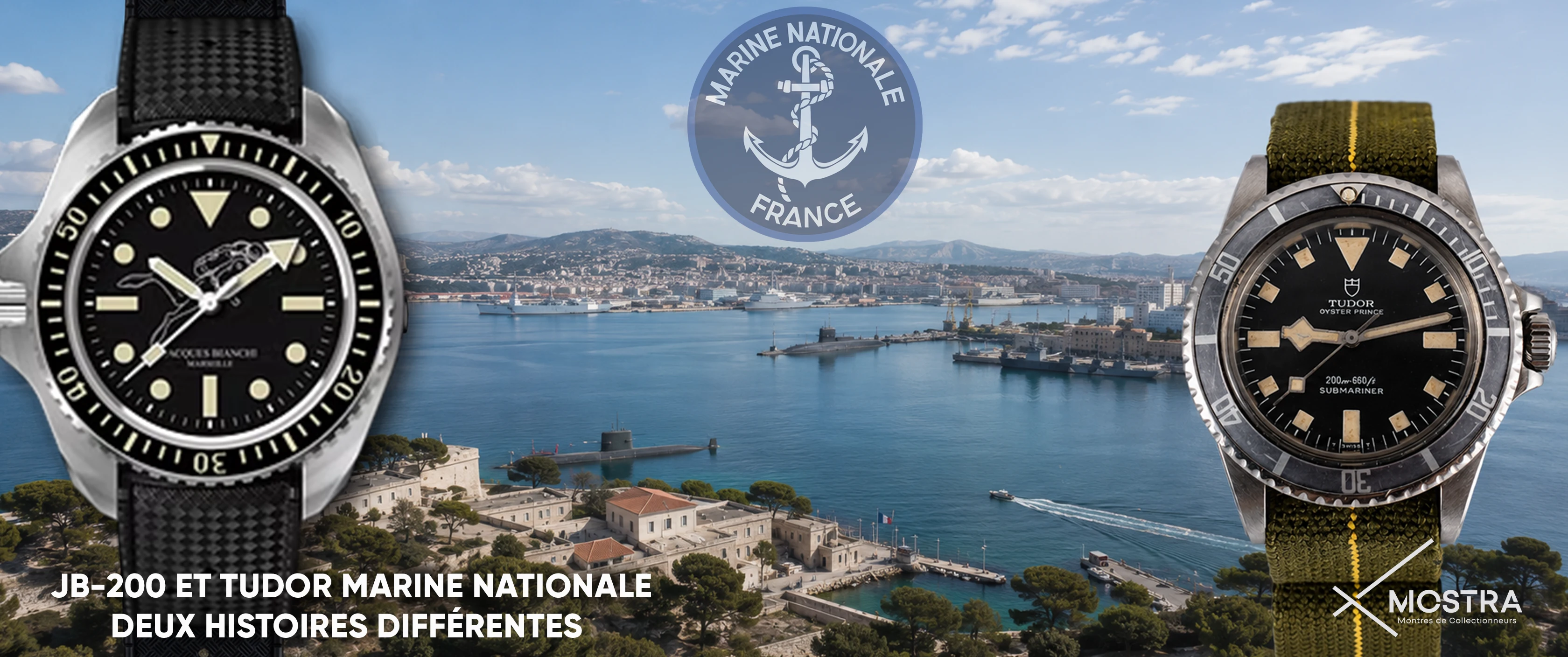
Jacques Bianchi JB200 and Tudor Marine Nationale: two different stories
The JB200’s presence within the French Navy naturally leads to comparisons with the Tudor Submariner Marine Nationale.
The two watches share an environment, but they do not answer the same philosophy.
The Tudor Submariner came from a Swiss industrial organisation benefiting from Rolex’s technical experience. Its Oyster case, automatic mechanical movement and structured production made it a standardised, proven instrument available in volumes that bore no comparison with those of Jacques Bianchi.
The JB200 was born in a Marseille workshop. It used a French quartz movement, adopted a left-hand crown and asserted its identity through a dial that no other watch could claim.
The first represents the power of an industrial architecture that became a worldwide reference.
The second demonstrates the ability of a French craftsman to design a local, functional and immediately recognisable response.
There is no evidence allowing the JB200 to be presented as a general replacement for the Tudor within the French Navy. Military acquisitions may coexist, answer separate contracts and concern different departments.
The question “Jacques Bianchi JB200 or Tudor Marine Nationale?” therefore does not call for a final ranking.
The Tudor possesses a longer military history, abundant documentation and international recognition. The Jacques Bianchi offers much more confidential production, a strongly French identity and exceptional proximity to Marseille’s maritime world.
To explore this comparison further, read our feature on the Tudor Submariner and its history with the French Navy.
A military watch serviced to remain in use
The repair registers recall a reality sometimes forgotten by the collectors’ market: a military watch is made to be serviced.
When a JB200 returned to the French Navy Watchmaker, the objective was not to preserve each of its components for a future collector.
It had to be restored to working order.
A worn gasket had to be replaced. A defective crown had to be changed. A hand that had become illegible could be renewed. A damaged movement had to be repaired or, if necessary, substituted.
These interventions may now complicate the analysis of an example. Yet they are not necessarily incompatible with its military authenticity.
A watch may be historically authentic without having retained every component present when it left the workshop. It may have received service parts entirely consistent with its use and period of maintenance.
The essential task is to distinguish period operational maintenance from a more recent commercial reconstruction.
Before becoming a collectible watch, the JB200 was an instrument
It is tempting today to view an old JB200 as a rarity intended to remain protected.
That would mean forgetting its reason for existing.
The 42 mm case, the crown placed on the left, the French quartz movement, the diver dial and the 200-metre water resistance are not elements of a story imagined after the event.
They belong to a watch designed to accompany a real activity.
The JB200 did not seek to rival the great Swiss dive watches on their own ground. It built its personality elsewhere, between a Marseille workshop, chandlers, Mediterranean professionals and several French Navy departments.
Its military history does not reside in an advertising photograph.
It appears in recorded numbers, assignments, requests for servicing and the pages of a workshop register.
That is probably where its greatest strength now lies.
The Jacques Bianchi JB200 does not merely tell us what it might have accomplished.
It carries the trace of what it was genuinely designed to do.
Part Three – References, variations and authenticity of the Jacques Bianchi JB200
“An old military watch can never be reduced to what appears in a photograph. It is read through the shape of its case, the printing of its dial, the material of its hour markers, the movement it houses and the interventions it has undergone. On a Jacques Bianchi JB200, every detail matters, but no detail should be studied in isolation.”
At first glance, a vintage Jacques Bianchi JB200 appears easy to recognise. Its 42 mm case, left-hand crown and the silhouette of a frogman crossing the dial form an identity that few watches can claim.
Recognising it, however, is not the same as authenticating it.
Since the revival of Jacques Bianchi Marseille and the launch of the 2021 reissue, several generations of JB200 now coexist on the market. Alongside the historical watches produced in the 1980s are modern reissues, special series, examples serviced during their working lives and a number of old watches whose configurations have been modified to varying degrees.
For the collector, the question is therefore no longer simply whether the watch is a Jacques Bianchi.
It is necessary to determine the period from which it comes, which components it has retained, which parts have been replaced and whether its military history can genuinely be documented.
A rare watch and documentation that remains fragmentary
The Jacques Bianchi JB200 never benefited from the industrial documentation associated with the major Swiss manufactures.
To date, there is no public catalogue allowing every evolution of dial, hands, bezel, case and movement to be classified with absolute certainty according to a detailed chronology.
This absence does not mean that anything is possible.
Several characteristics of the historical model are firmly established. Period photographs, the archives of Jacques Bianchi Marseille, surviving watches and the records of the French Navy Watchmaker provide a serious foundation.
They do not, however, always make it possible to transform every difference observed between two watches into a newly recognised official series.
A variation can have several origins:
- an evolution introduced during production;
- different availability of a component;
- a service intervention carried out in the 1980s or 1990s;
- a later repair performed by an independent workshop;
- a recent cosmetic restoration;
- the assembly of components from several watches.
The appraisal of a JB200 must therefore remain methodical.
A difference does not automatically prove the existence of a rare variation. It is first and foremost a question that must be documented.
The established characteristics of the historical JB200
Sources published by Jacques Bianchi Marseille allow several defining elements of the model that appeared in 1982 to be retained.
- a stainless-steel case measuring approximately 42 mm in diameter excluding the crown;
- a crown placed on the left side of the case;
- stated water resistance of 200 metres;
- a black dial carrying the silhouette of a large diver;
- a date window positioned at 6 o’clock;
- tritium-luminous hour markers and hands;
- a baton-style hour hand;
- a large arrow-shaped minute hand;
- a seconds hand ending in a square marker;
- a graduated diving bezel;
- a France Ébauches quartz movement in the early series;
- a black rubber strap suitable for diving.
Taken separately, none of these elements is sufficient to certify a watch.
A modern reissue also has a 42 mm case, a left-hand crown and a diver on the dial. A reconstructed watch may combine several components that visually resemble historical parts.
The value of the examination lies in the coherence of the whole.
The 42 mm case and left-hand crown
The historical JB200 case belongs to the generation of dive watches that sits between the slim “skin divers” of the 1960s and the more massive watches that would dominate the 1980s.
Its 42 mm diameter gives it considerable presence for its period without turning the watch into an excessively thick instrument.
The crown is positioned at 9 o’clock.
This so-called “destro” arrangement moves the crown away from the back of the hand when the watch is worn on the left wrist. It also contributes to the immediately recognisable silhouette of the JB200.
When examining an old example, diameter is nevertheless only a first reference point. It is also necessary to observe:
- the overall form of the case;
- the continuity between the lugs and flanks;
- the geometry of the crown guards;
- the regularity of the polished or brushed surfaces;
- the remaining thickness of the metal;
- possible traces of earlier polishing;
- the way the bezel integrates with the case.
A case marked by use can retain excellent geometry.
Conversely, a very shiny case may have been polished several times. Its edges then become softer, certain surfaces grow thinner and the original silhouette gradually loses its tension.
On a military or professional watch, a few impacts and scratches are not incoherent. They must, however, correspond to natural wear rather than conceal deep corrosion or a structural repair.
The presence of the crown on the left does not, by itself, prove the watch’s age. This architecture was faithfully reproduced on the 2021 reissue and on several contemporary creations from Jacques Bianchi Marseille.
The diver dial and the date at 6 o’clock
The dial is the face of the JB200 and probably the most important part of its identity.
On the historical model, a large diver silhouette crosses the black background. The frogman is shown in action, looking towards his own watch, in a composition that became Jacques Bianchi’s graphic signature.
The date window is positioned at 6 o’clock.
This date notably distinguishes the historical model from the first automatic reissue launched in 2021, whose dial was deliberately freed from this opening.
On documented vintage examples, the signature appears in abbreviated form, notably with the wording “J. Bianchi Marseille”. The typeface, character length, spacing and position of this signature should be compared with reference watches from the same period.
When studying a dial, the following points should be observed:
- the sharpness of the diver drawing;
- the thickness and continuity of its outlines;
- its position in relation to the hour markers and hands;
- the shape of the triangle at 12 o’clock;
- the arrangement of round and rectangular markers;
- the typeface of the signature;
- the form and framing of the date window;
- the texture of the black background;
- the ageing of the luminous material.
A refinished dial can appear very attractive in a general photograph. Examination under magnification sometimes reveals printing that is too thick, irregular outlines, an approximate typeface or luminous material applied without respecting the original form of the markers.
An unusually fresh dial paired with a heavily marked case should also be approached with care.
This difference is not automatic proof of restoration. The dial may have been replaced during an earlier intervention. It nevertheless calls for an explanation.
Tritium, hour markers and hands
The hands and hour markers of the historical JB200 use tritium.
After more than forty years, this material may have developed cream, sand, beige or slightly orange tones. The colour depends on many factors: exposure to light, humidity, temperature, storage and the exact composition of the deposit.
There is therefore no single patina colour valid for every JB200.
Uniformly beige luminous material is not automatically old. Restorers can now reproduce colours inspired by aged tritium.
The examination should focus on several points:
- the texture of the material;
- the regularity of its application;
- its behaviour under ultraviolet light;
- the speed at which any fluorescence disappears;
- the coherence between the hour markers, hour hand and minute hand;
- the presence of cracks, losses or local repairs.
The historical hands possess a specific design.
The hour hand takes a baton form. The minute hand ends in a large, immediately recognisable arrow. The seconds hand features a square marker, often described as a “square lollipop”.
These three forms were reproduced by the modern reissue. Their presence is therefore insufficient to date an example.
Their length, width, finish, the shape of the pinions and their precise relationship with the dial markers must all be studied.
Service hands may perfectly well have been installed during the watch’s life. They may be consistent with professional use while reducing the example’s degree of strict originality.
Reluming must also be disclosed. It can restore a watch’s legibility, but it does not carry the same meaning as luminous material preserved from the outset.
The bezel, inner flange and exposed components
The bezel of a dive watch is among the most exposed components.
It receives impacts, friction, salt, sand, sunlight and repeated handling. On a watch that was genuinely worn, its ageing is rarely identical to that of the dial protected beneath the crystal.
The historical JB200 bezel displays a complete graduation intended to indicate elapsed time. This graphic architecture was reproduced when the model was revived.
The study should focus on:
- the typeface of the numerals;
- the shape of the graduations;
- their spacing;
- the position of the starting marker;
- wear around the edge;
- coherence between bezel and case;
- the quality of rotation;
- signs of replacement or adaptation.
A replaced bezel does not invalidate the authenticity of the watch. It does, however, alter its level of originality and should be described accordingly.
The sloping inner flange surrounding the dial also contributes to the model’s identity. Its reflective treatment returns light towards the dial and gives the whole greater depth.
A watch whose bezel, crystal or inner flange has been changed can remain perfectly wearable and historically interesting. The collector simply needs to know what is being purchased.
The France Ébauches quartz movement
The historical JB200 is a quartz watch.
The early series are documented with a French France Ébauches FE 7121 movement. This characteristic is essential because it distinguishes the original watch from the automatic reissue introduced in 2021.
The words used must nevertheless remain precise.
The brand’s documentation indicates a France Ébauches movement for the early series and cites the FE 7121 calibre for the historical JB200. It does not provide a complete public inventory allowing it to be stated that every vintage JB200, whatever its period of production, must necessarily contain an absolutely identical version of the movement.
When an example is opened, several elements should be examined:
- the exact calibre reference;
- the quality of its installation in the case;
- the presence and shape of the movement spacer;
- the condition of the plate and electronic components;
- the cleanliness of the battery contacts;
- the coherence of the stem with the crown positioned on the left;
- traces of oxidation or intervention;
- possible workshop inscriptions.
A replacement movement may have allowed the watch to continue its career. On a professional instrument, this decision could have been entirely logical.
For today’s collector, however, it must be identified. A watch retaining its historical movement does not possess the same documentary value as an example fitted with a generic movement adapted several years later.
The risk of an old leaking battery
On a quartz watch more than forty years old, the condition of the movement cannot be judged solely by its ability to move the hands.
A forgotten battery can leak and damage the contacts, electronic circuit, coil or certain metal parts of the calibre.
A watch may have been cleaned and returned to working order while still retaining traces of earlier oxidation.
Before purchasing a vintage JB200, it is therefore useful to request:
- a clear photograph of the movement;
- the date of the last battery replacement;
- the nature of work carried out;
- details of any parts replaced;
- a check of electrical consumption;
- verification of the date function;
- an examination of the crown and setting stem.
The Mostra watchmaking workshop in Aix-en-Provence can establish a diagnosis before an irreversible decision is made.
A new battery alone does not constitute a service.
It merely confirms that the watch restarts. A serious inspection should also ensure that consumption remains normal and that the movement does not present damage likely to cause another rapid stoppage.
This is all the more important because certain vintage components can be difficult to replace without using a donor watch or making an adaptation.
To understand how a quartz watch is handled and which checks are useful after the case has been opened, read our guide to quartz watch battery replacement at the Mostra workshop.
The caseback and numbers
The caseback is an essential part of the appraisal.
It protects the movement, sometimes carries technical information and may provide a number allowing the watch to be connected with a register or archive.
In the case of JB200 watches that passed through the French Navy, several numbers are documented in the records of the French Navy Watchmaker in Toulon.
The presence of a number does not, however, establish military provenance on its own.
It is necessary to verify:
- the coherence of its form and position;
- the quality of the stamping or engraving;
- natural wear around the inscription;
- any correspondence with a document;
- continuity between the caseback, case and movement;
- the absence of recent reworking intended to recreate provenance.
A spectacular “Marine Nationale” engraving never replaces a document.
Conversely, a watch genuinely monitored by a military department may not carry an exterior marking immediately understood by the collector.
Provenance is built through the convergence of evidence: number, register, invoice, photograph, decommissioning document, identified testimony or family continuity.
An old JB200 is not necessarily military. As explained in our section on issue, assignment and provenance, a model historically used by the French Navy should not be confused with an individually documented example.
The Junior model with the small diver
The archives presented when the brand was revived also mention the development, during the 1980s, of a Junior version of the JB200.
This watch is distinguished by the smaller diver silhouette on its dial.
Its existence reminds us that Jacques Bianchi production was not necessarily limited to one graphic configuration.
It should not, however, be used to validate automatically every old dial carrying a reduced diver.
Public documentation on this model remains less extensive than for the full-size JB200. An example presented as a JB200 Junior should therefore be examined with particular attention:
- case coherence;
- dial architecture;
- signature;
- movement;
- dimensions;
- provenance;
- comparison with known documents and photographs.
In collectible watchmaking, claimed rarity must never replace demonstration.
The strap: a wear component
The historical JB200 is associated with a supple black rubber strap suited to diving.
The strap of a professional watch is nevertheless one of the first parts to disappear.
Rubber ages, hardens, splits or loses its flexibility. When a watch is worn at sea, the strap may be replaced several times during its career.
An old JB200 fitted with a recent strap is therefore not necessarily incoherent.
It is important to distinguish:
- the strap originally delivered with the watch;
- a vintage strap corresponding to the period;
- a service strap fitted during maintenance;
- a modern Tropic-style strap;
- a strap selected solely to make the watch wearable today.
The original strap may enhance the interest of a very well-preserved set. Its absence does not, however, call into question the authenticity of the case, dial or movement.
Safety must also remain the priority. An old strap that has become brittle should not be used for daily wear on a rare watch.
Parts replaced during service
A watch used by a military institution is serviced to remain operational.
When a crown loses its water resistance, it must be changed. When a crystal is broken, it is replaced. When a hand becomes illegible or a movement can no longer be repaired within a reasonable time, the workshop seeks a functional solution.
The watch’s future collectible interest does not enter into that decision.
A JB200 may therefore have received during its life:
- a replacement crown;
- a new crystal;
- a new bezel;
- service hands;
- a replacement dial;
- a repaired or substituted movement;
- several successive straps;
- new gaskets at each water-resistance check.
These interventions do not all carry the same importance.
Replacing a gasket is a normal and indispensable operation. Changing a dial alters the historical value of the watch much more profoundly.
A service part installed during the military career of the example may form part of its history. A modern part added to make the watch artificially more attractive belongs to another logic.
The issue is to understand when, why and how the intervention was carried out.
Authentic, original or period-correct JB200: three different ideas
The terms authentic, original and period-correct are often confused. Yet they do not describe the same reality.
An authentic Jacques Bianchi JB200
An authentic JB200 is a watch genuinely produced or assembled under the responsibility of Jacques Bianchi, rather than an imitation manufactured later.
Authenticity concerns the identity of the watch.
An original Jacques Bianchi JB200
An original JB200, in the strict sense used by collectors, retains the components fitted during manufacture or corresponding precisely to its configuration when it left the workshop.
A watch may therefore be authentic without being entirely original if its dial, hands, bezel or movement have been replaced.
A period-correct Jacques Bianchi JB200
A period-correct watch respects the technical and aesthetic characteristics expected for the model, even if certain components have been renewed.
A replacement crown, new crystal, recent gaskets or a modern strap can make a watch reliable and wearable without claiming that it has remained untouched since 1982.
This distinction makes it possible to describe a watch without unfairly devaluing it or exaggerating its level of originality.
To explore this method further, read our feature on the true condition of a pre-owned watch: authentic, original, period-correct, serviced or restored.
Restorations and watches assembled from parts
Growing interest in historical JB200 watches naturally encourages the restoration of tired examples.
A restoration is not necessarily objectionable.
It can save a dial attacked by moisture, stabilise fragile luminous material, restore a movement or allow a family watch to regain a coherent appearance.
It simply has to be disclosed.
The principal interventions to look for include:
- a repainted or reprinted dial;
- a redrawn diver;
- relumed hour markers;
- repainted hands;
- a recently reproduced bezel;
- a heavily polished case;
- reworked engravings;
- an added number;
- an adapted generic movement;
- an assembly of components taken from several watches.
A reconstructed watch may consist of several authentic parts and remain historically incoherent.
An old case, a genuine dial, a France Ébauches movement and a bezel from another example do not automatically recreate the watch’s original configuration.
The question is therefore not simply: “Is every part genuine?”
It is also necessary to ask: “Do these parts have a coherent reason to be together?”
Historical JB200 or 2021 reissue: the principal differences
The revival of Jacques Bianchi Marseille in 2021 allowed a new generation to discover the JB200.
The reissue remains faithful to the broad lines of the historical model, but it is not a strictly identical reproduction.
Several differences make it possible to distinguish the two generations.
The movement
The historical JB200 uses a quartz movement, with a France Ébauches FE 7121 calibre documented for the early series.
The founding 2021 reissue is fitted with a Seiko NH35 automatic mechanical movement.
The date
The historical model possesses a date window at 6 o’clock.
The 2021 reissue deliberately removes this date in order to simplify the dial.
The luminous material
Historical dials use tritium.
The reissue uses ivory-coloured Super-LumiNova, selected to recall visually the patina of old luminous materials.
The case
The 42 mm diameter and left-hand crown are retained.
The modern case nevertheless had to be redesigned and made thicker in order to house an automatic movement that was more substantial than the original quartz calibre.
The dial signature
Documented historical examples notably display the abbreviated signature “J. Bianchi Marseille”.
The reissue uses the full wording “Jacques Bianchi Marseille”.
Ageing
A watch from 1982 may show signs of use, tritium patina, a marked bezel insert and several earlier interventions.
A modern reissue must be assessed according to different criteria: cosmetic condition, operation of the automatic movement, presence of the box and papers, and consistency with the series concerned.
Both watches are legitimate.
One is a historical witness to French watchmaking in the 1980s. The other extends its design and makes it possible to wear it with the characteristics of a contemporary watch.
The checklist before buying a vintage Jacques Bianchi JB200
Before acquiring a historical JB200, it is advisable to gather as much information as possible.
Examine the dial
- Is the diver drawing sharp and correctly positioned?
- Does the dial have a date window at 6 o’clock?
- Does the signature correspond to documented historical examples?
- Do the markers display a coherent texture and ageing?
- Has the dial been repainted, cleaned or restored?
Examine the hands
- Are the baton, arrow and square-marker designs respected?
- Do the lengths correspond to the dial?
- Is the patina coherent with that of the hour markers?
- Have the hands been relumed or replaced?
Examine the case
- Do the diameter and overall form correspond to the historical model?
- Is the crown correctly positioned on the left?
- Are the volumes and edges still present?
- Has the case been heavily polished?
- Are there signs of corrosion or water ingress?
Examine the bezel and crystal
- Does the graduation correspond to documented models?
- Does the bezel turn normally?
- Is its wear coherent with that of the case?
- Has the crystal been replaced?
- Are there cracks or visible water-resistance defects?
Examine the movement
- Has the calibre been identified?
- Is it a France Ébauches FE 7121 or another movement?
- Is the installation coherent with the case?
- Has the battery caused oxidation?
- Has electrical consumption been checked?
- Does the date change correctly?
Examine the provenance
- Is the watch number legible?
- Is there a military document or a corresponding register entry?
- Is the identity of the previous owner known?
- Is the watch merely described as a model used by the Navy, or as an individually issued example?
- Are the seller’s claims accompanied by evidence?
Consider future use
- Will the watch be preserved or worn regularly?
- Is servicing required?
- Has water resistance been tested recently?
- Is the strap sufficiently secure for wearing the watch?
- Does the rarity of the movement make measured use preferable?
An old JB200 should never be submerged solely on the strength of the “200 metres” designation associated with the model.
After several decades, only a complete examination of the case, crown, crystal and gaskets can determine whether a watch may still be exposed to water.
Considering the purchase of a vintage Jacques Bianchi JB200?
Mostra can examine the coherence of the case, dial, hands, movement, number and documents before any military provenance or value is accepted.
Mostra’s technical assessment of a Jacques Bianchi JB200
At Mostra, the study of a military watch always begins with a simple question: what can genuinely be established?
On a Jacques Bianchi JB200, we do not seek to transform every difference into a rare variation or every sign of wear into proof of an exceptional mission.
We examine the watch component by component:
- coherence of the case;
- nature of the dial;
- age of the luminous material;
- correctness of the hands;
- condition of the bezel;
- identification of the movement;
- possible oxidation;
- quality of previous interventions;
- traceability of the number;
- actual level of provenance.
This method makes it possible to distinguish an authentic watch fitted with service parts from an entirely original example, a declared restoration or a watch assembled from different components.
Above all, it allows the piece to be described in the right words.
An authentic civilian JB200 does not need an invented military provenance to be interesting.
A documented issued watch does not need to be presented as belonging to a combat swimmer if the archives indicate only an assignment to a base or vessel.
A restored watch can remain beautiful, wearable and historically meaningful, provided that the restoration is explained.
The Jacques Bianchi “Armée de Terre”: A Confidential Evolution of the JB300
“Although the JB200 entered watchmaking history through its use by the French Navy, Jacques Bianchi never restricted his expertise to the maritime world alone. The natural evolution of his professional watches would also lead to the creation of a model associated with France’s land forces: the Jacques Bianchi Armée de Terre.”
During the late 1980s and early 1990s, Jacques Bianchi continued to develop his professional watches by refining the original concept. This new generation, now known as the JB300, retained the general architecture that had established the reputation of the JB200 while introducing technical improvements suited to the requirements of professional users.
The case preserved its immediately recognisable identity, with its crown positioned on the left, its strong visual character and its excellent legibility. Water resistance was increased to 300 metres, while an automatic mechanical movement progressively replaced the quartz calibre used in the earliest JB200 watches.
Among these developments was a particularly rare version: the Jacques Bianchi Armée de Terre.
This model is immediately distinguished by the official insignia of the French Army printed on the dial above the Jacques Bianchi Marseille signature. This personalisation gives the watch a clear institutional identity while preserving the qualities that had established the reputation of the Marseille-based watchmaker.
Unlike certain civilian watches that merely use military decoration, this version reflects Jacques Bianchi’s intention to offer instruments adapted to the specific requirements of different branches of the French armed forces.
The dial retains the traditional layout of the brand’s professional watches:
- a large triangle at 12 o’clock;
- highly luminous hour markers;
- a red inner 24-hour scale;
- a date window;
- generously sized hands designed for immediate legibility.
The characteristic cushion-shaped case remains one of the strongest signatures of Jacques Bianchi. Its design provides excellent protection while ensuring remarkable comfort on the wrist.
Known examples of this Armée de Terre version appear on the collector’s market far less frequently than conventional JB200 watches. This rarity can probably be explained by extremely limited production numbers and a distribution network that remained confidential.
As with the JB200 watches associated with the French Navy, however, a careful distinction must be made between a watch bearing the French Army insignia and a watch demonstrably issued or assigned to an identified serviceman. A documented military provenance must always rely on material evidence: a serial number, archives, assignment papers, administrative invoices, period photographs or a traceable ownership history.
For collectors, this version now represents one of the most original Jacques Bianchi productions. It perfectly illustrates the evolution of the Marseille-based watchmaker, whose expertise extended beyond military diving watches to meet a broader range of institutional requirements.
This diversity contributes to making Jacques Bianchi one of the rare French watch brands whose instruments accompanied both maritime professionals and certain members of the French land forces.
Mostra’s Perspective
Jacques Bianchi Armée de Terre watches remain particularly rare on the collector’s market. As with the JB200 watches associated with the French Navy, their interest depends above all on their authenticity, the consistency of their configuration, their condition and the quality of their provenance. A watch merely bearing the French Army insignia should never be described as a military-issued watch without supporting documentary evidence. This historical discipline is one of the foundations of the appraisal process carried out by the Mostra workshop.
Part Four – The Jacques Bianchi JB200 in French Navy service
“A military watch does not become historical because it resembles combat equipment. It becomes historical when a number, a register, a unit and a workshop intervention allow its presence within the armed forces to be traced. For the Jacques Bianchi JB200, the story begins precisely where legend must stop.”
At the end of the 1980s, the Jacques Bianchi JB200 gradually left the chandlers of southern France and entered the French Navy’s procurement channels.
This stage now gives the model a particular place in the history of French military dive watches. It must nevertheless be told with precision.
The JB200 was not intended exclusively for combat swimmers. Nor did it replace every Tudor Submariner then present within the French Navy. The published archives reveal a more nuanced reality and, ultimately, a much more interesting one.
JB200 watches appear in several military environments: a minehunter, naval air stations, a supply department, a diving school and the Mine-Clearance Divers Group.
This diversity reminds us that, within the French Navy, the word “diver” does not designate a single profession. It covers different specialities, levels of training and missions that may range from inspecting a hull to neutralising submerged ammunition, as well as special operations.
A military career documented from the late 1980s
The Jacques Bianchi JB200 was launched in 1982 as a civilian and professional dive watch.
It was initially distributed in small quantities through businesses connected with the sea, chandlery and diving in south-eastern France. Several years therefore passed before the model entered French Navy inventories.
According to historical information published by Jacques Bianchi Marseille, several batches of quartz JB200 watches were purchased towards the end of the 1980s by French Navy departments in Toulon, through the Approvisionnements de la Flotte, or Fleet Supply Service.
The brand estimates that these orders probably represented around sixty watches.
This figure must remain presented as an estimate. The accessible documents do not constitute an exhaustive inventory of every JB200 purchased, issued, transferred, repaired, lost or withdrawn from service by the French Navy.
They nevertheless establish an essential fact: the Jacques Bianchi JB200 is not merely a watch inspired by the military world. Several examples were genuinely integrated into the equipment monitored by French Navy departments.
This difference separates a true French military dive watch from a civilian model that simply adopts the aesthetic codes of the Navy.
What the records of the French Navy Watchmaker reveal
The principal elements published to date come from a study of the police and repair ledgers kept by the French Navy Watchmaker at the Toulon Arsenal.
The historical page of Jacques Bianchi Marseille reproduces and comments on several entries concerning quartz JB200 watches.
These documents are particularly interesting because they do more than indicate that a model may have been used by the Navy. They connect several watch numbers with identified departments or units.
The published references notably include:
- the JB200 number 89057, attached to the Saint-Raphaël naval air station;
- the JB200 number 89009, attached to the minehunter Persée;
- the JB200 number 89005, attached to the Saint-Mandrier naval air station;
- the JB200 watches numbered 89003 and 89004, attached to the First Section of the Fleet Supply Service;
- two other JB200 watches referenced as assigned to the Mine-Clearance Divers Group.
This list should not be interpreted as the totality of the watches delivered.
It corresponds to the examples whose traces have been presented publicly from the registers studied.
It is nevertheless sufficient to show that the JB200 experienced several forms of assignment and cannot be reduced to one prestigious unit alone.
The JB200 number 89057 at the Saint-Raphaël naval air station
The JB200 bearing the number 89057 is mentioned in March 1994 in the documents presented by Jacques Bianchi Marseille.
It was then attached to the Saint-Raphaël naval air station and was the subject of a service request dated 29 March 1994.
The brand’s historical page suggests that it may have been used by a helicopter diver or by a ship’s diver serving on one of the launches responsible for surveillance and maritime safety around the base.
This wording should be retained as a contextual hypothesis.
The register establishes the watch’s assignment to the base and its passage through servicing. It does not necessarily provide the name of the serviceman who wore it or the exact nature of each of its uses.
This distinction does not diminish the interest of the piece.
It simply reminds us that serious historical provenance must respect the limits of the available documents.
The JB200 number 89057 may be presented as a French Navy watch attached to the Saint-Raphaël naval air station. It should not, without further evidence, be transformed into the personal watch of a combat swimmer or a specific pilot.
The JB200 number 89009 aboard the minehunter Persée
The watch bearing the number 89009 also appears in information drawn from the records of the French Navy Watchmaker.
It is attached to the Persée, a French Navy minehunter bearing the hull number M649, and underwent servicing in March 1994.
This assignment places the JB200 in an environment directly connected with mine warfare.
The role of a minehunter is to detect, classify, identify and then help neutralise underwater threats capable of denying access to a maritime area, harbour or channel.
The presence of a dive watch aboard such a vessel is therefore entirely coherent.
It does not, however, allow us to claim automatically that the JB200 number 89009 was worn by a mine-clearance diver.
A naval vessel brings together many professions. The watch may have been used by a diver, kept as equipment for a particular function or assigned to one of the ship’s departments.
The document establishes the connection with the Persée. Identifying the precise wearer would require an additional archival document.
For the collector, this caution is essential. Assignment to a minehunter already constitutes significant provenance. There is no need to add an individual story that the archives do not demonstrate.
Saint-Mandrier and Fleet Supply
Three other numbers appear in the information published from the registers.
The JB200 number 89005 is attached to the Saint-Mandrier naval air station.
The watches numbered 89003 and 89004 are associated with the First Section of the Fleet Supply Service, for commissioning or intervention.
These entries are particularly instructive.
They show that certain JB200 watches were monitored by the departments responsible for procurement and equipment management before or during their assignment to units.
They also remind us that the name of a base is not sufficient to identify the user of a watch.
Saint-Mandrier is closely linked to the history of military diving and notably hosts Commando Hubert. Yet the mention of the base in a register does not prove that the JB200 number 89005 was worn by a combat swimmer.
It establishes a geographical or administrative assignment.
To connect this watch with Commando Hubert, a more precise assignment document, the user’s name, a photograph or a demonstrable continuity of provenance would be required.
Not every French Navy diver has the same profession
One of the main sources of confusion in the history of military watches comes from the word “diver” itself.
For the general public, a military diver is often assumed to be a combat swimmer. Within the French Navy, the realities are much more diverse.
They notably include:
- ship’s divers, present aboard different vessels or within certain units;
- mine-clearance divers, specialising in explosives and mine warfare;
- combat swimmers, belonging to the French Navy’s special forces;
- personnel involved in training, experimentation, rescue or naval aviation.
These professions may share initial training, techniques or certain items of equipment, but their missions are not identical.
This distinction helps explain the distribution of the Jacques Bianchi JB200.
A watch assigned to a naval air station does not tell the same story as a watch registered with the Mine-Clearance Divers Group.
A watch worn by a ship’s diver is no less military than one associated with a special-forces unit. It simply answers another use.
Ship’s divers: working below the waterline
A ship’s diver is a sailor trained to carry out different underwater interventions for the benefit of a vessel or unit.
His missions may notably include:
- hull inspection;
- checking propellers, sensors and water intakes;
- searching for an anomaly beneath the waterline;
- clearing a rope, net or line caught in a propeller;
- recovering an object dropped overboard;
- maintaining installations or mooring points;
- certain safety or assistance operations.
A ship’s diver is not necessarily an exclusive diving specialist.
He may perform another primary role aboard the vessel and hold, in addition, a qualification allowing him to work underwater when the situation requires it.
In this environment, a watch such as the JB200 provides a simple and independent time reference.
Its contrasted dial, 42 mm case, left-hand crown and French quartz movement answer a logic of immediate use.
The watch can help monitor elapsed time, coordinate an intervention or retain an independent reference separate from the principal equipment.
The possible presence of the JB200 number 89057 with a ship’s diver at the Saint-Raphaël base therefore fits an entirely coherent use of the model.
Mine-clearance divers: identifying and neutralising underwater threats
The profession of mine-clearance diver answers a much more advanced specialisation.
These sailors search for, identify and neutralise explosive devices discovered at sea, in harbours, on beaches or in maritime approaches.
Their missions may concern:
- mine warfare;
- harbour clearance;
- neutralisation of historical ammunition;
- securing a channel or anchorage;
- protection of vessels and infrastructure;
- underwater search;
- operations conducted in France or abroad.
Mine-clearance diver groups are now distributed across the different coastlines of metropolitan France. Their resources allow them to work at considerable depths and deal with conventional ordnance as well as more contemporary threats.
Documents published by Jacques Bianchi Marseille indicate that two JB200 watches are referenced as assigned to the Mine-Clearance Divers Group.
This mention constitutes one of the most direct links between the watch and specialised military diving.
It allows the JB200 to be described as a watch that genuinely equipped mine-clearance divers, without claiming that every watch purchased by the French Navy was intended for them.
The distinction matters.
The Jacques Bianchi JB200 can legitimately be sought after as a French mine-clearance diver’s watch. Yet only the individual provenance of an example can establish that the particular watch observed today genuinely belonged to that speciality.
Did the Jacques Bianchi JB200 equip Commando Hubert?
The question regularly returns among collectors: was the Jacques Bianchi JB200 worn by the combat swimmers of Commando Hubert?
The answer requires possibility, context and proof to be distinguished.
Commando Hubert is the French Navy’s combat-swimmer unit. Based at Saint-Mandrier, it specialises in underwater and amphibious action, discreet infiltration and different forms of special operation.
A JB200 is indeed referenced at the Saint-Mandrier base.
This information makes proximity to the Commando Hubert environment possible, but does not prove that the watch was issued to one of its swimmers.
The Saint-Mandrier base hosts several activities, departments and personnel. An assignment to the base cannot therefore be transformed automatically into an assignment to the commando.
On the basis of publicly accessible information, the JB200 cannot be presented as the exclusive or generally issued watch of Commando Hubert.
An example should be described as a JB200 Commando Hubert only if it is accompanied by specific provenance:
- an assignment document;
- the name and career of the former owner;
- a period photograph;
- a decommissioning document;
- an invoice, attestation or coherent military archive.
Without such evidence, the most accurate wording remains a JB200 attached to the Saint-Mandrier base.
This caution does not diminish the interest of the watch. It simply avoids confusing the real history of the French Navy with an attribution created to increase the commercial value of an example.
A watch for measuring time, not depth
The dive watch is sometimes presented as the instrument that alone ensured the diver’s safety.
This view is too simplistic.
A JB200 does not measure depth. It does not calculate decompression stops automatically and does not replace procedures, tables, the depth gauge or the other instruments forming part of the equipment.
Its role is to provide a clear and independent time indication.
The graduated bezel makes it possible to mark the beginning of an intervention and read the elapsed time.
The France Ébauches quartz movement offers precision suited to this use.
The seconds hand enables the wearer to check visually that the watch is operating.
Hands of different shapes and luminous hour markers make reading easier when light levels fall.
In a military environment, this simplicity has particular value.
An independent instrument can serve as a supplementary reference, a means of coordination or a fallback solution when another item of equipment becomes unavailable.
The JB200 must therefore be understood as one component of the diver’s equipment, rather than a single instrument capable of managing the entire dive.
The constraints of professional use beneath the sea
A watch worn in the course of professional maritime activity faces conditions very different from those encountered in daily life.
Salt water gradually attacks components when rinsing and servicing are not carried out correctly.
Sand, particles and deposits can lodge around the bezel or crown.
Temperature variations test the gaskets.
Impacts against a hull, boat, tool or cylinder leave marks on the case.
Equipment and gloves complicate handling.
Visibility can fall to the point where an insufficiently contrasted dial becomes useless.
In this context, the characteristics of the JB200 take on their full meaning:
- a 42 mm stainless-steel case;
- stated water resistance of 200 metres when manufactured;
- a black dial with a strong visual identity;
- broad, differentiated hands;
- tritium luminous material on historical examples;
- a crown placed on the left, away from the back of the hand;
- a French quartz movement;
- a rubber strap suited to contact with water.
None of these characteristics is spectacular when viewed separately.
Their association nevertheless creates a coherent instrument, designed to be read quickly and serviced without unnecessary sophistication.
This philosophy connects the JB200 with the great French purpose-built watches, from the Triton Spirotechnique to the contemporary military productions of RALF TECH.
A watch serviced to remain operational
The service entries recorded in the registers tell an essential part of the military career of the JB200.
An issued watch is not preserved to become a future collectible.
It is serviced so that it can continue to fulfil its function.
When a crown loses its water resistance, it must be changed.
When a crystal is damaged, it is replaced.
When luminous material becomes insufficient, the hands or dial may be renewed.
When a quartz movement can no longer be repaired quickly, the workshop may consider a substitution.
These interventions are entirely logical in a military context.
They explain why a French Navy JB200 may now display:
- a service crown;
- a replaced crystal;
- hands different from those fitted when it left the workshop;
- a renewed bezel;
- a repaired or changed movement;
- a modern strap;
- repeated traces of caseback opening.
Such a watch can remain authentic and historically coherent without being entirely original.
The appraisal consists in determining whether these replacements correspond to earlier maintenance, a later repair carried out correctly or a recent reconstruction intended for the collectors’ market.
What military servicing genuinely proves
The mention of a watch in a repair register provides several important pieces of information.
It proves that the example was present within the French Navy’s maintenance circuit on the indicated date.
It confirms its administrative connection with the unit or department mentioned.
It also shows that the watch was useful enough to be the subject of a repair request rather than being discarded immediately.
It does not, however, describe every mission carried out with the watch.
A service date does not reveal how many dives the example completed, the depths at which it was used or precisely which serviceman wore it.
The register is proof of presence and monitoring.
It must not become the starting point for an invented operational narrative.
It is precisely this documentary discipline that gives value to military pieces that can genuinely be traced.
The gradual arrival of dive computers
The military career of the JB200 unfolded during a transitional period.
During the 1980s and then throughout the 1990s, electronic diving instruments gradually became more widespread. Dive computers could bring together several items of information: depth, duration, ascent rate and calculation of decompression parameters.
This development transformed the role of the watch.
It gradually ceased to be the principal individual instrument for measuring time underwater.
It did not become useless.
An independent watch retained several advantages:
- it provided an immediately accessible time reference;
- it could serve as a backup solution;
- it worked independently of the primary computer;
- it allowed different phases of an intervention to be coordinated;
- it remained readable outside the dive.
This redundancy corresponds perfectly with the logic of professional equipment.
The presence of JB200 watches in service records in 1994 also shows that the model continued to be monitored several years after its acquisition by the French Navy.
What collectors should verify
Growing interest in French military watches makes provenance particularly important.
An old JB200 should not be described as issued solely because it belongs to the same generation as the examples used by the French Navy.
Before purchase, several elements should be requested.
The watch number
The number should be legible, coherent in form and comparable with documented examples.
A fresh, irregular engraving or one positioned in an unusual place requires detailed study.
The archival document
When a seller claims military provenance, the basis for that claim should be explained.
A copy of a register, an intervention sheet, a decommissioning document or an identifiable attestation carries more weight than a simple oral history.
The precise unit
A watch assigned to a base should not automatically be attributed to the most famous unit stationed there.
Saint-Mandrier does not necessarily mean Commando Hubert.
A minehunter does not automatically mean a mine-clearance diver.
A naval air station does not necessarily mean a helicopter diver.
The identity of the former owner
When known and documented, the serviceman’s identity can strengthen provenance considerably.
Personal confidentiality must nevertheless be respected, and coherence between career, dates and claimed unit must be checked.
Material coherence
The case, dial, movement and number should tell the same story.
An authentic document does not automatically make an assembly of parts from several watches coherent.
Conversely, a watch fitted with service parts may remain historically correct if the interventions are consistent with its career.
JB200 and Tudor Marine Nationale: uses that may have coexisted
The JB200 should not be presented as the general replacement for the Tudor Submariner within the French Navy. The two models may have coexisted, answered different procurement contracts and been assigned to separate departments.
To explore their differences in design and military career, return to our comparison between the JB200 and the Tudor Marine Nationale.
The position of the JB200 among other French military watches is examined later in the section Is the JB200 the best French military watch?.
Mostra’s documentary assessment of a military JB200
At Mostra, a military watch is never appraised from its story alone.
We begin by examining the piece itself: case, dial, hands, bezel, movement, caseback and number.
We then compare these elements with the available documents.
Coherent military provenance must connect three histories:
- that of the model;
- that of the individual example;
- that of its assignment.
A JB200 can be authentic without being military.
It can be military without having belonged to special forces.
It may have received service parts without losing its historical interest.
It may also be entirely original without its individual provenance being known.
This way of describing watches avoids shortcuts and protects the collector.
Above all, it respects the people, units and workshops that genuinely used and maintained these instruments.
The Jacques Bianchi JB200 does not need an added legend.
Its diver dial, French movement, recorded numbers and entries in the Toulon registers are enough to give it a unique place in France’s watchmaking heritage.
Part Five – From military instrument to collectible watch: value, market and buying advice
“An old watch does not become valuable simply because time passes. It gains value when its history becomes legible, when its configuration can be understood and when documents stop telling a legend and begin establishing facts. The Jacques Bianchi JB200 now belongs to that category of watches examined not only for what they indicate, but for what they bear witness to.”
For many years, the Jacques Bianchi JB200 remained an almost confidential watch.
A few Marseille divers, former servicemen, watchmakers and specialist collectors knew its large diver dial, left-hand crown and French quartz movement. For the rest of the market, it remained in the shadow of the Tudor Submariner Marine Nationale, the Blancpain Fifty Fathoms and the great Swiss dive watches.
The situation gradually changed.
The rediscovery of French military watches, growing interest in independent production and the revival of Jacques Bianchi Marseille in 2021 placed the JB200 back within its historical context.
It is no longer regarded simply as an original dive watch produced in southern France. It is studied as one of the most distinctive witnesses to French maritime watchmaking in the 1980s.
This recognition naturally changes demand. It also raises new questions.
How much is a vintage Jacques Bianchi JB200 worth?
Is a French Navy JB200 worth more than a civilian example?
How can a historical watch be distinguished from a modern reissue?
Should a JB200 be serviced before it is sold?
And, above all, how can one avoid paying for a story that the watch cannot demonstrate?
A late recognition
The Jacques Bianchi JB200 did not immediately join the circle of great collectible watches.
When it appeared in 1982, it was first and foremost a functional dive watch. Its initial distribution remained limited and took place mainly through shops connected with chandlery and nautical activities in south-eastern France.
At that time, the market did not yet look at French military watches with the attention they receive today.
Collectors favoured major Swiss brands, mechanical movements and references already recognised by specialist books.
A French quartz dive watch, produced in small volumes and distributed outside the major watchmaking networks, did not yet meet traditional collecting criteria.
This marginal position explains why many JB200 watches were worn without particular precautions.
They were submerged, serviced, repaired and sometimes forgotten at the back of a drawer when their batteries ran down.
Some received new hands, another bezel, a replacement crown or an adapted movement.
Others lost their original straps, packaging and documents that might have allowed their stories to be traced.
Only several decades later did attitudes begin to change.
Collectors rediscovered French brands, issued watches, low-volume production and local stories long eclipsed by major international manufactures.
The JB200 combines precisely these different criteria:
- a strongly asserted Marseille origin;
- a design connected with the professional diving world;
- a French quartz movement in the early series;
- an immediately recognisable graphic identity;
- confidential historical production;
- documented military assignments for certain examples;
- a brand successfully revived several decades later.
Its current recognition is therefore not merely the result of fashion.
It rests on the gradual accumulation of historical, technical and documentary elements that finally allow us to understand what this watch represented.
Three markets to distinguish
Speaking of the value of a Jacques Bianchi JB200 as though only one model existed immediately leads to errors.
The JB200 name now covers three different worlds.
The historical civilian JB200 of the 1980s
The first category concerns watches produced in the 1980s and sold on the civilian market.
They reproduce the historical characteristics of the model: 42 mm case, crown placed on the left, black dial with the large diver, date window at 6 o’clock, tritium luminous material and a France Ébauches quartz movement in the early series.
These watches are authentic and historically important even when they never belonged to the French Navy.
Their value depends on their condition, configuration, movement and the preservation of period components.
A fine civilian JB200 should never be regarded as a secondary or incomplete version.
It represents the watch as it was first offered to divers and professionals along the Mediterranean coast.
The documented military JB200
The second category concerns examples purchased or monitored by the French Navy.
These watches may carry a number corresponding to a known entry in the records of the French Navy Watchmaker, an assignment or an intervention document.
Military provenance can considerably strengthen the interest of a JB200 when the documentary chain is clear.
Several situations must nevertheless be distinguished:
- a watch whose model is simply identical to the one used by the French Navy;
- a watch carrying a number compatible with the period;
- a watch whose number appears in a register;
- a watch connected with a base, vessel or unit;
- a watch accompanied by the identity and documents of its former wearer.
These situations do not possess the same historical strength.
The expression “Marine Nationale” should therefore never be used as a simple sales argument.
It must correspond to what the documents genuinely allow us to establish.
Contemporary reissues and series
The third category brings together watches produced since the revival of Jacques Bianchi Marseille.
The founding 2021 reissue preserves the 42 mm case, left-hand crown and famous diver dial, but receives a Seiko NH35 automatic mechanical movement and abandons the date window of the historical model.
Other interpretations then expanded the collection.
The Méduse, Poulpro, Night Diver, Maxi Dial and AquaStrike editions extend the identity of the JB200 while using different movements, dials, luminous materials and, in some instances, crown positions.
These watches have their own collectors’ market.
A complete, numbered contemporary limited series preserved with its documents can become sought after.
It should not, however, be valued as a French Navy JB200 from the 1980s.
The reissue tells the story of the brand’s revival.
The historical watch tells the story of its first life.
Discover the contemporary Jacques Bianchi watches available at Mostra, depending on current arrivals and references.
Why rarity alone is not enough to create value
The limited historical production of the JB200 is naturally one of its principal attractions.
The early series are said to have been produced in very small numbers, while military acquisitions are generally estimated at a few dozen examples, probably around sixty.
This rarity must nevertheless be interpreted with caution.
A rare watch is not automatically an expensive watch.
For rarity to become market value, several conditions must be met:
- the model must be identifiable;
- its history must be understood;
- genuine demand must exist;
- collectors must be able to compare several examples;
- the watch offered must present a coherent configuration;
- future servicing must remain possible.
A watch produced in very small numbers but unknown to the market can remain undervalued for a long time.
Conversely, a well-documented, immediately recognisable reference connected with a prestigious institution can generate strong demand despite greater production volumes.
The JB200 sits between these two situations.
Its production is genuinely confidential, its design is strong and its military history is established for several examples.
However, the limited number of public transactions still makes it difficult to establish a universal market value.
The criteria that determine the value of a Jacques Bianchi JB200
The value of a JB200 can never be read in a single detail.
It results from the combination of several criteria that must be studied together.
1. Military provenance
With condition being equal, documented military provenance can add further heritage value.
The document must, however, correspond to the watch itself.
A generic photograph of French Navy divers or a copy of a register that does not mention the number of the example is not always sufficient to establish individual provenance.
The most important elements notably include:
- correspondence between the watch number and an archive;
- mention of a base, vessel or unit;
- a repair or commissioning sheet;
- a decommissioning document;
- the identity of the former user;
- period photographs;
- verifiable documentary or family continuity.
A military watch fitted with service parts may remain more historically interesting than an entirely original civilian example if its provenance is strong and clearly established.
This principle is not an automatic pricing rule.
It simply reflects the way some collectors value lived history above absolute preservation.
2. Originality and coherence of the configuration
A JB200 may be authentic without being entirely original.
This distinction is essential.
An authentic watch is genuinely a historical Jacques Bianchi.
An original watch retains the components corresponding to its initial configuration.
A period-correct watch may have received replacement elements suited to the model and its use.
To establish the degree of originality, it is necessary to examine:
- the dial;
- the hands;
- the bezel;
- the crown;
- the crystal;
- the caseback;
- the movement;
- the movement spacer;
- the strap.
Not every part has the same importance.
Replacing a gasket is normal and indispensable.
Replacing a dial, movement or numbered caseback changes the historical reading of the watch far more profoundly.
3. The condition of the dial and luminous material
The diver dial is the signature of the JB200.
Its condition therefore directly influences the interest of the watch.
A period dial may display:
- a slight variation in the black tone;
- tritium hour markers that have turned cream or beige;
- small traces of moisture;
- homogeneous patina;
- minor defects associated with age.
These signs are not necessarily major faults.
They may contribute to the visual authenticity of the example.
Conversely, an excessively perfect dial should be observed carefully.
It may have been replaced, repainted, reprinted or relumed.
The quality of a restoration does not change its nature. A restored dial may be very beautiful, but it should not be presented as a dial left untouched since 1982.
Coherence between the hour markers and hands is also important.
Very white hands on a strongly patinated dial may indicate replacement.
Hands deliberately tinted to imitate ageing require closer analysis of the material and its texture.
4. The France Ébauches quartz movement
The historical movement plays an essential role in the documentary value of the JB200.
The early series are notably associated with the French France Ébauches FE 7121 calibre.
The presence of this movement, its condition and the quality of its installation should be verified.
On an old quartz watch, the principal danger often comes from a forgotten battery.
Leakage can attack:
- the contacts;
- the coil;
- the electronic circuit;
- the plate;
- certain screws;
- the setting stem.
A watch that is working when photographed may nevertheless present abnormal electrical consumption or traces of earlier oxidation.
The condition of the movement must therefore be studied beyond the simple motion of the seconds hand.
A replacement movement does not prevent purchase.
It does, however, alter the historical value of the watch, particularly if the calibre installed no longer corresponds to the original architecture.
Quartz should not be regarded as a weakness of the JB200.
It belongs to its design and its period.
Replacing its historical movement with a mechanical calibre would not constitute an improvement, but a transformation.
5. The case, bezel and crown
The 42 mm case should retain coherent geometry.
Signs of use are normal on a professional watch.
Excessive polishing can, however, soften the forms, thin certain surfaces and remove part of the original character.
The bezel is one of the most exposed components.
Its insert, graduations and rotation system should be examined carefully.
A replacement bezel may be acceptable when it corresponds to an earlier service intervention.
It simply has to be identified.
The left-hand crown is one of the signatures of the historical JB200.
Its condition must be checked because it contributes directly to the water resistance of the case.
An old crown may be aesthetically interesting while no longer providing the protection required for immersion.
Collectible value and the ability to return underwater are two different questions.
6. The number and archives
The individual number may be decisive when it allows the watch to be connected with a military archive.
It is necessary to examine:
- its form;
- its depth;
- its position;
- its wear;
- the coherence of the caseback with the case;
- correspondence with the documents presented.
A recently added engraving may attempt to give military provenance to a civilian watch.
Conversely, a genuinely military watch may not carry a large exterior inscription that is immediately legible.
Provenance should never be inferred from one marking alone.
It is built through the convergence of number, document, configuration and chronology.
7. The strap, box and accessories
On a historical JB200, the rubber strap is a wear component.
Its replacement is entirely logical after several decades.
The presence of a period-correct old strap may enhance a set, but its absence does not call the authenticity of the watch into question.
The box and documents must also be interpreted according to the period.
For a modern watch, a complete set including box, card, invoice and accessories carries real importance on the pre-owned market.
For a JB200 from the 1980s, the situation is different.
Civilian packaging has often disappeared, and military watches were not necessarily retained with an individual presentation comparable to that of a luxury watch.
An assignment document, service sheet or period photograph may therefore possess greater historical interest than a generic box found separately.
8. Service history
An old invoice, service entry or workshop document can help explain the components present on the watch.
The absence of an invoice does not mean the watch has never been opened.
After forty years, an example genuinely used has probably undergone several interventions.
What matters is determining whether those interventions respected the coherence of the watch.
A recent service can be an advantage when the movement has been checked correctly and historical components preserved.
It can become a disadvantage if accompanied by excessive polishing, an undisclosed relume or the unnecessary replacement of heritage components.
9. Genuine market demand
Value finally depends on the number of buyers prepared to acquire the watch when it is offered.
Rarity limits supply, but it also limits comparisons.
A JB200 may generate strong interest from a collector specialising in the French Navy while remaining unknown to a more general buyer.
The quality of presentation, precision of description and confidence in the appraisal therefore play an important role.
What is a Jacques Bianchi JB200 worth in 2026?
There is no single market value for the Jacques Bianchi JB200.
The market remains too narrow and the configurations too different to reduce every example to one universal price range.
At a minimum, it is necessary to distinguish:
- the historical civilian JB200 in coherent configuration;
- the restored vintage JB200 or one fitted with replacement parts;
- the military JB200 with partial provenance;
- the military JB200 corresponding to a named or numbered archive;
- the 2021 automatic reissue;
- modern limited series;
- contemporary versions currently in the catalogue.
In July 2026, several contemporary JB200 models are offered new by Jacques Bianchi Marseille at approximately €1,395 to €1,400, depending on the version.
This retail price provides a reference for modern watches.
It does not constitute the value of a historical JB200 from the 1980s.
Vintage watches follow a different logic.
Their value depends more heavily on the rarity of the individual example, its dial, movement, provenance and the possibility of connecting its number with an archive.
Asking prices of several thousand euros may appear on the international market for old JB200 watches.
An asking price does not, however, demonstrate that a transaction was actually concluded at that level.
The best method is to compare:
- public auction results;
- professional sales that were genuinely completed;
- comparable configurations;
- the cost of any work required;
- the quality of provenance;
- demand at the time of valuation.
A serious valuation must always be dated.
It corresponds to a particular market, for a particular watch, in a particular condition.
Asking price, actual sale price, trade value and insurance value
Several values may be associated with the same watch without being contradictory.
The asking price
This is the amount requested by a seller.
It may include room for negotiation, a commission, a professional guarantee or simply an ambition that the market will never validate.
The actual sale price
This is the amount genuinely paid.
In an auction, it should be specified whether the result is announced with or without the buyer’s premium.
In an international transaction, currency, taxes, import charges and transport can also alter the final cost.
The trade or direct-purchase value
A professional purchase offer takes account of future resale, the checks required, technical risk, guarantee, costs and the time needed to present the watch.
It is therefore different from a retail selling price.
The insurance value
Insurance value may correspond to the cost of finding a comparable example within a reasonable period.
It should not be confused with an immediate trade value.
Heritage value
A family, military or archived watch may possess historical and emotional value greater than its market price.
In certain cases, preserving the documents and passing on the complete set makes more sense than seeking the fastest sale.
The revival of Jacques Bianchi and its influence on vintage watches
The return of the JB200 in 2021 profoundly changed the visibility of Jacques Bianchi Marseille.
The subscription-funded project introduced the watch to a new generation of enthusiasts far beyond the original circle of French collectors.
The diver dial, left-hand crown and Marseille story became immediately recognisable once again.
This revival probably contributed to the rediscovery of historical examples.
It also created new sources of confusion.
Some advertisements mix the characteristics of the 1982 watch with those of the automatic reissue.
Others present a modern version as a perfectly identical reproduction of the military model.
Yet several differences are important:
- the historical movement is quartz, while the 2021 reissue is automatic;
- the historical model possesses a date at 6 o’clock;
- the first automatic reissue removes this date;
- historical tritium is replaced by Super-LumiNova;
- the modern case was redesigned to house a thicker movement;
- contemporary series subsequently introduced several changes to dials, movements and crown positions.
The revival does not diminish the interest of the vintage watch.
It gives it greater visibility.
It also makes it possible to wear a modern JB200 in the water without imposing on a historical watch the constraints of an activity for which its present water resistance is no longer guaranteed.
How to buy a vintage Jacques Bianchi JB200
The purchase of an old JB200 should begin with documentation, not price.
Before making a decision, clear and unretouched photographs should be requested.
The essential photographs
- a perfectly sharp frontal view;
- views of the dial from several angles;
- a close-up of the hands and hour markers;
- a view of the bezel;
- both sides of the case;
- the crown placed on the left;
- the caseback and its number;
- the movement, opened by a professional;
- the inside of the caseback where possible;
- the documents and accessories being offered.
An inexperienced private seller should not be asked to open the watch personally.
Incorrect handling may scratch the caseback, damage a gasket or harm a component that has become difficult to replace.
Questions to ask the seller
- How long has the seller owned the watch?
- Is the identity of the previous owner known?
- Did the watch belong to a serviceman?
- Which document supports that claim?
- Has the dial been restored or relumed?
- Have the hands been replaced?
- Is the movement the one present when the watch was acquired?
- Has a battery ever leaked?
- Has the watch been pressure-tested?
- Are service invoices available?
Expressions that call for caution
Certain descriptions are not necessarily false, but they require evidence:
- “Commando Hubert watch”;
- “worn by a combat swimmer”;
- “released directly by the French Navy”;
- “completely original”;
- “never opened”;
- “water-resistant to 200 metres”;
- “special military calibre”;
- “unique example”.
An old watch can be extremely interesting without having belonged to special forces.
A seller who describes precisely what is known and what remains uncertain often inspires more confidence than one who transforms every uncertainty into certainty.
Wearing or preserving a historical JB200
A vintage JB200 can perfectly well be worn, provided its use is adapted to its actual condition.
The principal point of vigilance concerns water.
The historical “200 metres” designation corresponds to the performance stated at the time of manufacture.
It does not guarantee that an example more than forty years old still possesses the same water resistance.
Before any exposure to water, the following should be checked:
- the crystal;
- the crown;
- the stem;
- the caseback;
- the contact surfaces;
- the gaskets;
- possible corrosion;
- the case’s resistance during an appropriate pressure test.
Even after a satisfactory inspection, the owner may choose to preserve the watch and entrust nautical activities to a contemporary reissue.
The old quartz movement also requires regular monitoring of the battery.
When a JB200 is not worn for an extended period, a depleted battery should not be forgotten inside the case.
The strap should finally be selected with safety in mind.
An old rubber strap that has become brittle may be preserved with the watch but replaced by a recent strap when the watch is worn.
This solution preserves the historical component while avoiding the risk of dropping the watch.
For regular nautical use, a tested contemporary dive watch may be preferable to a historical example. Discover the contemporary and vintage dive watches selected by Mostra.
To explore these precautions further, read our article on watch care in Aix-en-Provence and Marseille.
How to prepare a Jacques Bianchi JB200 for sale
Preparing a sale does not mean making the watch look artificially newer.
It means gathering the information needed to understand it.
Gather the documents
Look for:
- old invoices;
- service documents;
- period photographs;
- military documents;
- letters;
- the box and accessories;
- replaced parts retained by a workshop;
- any information concerning the former owner.
An old photograph showing the watch on its user’s wrist can become particularly important when accompanied by a name, date and coherent unit.
Do not over-clean the watch
An old dial should never be cleaned with an improvised product.
The case should not be polished before appraisal in the hope of increasing its value.
Deposits, marks and scratches should be examined before any decision is made.
An irreversible intervention may remove evidence useful for authentication.
Keep the old parts
When a crown, hand, bezel or strap has been replaced, the former part should be retained whenever available.
Even if unusable, it can help document the watch’s earlier configuration.
Prepare an accurate description
A good description should distinguish:
- established facts;
- information transmitted orally;
- parts identified as replacements;
- elements whose origin remains uncertain;
- the actual level of military provenance.
This transparency does not necessarily reduce value.
It secures the transaction and attracts collectors seeking a watch that has been properly described.
To offer a watch directly, use our Sell My Watch page.
Also read our guide to selling a watch in Aix-en-Provence through valuation, direct purchase or consignment.
Should a JB200 be serviced before sale?
There is no single answer for every watch.
A stopped JB200 may simply need a battery.
It may also have a damaged coil, oxidised circuit, date problem or a movement that was replaced in the past.
Before beginning any intervention, a diagnosis is preferable.
Servicing may be appropriate when it makes it possible to:
- identify the movement;
- verify the absence of oxidation;
- measure electrical consumption;
- check operation of the date;
- replace a battery without changing the configuration;
- secure the crown or caseback;
- document the technical condition precisely.
An intervention may be inadvisable before valuation when it involves:
- substantial polishing;
- replacement of the dial;
- an unnecessary relume;
- the loss of historical hands;
- replacement of a repairable movement;
- the loss of an old service part;
- a restoration whose effect on value has not been assessed.
The correct decision depends on the objective.
A watch intended for daily wear is not prepared in the same way as a military example preserved as a historical document.
The Mostra watchmaking workshop in Aix-en-Provence can establish a diagnosis before an irreversible decision is made.
Building a collection of French military watches
The Jacques Bianchi JB200 takes on its full meaning when placed within the broader history of French military watchmaking.
The JB200 can form the starting point of a collection devoted to pre-owned French military watches, as well as to different generations of professional dive watches.
Several other models allow different periods and philosophies to be told around it.
The Tudor Submariner Marine Nationale
The Tudor represents the strength of a Swiss industrial watch adopted for several decades by the French Navy.
Its Oyster case, automatic mechanical movement and many documented variations make it an international reference.
Read our article on the Tudor Submariner and its history with the French Navy, together with our selection of pre-owned and vintage Tudor Submariner watches.
The Triton Spirotechnique
The Triton belongs to an earlier period, that of the pioneers of autonomous diving.
Its crown at 12 o’clock protected beneath a cap and its links with the world of La Spirotechnique make it one of the most original French watches of its period.
It represents exploration and the invention of a new architecture.
Auricoste watches
Auricoste possesses a longer institutional history connected with the French Navy, aviation and armed forces.
Its chronographs and dive watches naturally complement a collection devoted to French military equipment.
Discover the pre-owned Auricoste watches selected by Mostra.
RALF TECH watches
In the twenty-first century, RALF TECH extends the idea of a French watch developed around professional and military use.
Its operational series, Hybrid or Electric movements and links with several contemporary units tell the story of another generation of purpose-built watches.
Read our feature on the RALF TECH WRX, its military series and its value on the pre-owned market.
Also discover our selection of pre-owned RALF TECH WRX watches.
Together, these watches tell several decades of development:
- the birth of autonomous diving;
- industrial standardisation;
- the artisanal Marseille response;
- the specialisation of contemporary military watches.
Is the JB200 the best French military watch?
The search for the best French military watch calls for a definition rather than a ranking.
The best for which use?
The most innovative?
The most widely issued?
The rarest?
The one most directly connected with a unit?
The easiest to wear today?
The Jacques Bianchi JB200 does not possess the longest military career.
It did not reach the production volumes of the Tudor Submariner and cannot claim the institutional longevity of Auricoste.
It nevertheless occupies a unique place.
- It was born in Marseille, directly within the environment of professional diving.
- It was created by a watchmaker-repairer familiar with the real constraints of water-resistant watches.
- It uses a French movement in its early series.
- It possesses an immediately identifiable architecture and dial.
- Several examples are documented in French Navy records.
- Its historical production remains particularly limited.
The JB200 is therefore not necessarily the best in an absolute sense.
It is probably one of the most personal and engaging French military watches.
It does not look like a watch designed by committee.
It still resembles one person’s idea, drawn in one city and tested against the sea.
Having a Jacques Bianchi JB200 appraised by Mostra
The appraisal of a JB200 must answer several distinct questions.
Is the watch authentic?
Do the case, dial, caseback and movement correspond to genuine historical or contemporary Jacques Bianchi production?
What is its configuration?
Which components appear to be period, replaced, restored or adapted?
What is its technical condition?
Does the movement operate normally? Has the battery caused oxidation? Are the date, crown and stem functional?
Can the military provenance be demonstrated?
Does the number correspond to an archive? Does the document presented genuinely concern this example? Is the claimed assignment established precisely?
Which value should be used?
Is it a retail, trade, insurance or heritage-transmission value?
At Mostra, the examination begins with the watch itself.
The story is then compared with the components, numbers, documents and available information.
This method makes it possible to distinguish:
- a historical civilian JB200;
- a documented military watch;
- an authentic example fitted with service parts;
- a restoration;
- a watch assembled from parts;
- a modern reissue;
- a complete contemporary limited series.
An appraisal therefore serves more than simply announcing a price.
It gives the watch a description that can be understood and passed on.
To learn more, visit our page devoted to the appraisal and authentication of pre-owned watches.
FAQ – Jacques Bianchi JB200, price, value and collecting
Where can a pre-owned Jacques Bianchi JB200 be purchased?
Available references vary according to new arrivals. Browse the pre-owned Jacques Bianchi watches selected by Mostra.
How much is a vintage Jacques Bianchi JB200 worth?
Value depends on the configuration, dial, movement, case, replaced parts and provenance. The small number of public transactions does not make it possible to establish one universal value applicable to every example.
Is a JB200 Marine Nationale worth more?
Precisely documented military provenance can strengthen the value and desirability of the watch. Any premium nevertheless depends on the quality of the documents and their correspondence with the number of the example.
Are all JB200 watches from the 1980s military?
No. The JB200 was first marketed as a civilian and professional watch. Only certain batches were subsequently purchased by the French Navy.
How can a historical JB200 be recognised?
The historical model is notably characterised by its case of approximately 42 mm, left-hand crown, large diver dial, date at 6 o’clock, tritium and a France Ébauches quartz movement in the early series.
What is the difference between the 1982 JB200 and the 2021 reissue?
The historical watch is quartz-powered and possesses a date at 6 o’clock. The founding 2021 reissue receives a Seiko NH35 automatic movement, uses Super-LumiNova and has no date window.
Does the quartz movement reduce the value of a vintage JB200?
No. Quartz forms part of the historical design of the model. A coherent and correctly preserved France Ébauches movement is an important element of its authenticity.
Can you dive with an old Jacques Bianchi JB200?
A watch more than forty years old should never be submerged without prior inspection. The historical 200-metre designation does not guarantee the present water resistance of the example.
Can a restored JB200 remain interesting?
Yes, provided the restoration is described correctly. A restored watch does not possess the same degree of originality as a preserved example, but it can remain authentic, wearable and historically important.
Should a JB200 be serviced before sale?
It is preferable to request a diagnosis before any intervention. Useful servicing can secure the movement, but polishing, reluming or unnecessary replacement of historical parts may reduce the watch’s heritage interest.
How can one prove that a JB200 belonged to the French Navy?
Evidence may rest on a number corresponding to a register, a repair sheet, assignment document, decommissioning document, period photograph or clearly established personal provenance.
Is the JB200 the best French military watch?
It is one of the most distinctive through its Marseille origin, design, dial and confidential production. The notion of the best watch nevertheless depends on the criteria selected and the models with which it is compared.
Where can a pre-owned French military watch be purchased?
Discover the selection of pre-owned military and aviation watches offered by Mostra.
Where can pre-owned dive watches be found?
Explore our selection of pre-owned, vintage and contemporary dive watches.
Conclusion – A watchmaker’s watch, the memory of a city
Some watches become famous through the power of their brand.
Others become famous because they accompanied an achievement, an expedition or a military unit.
The Jacques Bianchi JB200 followed a more discreet path.
It was born in Marseille, in the workshop of a watchmaker who understood water-resistant watches not through their catalogues, but through the failures, impacts, water ingress and repairs they entrusted to him.
It appeared in 1982 with a 42 mm case, a crown placed on the left, a French quartz movement and a diver drawn across its dial like a declaration of intent.
It then joined several French Navy departments.
Numbers appeared in the records of the French Navy Watchmaker. Watches were attached to bases, a minehunter, Fleet Supply and mine-clearance divers.
The model then gradually disappeared from centre stage.
Dive computers transformed equipment. French quartz watches became less visible. The JB200 entered the long period of silence that sometimes precedes recognition.
Its revival in 2021 changed the way it was viewed.
A new generation discovered its design, origin and military history. Old watches emerged from collections. Archives were studied. Configurations were compared.
The JB200 then became more than an old dive watch.
It became a fragment of Marseille’s maritime and military heritage.
Its present value does not rest solely on rarity.
It rests on the coherence of its story: one man, one workshop, one city, the sea and a few dozen watches, some of which genuinely served.
Owning a historical Jacques Bianchi therefore means more than wearing a vintage dive watch.
It means keeping on the wrist the trace of a period when a professional watch could still be born at the workbench of an independent watchmaker and earn, through use, a place in the records of the French Navy.
Further reading in Mostra Magazine
- Understanding the true condition of a vintage watch before buying
- Watch water resistance and pressure testing
- RALF TECH WRX: history and military editions
Looking for or already own a Jacques Bianchi?
Discover the models available at Mostra or have your JB200, its configuration, condition and possible military provenance examined.
These products might interest you
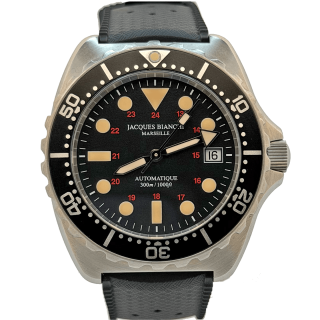
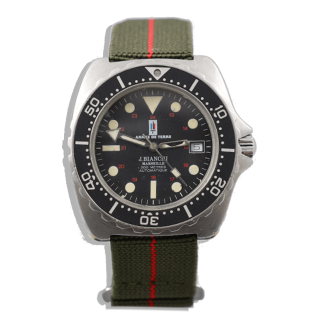
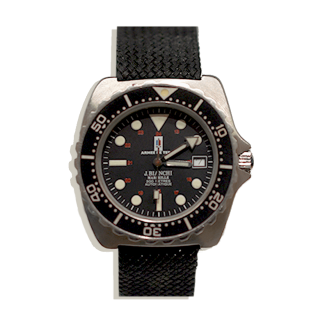
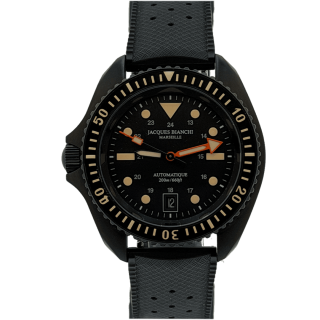
Share this content