Tudor Submariner: History, French Navy References and Collector’s Guide from the 7922 to the 79190
From the 1954 Tudor Submariner 7922 to the final 79190: history, Snowflake, French Navy, 7928, 9401, ETA calibres, authentication, value, restoration and the Mostra guide to buying and collecting a vintage Tudor Submariner.
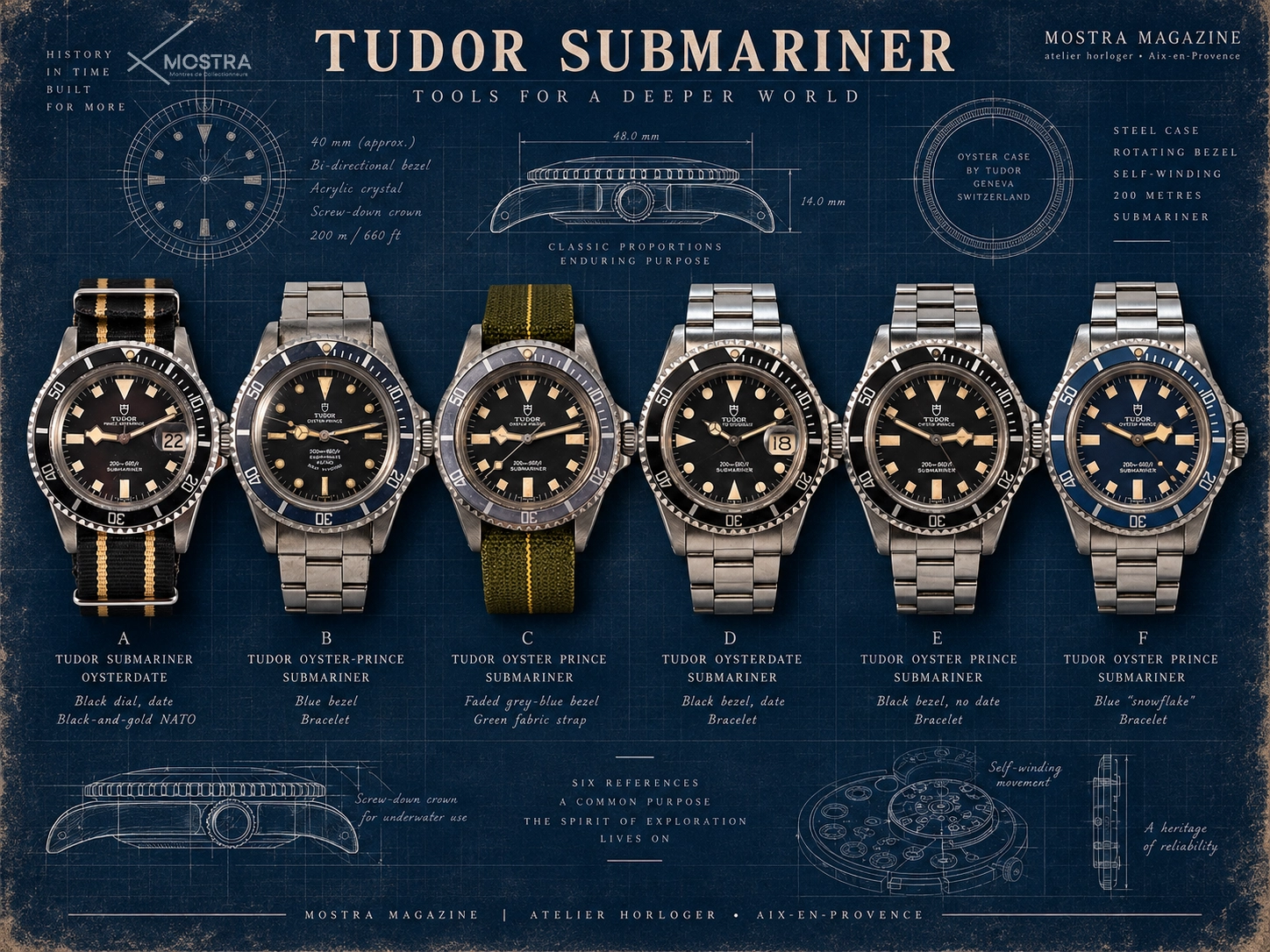
Tudor Submariner: history, references and collector’s guide from the 7922 to the 79190
From the first Tudor Oyster Prince Submariner of 1954 to the French Navy Snowflakes and the final 79190: forty-five years of another history of the diving watch.
The Tudor Submariner is often presented as the more accessible sister of the Rolex Submariner. That definition helps explain its origins, but it quickly becomes insufficient. Between 1954 and 1999, Tudor developed a genuine lineage of professional diving watches, used several successive movement families, built an instantly recognisable visual identity around the Snowflake hands and wrote a remarkable operational history with the French Navy and other military users.
For today’s collector, the difficulty is therefore no longer simply recognising a Tudor Submariner. It lies in determining which reference, which dial generation, which movement, which components, which provenance and which level of preservation are actually in front of you.
By Thierry Serna and Jean-Baptiste Contini
Historical, heritage and market analysis: Thierry Serna
Technical analysis and workshop methodology: Jean-Baptiste Contini
MOSTRA ESSENTIALS — FOR READERS IN A HURRY
The Tudor Submariner in two minutes
The first Tudor Oyster Prince Submariner reference 7922 appeared in 1954. It adopted the Oyster case principle, used crowns, bracelets or components still linked to Rolex depending on the generation, but received its own movement strategy and gradually developed a distinct identity.
Four major periods structure its history. 1954–1968 covers references 7922, 7923, 7924 and especially 7928. From 1969, the 7016 and 7021 introduced square hour markers, Snowflake hands and ETA movements. From the mid-1970s, the 9401/0 and 9411/0 firmly established this identity, particularly within military issue. From the end of the 1980s, the 79090 and then 79190 returned to a more classical design before the Submariner line disappeared in 1999.
Military history is fundamental. Tudor watches were evaluated by the G.E.R.S. in Toulon from 1956. The French Navy subsequently used several generations and, from 1974, some watches received the famous M.N. engravings followed by the year of issue. The blue 9401 Snowflake would become one of the most emblematic military Tudors.
Even so, an engraving, a tropical dial or a pair of Snowflake hands is never enough to determine the quality of a watch. Reference, serial number, dial, hands, bezel, crown, case, movement, bracelet, markings and provenance must tell a coherent story.
The useful question is therefore not merely “Is this a genuine Tudor Submariner?”, but “Exactly which Tudor Submariner is it, from which period, with which components and in what state of preservation?”
Understand the four generations | See the 12 Mostra checks | Discover Tudor watches available from Mostra

The Tudor Submariner in four major generations
Almost half a century of production becomes much easier to understand when the references are grouped around four major stages. Behind the dial, bezel, movement and military-issue variations, the evolution follows a clear logic: the birth of the Oyster diver, the appearance of the Snowflake identity, the maturity of the military ETA generations, and finally the modernised last generation.
| Major era | Period | Key references | Movements | What to remember |
|---|---|---|---|---|
| First generation | 1954–1968 | 7922, 7923, 7924, 7928 | 390 / ETA 1182 | Birth of the Tudor diver, Big Crown and development of crown guards |
| Birth of the Snowflake | From 1969 | 7016 / 7021 | ETA 2483 / 2484 | Tudor shield, square markers, Snowflake hands and date on the 7021 |
| Military and ETA maturity | Mid-1970s–1980s | 9401/0, 9411/0, 76100 | ETA 2776 / 2784 / 2824-2 | Tudor blue, French Navy, Snowflake and transition towards more modern mechanics |
| Final generation | 1989–1999 | 79090 / 79190 | ETA 2824-2 | Return to a more classical aesthetic, followed by sapphire and a unidirectional bezel |
If you remember only one chronology, remember this one: 7922 → 7924 → 7928 → Snowflake 7016/7021 → 9401/9411 → 76100 → 79090 → 79190.
IN THIS ARTICLE
Understanding the origins
Hans Wilsdorf’s vision: a Tudor is not simply a cheaper Rolex
1954: reference 7922, the true starting point
1955: 7923, the unusual manual-wind Submariner
1958: 7924 Big Crown and 200 metres
1959–1967: 7928 and the definitive silhouette
Tropical: when ageing becomes a collecting characteristic
French Navy and military history
1956: the French Navy enters Tudor history
A French Navy Tudor is not defined only by “M.N.”
1969: the Snowflake gives Tudor a face of its own
7016 and 7021: the mechanical break with calibre 390
Was the Snowflake created for the French Navy?
9401/0: the emblematic French Navy Tudor
9411/0: the Snowflake with date
Military straps and the NATO question
The other military story: Tudor and the US Navy
The final generations
76100: the little-known transition of the 1980s
1989: 79090, return to classical codes
1995: 79190, the last Tudor Submariner
What about the Mini-Submariners?
The main Tudor Submariner references at a glance
Understanding and authenticating a Tudor Submariner
Tudor Submariner versus Rolex Submariner
Recognising a Tudor is easy; understanding which one you are looking at is harder
Why Snowflakes require particular expertise
Original dial, Tudor service dial or restored dial
Is a French Navy Tudor necessarily more interesting?
The 8 mistakes to avoid before buying
The 12 Mostra checks
Wearing, restoring and collecting
Can you still dive with a vintage Tudor Submariner?
Before restoring a Snowflake
Which Tudor Submariner should you choose today?
What really determines the value of a Tudor Submariner?
The Tudor Submariner market: rarity, provenance and quality
Is the Tudor Submariner an investment?
Mostra, expertise and the pre-owned market
The end of the Submariner did not erase its DNA
Why buy a vintage Tudor Submariner from Mostra?
Having a Tudor Submariner appraised, maintained or sold
Explore further: Mostra dossiers related to the Tudor Submariner
Tudor Submariner FAQ
A cheaper Tudor than a Rolex? Hans Wilsdorf’s vision is more subtle
Tudor history begins before the Submariner. From the 1920s, Hans Wilsdorf sought to offer a watch capable of delivering a high level of reliability and quality while remaining more accessible than Rolex. The Tudor name appeared during the 1920s, came under Wilsdorf’s direct control in the 1930s and Montres Tudor S.A. was established in 1946.
This organisation explains part of the construction of the earliest Tudors. Rolex contributed its experience of Oyster water resistance, distribution and servicing, while Tudor followed a different movement strategy that made it possible to contain costs without abandoning the idea of a robust and reliable watch.
When the Tudor Submariner appeared, the relationship was therefore genuine. Certain crowns, bracelets and components could bear the Rolex name. But this relationship does not mean that Tudors were downgraded Rolex watches or simply reconditioned products.
The formula is far more interesting: a technical architecture shared in certain areas, different movements and, progressively, an identity of its own.
This evolution is precisely what makes the Tudor Submariner so compelling for collectors. Reference after reference, it allows us to observe the moment when a watch born within the Oyster universe becomes an object whose visual codes will eventually identify Tudor itself.
1954: Tudor Oyster Prince Submariner 7922, the true starting point

The first Tudor diving watch in the Submariner lineage appeared in 1954 as reference 7922. Its architecture was already remarkably coherent: Oyster case with screw-down caseback and crown, highly legible black dial, large luminous hour markers, graduated rotating bezel and domed acrylic crystal.
Its stated water resistance was initially 100 metres.
The watch used the Tudor automatic calibre 390, developed on a Fleurier base and running at approximately 18,000 vibrations per hour. The screw-down crown and Oyster bracelet on certain configurations still carried Rolex signatures.
This detail is fundamental when authenticating early Tudors. Finding a Rolex-signed crown or bracelet on a Tudor Submariner of this period is not necessarily inconsistent. Depending on reference and year, it may be exactly what should be present.
The difficulty is therefore not to apply to 1950s Tudors the visual and industrial separation that would characterise the two brands much later.
1955: 7923, the unusual and rare manual-wind Submariner
Reference 7923 occupies an almost experimental place in the chronology. Unlike the other major historical Tudor Submariner generations, it uses a manual-wind ETA 1182 movement, also running at approximately 18,000 vibrations per hour.
The absence of a rotor allows for a relatively thin watch and naturally alters the presentation of the dial. Wording associated with automatic winding disappears, while stated water resistance remains 100 metres.
This reference above all reminds us that, in the mid-1950s, the Tudor Submariner formula was not yet fixed. Tudor explored several solutions before stabilising the architecture that would dominate the following decades.
For collectors, the 7923 now belongs among the most unusual references in the family. Its rarity demands extreme caution: dial, movement, case, crown, hands and bezel must be studied together.
1958: the 7924 Big Crown takes the Tudor Submariner to 200 metres

With the 7924 of 1958, Tudor crossed an important threshold. The case was strengthened, the crystal became more robust and stated water resistance increased from 100 to 200 metres.
The watch is now nicknamed the Big Crown because of its large screw-down crown measuring approximately 8 mm. The case, around 37 mm in diameter, retained the absence of crown guards that gives this generation an instantly recognisable silhouette.
The movement remained calibre 390.
The combination of a large crown, relatively compact case, black dial and unprotected bezel architecture creates an aesthetic that is now highly sought after.
But the Big Crown nickname should never be enough to justify a purchase. On a reference this old, the crown itself, dial, insert, case and luminous components may have been replaced or restored over the decades.
1959–1967: reference 7928 searches for, then finds, the definitive silhouette

The 7928 is probably one of the most important references in the entire history of the Tudor Submariner.
From 1959, the first crown guards appeared. Collectors now distinguish several forms, including the earliest Square Crown Guards, followed by Pointed Crown Guards, before more rounded guards were adopted during the 1960s.
The diameter moved closer to 39 mm, water resistance remained rated at 200 metres and the automatic calibre 390 continued to power the watch.
This evolution is particularly interesting because it shows how a single reference can contain several visually very different generations. A 1959 7928 with square crown guards and a later 7928 do not occupy exactly the same place in a collection even if the reference number engraved between the lugs remains identical.
By the end of the 1960s, the Tudor Submariner had almost found the overall architecture that would provide the basis for the next generation.
Tropical: when ageing becomes a collecting characteristic

Certain early dials and bezel inserts can change colour over time under the effect of light, heat, humidity or their own chemical composition.
The term Tropical is now used for certain natural evolutions towards brown, chocolate or warmer tones. On a beautiful vintage Tudor, this transformation can give the watch remarkable personality.
But the term requires the same caution as “Patrizzi” on a Daytona.
Not every brown dial is automatically a desirable tropical dial. Deterioration caused by moisture ingress, corrosion, failing lacquer or human intervention does not carry the same significance.
Patina is interesting only when it remains coherent with the material history of the watch.

1956: when the French Navy enters Tudor history
The relationship between Tudor and the French Navy is one of the most important chapters in the history of the brand.
At the beginning of 1956, the Groupement d’Études et de Recherches Sous-Marines, the G.E.R.S. based in Toulon, received Tudor Submariner references including the 7922 and 7923 for evaluation.
Early feedback confirmed the watch’s potential as a diving instrument. The search for greater water resistance then accompanied the arrival of the 7924 rated to 200 metres, while reference 7928 was subsequently used in different operational contexts.
This history profoundly changes the way the Tudor Submariner should be viewed. It is no longer merely a commercial variation of an Oyster architecture: it becomes a tool watch genuinely tested and used by professional divers.
The French Navy would remain associated with several generations of Tudor, contributing strongly to the modern image of the brand among collectors.
A French Navy Tudor is not defined only by “M.N.”

Military use and the presence of military engraving must be distinguished.
Tudor Submariners were used by the French Navy from the 1950s, long before the appearance of the famous caseback markings.
From 1974, certain watches received the initials M.N. followed by the year of issue. Markings such as M.N. 75 or M.N. 76 have become extremely familiar to collectors.
But an engraving can be reproduced.
The presence of two letters and a year is therefore never enough to establish provenance. Font, depth, position, caseback, reference, serial number, production period, dial, movement and, where possible, documentation must converge.
On a military watch, an engraving is a clue. Provenance comes from the convergence of clues.
This methodology follows the same logic developed in Mostra’s other historical dossiers devoted to issued watches and the French Navy.
1969: the Snowflake finally gives Tudor a face of its own
In 1969, the history of the Tudor Submariner changed radically.
The new 7016 and 7021 references gradually moved away from the visual vocabulary directly associated with the earliest Submariners. The hour markers became square and the hands adopted large angular luminous surfaces that collectors would later nickname Snowflake.
The logo also evolved: the Tudor shield took the place it would retain for decades.
The change was not merely aesthetic. The large luminous areas of the hands and markers improved legibility in darkness, an essential quality for a genuine diving watch.
This is probably the moment when the Tudor Submariner became instantly recognisable without the observer needing to read the brand name on the dial.
The Snowflake would later move beyond the Submariner line itself. It became one of the most enduring signs of Tudor identity and would reappear decades later within the Black Bay and Pelagos families.
7016 and 7021: the mechanical break with calibre 390

The change of dial was accompanied by an important mechanical transformation.
The no-date 7016 received the automatic ETA 2483, while the date-equipped 7021 used the ETA 2484. The 7021 added a date window at 3 o’clock and a Cyclops magnifier.
Tudor therefore moved away from the 390 movement family used in several previous generations and adopted robust, rational and widely proven ETA movements.
The case nevertheless retained the Oyster principle and various external components could still carry a Rolex signature depending on period.
The Tudor Submariner paradox now appeared in all its richness: a case architecture rooted in the Oyster universe, an ETA movement and a Snowflake face that was now deeply Tudor.
Was the Snowflake created for the French Navy?
The claim is often repeated in an overly simplified form.
The Snowflake clearly follows a functional logic. The increased luminous surface of the hands and hour markers improves legibility, a quality particularly relevant to professional and military divers.
The association between Snowflake and the French Navy is therefore historically very strong.
But that does not necessarily mean that the French Navy itself designed the hands or specifically commissioned that exact shape.
The most rigorous formulation is to consider the Snowflake as a Tudor development whose functional qualities matched the needs of professional divers particularly well and which became inseparable from the military history of the brand.
This nuance does not reduce the importance of the story. It simply makes it stronger.
9401/0: probably the most emblematic French Navy Tudor

From the mid-1970s, the 9401/0 gradually succeeded the previous generations.
It received the automatic ETA 2776, bringing among other things a more modern frequency and a hacking-seconds function that allowed more precise time setting.
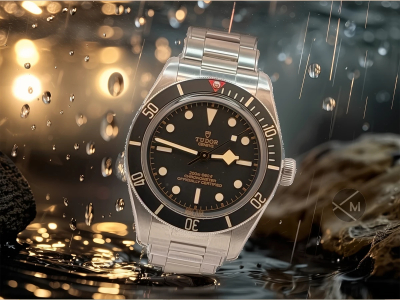
Several dial and bezel combinations existed. Blue took on particular importance and produced one of the most emblematic images of the Tudor Submariner.
The blue 9401 Snowflake became closely associated with the French Navy. Some casebacks carried the initials M.N. followed by the year of issue.
This watch almost single-handedly brings together several elements that have now become characteristic of Tudor: blue, Snowflake, robustness, diving and French military history.
For collectors, it is also a reference that requires great caution. The strong desirability of military examples naturally increases the appeal of false markings, assembled watches and restorations designed to create a more seductive history than the watch truly possesses.
9411/0: the Snowflake with date
The 9411/0 extends the same philosophy by adding the date.
It primarily uses the automatic ETA 2784, paired with a date window at 3 o’clock and a Cyclops magnifier. Black and blue dials offer several collecting configurations.
For some enthusiasts, the no-date version offers superior visual purity. For others, the date and Cyclops are part of the very particular charm of 1970s and 1980s Tudor Submariners.
The current market does not settle this question absolutely. Condition, originality and provenance often matter more than the simple choice between date and no-date.
Military straps: why a modern NATO can tell a false story
Military watches introduce another difficulty: the difference between commercial configuration, issue configuration and the configuration actually used in the field.
Certain Tudors intended for the French Navy were used on textile straps, including nylon straps and various improvised systems adapted by divers.
The metal bracelet was not necessarily the central element of military issue.
This history has naturally led many contemporary collectors to wear their French Navy Tudors on NATO or similar straps.
That choice can be aesthetically and historically coherent.
It never constitutes proof of provenance.
A modern strap can evoke the spirit of the watch. It cannot prove its history.
The other military story: Tudor and the US Navy
The French Navy occupies a central place in the Tudor imagination, but the military history of the Submariner extends far beyond France.
Tudor Submariner references appear in documentation associated with American military divers. The 7928 is notably linked to the world of the Underwater Demolition Teams, while references 7016, 7021 and later generations are documented within the environment of the US Navy.
This provenance is often more difficult to establish than that of a French M.N. watch. American examples do not necessarily carry an immediately identifiable standardised military marking.
The absence of an engraving does not therefore automatically mean the absence of military history.
But the absence of a marking makes documentation, provenance and chronological coherence even more important.
76100: the little-known transition of the 1980s

Reference 76100 represents one of the most interesting transitions in Tudor history.
It uses the automatic ETA 2824-2, features a date and appeared in several visual configurations. Some examples are notably known with an hour hand nicknamed Lollipop.
The 76100 sits between the classic Snowflake universe and the more conventional 79090 generation.
It also has a military dimension, with references from this family appearing in procurement documentation linked to the US Navy.
Its modern appeal comes precisely from this intermediate position. It is less immediately iconic than a blue 9401, but it tells an important mechanical and aesthetic transition.
1989: 79090, a return to the classical Submariner codes
In 1989, reference 79090 introduced a visually more classical phase.
Snowflake hands disappeared in favour of a design more directly related to traditional Submariner codes. Dials were available notably in black or blue with matching bezels.
The case remained around 39 mm and stated water resistance stayed at 200 metres.
The movement was the ETA 2824-2, robust and widely proven.
The 79090 occupies an interesting position on today’s market. It retains the acrylic crystal and spirit of earlier Tudors while using a more modern mechanical architecture that is simpler to maintain than the earliest generations.
It can therefore be an excellent entry into the Tudor Submariner universe for a collector who genuinely intends to wear the watch.
1995: 79190, the last Tudor Submariner

The 79190 entered the catalogue in the mid-1990s and represents the final major reference of the historic line.
It introduced several important developments: sapphire crystal, metal-surrounded hour markers and a unidirectional rotating bezel. The date remained associated with the Cyclops and the movement belonged to the ETA 2824-2 family.
Black or blue dials retained a familiar aesthetic, but the overall feel became more contemporary.
The Tudor Submariner line disappeared from the catalogue in 1999.
The 79190 therefore has a particular significance. It is not necessarily the rarest or most spectacular reference, but it represents the last Tudor to officially carry the Submariner name.
What about the Mini-Submariners?
Tudor Submariner history is not limited to cases around 39 mm.
Tudor also developed smaller-diameter versions, often grouped today under the Mini-Sub name or within intermediate families.
These watches remind us that Tudor did not always conceive the diving watch only as a large men’s watch. Several diameters coexisted and certain compact references now enjoy renewed interest as smaller watches return to favour.
They nevertheless form a side branch of the history. To understand the construction of the professional Tudor Submariner, references 7922, 7924, 7928, 7016, 7021, 9401, 9411, 76100, 79090 and 79190 remain the main landmarks.
The main Tudor Submariner references at a glance
| Reference | Key period | Calibre | Date | Crystal | Stated water resistance | Collector landmark |
|---|---|---|---|---|---|---|
| 7922 | 1954 | 390 | No | Acrylic | 100 m | First Tudor Submariner |
| 7923 | 1955 | ETA 1182 | No | Acrylic | 100 m | Rare manual-wind version |
| 7924 | 1958 | 390 | No | Acrylic | 200 m | 8 mm Big Crown |
| 7928 | 1959–late 1960s | 390 | No | Acrylic | 200 m | Evolution of the Crown Guards |
| 7016 | From 1969 | ETA 2483 | No | Acrylic | 200 m | First Snowflake generation |
| 7021 | From 1969 | ETA 2484 | Yes | Acrylic with Cyclops | 200 m | Snowflake Date |
| 9401/0 / 94010 | Mid-1970s–1980s | ETA 2776 | No | Acrylic | 200 m | Tudor blue, French Navy |
| 9411/0 / 94110 | 1970s–1980s | ETA 2784 | Yes | Acrylic with Cyclops | 200 m | Snowflake Date |
| 76100 | 1980s | ETA 2824-2 | Yes | Acrylic | 200 m | Transition, Lollipop hand on certain versions |
| 79090 | From 1989 | ETA 2824-2 | Yes | Acrylic with Cyclops | 200 m | Return to classical design |
| 79190 | 1995–1999 | ETA 2824-2 | Yes | Sapphire with Cyclops | 200 m | Last Tudor Submariner |
The periods are deliberately presented as guidelines. References, dials, bracelets, movements and service components may overlap depending on year. A date in a table should never be used on its own to authenticate a Tudor Submariner.
Tudor Submariner versus Rolex Submariner: shared roots, two different histories
Comparing the two families is inevitable.
The earliest Tudors genuinely used several elements from the Rolex Oyster universe. Cases, crowns and bracelets may carry a Rolex signature while Tudor followed another strategy for its movements.
From 1969, however, the histories diverged much more clearly.
Rolex continued the evolution of its own Submariner through references 5512, 5513, 1680 and then the sapphire generations. Tudor simultaneously introduced the Snowflake, blue, ETA movements and a military history that became extremely visible.
From that moment, reducing Tudor to the role of economical Rolex becomes particularly limiting.
The Rolex Submariner and Tudor Submariner share a genealogy. They no longer tell exactly the same story.
To follow the parallel branch, see our dossier Rolex Submariner: history, references and collector’s guide.
Recognising a Tudor Submariner takes a few seconds. Understanding which one you are looking at can take much longer.
The silhouette of a Tudor Submariner is easy to recognise. The real work begins afterwards.
A 7928 with Square Crown Guards and a later 7928 may carry the same reference while belonging to two different collecting categories.
A civilian 7016 and a 7016 linked to the French Navy may share much of their architecture but not their provenance.
A blue Snowflake 9401, a black version or a later configuration may represent different moments in production.
A 79090 and a 79190 may look very similar in a photograph, while their crystal, bezel and chronological position clearly separate them.
The reference defines the family. The dial, hands, crown, case, movement, markings, bracelet and history define the identity of the individual watch.

Snowflake dials: why they require particular expertise
Snowflakes have become the most immediately recognisable Tudor Submariners.
They are also among the most complex to buy correctly.
The collector must examine dial generation, colour, typography, square hour markers, luminous material, Snowflake hands, their tone, bezel insert, case and movement.
Perfect chromatic matching is not necessarily an advantage. A fifty-year-old watch may show slightly different ageing between dial and hands.
Conversely, spectacular patina proves nothing by itself.
The objective is therefore not to find the watch that looks oldest, but the one whose different elements have aged in a manner compatible with its history.
Original dial, Tudor service dial and restored dial: three different realities
This distinction is fundamental in the Tudor Submariner market.
An original dial corresponds to the watch’s production configuration.
A Tudor service dial can be completely genuine while belonging to a later generation. It may have been installed during servicing to replace a damaged dial.
A restored, repainted or aftermarket dial belongs to another category.
In all three cases, the watch can tell the time and be mechanically healthy.
Its heritage interest and collector value can nevertheless be profoundly different.
The same reasoning must be applied to the hands, bezel insert, crown, bracelet and sometimes the caseback.
Is a French Navy Tudor necessarily more interesting than a civilian Tudor?
No.
An authentic and properly documented French Navy Tudor possesses exceptional historical significance. But a doubtful engraving, manufactured provenance or incoherent configuration can make a supposed M.N. less interesting than an excellent civilian watch.
Conversely, a superb civilian 7928 with a beautiful dial, lightly polished case, coherent movement and period-correct components can be an outstanding collector’s piece.
The market naturally values military provenance.
Expertise must first demonstrate that provenance before assigning it a premium.
BUYING A VINTAGE TUDOR SUBMARINER: 8 MISTAKES TO AVOID
1. Buying the word Snowflake before buying the watch.
A square hand or blue dial is never enough to establish the quality of the individual example.
2. Treating an M.N. engraving as stand-alone proof.
An engraving can be reproduced. Coherent provenance is much harder to reproduce.
3. Automatically rejecting a Rolex crown because the watch is a Tudor.
On certain generations, a Rolex-signed crown or bracelet is exactly what is historically coherent.
4. Confusing patina with deterioration.
A naturally tropical dial is not synonymous with moisture, corrosion or restoration.
5. Trying to make a fifty-year-old Snowflake look new.
Irreversible polishing or cosmetic replacement can remove part of its heritage interest.
6. Buying from the year alone.
References and configurations overlap. Serial number, dial, movement and components must always be compared.
7. Neglecting the movement because it is an ETA.
A robust movement can still have suffered decades of wear, poor servicing or unsuitable replacement parts.
8. Believing that a NATO strap proves military origin.
The way a watch is worn today can never demonstrate its issue history.
The twelve Mostra checks before buying a Tudor Submariner
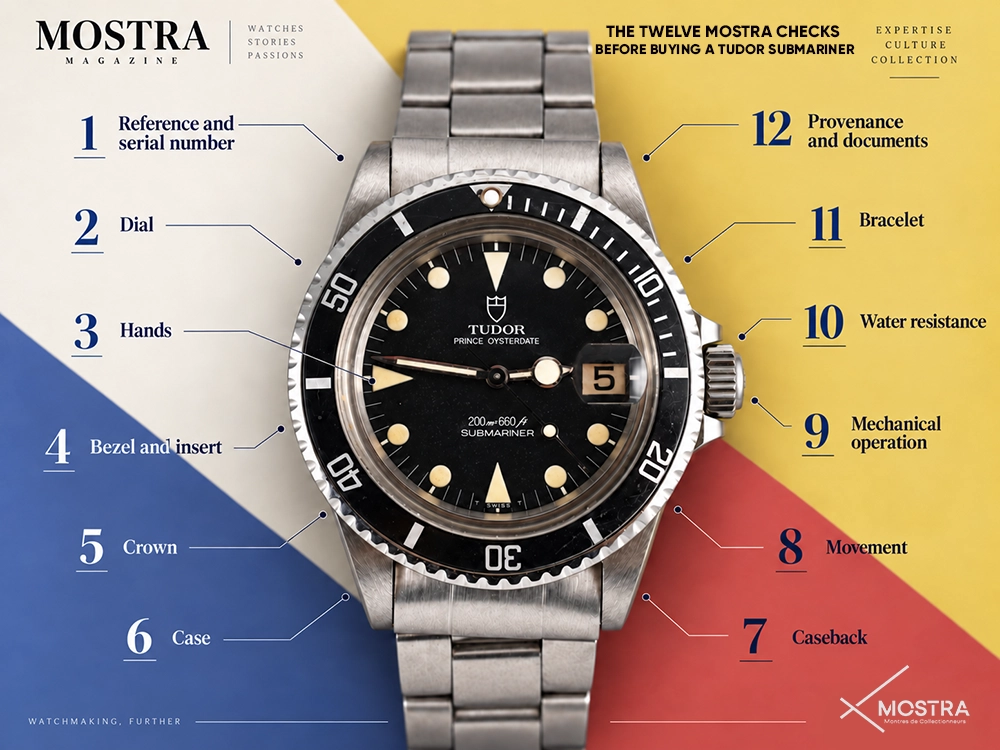
1. Reference and serial number: precisely identify the generation and verify chronological coherence.
2. Dial: check typography, rose or shield logo, stated depth rating, luminous material, condition and any restoration.
3. Hands: verify their type — Mercedes, baton, Snowflake, Lollipop or later configuration — together with luminous material.
4. Bezel and insert: identify generation, graduation, ageing, rotation and any replacement.
5. Crown: Tudor or Rolex depending on period, dimensions, screw-down action, tube and coherence with the case.
6. Case: examine numbers, lugs, shoulders, volumes, edges and traces of polishing.
7. Caseback: check internal references, signatures and any military markings.
8. Movement: identify 390, ETA 1182, 2483, 2484, 2776, 2784 or 2824-2 according to reference.
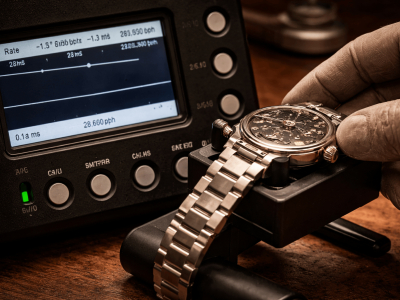
9. Mechanical operation: rate, winding, date change and hacking seconds when these functions are present.
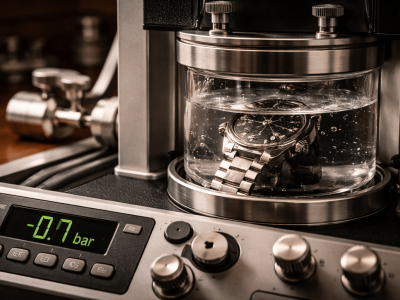
10. Water resistance: measure actual condition rather than infer current capability from the historical 100- or 200-metre marking.
11. Bracelet: check Rolex or Tudor signature depending on period, reference, end links, play and security.
12. Provenance and documents: particularly important when the watch is presented as military or associated with a specific unit.
This method makes it possible to move beyond a simplistic vision in which a Tudor is merely “genuine” or “fake”. A watch can be authentic with a service dial. It can be highly original while requiring major mechanical servicing. It can carry a genuine old engraving without having enough documented provenance to justify every commercial conclusion someone might wish to attach to it.
The quality of a Tudor Submariner comes from the balance between authenticity, historical coherence, preservation, mechanics and provenance.
Can you still dive with a vintage Tudor Submariner?
Historically, yes: these watches were designed and used as genuine diving instruments.
But a 1970s 9401 is now approaching half a century old and a 7928 can be more than sixty years old.
The “200 m” inscription therefore describes the historical specification of the watch, not automatically its present water resistance.
Gaskets, crown tube, caseback, crystal and crown age. A case may also have been polished, opened or modified several times.
Before any immersion, a vintage Tudor Submariner must be tested.
On particularly rare, military or historically important pieces, the most rational decision may even be not to immerse them any longer and to reserve diving for a modern watch.
Before restoring a Snowflake: understand what you may be removing
BEFORE ERASING A MARK, YOU NEED TO KNOW WHAT IT IS TELLING YOU
Luminous material that has turned ivory, a slightly faded bezel insert, a few scratches or a variation in colour are not necessarily defects that need correcting.
On a collectible Tudor, irreversible cosmetic intervention can remove precisely what allowed its age and preservation to be read.
Restoration must distinguish what is simply old from what genuinely threatens the operation or long-term preservation of the watch.
Stable tritium does not need replacing because it no longer glows. A small scratch does not automatically require polishing. A faded insert may be historically more interesting than a new service insert.
The mechanics follow a different logic. A worn component, tired spring, dried gasket or damaged wheel should be treated when reliability requires it.
Preserving a vintage Tudor therefore does not mean refusing maintenance. It means intervening with discernment.
Which Tudor Submariner should you choose today?
For the collector of the earliest period
The 7922, 7923 and 7924 represent the birth of the lineage. They offer the strongest historical connection to the earliest years of the Tudor diver, but they also require the highest level of expertise.
For someone looking for the great classical vintage architecture
The 7928 is probably one of the most fascinating references. Its different crown-guard shapes allow a true chronology to be built within a single reference.
For someone who wants the strongest Tudor identity
The 7016, 7021, 9401 and 9411 Snowflakes represent the visual heart of the Tudor Submariner. They are instantly recognisable and form the point at which the brand develops its own language.
For the military collector
A properly documented blue 9401 M.N. naturally belongs among the most emblematic configurations. But the quality of provenance remains more important than the engraving alone.
For entering vintage Tudor with a watch that is easier to wear
The 76100 and 79090 offer an excellent compromise between history, the ETA 2824-2 movement, restrained dimensions and the possibility of regular use.
For someone looking for the end of the lineage
The 79190 brings sapphire and a unidirectional bezel while retaining the Submariner name. Its position as the final historical generation gives it particular significance.
The best Tudor Submariner is not necessarily the rarest. It is the one whose generation, configuration, condition and level of documentation match the collector’s project.
What really determines the value of a Tudor Submariner?
Two Tudor Submariners carrying the same reference can have very different values.
The reference forms the first level of interpretation, but it is not enough. An early 7928 with unusual crown guards is not valued in the same way as a much later 7928. A civilian 9401 and a documented French Navy 9401 do not follow exactly the same logic.
The dial is then one of the essential criteria. Its type, luminous material, patina, condition and chronological conformity can strongly affect the interest of the watch.
The case also plays a major role. Thick lugs, visible edges and well-preserved volumes tell a different story from a watch that has undergone several heavy polishes.
On a military piece, provenance can become decisive. Solid documentation, coherent history and compatible markings can create heritage value that the reference alone cannot explain.
Finally come the movement, bezel, crown, bracelet, service parts and documents.
To explore this methodology in greater depth, see our dossier What Is My Watch Really Worth? The Twelve Criteria That Determine Its Value.
The Tudor Submariner market: rarity, provenance and quality
The Tudor Submariner market is more fragmented than it may appear.
The earliest references follow a logic of historical rarity. Snowflakes benefit from strong visual recognition. French Navy watches add the question of provenance. The 79090 and 79190 occupy a more accessible territory closer to neo-vintage collecting.
There is therefore no single “Tudor Submariner price”.
A rare but restored watch may be less interesting than a more common example in exceptional original condition. A supposed military provenance that is poorly demonstrated may be less attractive than an irreproachable civilian watch.
The market often rewards rarity, but it increasingly rewards the real quality of the individual watch and the ability to document what is being claimed.
Is the Tudor Submariner an investment?
The question deserves the same caution as with a Rolex Submariner or Daytona.
A 7924 Big Crown, a 9401 M.N., a civilian 79090 and a 79190 do not belong to one single market. They do not attract exactly the same buyers and their rarity does not depend on the same criteria.
On older references, value depends heavily on the configuration, originality of the dial, preservation of the case, coherence of the components and provenance.
A genuinely rare and very well-preserved piece can follow a long-term heritage logic because the population of truly comparable examples cannot increase.
But no future increase in value can be guaranteed.
Price remains subject to supply, demand, economic conditions and changing collector tastes.
At Mostra, we therefore prefer to speak of heritage value rather than return: buying the right reference, in the right configuration, in the right condition and at the right price remains more important than trying to predict the market’s next move.
The end of the Submariner did not erase its DNA
The disappearance of the Submariner name from the Tudor catalogue in 1999 did not mean the disappearance of its history.
The Black Bay and Pelagos families each carry part of that heritage.
The Black Bay brings together several historical Tudor codes without exactly reproducing any one vintage reference. The Pelagos continues more directly the logic of the contemporary professional instrument.
The Pelagos FXD later reinforced Tudor’s connection with its naval history in a particularly visible way.
Most importantly, the Snowflake never really disappeared.
It stopped belonging only to the Tudor Submariner and became one of the most obvious visual signatures of Tudor itself.
Why buy a vintage Tudor Submariner from Mostra?
Buying a vintage Tudor Submariner is not simply a matter of choosing a reference or a dial colour.
It means understanding which watch is actually in front of you.
At Mostra in Aix-en-Provence, the historical and heritage reading of the watch is combined with the technical examination carried out by our workshop.
A 7928, a 9401 Snowflake, a 76100 and a 79090 are not examined according to exactly the same priorities.
On an early Snowflake or military piece, preservation of the dial, hands, bezel, case and markings can take on considerable heritage importance.
On a 79090 or 79190 intended for regular wear, movement condition, crown, date function and actual water resistance also become decisive.
Each Tudor Submariner selected by Mostra is therefore assessed according to its generation, intended use and collecting significance.
When necessary, the watch is checked or serviced by the Mostra watchmaking workshop. Rate, winding, date operation, mechanical condition and water resistance can be verified according to the nature of the piece.
Watches prepared and sold by Mostra benefit from a certificate of authenticity and a three-year warranty, together with follow-up from our workshop.
Discover pre-owned Tudor watches selected by Mostra
Having a Tudor Submariner appraised, maintained or sold
Do you own a 7922, 7928, 7016, 7021, 9401, 9411, 76100, 79090, 79190 or a Tudor Submariner presented as a military watch?
Precise identification is always the first step before a decision involving restoration, insurance, purchase or sale.
Mostra can assist you in identifying the reference, examining dial and hand coherence, checking the movement, distinguishing certain service components, analysing military markings and assessing the overall state of preservation.
When a sale is being considered, these elements help avoid an estimate based only on a reference number or on an auction result for a watch that is not truly comparable.
Discover the Mostra watchmaking workshop
Explore further: Mostra dossiers related to the Tudor Submariner
Understanding a Tudor Submariner often means going beyond the history of the model itself. The relationship with Rolex, military provenance, mechanical condition and pre-owned market value all belong to broader questions.
Rolex Submariner: history, references and collector’s guide
Follow the parallel development of the Rolex branch and understand the points where the two families meet and then diverge.
What Is My Watch Really Worth?
Understand why reference, condition, provenance, coherence, set and market must be studied together.
The Mostra watchmaking workshop
Inspection, diagnosis, maintenance and servicing of modern, vintage and collectible watches in Aix-en-Provence.
Discover pre-owned Tudor watches available from Mostra
Tudor Submariner FAQ: the most frequently asked questions
What is the first Tudor Submariner?
The Tudor Oyster Prince Submariner reference 7922, introduced in 1954. It uses the automatic calibre 390 and was initially rated to 100 metres of water resistance.
Which Tudor Submariner is called the Big Crown?
The 1958 reference 7924, recognisable notably by its large crown of approximately 8 mm and its stated water resistance of 200 metres.
What is a Tudor Snowflake?
The Snowflake nickname refers to Tudor watches equipped with large angular hands and, in their most emblematic configurations, square hour markers introduced from 1969.
Are all Tudor Snowflakes military watches?
No. Snowflakes were also sold on the civilian market. Their design is strongly associated with Tudor’s military history, but it does not constitute proof of military issue.
How can a French Navy Tudor be identified?
No single element is sufficient. Reference, serial number, caseback, engraving style, dial, hands, movement, year and provenance must be studied together.
What does “M.N. 76” mean on a Tudor?
On a coherent watch genuinely linked to French military issue, M.N. refers to the Marine Nationale and the numbers generally indicate the year of issue.
Why do some vintage Tudors carry Rolex parts?
Because several historical generations officially used components from the Oyster universe, including certain Rolex-signed crowns, cases or bracelets. Their presence must nevertheless be coherent with the reference and period.
What is the difference between the Tudor 7016 and 7021?
The 7016 is a no-date watch using the ETA 2483. The 7021 adds a date at 3 o’clock and uses the ETA 2484.
What is the difference between the Tudor 9401 and 9411?
The 9401 is primarily a no-date version using the ETA 2776. The 9411 adds the date and primarily uses the ETA 2784.
What is the last Tudor Submariner?
The 79190, introduced in the mid-1990s and produced until the Submariner line disappeared from the Tudor catalogue in 1999.
Is a French Navy Tudor always worth more than a civilian Tudor?
Not automatically. Authentic and documented military provenance can create a significant premium, but a highly original and perfectly preserved civilian watch can be more interesting than a supposed M.N. watch with uncertain history.
Can you still dive with a vintage Tudor Submariner?
Only after an appropriate water-resistance test. The depth stated on the dial or caseback describes the historical specification of the watch and does not guarantee the current condition of its gaskets, crown or crystal.
Tudor Submariner: when the alternative becomes an independent history
For a long time, the Tudor Submariner was viewed in the shadow of the Rolex Submariner.
That interpretation was understandable.
The two families share Hans Wilsdorf, the Oyster principle, a common silhouette and, for many years, certain components from the same industrial universe.
But forty-five years of evolution eventually tell another story.
The 7923 experiments with manual winding. The 7924 enlarges its crown and reaches 200 metres. The 7928 successively evolves its crown guards. The 7016 and 7021 introduce the Snowflake. Blue 9401 watches accompany the history of the French Navy. The 76100 provides the transition into the 1980s. The 79090 returns to historical codes while the 79190 finally closes the lineage with sapphire.
The Tudor Submariner therefore begins its existence with an obvious Rolex relationship.
It ends it with an equally obvious Tudor identity.
A Tudor Submariner is not merely a historical alternative to the Rolex Submariner. It is one of the places where Tudor gradually learned to become Tudor.
And that is precisely where collecting begins.
These products might interest you


Share this content