What Is My Watch Really Worth? The Twelve Criteria That Determine Its Value on the Pre-Owned Market
A pre-owned watch does not have one single value. Retail price, listing, trade-in, insurance, purchase invoice, taxation, consignment or auction: Mostra explains the twelve criteria that truly determine its value.

By Thierry Serna and Jean-Baptiste Contini
Historical, heritage and market analysis: Thierry Serna
Technical analysis and workshop methodology: Jean-Baptiste Contini
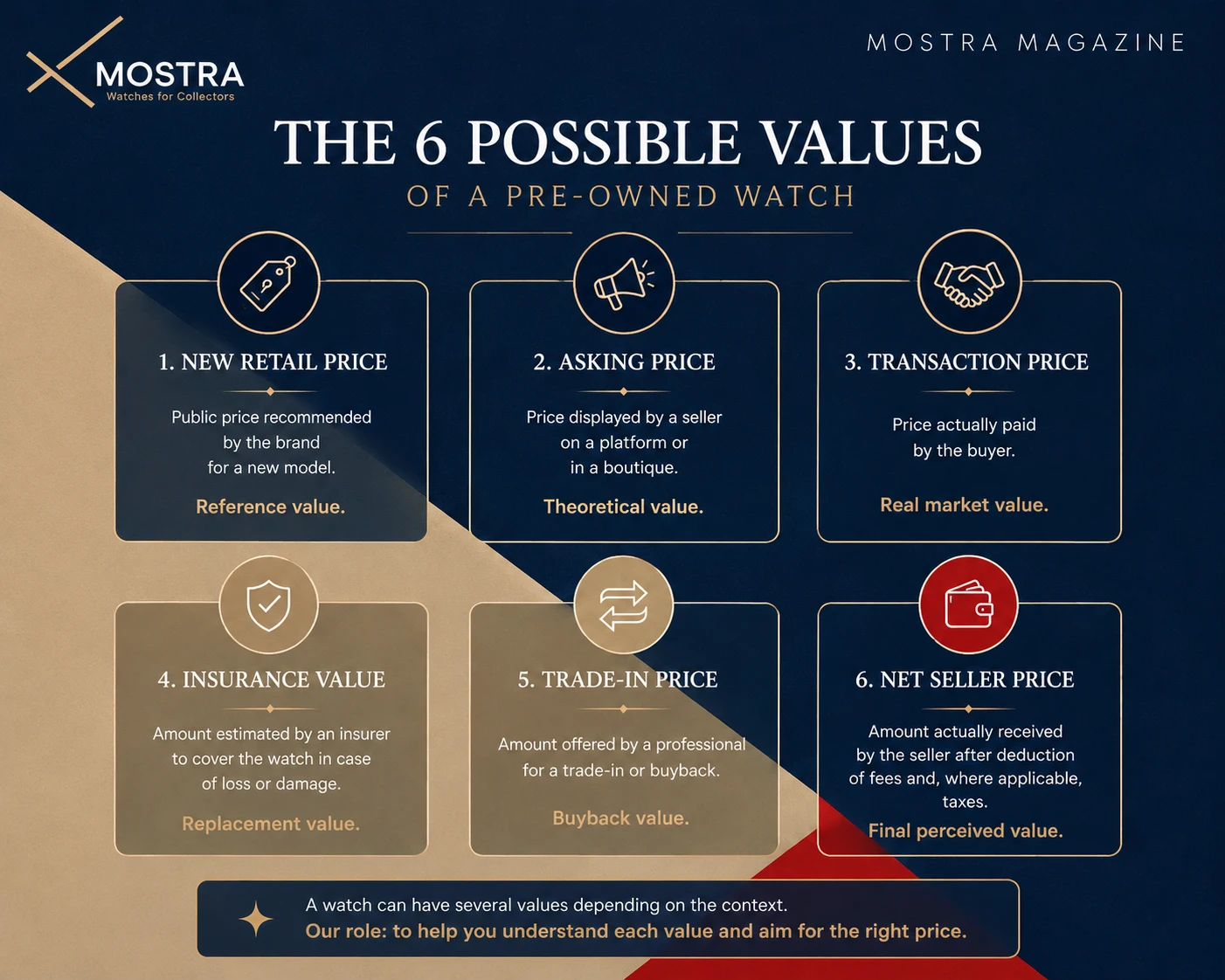
What is my watch really worth? The question seems simple. Yet it never truly is. A pre-owned watch does not have one single value, fixed once and for all like a number engraved into steel. It can have several prices depending on the context in which it is being considered: new retail price, asking price in a listing, price actually achieved in a transaction, appraisal or insurance value, trade-in price offered by a professional, or net amount received after consignment or auction.
This is often where the misunderstanding begins. The owner looks at a platform, sees a high listing, and naturally thinks their watch is worth that amount. The professional looks at something else: the actual watch, its condition, its configuration, its coherence, its documentation, its possible need for servicing, its liquidity and the price at which a transaction can genuinely be concluded. Between the two, it is not a matter of opposing dream and reality. It is simply a matter of distinguishing an advertised price from an achieved value.
At Mostra, the valuation of a watch is built from a complete reading of the object. A collector’s watch is not worth something only because of its brand. It is worth something because of its exact reference, its year, its dial, its hands, its case, its movement, its parts, its documents, its provenance and the real demand of the market. A watch is not reduced to a price guide. It is read, piece by piece, with the eye of the watchmaker, the collector and the market.
The Essential Summary for Readers in a Hurry
Short on time? Remember this first: a pre-owned watch does not have one single value. It can have a new retail price, an advertised price in a listing, a price actually achieved in a sale, an appraisal or insurance value, a professional trade-in price, or a net seller amount after consignment or auction. These figures can be very different, because they do not follow the same logic.
The most visible price is therefore not always the fairest price. An online listing often indicates what a seller hopes to obtain, not what the market has actually paid. Conversely, a serious valuation takes the watch itself into account: its brand, its exact reference, its year, its configuration, its dial, its hands, its case, its movement, its parts, its documents, its provenance and the real liquidity of the market.
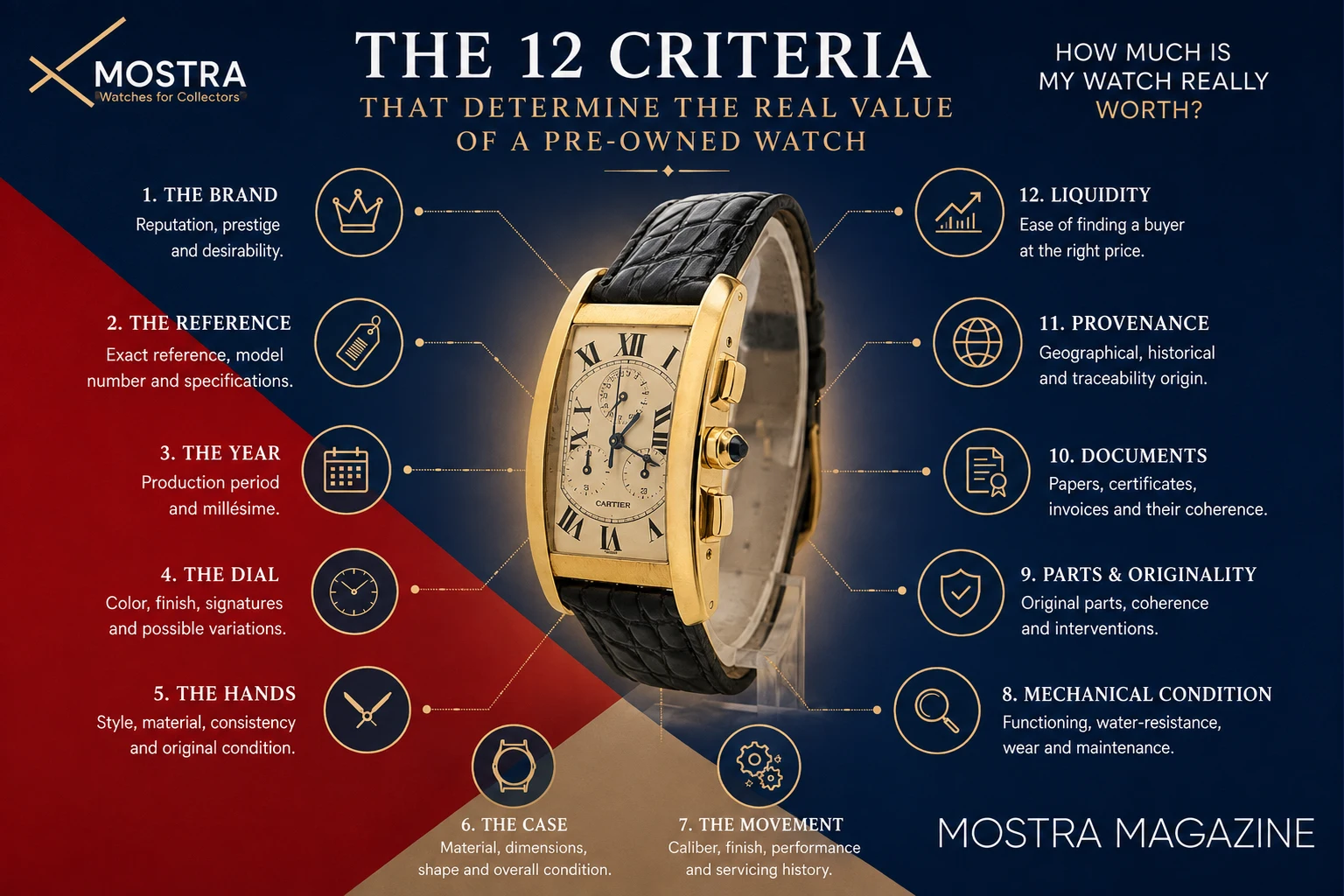
The twelve decisive criteria are: the brand, the model and reference, the year and generation, the material and configuration, the real rarity, the condition of the dial and hands, the case geometry, the mechanical condition, the original or service parts, the box, papers and history, the provenance, then the demand and liquidity of the market.
For professionals, collectors and lovers of detail, the complete article goes further: it explains how to move from a price seen online to a real market value, useful when selling, insuring, passing on, trading in or appraising a collector’s watch.
Need to Value or Sell Your Watch?
Would you like to know the value of your watch, prepare a sale or determine whether an in-depth appraisal is necessary? Mostra can help you distinguish market value, insurance value, professional trade-in price and net seller proceeds.
Have my watch valued and submit it to Mostra | Have my watch appraised
One Watch, Several Values: Why the Same Object Can Have Several Prices
The first mistake is to think that a watch has only one value. In reality, the word “value” changes meaning depending on the situation. A watch one wishes to insure, sell quickly, consign with a professional, present at auction or pass on within a family context is not valued in exactly the same way. The figure may therefore vary without one of the estimates necessarily being wrong.
Retail Price, Market Price, Trade-In or Insurance Value: What Is the Difference?
| Type of value | What does it correspond to? |
|---|---|
| Retail price | The new-watch price set by the brand or its authorised network. |
| Asking price | The amount requested by a seller, with no guarantee that a transaction will take place at that price. |
| Market price | The amount at which genuinely comparable watches actually find a buyer. |
| Insurance value | The value used to document and protect the watch in the event of loss or damage. |
| Professional trade-in price | The amount offered by a professional who then assumes preparation, warranty and resale risk. |
| Net seller proceeds | The amount actually received by the owner after costs and charges associated with the chosen selling method. |
The new retail price corresponds to the official price of a watch when it is sold by the brand or through its distribution network. It is a useful reference point, especially for recent watches, but it is never enough to determine pre-owned value. Some references trade above retail price when they are highly sought-after or difficult to obtain. Others, although excellent from a watchmaking standpoint, suffer a significant discount as soon as they leave the official network.
The asking price in a listing is a price of intention. It reflects what a seller hopes to obtain, not what the market has actually paid. A listing may remain visible for several months because its price is too ambitious. It may also concern a watch that is more complete, better preserved, better documented or simply more desirable than the one being compared. Confusing a listing with an actual transaction often means confusing a shop window with a cash register.
The price actually achieved in a transaction is much more revealing. It is the price at which the watch found a buyer. It includes negotiation, the trust granted to the seller, the quality of the presentation, the level of warranty, possible fees, the selling time and the real condition of the piece. This price, when known and truly comparable, is the best basis for reasoning.
The appraisal or insurance value follows a different logic. It is used to document a watch, protect its owner and set a replacement value in the event of theft, loss or damage. It may be higher than a trade-in offer, because it does not necessarily correspond to the price a professional would agree to pay immediately. It concerns patrimonial protection, not instant liquidity.
When the objective is to document a watch precisely, assess its coherence and establish its value, Mostra also offers a pre-owned and collector’s watch appraisal service.
The trade-in price offered by a professional includes an economic reality. A professional who buys a watch must inspect it, verify its authenticity, sometimes service it, warranty it, insure it, immobilise it, photograph it, present it, bear operating costs and accept the risk of a resale taking longer than expected. This price therefore cannot be identical to the final public price at which the watch will be offered after preparation.
If your objective is to understand the trade-in possibilities for your watch, you can submit your watch to Mostra for an initial valuation.
The net seller amount after consignment or auction is yet another notion. It corresponds to what the owner actually receives once fees, commissions, insurance, possible restoration, selling costs or auction fees have been deducted. A spectacular hammer price may seem attractive at first glance, but the net amount received is not always what one imagined. Conversely, well-managed consignment can sometimes offer an interesting balance between price, security and presentation.
| Type of value | What it means | How it helps the owner | Not to be confused with |
|---|---|---|---|
| Official retail price when new | The official price set by the brand or its authorised retail network. | Compare a recent watch with its original or current retail price. | Its actual value on the pre-owned market. |
| Asking price | The price a seller hopes to obtain on a marketplace or in a boutique. | Observe a market trend without reaching conclusions too quickly. | The price actually paid by a buyer. |
| Transaction price | The amount actually obtained when a sale is completed. | Measure the reality of the market. | A purely theoretical valuation. |
| Appraisal or insurance value | A value established to document or protect the watch. | Insure, pass on, declare or include the watch in a heritage file. | An immediate professional purchase offer. |
| Professional purchase price | A purchase price that takes account of inspection, risk, warranty obligations and future resale. | Sell quickly and securely. | The final public selling price. |
| Net seller proceeds | The amount actually received after any fees, commissions, taxes or auction charges. | Understand what the owner will actually receive. | The hammer price, displayed price or gross selling price. |
The Twelve Criteria That Determine the Real Value of a Pre-Owned Watch
1. The Brand: The First Reference Point, Never the Only One
The brand remains the first signal. It influences trust, desirability, market depth and ease of resale. A pre-owned Rolex, a pre-owned Omega, a pre-owned Cartier, a Jaeger-LeCoultre, a Tudor, an IWC or a Breitling are not received in the same way by buyers. Certain maisons benefit from worldwide recognition, a strong history and steadier demand.
But the brand is never enough. A prestigious signature can appear on a transformed, over-polished, incomplete or less sought-after watch. Conversely, a more discreet house may have produced a rare, historically important or highly desirable piece for a circle of informed collectors. Value often begins with the name written on the dial, but it never stops at that name.
2. The Model and Reference: The Exact Identity of the Watch
Two watches that look alike may have very different values. The exact reference is therefore essential. It identifies the generation, diameter, movement, dial type, bezel, production period, expected bracelet and sometimes the rarity of a particular configuration.
A Speedmaster is not simply a Speedmaster. A Submariner is not merely a Submariner. A Tank, a Reverso, a Seamaster, a Navitimer or a Fifty Fathoms must be placed within their precise reference. A variation in calibre, dial, typography or production period can strongly alter value. The market does not pay for a general idea. It pays for a precise piece, correctly identified.
To understand this logic within an iconic watch family, one can consult the selection of pre-owned Omega Speedmaster watches, where differences in references, periods and movements play an essential role in the perception of value.
3. The Year and Generation: Placing the Watch in Its Time
The year of production or the year of sale makes it possible to place a watch within a technical, aesthetic and historical generation. First series, last series, transition years or configurations produced over a short period may attract greater interest. For modern watches, the year also influences the type of warranty card, the presence of documents, the bracelet reference or the evolution of the movement.
For antique and vintage watches, the year primarily serves to verify coherence. A dial, hands, case and movement must correspond to the announced period. A piece may be authentic without being entirely coherent with its year. This is one of the most important nuances of the market. It is also at the heart of the distinction between antique watches and vintage watches.
4. Material and Configuration: Steel, Gold, Platinum, Dial and Bracelet
The material plays a direct role in value, but not always in an obvious way. Gold may naturally appear more precious than steel, yet certain steel sports watches are more sought-after than their gold equivalents. Yellow gold, rose gold, white gold, platinum or two-tone configurations each answer to a particular demand, depending on the period and the use.
The configuration matters as much as the material. A black, white, blue, champagne, tropical, sector, guilloché, lacquered or gem-set dial does not create the same perception. The original bracelet, bezel, indexes, luminous material, typography and finishing details build the identity of the watch. In certain cases, the configuration represents almost the entire value, especially when the watch exists in several variants that are very unevenly sought-after.
5. Real Rarity: Distinguishing the Rare from the Merely Uncommon
Rarity is one of the most commonly used words in watch listings. It is also one of the most dangerous. A watch may be rarely seen on the market without being truly rare. It may be rare but not very much in demand. It may have been produced in small numbers without creating strong tension among collectors. Conversely, a watch produced in significant quantity may remain highly liquid if it embodies a sought-after aesthetic, function or period.
Real rarity is measured by the combination of several elements: number produced, number preserved, quality of surviving examples, coherence of configurations, historical interest and active demand. Rarity has economic value only when it meets desire. Without demand, it remains information. With strong demand, it becomes a factor of tension.
6. Dial and Hands Condition: The Face of the Watch
The dial is often the soul of a watch. It is what one looks at first. It is also what reveals the most: exposure to light, humidity, earlier interventions, restoration, replacement, natural patina or alteration. A well-preserved original dial can transform the value of a watch. A repainted, replaced or poorly restored dial can, on the contrary, sharply reduce its interest.
The hands must be read with the same attention. Their shape, length, luminous material, colour and ageing must be coherent with the dial and the period of the watch. A homogeneous patina can be more desirable than an artificially rejuvenated ensemble. The collector does not always seek clinical perfection. He seeks coherence, emotion and the truth of use.
This approach echoes the analysis developed in the guide Pre-Owned Watches: Understanding the Real Condition Before Buying, which distinguishes cosmetic appearance from patrimonial and technical reality.
7. Case Geometry: What Polishing Can Reveal or Erase
The case carries the life of the watch. It tells of daily wear, shocks, servicing, restorations and sometimes excessive polishing. On a collector’s watch, case geometry is an essential criterion. The lugs, bevels, edges, flanks, brushed surfaces, shoulders and proportions must preserve, as much as possible, their original design.
An over-polished case can lose a significant part of its value, even if the watch appears shiny at first glance. What the untrained eye sometimes interprets as good condition may be, for a professional, the disappearance of a geometry. An old watch does not need to look new. It must have preserved its material, its balance and its presence.
On an antique, vintage or collector’s watch, any aesthetic intervention should be approached with caution in order to preserve the material, edges and historical coherence of the piece. Read our guidance before intervening on a vintage or antique watch.
8. Mechanical Condition: The Value You Cannot Always See
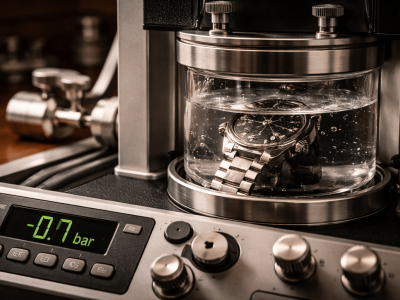
A watch may be attractive in photographs and yet require significant intervention. Mechanical condition must be checked methodically: precision, amplitude, power reserve, winding function, date change, time setting, chronograph start, reset, component wear, movement cleanliness and water-resistance according to the expected use.
This criterion is often poorly taken into account by automatic valuations, because it is not always visible in a listing. Yet a complete service, a search for parts or a restoration can strongly alter the net value of a watch. Conversely, a checked, healthy, coherent and warrantied watch inspires greater confidence. The health record of a pre-owned watch precisely helps make visible what photographs do not always show.
9. Original Parts, Service Parts and Conformity: The Decisive Nuance
The value of a watch also depends on the nature of the parts that compose it. Several notions that are often confused must be distinguished. An authentic part may come from the brand. An original part may designate a factory-fitted part or one coherent with the production period. A service part may be authentic, supplied during maintenance, but later than the initial production. A part may finally be compliant with the technical specification of the watch without being the part historically fitted at origin.
This nuance is crucial. On a recent watch, an authentic and compliant service part may be perfectly acceptable. On a highly sought-after vintage watch, a replaced dial, bezel or set of hands can strongly alter collector interest. It is therefore not enough to ask whether a part is genuine. One must know whether it is coherent with the watch, its period and the patrimonial value one seeks to establish.
10. Box, Papers, Purchase Invoice and History: The Added Confidence
The presence of the box, papers, warranty card, original invoice, booklets, extra links, service documents or archives brings an additional degree of confidence. It makes it possible to better understand the origin of the watch, its journey, its interventions and sometimes its original sale date.
A full set does not automatically transform an average watch into an exceptional piece, but it can make a significant difference on modern, highly sought-after or strongly collected models. For certain references, the gap between a watch alone and a complete watch can be substantial. For others, the condition of the dial, the case geometry or the mechanical coherence will remain more important than the presence of a box with no particular historical value.
Can a watch without papers be sold?
Yes, a watch without papers can be sold. Many antique watches, inherited watches, watches purchased several decades ago or watches long kept within a family no longer have their box or original certificate. The absence of papers does not make a watch unsellable. It simply shifts the analysis towards other criteria: coherence of the reference, dial condition, case quality, movement, numbers, parts, family provenance, service invoices and workshop examination.
But a watch without papers is not presented in the same way as a watch accompanied by a complete file. It may require more time to reassure the buyer, justify its insurance value, build its trade-in price or establish its net seller amount. The more important the watch, the more sensitive the documentation becomes. A purchase invoice, even an old one, a service invoice, an inheritance document or a written family history can then partly compensate for the absence of the original set.
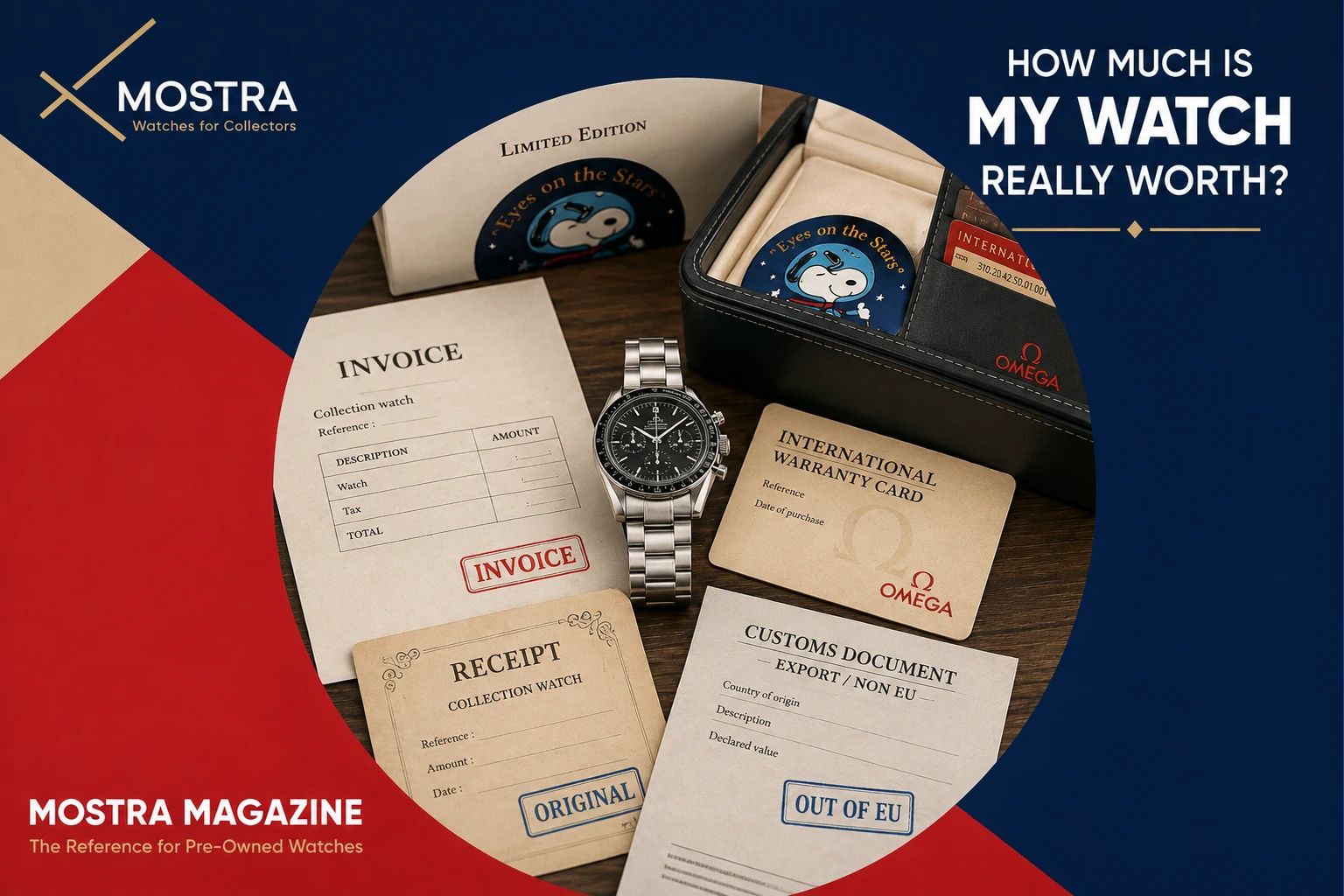
Boxed Note — Purchase invoice, tax status and net seller amount
Among all the documents that accompany a watch, the papers relating to its purchase occupy a particular place, sometimes even more important than the box, the booklet or the original certificate. The box reassures, the certificate identifies, but the invoice tells something else: it connects the watch to a buyer, a date, a place, a price and a transaction. When it clearly mentions the reference, the serial number, the buyer’s name, the professional seller or the auction house, it becomes a document of patrimonial traceability. It makes it possible to understand not only what the watch is, but also how it entered the owner’s estate.
This dimension becomes essential at the time of resale. In France, the sale by a private individual of a watch, a piece of jewellery or a precious object may have tax consequences when the sale price exceeds €5,000. Under the regime applicable to jewellery, watches and precious objects, the flat tax is in principle 6% of the sale price, to which the 0.5% CRDS is added, representing a total charge of 6.5%. This point must be integrated into the seller’s reasoning, because it can significantly alter the net amount actually received. The question is therefore not only how much the watch is worth, but also how much will remain for the owner once the transaction has been correctly treated.
The nuance is important: this flat tax applies in principle to the sale price, and not only to the profit made. This is precisely where the purchase invoice becomes decisive. When the seller can seriously prove the acquisition date and the acquisition price of the watch, they may, under certain conditions, request the application of the ordinary regime for capital gains on movable property instead of the flat tax. In that case, taxation no longer applies to the total sale price, but to the actual capital gain, meaning the difference between the sale price and the purchase price, after taking into account the applicable tax rules.
This capital gains regime may be more favourable when the profit is low, non-existent, or when the watch has been held for a long time. The capital gain is reduced by a 5% allowance for each year of ownership beyond the second year, with full exemption after 22 years of ownership, provided this can be demonstrated with probative documents. The invoice, a receipt, an auction sale slip, a succession document, a deed of gift or any document allowing the watch to be clearly individualised may then become decisive. Without sufficient proof, the seller may remain subject to the flat-rate regime, even if the sale does not generate the gain they had imagined.
The invoice is also important for watches originating from countries located outside the European Union. A watch purchased abroad, imported, transmitted or resold in France must be capable of being presented with a clear status: origin of purchase, lawful entry into the territory, customs declaration where applicable, VAT or duties paid when they were due. For a valuable watch, the absence of supporting documents can create uncertainty that will weigh on the trade-in, the consignment, the insurance or the future resale. Conversely, a coherent invoice, accompanied where necessary by import documents or proof of release for free circulation, reassures the buyer and secures the professional involved in the transaction.
This is why one must distinguish decorative papers from useful papers. An original box adds charm and completes the set. An original certificate confirms part of the watch’s identity. But a coherent nominative invoice can establish the economic history of the piece, its entry price into the owner’s estate, its commercial provenance, its individualisation and sometimes its tax status. In the pre-owned market, this difference is crucial: it can influence confidence, the insurance value, the trade-in price, the net seller amount and the fluidity of the transaction.
Official sources to consult: Bercy Infos — Sale of precious objects: which taxation? | BOFiP — Flat tax on precious objects | BOFiP — Option for the capital gains regime | Form no. 2091-SD | Form no. 2092-SD.
Caution: these indications are general and concern occasional patrimonial sales made by private individuals, subject to the seller’s tax situation, the place of sale, the origin of the watch, the supporting documents available and the evolution of the texts. A habitual buying-and-reselling activity may fall under a professional regime. For an important sale, it is recommended to verify the situation with the professional assisting the transaction or with a tax adviser.
11. Provenance: When History Accompanies the Object
Provenance is not limited to a beautiful anecdote. It must be credible, documented and connected to the watch. A first-owner watch, a military-issued watch, a pilot’s watch, a diver’s watch, a company watch, an award watch, a family watch or a watch linked to a public figure may carry additional value if its history can be verified.
A coherent engraving, an old invoice, a period photograph, an archive, a letter, a certificate or a transmission history can give a watch particular depth. But the story must never replace expertise. In the collector’s market, history is precious when it illuminates the object. It becomes fragile when it claims to compensate for its inconsistencies.
When provenance, markings or a specific history may influence the value of a watch, a professional watch appraisal helps compare the story with the actual characteristics of the watch and the documents available.
12. Market Demand and Liquidity: The Final Judge
The value of a watch finally depends on demand at the time it is offered. Some watches are very liquid: they sell quickly because they are known, sought-after, reassuring and easy to compare. Others are more confidential: they may be fascinating, rare or important, but require the right buyer, at the right moment, with the right level of explanation.
Liquidity is a central notion. A watch may have a fine theoretical value but require time to find its buyer. Another may sell quickly because it corresponds to immediate demand. The pre-owned market is not only a price guide. It is a meeting between a watch, a seller, a buyer, a price and a moment.
This is why a general selection such as the pre-owned watches available at Mostra is not read merely as a list of prices. It also helps to understand watch families, levels of demand and value gaps between closely related references.
Trade-In, Consignment, Appraisal or Auction: Which Solution Should You Choose?
The right solution depends on the watch, its condition, its papers, its origin and your objective. A trade-in prioritises security and speed. Consignment can aim for a better net seller amount. An appraisal helps document an insurance or heritage value.
Submit my watch to Mostra | Have my watch appraised | Discover the watchmaking workshop
To go further: compare trade-in and consignment.
Three Numerical Examples to Understand Net Seller Proceeds
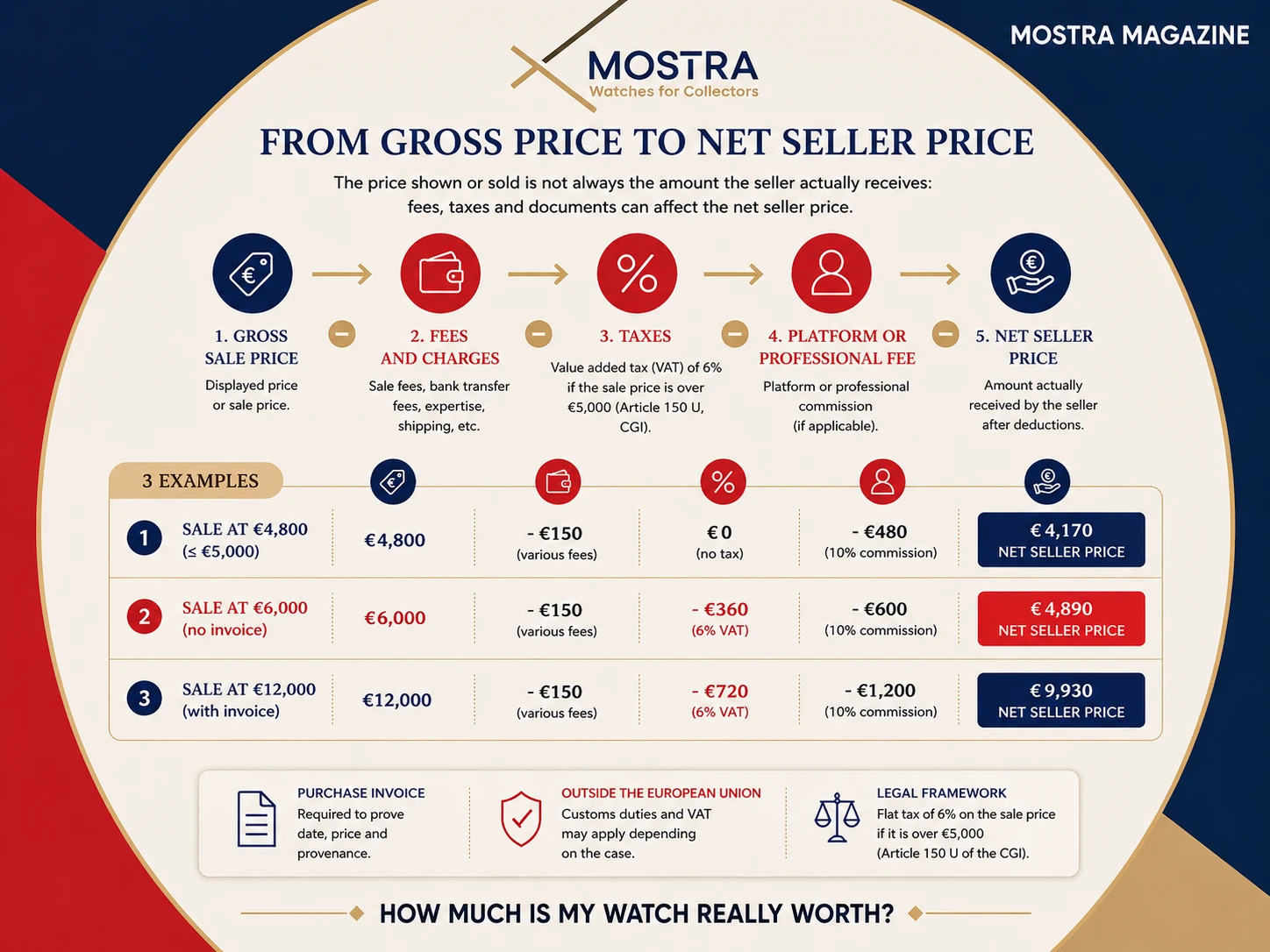
The best way to understand the difference between advertised price, market value and net seller amount is to look at a few simple cases. The following examples are deliberately schematic. They do not replace tax advice, but they show why a watch sold at the same gross price may not produce the same net amount for its owner.
| Situation | Gross sale price | Available documents | Simplified tax treatment | Impact on net seller proceeds |
|---|---|---|---|---|
| Example 1: watch sold below the threshold | €4,800 | Watch with or without papers, but sold for €5,000 or less. | For a watch classified in France as jewellery or a precious object, the flat-rate tax is generally not due below this threshold. | Net seller proceeds will mainly depend on any selling, transport, preparation or commission costs. |
| Example 2: watch sold without a purchase invoice | €6,000 | No invoice proving the purchase price and acquisition date. | The French flat-rate tax may apply to the total selling price: 6.5% of €6,000, or €390 in principle. | Before any commission or other costs, the amount remaining after tax would be €5,610. Any sales commission would then further reduce the net amount received. |
| Example 3: watch sold with a purchase invoice | €12,000 | A named invoice proving that the watch was acquired for €13,000, or an older invoice clearly establishing the purchase date and price. | When the required conditions are met, electing for the French capital-gains regime may allow the tax calculation to be based on the actual gain, or on the absence of any gain. | The invoice may become decisive: it can avoid calculating tax solely on the total selling price and help establish fairer net seller proceeds. |
These examples show why the purchase invoice is not merely an administrative document. It can alter confidence, the applicable taxation, the calculation of net value and the way a professional or buyer will analyse the watch. Two watches sold at the same gross price may therefore leave very different amounts to their owner.
Why Automatic Valuation Platforms Are Not Always Enough
Online valuation tools can provide a first orientation. They make it possible to identify trends, compare certain listings and avoid the most obvious mistakes. But they never replace the real examination of a watch. They struggle to read the geometry of a case, the quality of a dial, the coherence of the hands, the mechanical condition, the nature of the parts, the service history or the quality of a set.
They can also confuse advertised prices with prices actually achieved, compare neighbouring but different references, or ignore fees, delays and risks. For a collector’s watch, value is not calculated merely by an average. It is built through reading.
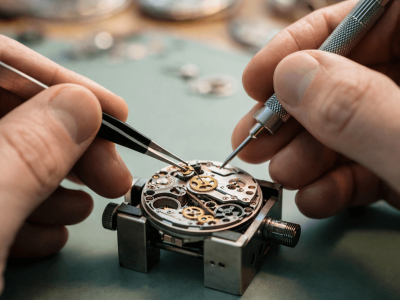
The Mostra Observatory 2026 showed precisely how much a workshop examination can reveal elements invisible in photographs: precision, water-resistance, authenticity, polishing, bracelet, real movement condition and possible need for servicing. The value of a watch is not born only from what one sees. It is also born from what one checks.
Trade-In, Consignment and Auctions: Three Paths, Three Logics
When an owner wishes to sell a watch, the right channel must be chosen. The professional trade-in generally offers a quick, secure and clear answer. The proposed price is lower than the final public price, but it avoids uncertainty, multiple negotiations, payment risks, disputes and prolonged delays.
Consignment can make it possible to aim for a higher net amount, provided one accepts time, commission and the uncertainty of the result. It is particularly suited to watches whose value deserves careful presentation, a qualified audience and professional support. The important point is not only the displayed price, but the net seller amount actually achieved after fees, possible taxation and selling time.
Auctions can be relevant for rare, historical, well-documented pieces likely to create competition between buyers. But they are not suitable for every watch. They involve a calendar, fees, a possible reserve price and an element of uncertainty. Some watches shine there. Others become diluted.
To explore this question further, the guide Selling Your Watch in Aix-en-Provence: Valuation, Trade-In and Consignment details the different possible solutions for an owner wishing to sell under the right conditions.
The Mostra Method: Looking at the Watch Before Giving a Figure
At Mostra, the valuation of a watch always begins with the object itself. It is not merely a matter of announcing a price, but of understanding what is in front of us. A watch is examined as a whole: brand, reference, year, configuration, dial condition, hands, case, movement, bracelet, parts, documents, history, purchase invoice, insurance value and market potential.
This approach makes it possible to distinguish several realities: sentimental value, patrimonial value, insurance value, trade-in value, consignment value and possible resale value. It avoids the confusion created by overly optimistic listings or overly quick comparisons.
For a serious valuation, the watch must be observed with the patience required by a collector’s object. A photograph may seduce, but it gives neither movement amplitude, nor water-resistance, nor the exact nature of a service part, nor the remaining thickness of an over-polished lug. Expertise is precisely that discipline which consists in bringing visible beauty closer to technical truth.
The guide Why Have Your Watch Appraised in Aix-en-Provence? presents this complete approach, at the crossroads of the workshop, the market and patrimonial reading.
Preparing your watch for valuation: the elements to gather
Before requesting a valuation, it is useful to gather everything that accompanies the watch. The box, warranty, invoices, booklets, extra links, service documents, old photographs and provenance information can help establish a fairer value. Even when a document appears secondary, it may provide decisive information about the year, the journey or the maintenance of the watch.
Checklist before valuation
- The watch itself, ideally not aggressively cleaned before examination.
- The box and papers, even incomplete.
- The purchase invoice, nominative if it exists, or any document establishing the date, price and seller.
- Service invoices, useful for understanding maintenance and replaced parts.
- Extra links, original bracelets or preserved accessories.
- Import or customs-status evidence, especially for a watch originating from a country outside the European Union.
- Old photographs, useful for documenting provenance or configuration.
- Family or professional information, when it can explain the history of the watch.
Once these elements have been gathered, you can submit your watch to Mostra with its reference, year, available documents and photographs to obtain an initial orientation.
A serious valuation does not consist in artificially embellishing the file. On the contrary, it consists in presenting the watch with precision. The market accepts watches that have lived, when they are described honestly. What it sanctions are approximations, omissions and inconsistencies.
Further Reading on Value, Condition and Selling a Watch
Conclusion: The True Value of a Watch Is a Conclusion, Not an Intuition
What is your watch really worth? It is worth what its identity, condition, history and the market allow to be established seriously. It may be worth more than expected if its dial is remarkable, its case preserved, its configuration rare and its history solid. It may be worth less than a spectacular listing if its movement requires intervention, if its parts have been replaced, if its case has lost its geometry or if demand is weaker than imagined.
The value of a watch is therefore not merely a figure. It is a conclusion. It is born from examination, expertise, knowledge of the market and the ability to distinguish appearance from reality. In the world of pre-owned watches, the most serious price is not always the most flattering. It is the one that respects the object, its history, its owner and the market to which it is addressed.
Have a Watch Valued, Sold or Appraised at Mostra
Would you like to know the real value of your watch, prepare a sale, secure a purchase, establish an insurance value or understand the exact condition of a collector’s piece? Mostra supports you in Aix-en-Provence and online with an approach based on watchmaking expertise, condition transparency and knowledge of the pre-owned market.
Prepare the sale of my watch | Understand the Mostra appraisal approach | Discover our pre-owned watches
FAQ — What Is My Watch Really Worth?
Why does my watch not have a single value?
Because value depends on context. An insurance value, a trade-in price, an asking price and a net seller amount do not follow the same logic. The watch is the same, but the purpose of the valuation changes.
Is the price shown in a listing a good reference?
It is an indication, but not proof. A listing shows what a seller is asking. It does not always show the price actually achieved, the time needed to sell, the exact condition of the watch or the fees incurred.
Why is a professional trade-in price lower than the public price?
Because a professional takes on inspection, authentication, possible servicing, warranty, presentation, stock immobilisation and commercial risk. The trade-in price is therefore not the final resale price.
To obtain an initial proposal adapted to your watch, you can submit your watch to Mostra.
What is the difference between insurance value and sale value?
Insurance value is used to protect the owner and provide for the replacement of the watch in the event of a loss. Sale value corresponds to the amount a buyer is prepared to pay in a real transaction.
To document an insurance or heritage value, discover our pre-owned watch appraisal service.
Can a watch without papers be sold?
Yes. A watch without papers can be sold, especially if it is coherent, authentic, in good condition and properly appraised. The absence of papers can nevertheless influence confidence, selling time, trade-in price and net seller amount.
Is the purchase invoice more important than the box?
Often yes. The box completes the set, but the purchase invoice can prove a date, a price, a seller, an owner and sometimes a tax or customs status. For a valuable watch, it may become more useful than a presentation element.
Why does the purchase invoice matter for taxation?
Because it can make it possible to prove the acquisition price and date. It may therefore be decisive when comparing the flat tax with the possible option for the capital gains regime on movable property.
Which tax can concern the resale of a watch by a private individual in France?
For an occasional patrimonial sale of a watch treated as jewellery or a precious object, the flat tax may apply when the sale price exceeds €5,000. It is in principle 6% of the sale price, increased by 0.5% CRDS.
Does the 6.5% tax apply only to the profit?
No. The flat tax applies in principle to the sale price. This is why the purchase invoice can be important: it may make it possible, under certain conditions, to opt for the capital gains regime when this regime is more suitable.
How important are papers for a watch bought outside the European Union?
They can be essential. An invoice, a customs declaration or proof of VAT paid can reassure about the lawful entry of the watch into the territory and secure a sale, insurance, trade-in or consignment.
Is the brand the most important criterion?
The brand is a major criterion, but it is not enough. The reference, condition, configuration, dial, case, documents and market demand can strongly alter value between two watches of the same brand.
Why is the exact reference essential?
Because the same commercial name may cover several generations, several calibres and several configurations. The exact reference makes it possible to compare the watch with truly equivalent pieces.
Is an older watch always worth more?
No. Age alone does not guarantee value. An old watch must be desirable, coherent, well preserved and sought-after. Certain recent watches may be more liquid or more in demand than older models with limited appeal.
Does a patinated dial increase value?
Patina may increase interest if it is natural, homogeneous and coherent with the age of the watch. Conversely, significant alteration, clumsy restoration or a repainted dial can reduce value.
Does a polished watch lose value?
Not always, but excessive polishing can reduce value, especially on a collector’s watch. When edges, bevels or case proportions disappear, the watch loses part of its original presence.
Does mechanical condition strongly influence price?
Yes. A watch whose movement requires heavy servicing or hard-to-find parts can see its net value decrease. Conversely, a checked, healthy and warrantied watch inspires greater confidence.
To document the condition of a watch precisely, consult the Mostra Watch Health Record. In the event of a malfunction, our watchmaking workshop in Aix-en-Provence can guide you towards the appropriate intervention.
What is a service part?
A service part is a part replaced during maintenance, often supplied by the brand or compliant with specifications. It may be perfectly functional, without being the part fitted at origin during production.
Is a full set essential?
No, but it can increase confidence and value, especially for modern or highly sought-after watches. A watch alone can remain interesting if its condition, coherence and configuration are remarkable.
Which solution should I choose between trade-in, consignment and auction?
Trade-in favours speed and security. Consignment can aim for a higher net amount with a longer timeframe. Auctions are mainly suited to rare, historical or highly sought-after pieces. The right choice depends on the watch and the owner’s objective.
To prepare a sale in practical terms, also read our guide Selling Your Watch in Aix-en-Provence: Valuation, Trade-In and Consignment.
What is the best way to know the real value of my watch?
The most reliable method is to combine exact identification, aesthetic and mechanical condition, component coherence, documentation and real market conditions. A professional appraisal brings these elements together when a precise valuation is required.
These products might interest you


Share this content