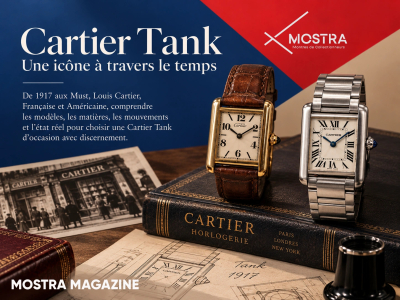
Cartier Tank: History, Models, References and Collector’s Guide
A Tank is recognised by its lines, but chosen for its details. From the vermeil Must to the gold Louis Cartier, explore more than a century of history and discover how proportions, movement and condition distinguish two seemingly similar watches.
By Thierry Serna — Mostra Magazine
Feature prepared on 14 October 2026.
“A Tank is recognised by its lines. The one you choose is understood through its proportions, its material and what time has left intact.”
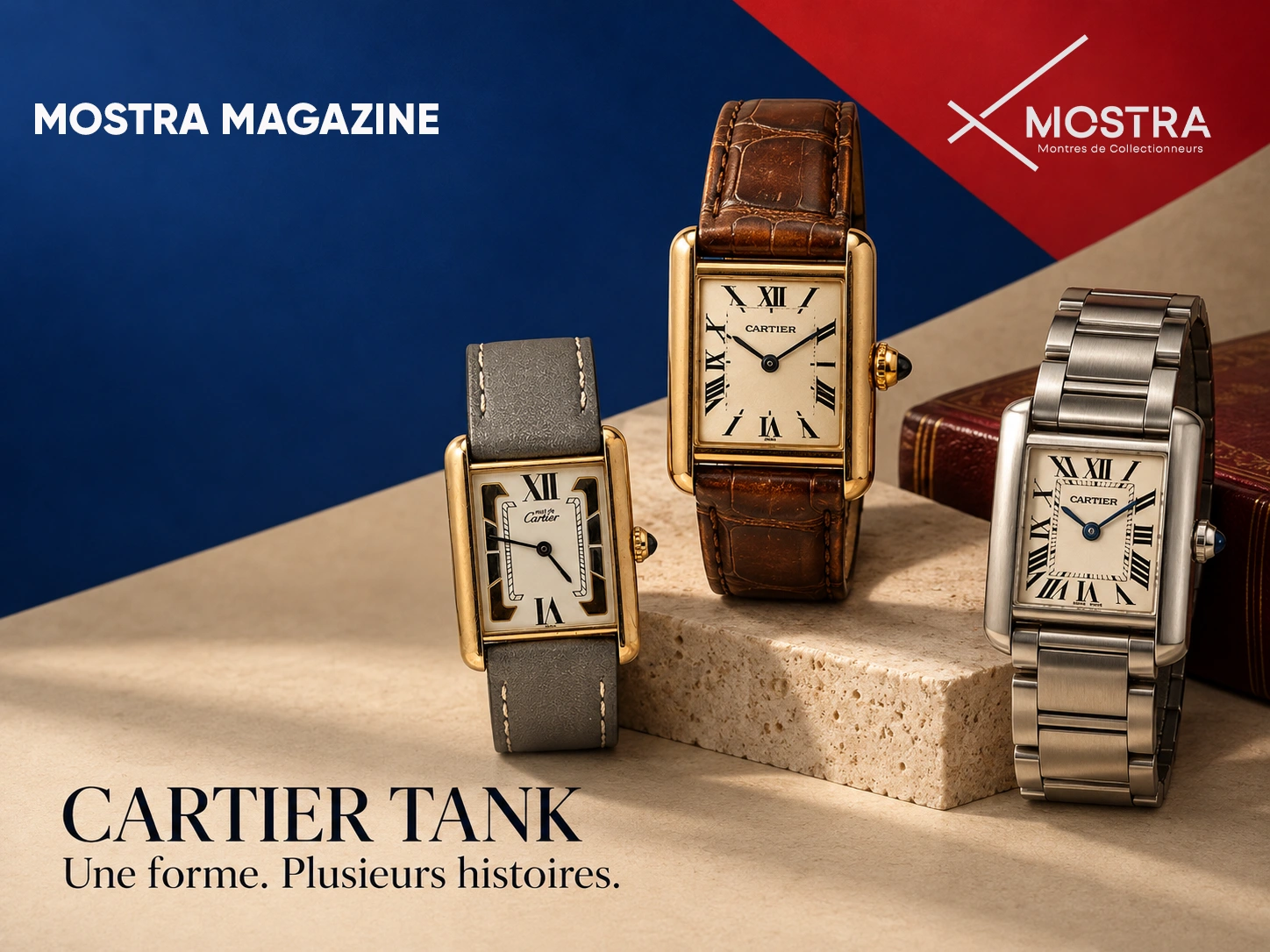
A Cartier Tank does not need to occupy the entire wrist to find its place there. Two parallel lines, a dial held between them, a strap that seems to extend the case: its authority comes from this economy of means. Then the light shifts. It reveals the softness of a gold brancard, the edge of a steel Tank Solo or the articulated links of a Française. Behind a familiar name, noticeably different objects emerge.
This is where choosing begins. A manually wound Must in vermeil, a gold quartz Tank Louis Cartier and an automatic Tank Française are not three equivalent versions of the same watch. They belong to a shared history, but offer different proportions, different constructions and different relationships with use. A front-facing photograph or the words “Cartier Tank” alone cannot provide a serious basis for comparison.
This feature follows their history to answer a very practical question: how do you choose your Tank without confusing its shape, generation, movement and the quality of the individual example? Collectors will find reference landmarks; first-time buyers, a method for looking beyond the dial. To place the Tank within the broader story of the Maison, our history of Cartier watches and their iconic models offers complementary reading.
MOSTRA ESSENTIALS — FOR READERS SHORT OF TIME
The Cartier Tank in three minutes
1917 marks its creation; 1919, the beginning of commercial sales. The original Tank predates the many interpretations that would build the collection. Louis Cartier, Cintrée, Must, Française and Américaine are not interchangeable names.
The Must name covers two histories that must be distinguished. The older generations, launched in 1977, notably include vermeil cases and manually wound or quartz movements. The contemporary Tank Must, relaunched in 2021, uses a different construction, primarily in steel, with several mechanical and electronic solutions depending on the reference.
The material does not reveal the movement. A gold Tank can be quartz; a steel Française can be automatic. Likewise, vermeil is gold-covered silver, not a solid-gold case.
The quality of a purchase is determined by the individual example. Dial configuration, preservation of the brancards, any plating, bracelet condition, operation and interventions must be explained. A shinier watch is not necessarily a better-preserved one.
Compare the families · See the twelve checks · Discover Tanks at Mostra
1917–1919: a new shape, before it became a collection
Two dates to retain, an origin to understand
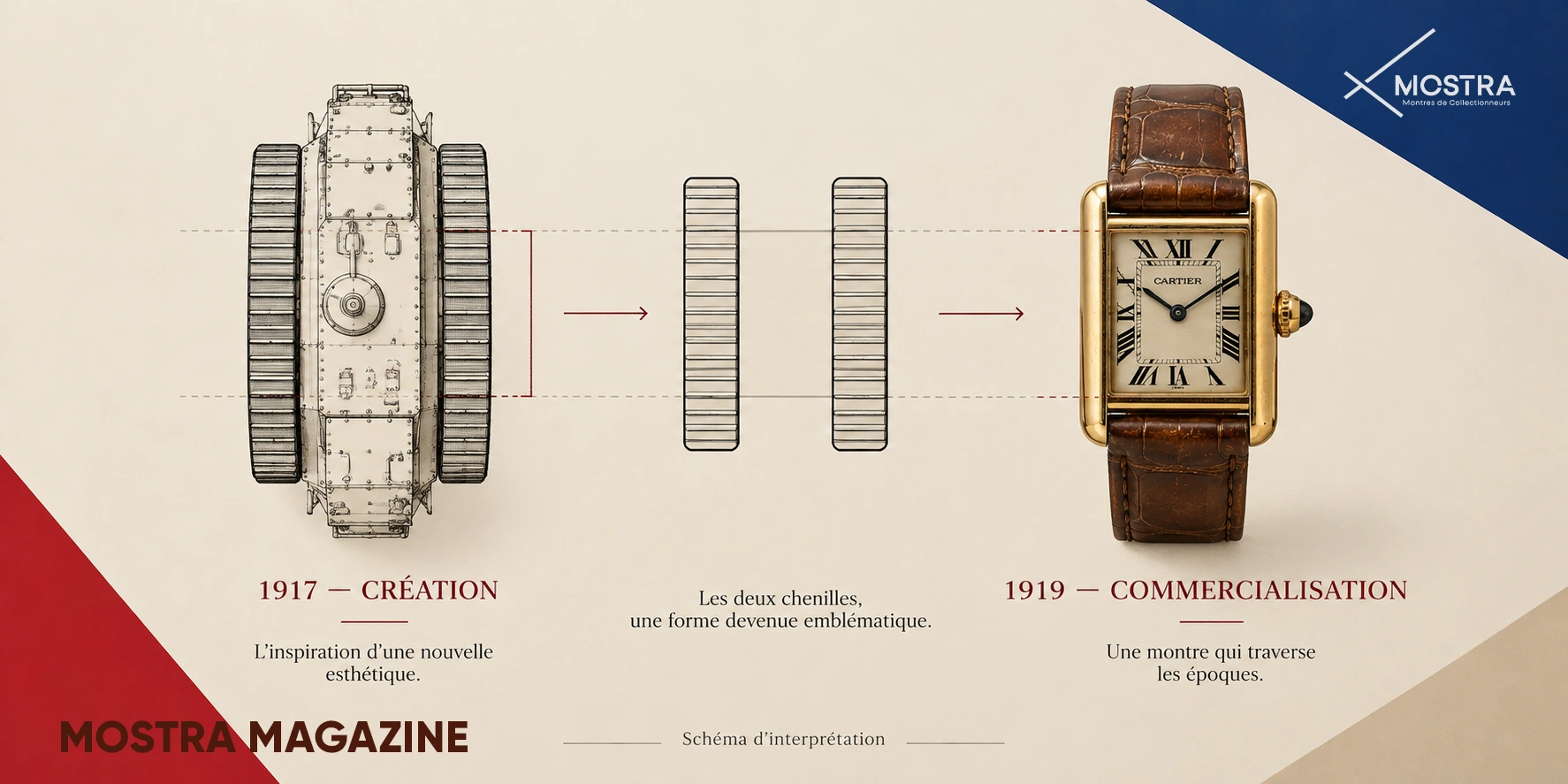
Cartier dates the creation of the Tank to 1917, followed by its commercial introduction in 1919. This distinction prevents the invention of a design from being confused with its actual appearance in shop windows. In the Maison’s account, the silhouette of the earliest tanks, viewed from above, inspired the idea of two lateral elements framing a central section. The brancards evoke the tracks; the dial occupies the space between them.
What matters in this origin is the act of transformation. The Tank did not become a military watch in the sense of an officially issued instrument. Louis Cartier retained an arrangement of volumes and turned it into a wristwatch whose strap seemed to belong to the case. The inspiration was translated, then almost forgotten in the self-evident nature of the object. Its geometry anticipated certain sensibilities that would later find their fullest expression in Art Deco.
Why a Tank is not simply a rectangular watch
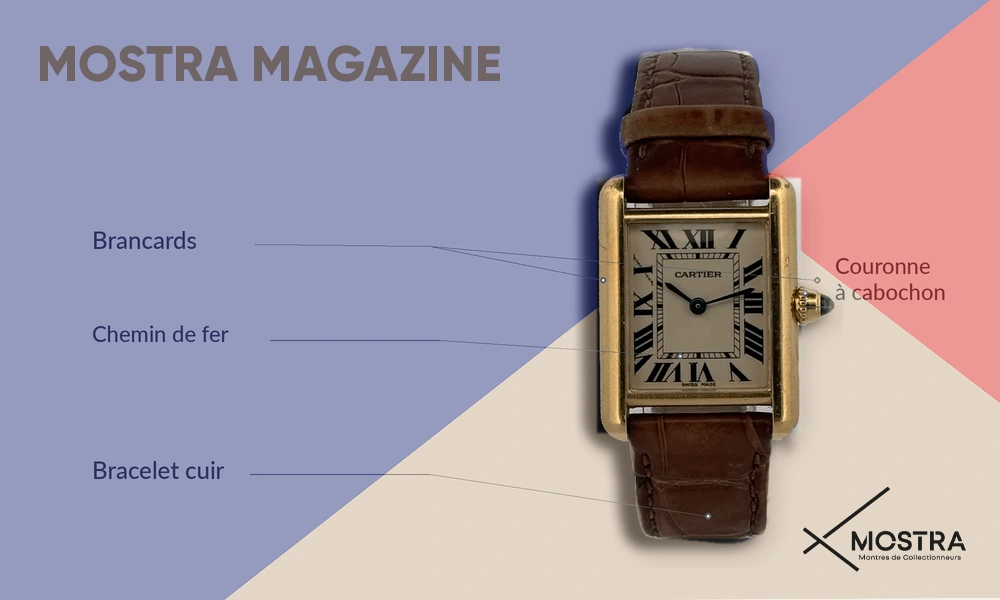
The brancards are the two longitudinal elements that structure the silhouette. Their thickness, length, curvature and connection to the strap largely determine the watch’s presence. A Roman-numeral dial placed inside a rectangular case is therefore not enough to explain the Tank design. You must observe how the lines continue beyond the dial, then how the strap carries them onwards.
This reading also distinguishes the Tank from another great Cartier, the Santos. The two families share a world, but organise the case, bezel and attachments differently. Our feature on the Cartier Santos and its language of exposed screws helps explain this other way of building an immediately recognisable silhouette.
The first variations: stretching, curving, shifting the eye
The Tank Cintrée of 1921 elongated and curved the watch; the Tank Louis Cartier of 1922 softened its brancards. The Chinoise, also born in 1922, gave a particular role to the horizontal crossbars. The Tank principle became a field of experimentation: the watch could grow longer, change its balance or evoke an architectural structure without losing its identity.
Other interpretations changed the way it was read more radically. The Tank à Guichets of 1928 presented its indications through apertures; the reversible lineage inaugurated in 1932, subsequently continued by the Basculante, explored turning the case over; the Asymétrique of 1936 tilted the composition. These creations remind us that the Tank’s history cannot be reduced to a white dial or twelve Roman numerals. Some of its most singular expressions depart precisely from this now-classic image.
1977–2025: an icon opens up to different ways of wearing a watch
With the Must models of 1977, Cartier brought the Tank to a wider audience and granted its dials new freedom. The Américaine in 1989, the Française in 1996 and then the Solo from 2004 established distinct propositions: a long, curved silhouette, continuity with a metal bracelet or a pared-back interpretation of the classic rectangle.
The relaunch of the Tank Must in 2021, the renewal of the Française and Américaine in 2023, and the arrival of a new-generation automatic Tank Louis Cartier in 2025 show that this history remains active. One family does not systematically replace the previous one. Several ways of wearing a Tank coexist, and the pre-owned market adds generations no longer found in the current catalogue.
The great Cartier Tank families: what really changes
The original Tank, generally referred to as the Tank Normale, must be distinguished from the Louis Cartier that appeared later: their names do not describe exactly the same design. The following table serves as an overview. Dates indicate the appearance of a family, not the manufacturing year of every example bearing its name. Movements and materials must then be identified reference by reference.
| Family | Historical landmark | What the eye should compare |
|---|---|---|
| Original Tank / Normale | 1917; commercial introduction in 1919 | The brancard principle and the integration of the strap into the design. |
| Tank Cintrée | 1921 | Considerable length, narrow width and pronounced curvature. |
| Tank Louis Cartier | 1922 | Softened brancards; several generations, dimensions and movements. |
| Must de Cartier Tank | 1977 | Vermeil on many older references and a wide variety of dials. |
| Tank Américaine | 1989 | An elongated, curved interpretation, not to be confused with the Cintrée. |
| Tank Française | 1996; renewed in 2023 | The relationship between the case and the articulated metal bracelet. |
| Tank Solo | From 2004 | Flatter surfaces and brancards; several materials and sizes. |
| Tank Anglaise | 2012 | A crown integrated into the right-hand brancard and a more enveloping construction. |
| Tank MC | 2013 | A more substantial presence, notably associated with the automatic 1904 MC movement. |
| Contemporary Tank Must | From 2021 | Modern construction, with quartz, SolarBeat or automatic movements depending on the reference. |
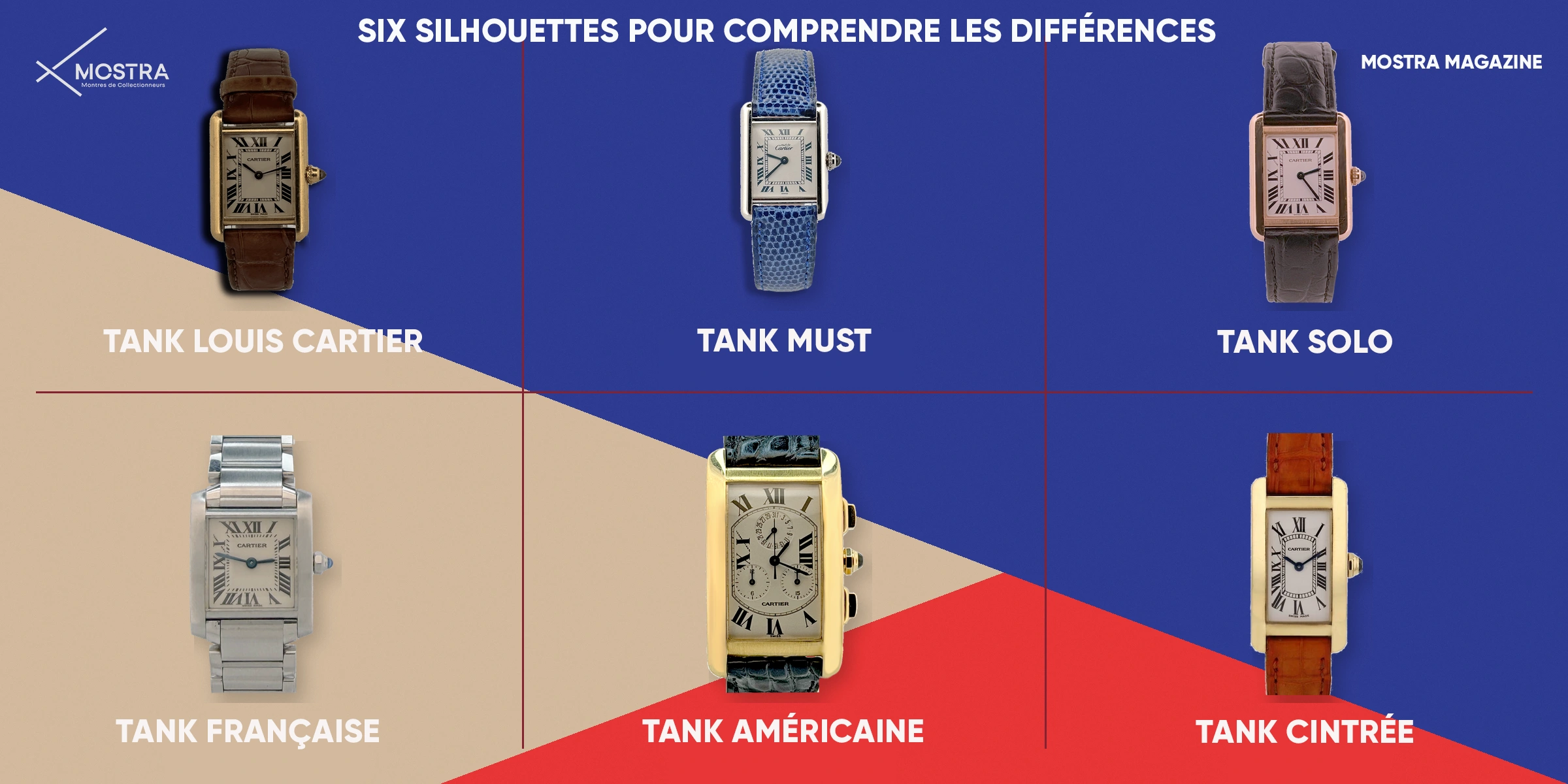
Tank Louis Cartier: the softness of the brancards, not a single movement
The Louis Cartier expresses a particularly accomplished interpretation of the classic Tank. Its softened brancards catch the light without breaking it; the dial seems to sit within an unbroken contour. Its appeal lies in the proportions and the quality of the surface transitions. Two generations that look similar from the front can offer a different presence when viewed in profile or fastened around the wrist.
One overly convenient equation must nevertheless be set aside: Tank Louis Cartier does not necessarily mean manual winding. The gold Tank Louis Cartier reference 2442 presented by Mostra illustrates a quartz execution. Other references use manually wound mechanisms. In 2025, Cartier also introduced a new-generation large model with the automatic 1899 MC movement. Choosing a Louis Cartier must therefore begin by identifying the version, rather than with a general idea of what it ought to contain.
Tank Cintrée and Tank Américaine: two ways of inhabiting length
The Cintrée invites you to read the watch in profile. Curvature matters as much as the frontal view, and its length demands a careful fitting. The Américaine, launched in 1989 with inspiration drawn from that heritage, developed its own balance. It is not simply an enlarged Cintrée or a stretched Louis Cartier: the case volumes and connections to the strap must be considered together.
The gold quartz Tank Américaine 1710, documented at Mostra, provides a telling example: approximately 35 × 19 mm is enough to produce a distinctly elongated silhouette. Width alone would give an incomplete impression of its presence. The 2023 renewal further refined the Américaine’s design and introduced calibre 1899 MC in certain automatic versions, without eliminating the family’s other propositions.
Tank Française: the bracelet belongs to the architecture
Introduced in 1996, the Française made the relationship between case and bracelet a central subject. The links continue a construction more angular than that of a Louis Cartier on leather. The watch is worn as an articulated object around the wrist, with a play of polished and satin-finished surfaces that deserves to be preserved. The bracelet is therefore not a secondary accessory that can always be replaced without affecting the overall balance of the purchase.
Two Mostra examples illuminate the diversity of this family: the quartz Tank Française 2384, measuring approximately 26 × 20 mm, and the automatic Tank Française 2302, measuring approximately 32 × 28 mm, with central seconds and a date. The change goes beyond dimensions: display, movement and servicing rhythm differ.
The 2023 redesign revised the case, crown and visual articulation of the bracelet. It must be distinguished from the first generation, but did not mark the arrival of the first automatic movement in the Française’s entire history: the 2302 demonstrates that. A recent sales date is therefore not enough to identify the design of the latest renewal.
Tank Solo: an interpretation to collect in its own right
The Solo appeared from 2004 with a flatter interpretation of certain volumes. Its brancards and surfaces should be compared, rather than presenting it as a Louis Cartier with nothing more than part of the price removed. Material, proportions and construction contribute to an identity of its own. The family includes several sizes and types of movement; not every Solo is an identical quartz watch.
The 2018 steel Tank Solo W5200005 presented by Mostra combines a format of approximately 31 × 24 mm, a Cartier 157 quartz movement and a leather strap. It illustrates a direct approach to the Tank design. Other Solo models combine gold case elements with a steel caseback: this construction must be described component by component, without confusing it with simple plating.
Tank Anglaise and Tank MC: two other expressions of the 2010s
The Tank Anglaise of 2012 integrated its crown into the right-hand brancard, giving the case a different continuity. This characteristic requires the watch to be viewed as a volume, rather than only within the boundaries of its dial. The Tank MC, introduced in 2013, offered a more substantial proposition, notably built around the automatic 1904 MC movement and a sapphire caseback. The letters MC stand for Manufacture Cartier.
These families appeal to anyone seeking a presence different from the classic, slender Tank on leather. They are not necessarily superior versions: their movements, thicknesses and proportions answer different preferences. On the pre-owned market, they should be compared within their own references rather than against a Must selected solely for a resemblance between dials.
The singular Tanks: collecting an interpretation, not just a name
The Chinoise, Basculante and Asymétrique appeal to an eye interested in the exploration of form. The pleasure then lies in a particular relationship between case, display and architecture. Supposed rarity does not remove the need to establish the exact generation, movement and configuration. A contemporary reinterpretation can be remarkable without possessing the age or individual history of the model that inspired it.
The Cartier Privé Tank à Guichets presented in 2025 makes this distinction particularly clear. It revisits a 1928 creation and receives manually wound calibre 9755 MC. The display is digital in the sense that numerals are read through apertures; this does not imply an electronic movement. The Tank can thus change its expression without requiring the familiar vocabulary of a dial with hands.
Vintage Must and contemporary Must: the same name, two eras to examine separately
1977: the Must opens the Tank to a different freedom
Older Must models occupy a particular place in Cartier’s history. Launched in 1977, they broadened access to the Maison’s watches and gave the dial freedom in colour and composition. Vermeil formed part of this proposition: it offered the warm appearance of gold over a silver structure, without the need to reproduce the construction of a solid-gold Tank.
For the collector, their appeal lies precisely in that era. A Must should not be reduced to an authorised imitation of a more expensive Tank. It has its own materials, dials and memory of use. Some are chosen for a deep monochrome colour, others for a particular decoration or the gesture of a manually wound movement. Quartz versions belong just as fully to the line’s history.
The 1992 Must Tank Trinity Large Model reference 99009, documented at Mostra, combines a vermeil case, a dial with three-colour decoration and manually wound calibre 78-1. Its dimensions of approximately 31 × 23 mm show what “Large Model” could mean in this generation. The word Trinity describes a decorative language here; it does not turn the case into an assembly of three solid-gold alloys.
2021: the contemporary Tank Must is not an older Must returned to production unchanged
The 2021 relaunch revived the name and certain aesthetic principles, but adopted a different construction. Contemporary steel references, quartz versions with extended battery life, SolarBeat and automatic models must be read separately. Buying a recent Must and seeking a vermeil Must from the 1980s or 1990s are two different projects.
The steel Tank Must 4322 on a steel bracelet, a 2024 example presented by Mostra, illustrates this second era. Its practical appeal rests on a contemporary quartz configuration and its case-and-bracelet ensemble. The Must name establishes a lineage; it guarantees neither a shared material nor mechanics identical to those of the older watches.
| Question | Older Must models | Contemporary Must models |
|---|---|---|
| What are you looking for? | A historic generation and its collectible configuration. | A current interpretation to select according to its reference and intended use. |
| Which material? | Notably vermeil on many references. | Notably steel on the regular references discussed here. |
| Which movement? | Manual or quartz, depending on the version. | Quartz, SolarBeat or automatic, depending on the version. |
| What should be examined first? | Plating, dial, preservation of the case and interventions. | Full reference, dimensions, operation, bracelet and documentation. |
Vermeil, steel, gold: colour alone does not identify the material
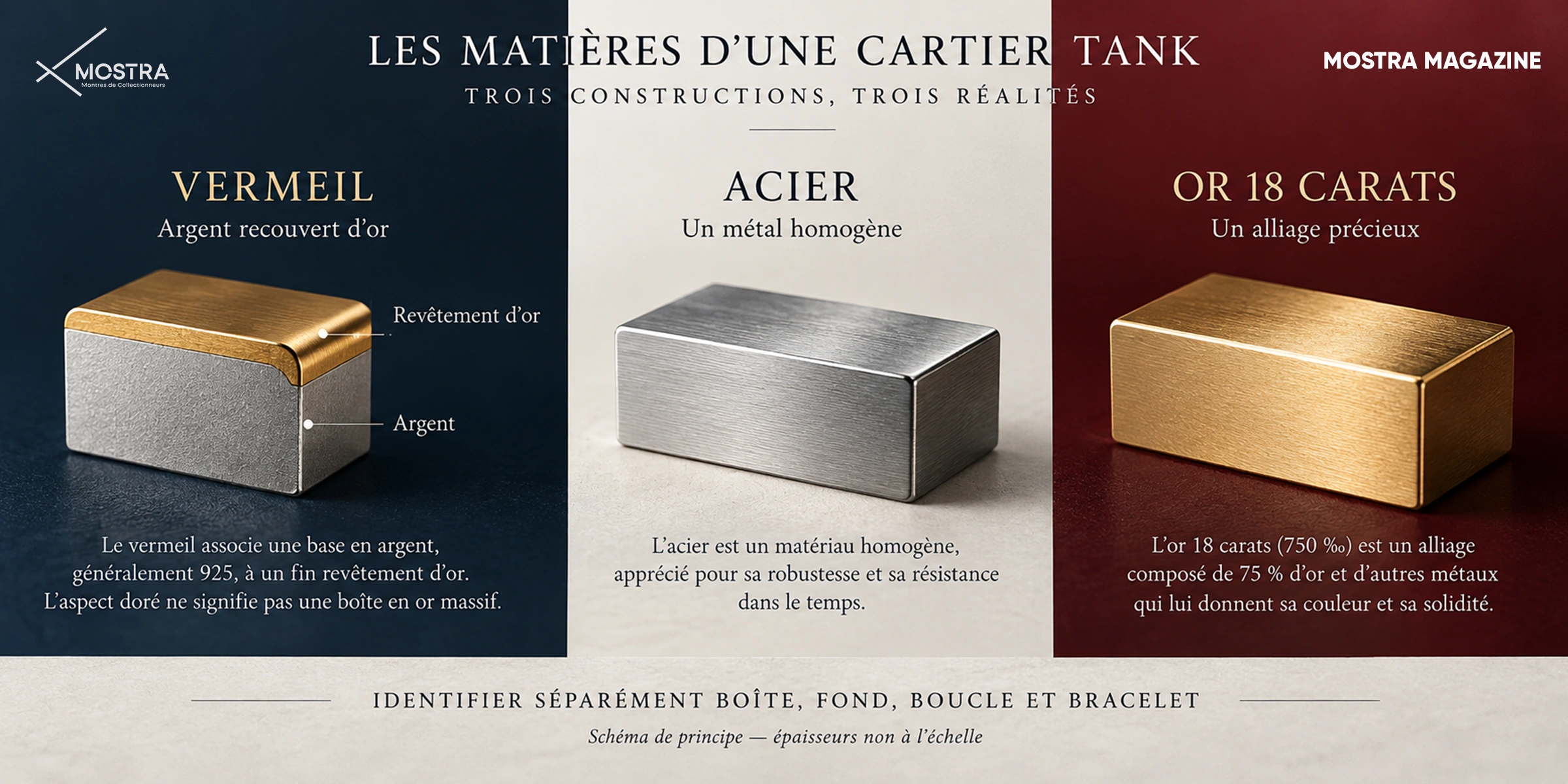
Vermeil: silver beneath a layer of gold
On the vermeil Must models considered here, the structure is silver, generally of 925 fineness, covered with gold. The watch therefore compares neither with a solid-gold case nor automatically with a gold-plated base-metal case. The underlying material, plating and their condition must be identified. The word vermeil describes a construction; it does not describe how well that construction has survived several decades.
The examination concentrates on the corners, ends of the brancards, contact areas and the region around the crown. Loss of gilding can expose the metal underneath. Conversely, a recent surface treatment can give a very uniform impression to a case that has already been refinished. Re-gilding must be disclosed when known: it does not carry the same meaning as an older coating that has been preserved.
This material also calls for particular restraint in restoration. Abrasive polishing removes material and can reduce the plating. Before trying to eliminate a mark, it is necessary to decide what should be preserved. For a collectible Must, a small, explainable trace may be preferable to an entirely new-looking surface obtained through poorly documented work.
Steel: look at the finishing rather than the shine alone
Steel offers a different relationship with wear, but it does not make the lines indestructible. Edges can be softened; transitions between polished and satin-finished surfaces can lose their precision. On a Solo or a Française, these changes affect the way light defines the watch. Appealing cosmetic condition must not be assessed solely by the absence of visible scratches.
Cases from the same family and generation must be compared. The curvature expected on a Louis Cartier is not an anomaly because a neighbouring Solo displays flatter surfaces. Assessing preservation therefore begins with knowing the shape one should expect to find.
Solid gold and gold-and-steel constructions: describe every element
The designation 750-fineness gold, or 18-carat gold, describes an alloy containing 75% gold by mass. It does not automatically extend that material to the entire watch. Case, caseback, buckle and bracelet may use different constructions depending on the reference. A watch on leather clearly does not contain the same quantity of precious metal as an example with a gold bracelet, and that quantity alone does not exhaust their collectible interest.
A construction combining gold case sections with a steel caseback must be described as such. It is not equivalent to a case made entirely of steel and covered with gold. Likewise, a gold-coloured buckle does not prove that it is solid gold. Hallmarks and inscriptions must be assessed against the expected configuration and an examination of the components, never against colour alone.
The dial: this is often where the watch’s identity is decided
Roman numerals, a railway minute track and blued hands belong to Cartier’s classic image, but they are not a mandatory checklist for every Tank. Must models with coloured dials and certain creations without that arrangement demonstrate the opposite. The absence of Roman numerals is therefore not, on its own, a reason to reject a watch; it calls for identifying the correct reference.
The difficulty lies in distinguishing the legitimate variety of dials from a later modification. Typography, placement of inscriptions, surface condition and transitions must be examined together. A small signature incorporated into a numeral is not sufficient to authenticate a watch. Nor does a glossy finish justify calling a dial enamel: lacquer, surface treatments and materials must be identified, not guessed.
On older Must models, a cracked dial calls for caution. Ageing may interest a collector, but its stability must be checked, and deterioration should not systematically be turned into a virtue under cover of a nickname. A refinished or replaced dial may make a watch enjoyable to wear; it must be described accordingly when the evidence allows that conclusion to be established.
The cabochon and diamonds: two shortcuts to avoid
The word cabochon describes a form of cut, not, by itself, the nature of a stone. Depending on the reference, Cartier uses materials including synthetic spinel or sapphire. The blue colour therefore constitutes neither a gemmological identification nor sufficient proof of authenticity. The crown must also be examined for its shape, fit and operation.
For a gem-set Tank, it is necessary to establish whether the configuration corresponds to a version supplied by the Maison or to setting carried out afterwards. The presence of genuine diamonds does not resolve this question. A jewellery modification must be documented and incorporated into the assessment of the watch, rather than automatically presented as a rare factory-original reference.
Manual, quartz, automatic: what relationship would you like to have with your Tank?
Manual winding: a gesture and a mechanism to examine
A manually wound Tank offers a tactile relationship. You remove it from the wrist, take the crown between your fingers and gently wind the mainspring. This gesture accompanies the choice of an older Must or certain Tank Louis Cartier and Cintrée models. It requires accepting the actual power reserve of the example and adapting your wearing habits accordingly.
The beauty of this ritual does not replace diagnosis. Consistency of winding, timekeeping, autonomy and component condition must be checked. With a manually wound movement, do not force the crown beyond the clear resistance at the end of winding. Unusual stiffness or an increasingly short running time calls for examination, not additional force on the crown.
Quartz: a genuine part of the Tank’s history
Quartz answers another brief: picking up your watch and finding it on time without having to wind it after every period of rest. It is particularly suited to a piece worn in rotation, provided the condition of its battery and movement is monitored. Its appeal is not merely a matter of price; the gold Louis Cartier 2442 and Française 2384 show that material, family and movement type follow different combinations.
A quartz watch is not a maintenance-free watch. A battery replacement alone says nothing about electrical consumption, the condition of the contacts, an earlier leak or the operation of the gear train. A stopped watch should not be bought solely on the promise that “it only needs a new battery”. That assumption must be checked, particularly when the cost or availability of a component could change the appeal of the purchase.
Automatic: look at the whole, not just the rotor
Automatic winding uses movements of the wrist to maintain the mainspring’s energy. It does not remove the need for initial winding in accordance with the instructions or for sufficient wearing time. On a Tank, it often accompanies a change in proportions and sometimes in the display. The Française 2302, with its calibre 120, therefore offers a different experience from a small two-hand Française.
Among contemporary references, the extra-large Tank Must WSTA0053 receives automatic calibre 1847 MC, with an advertised power reserve of 40 hours for this version. The 1899 MC appears in certain Américaine models renewed in 2023 and in the new-generation large Tank Louis Cartier presented in 2025. These designations must not be generalised to every watch bearing the same family name.
SolarBeat: quartz powered by light
SolarBeat, introduced in the Tank Must in 2021, uses light to power a quartz movement through a photovoltaic system. It is neither an automatic mechanism nor a manually wound movement. Energy management, exposure instructions and the energy-storage element must be assessed according to the version concerned.
When buying pre-owned, behaviour after appropriate charging and the operating condition of the whole assembly must be checked. A theoretical service interval advertised for a technology does not mean that the watch can run indefinitely in darkness. Nor is the Must name on a listing sufficient to distinguish a SolarBeat from the other quartz versions.
Three mechanical calibres: figures to associate with a reference
| Calibre | Example of application | Winding | Frequency | Jewels | Indicative reserve |
|---|---|---|---|---|---|
| Cartier 78-1 | Mechanical Must Tank 99009 presented in this feature | Manual | 21,600 vph | 17 | Approximately 44 hours |
| Cartier 120 | Tank Française 2302 | Automatic | 28,800 vph | 20 | Approximately 40 hours |
| Cartier 1917 MC | Certain contemporary Tank Cintrée models | Manual | 21,600 vph | 19 | Approximately 38 hours |
The running times shown are indicative figures after full winding. They are not the results of an inspection of a pre-owned watch. A jewel count or frequency does not, on its own, rank the quality of an example; its preservation and operation remain decisive.
A Tank’s size is understood on the wrist, not like the diameter of a round watch
Small, large, extra-large: relative designations
A Tank measuring 24 mm across does not compare directly with a round watch of 24 mm in diameter. Length, dial area, brancard design and the way the strap falls around the wrist influence perception together. Thickness and curvature must also be considered. A narrow Américaine can occupy more of the wrist lengthwise than a wider but shorter Tank.
“Large Model” is not a universal measurement. An older 31 × 23 mm Must and a contemporary large Must measuring 33.7 × 25.5 mm have different proportions. Commercial terms must always be accompanied by dimensions. In this feature, these are given as length × width, excluding the crown, with rounded measurements indicated for older examples.
| Size and reference example | Length × width | Thickness | Movement of the version cited |
|---|---|---|---|
| Small model — WSTA0107 | 29.5 × 22 mm | 6.6 mm | Quartz |
| Large model — WSTA0106 | 33.7 × 25.5 mm | 6.6 mm | Quartz |
| Extra-large model — WSTA0053 | 41 × 31 mm | 8.4 mm | Automatic 1847 MC |
These three sizes do not establish a hierarchy of taste. A small Tank can be chosen for its discretion by a man or a woman; a more prominent version can suit another way of wearing jewellery and clothes. Trying it on should answer that preference, without mechanically applying a gender rule or a wrist-circumference figure.
How to try on a Tank usefully
Fasten it at the correct length, look at the wrist from a natural distance, then examine the profile. Do the ends of the case sit correctly? Does the strap bend without leaving an uncomfortable gap? Does the crown interfere when the hand bends upwards? A photograph taken very close can distort perception; the impression in a mirror and beneath a sleeve usefully complements the close-up view.
To broaden the comparison, our feature devoted to the shaped watches Chanel Boy·Friend, Jaeger-LeCoultre Reverso and Hermès Cape Cod shows other relationships between case, dial and strap. The purpose is to compare presence, rather than choosing only the largest number on a specification sheet.
The leather strap: part of the design and a component that wears
Lug width alone is not enough to define an appropriate strap. Its thickness, curvature, length and compatibility with the buckle influence how it sits on the wrist. An overly thick strap can weigh down a slender Tank; a strap unsuitable for a folding clasp can compromise comfort or secure closure. A Cartier buckle must be identified separately from the leather attached to it.
A good-quality replacement strap can be a sound choice for everyday use, provided it is not presented as the one supplied with the watch. On an older piece, a heavily worn period strap can be kept with the documentation without being used daily. Preserving an accessory and wearing a watch safely are not incompatible objectives.
The metal bracelet: a Française’s actual condition is also read between the links
Play in a metal bracelet results notably from wear at its articulations; the metal has not simply “stretched” like an elastic material. The pins, connections to the case, evenness of the drape and locking of the clasp must be examined. Shiny links can conceal a mechanically tired assembly.
The available length must be checked before purchase, together with any additional links actually supplied. The cost and availability of components needed for adjustment must be established before treating a watch as a bargain. On a Française, the quality of the case-and-bracelet ensemble is one of the central subjects of the examination.
Authenticity and condition: the twelve points to examine before buying
Authentic, originally fitted, service: concepts to keep separate
An authentic Cartier part comes from the brand. An originally fitted part is the component that equipped that example when it was manufactured, where this attribution can be established. A service part can be authentic while having replaced an earlier element. Finally, a component’s conformity with a specification must be examined separately from how long it has been on the watch.
These distinctions avoid two extremes: declaring every watch with a service dial fake, or describing an example as “entirely original” when the history of its components remains unknown. Wear-related supplies are not assessed in the same way as a collectible dial either. The quality of a description lies in what it explains, including when it acknowledges a limit in the documentation.
To explore these distinctions further, read our guide to the true condition of a pre-owned watch before buying.
Reading references without confusing model and individual number
On the market, a Tank may be described using a short reference, such as 2384 or 2302, and a longer commercial reference often beginning with W. These details do not fulfil the same role as the watch’s individual number. The caseback, documents and configuration must be checked against the numbering system of the generation concerned.
The date on a warranty card generally corresponds to a sale, not necessarily to the year in which the model was designed or each component manufactured. An engraving, a red presentation box or a card cannot certify the whole on its own. Conversely, the absence of a box and papers is not sufficient to declare a watch fake: it reduces the available documentation and increases the importance of examination.
| Inspection point | What the examination should establish |
|---|---|
| 1. Family and generation | Is the watch correctly named, without confusion between Must, Solo, Louis Cartier or another branch? |
| 2. References and numbers | Do the inscriptions and documents correspond to the configuration observed? |
| 3. Materials | What is the construction of the case, caseback, buckle and bracelet? |
| 4. Brancards and volumes | Have the expected shapes been preserved? What refinishing is visible? |
| 5. Any plating | On a vermeil Must, is there wear, loss of gilding or evidence of later treatment? |
| 6. Dial and hands | Is the configuration consistent? Can restoration or replacement be identified? |
| 7. Crystal and crown | Are the components appropriate and in a condition to fulfil their function? |
| 8. Movement | Has the calibre been identified and its condition examined, particularly following possible moisture ingress? |
| 9. Measured operation | Rate and autonomy for mechanical movements; appropriate checks of power supply, consumption and operation for quartz. |
| 10. Strap, bracelet and closure | Do the articulations, attachments, clasp and length allow safe and comfortable wear? |
| 11. Water resistance | Is an appropriate test possible and has it been carried out? Is its result or absence explained? |
| 12. Documentation and interventions | What do the documents establish? Which parts have been replaced, and what limitations of use are stated? |
This framework organises the appraisal; it does not allow a watch to be certified from a single photograph. Our Pre-Owned Watch Health Record and its twelve checks explains this general method, while the feature devoted to watch appraisal at Mostra clarifies the scope of an examination.
These principles are also supported by the Mostra Observatory 2026, based on inspections of 100 pre-owned watches in the workshop.
Maintaining a Tank without erasing its design
A mechanical service, a battery replacement and an aesthetic restoration answer three different needs. Before any intervention, the objective must be defined: restoring reliable operation, addressing a fault or changing the presentation. Replacing a dial and polishing a case deserve a discussion separate from the work required on the movement.
On a collectible watch, photographing the initial condition and recording the decisions preserves the memory of the intervention. A slight cosmetic flaw does not automatically justify refinishing a surface. Conversely, deterioration that threatens operation must not be ignored in the name of patina. The right decision depends on the piece, its condition and its owner’s intentions.
Can you swim with a Cartier Tank?
The answer must be based on the reference and its current condition, not the prestige of the brand. A catalogue water-resistance rating is not a permanent result: gaskets, the crown and sealing surfaces age. With an older Tank whose water resistance has not been confirmed, the precaution is to avoid immersion. A leather strap should also be protected from water.
The crown must not be operated in water. If condensation appears beneath the crystal, the watch should be examined promptly rather than left until it stops. For a quartz Tank set aside, an exhausted battery should not remain forgotten inside the movement for years. These precautions have more practical value than a general statement that every Tank would be suited to the same use.
Which Cartier Tank should you choose? Begin with the project, then examine the example
For a first Tank: ease of use without simplifying the examination
A quartz Solo or contemporary Must can provide a coherent introduction for someone seeking a watch that is easy to pick up on time and wear in rotation. The choice must nevertheless take account of size, strap, buckle and condition. A recent but incomplete watch, or one poorly suited to the wrist, is not automatically preferable to a well-documented earlier generation.
For someone who enjoys the act of winding, an older mechanical Must opens up a different relationship with the Tank. The vermeil and dial must then be examined carefully, without expecting an older object to have the uniform presentation of a new watch. The right choice is one whose particular characteristics are understood before purchase.
For a gold watch or a metal bracelet: compare complete ensembles
A gold Louis Cartier invites examination of the metal, the refinement of its lines and the movement actually fitted. An Américaine calls for trying its length and curvature on the wrist. A Française requires the case and bracelet to be considered as a whole. In all three cases, a photograph of the dial provides only the beginning of the answer.
It is useful to plan an overall budget: acquisition, any bracelet adjustment, necessary maintenance and accessories genuinely wanted. The difference between two prices does not always correspond to a difference in profit margin; it can reflect configurations, conditions and service commitments that are not equivalent.
Specific references to compare at Mostra
The following listings serve as documented examples. Some may concern watches that have already been sold. They help explain a configuration; the Cartier Tank selection remains the starting point for checking availability.
| Documented example | Construction and movement | The value of the comparison |
|---|---|---|
| Must Trinity 99009 | Vermeil; manual winding | The decoration, plating and mechanics of an older Must. |
| Solo W5200005 | Steel; quartz | A different brancard geometry and a pared-back interpretation on leather. |
| Française 2384 | Steel, steel bracelet; quartz | A compact presence and the importance of the articulated bracelet. |
| Française 2302 | Steel, steel bracelet; automatic | Different dimensions, display and mechanics. |
| Louis Cartier 2442 | Yellow gold; quartz | Proof that gold and manual winding are not inseparable. |
| Américaine 1710 | Yellow gold; quartz | Length and curvature as selection criteria. |
| Contemporary Must 4322 | Steel, steel bracelet; quartz | A different era from that of the vermeil Must models. |
Why do two very similar Tanks have different values?
Imagine two Must watches from the same generation. The first retains a consistent dial, clearly defined volumes and plating whose marks are described. The second has been re-gilded and has a restored dial. Both may be enjoyable to wear; they do not offer the same historical preservation. The buyer must be able to choose with an understanding of these differences, without being led to believe that a new-looking appearance alone proves superior quality.
The reasoning changes again when comparing a vermeil Tank with a gold Louis Cartier, or a Française with a complete bracelet against an example missing several necessary links. Value depends on a precise configuration, its condition, documentation and terms of sale. Our feature on the twelve criteria that determine the value of a pre-owned watch explores this reading in detail.
Asking price, selling price and purchase offer: three different pieces of information
A listing indicates a seller’s expectation. A documented transaction gives a price actually achieved within a specific context. A purchase offer, meanwhile, takes into account the condition observed, any necessary work, the professional’s commitments and the circumstances of resale. Confusing these amounts prevents a valuation from being properly understood.
To value a Tank, the comparison must therefore concern sufficiently similar examples, then explain the differences. An average drawn from watches grouped under one name but made from different materials or belonging to different generations does not provide a serious answer for the owner. A useful valuation must remain dated and reasoned.
Is the Cartier Tank an investment?
The Tank is first and foremost a watch, a design and a collectible object. Certain configurations may attract particular interest; this guarantees neither a future increase in value nor a quick resale. Maintenance costs, any transaction fees and the initial price must be included in the assessment.
The collector’s most practical protection consists of understanding what they are buying. A correctly identified reference, an explained condition and a coherent price are worth more than a general promise based on Cartier’s reputation. A well-chosen Tank should retain its appeal on the wrist even when you stop browsing listings.
Why choose Mostra to buy, maintain or sell a Cartier Tank?
At Mostra, in Aix-en-Provence, examination begins with the watch held in the hand. The reference provides a framework; the case, dial, movement and bracelet establish more precisely what the example has preserved, what has changed and the conditions under which it can be worn. This reading connects collectible interest with the reality of use.
Our in-house watchmaking workshop allows diagnosis, maintenance and any necessary interventions to be organised according to the watch’s condition. Thorough preparation does not consist of systematically replacing visible components: it consists of making the appropriate decisions and explaining them. Mostra operates as an independent professional; the warranty offered is the Mostra three-year warranty, subject to its applicable terms.
That guidance also concerns the questions that emerge during a fitting: is an Américaine too long for the comfort sought? Does a Française have the necessary links? Does the ritual of a manually wound Must suit the way you wear your watches? The quality of advice is measured by the precision of these answers.
Preparing for an appraisal or a sale
To present your Tank, gather clear photographs of the dial, caseback, case sides and bracelet, together with any available documents and invoices. Do not open the watch yourself to photograph the movement. An initial conversation helps guide the analysis; physical examination remains necessary to confirm what images cannot establish.
Before a sale, avoid commissioning polishing, re-gilding or dial restoration in the belief that it will automatically make the watch more attractive. First establish what is necessary and what would alter its collectible configuration. The decision can then be made on a clear basis.
A TANK IS CHOSEN IN THE DETAILS.
Are you seeking a first Cartier, an older Must or a specific generation? Would you like to understand the condition of your watch or prepare its sale? Mostra assists you at the boutique in Aix-en-Provence and remotely for the initial conversation.
Discover Cartier Tanks · Offer my watch to Mostra · Have a Cartier Tank appraised · Discover the workshop
The rectangle remains; the choice becomes personal
After comparing references, materials and movements, we often return to a very simple sensation. The watch sits correctly, the strap finds its length and the proportions feel natural. The knowledge accumulated does not replace this moment; it allows it to be enjoyed without misunderstanding.
The Tank owes much to the strength of its design. The one that enters your collection will also owe its place to its state of preservation, an understood history and a particular way of accompanying your days. Recognising a Tank is the beginning. Choosing yours means truly looking at it.
FAQ: collectors’ questions about the Cartier Tank
Does the Cartier Tank date from 1917 or 1919?
1917 corresponds to its creation in Cartier’s chronology; 1919 to the beginning of commercial sales. The launch dates of subsequent families must be distinguished from these two landmarks.
Is a Must de Cartier a genuine Cartier Tank?
The Must Tank is a Cartier line. A watch presented under this name must nevertheless be examined individually: the existence of the family does not prove the authenticity of every example bearing its inscription.
Is a vermeil Must made of solid gold?
No. Vermeil combines a silver base with a coating of gold. The condition of both must be examined, and this construction distinguished from a solid-gold case or other forms of plating.
What is the difference between an older Tank Must and a recent Must?
The name connects two eras, but references can differ in material, dimensions, movement and equipment. An older vermeil Must and a contemporary steel Must are not the same watch simply manufactured on two different dates.
Are all Tank Louis Cartier watches mechanical?
No. There are quartz and mechanical versions. The new-generation large Tank Louis Cartier presented in 2025 notably uses an automatic movement. The exact reference takes precedence over a rule assumed to apply to the entire family.
Is a Tank without a seconds hand necessarily quartz?
No. A two-hand display can be associated with several types of movement. The absence of a visible seconds hand does not identify the movement type; the reference and calibre must be established.
Is the blue cabochon always a sapphire?
No. The nature of the stone depends on the reference and can notably be synthetic spinel or sapphire. Cabochon describes a form of cut; its colour is not sufficient identification.
Which Tank size should you choose for a small wrist?
Length, width, curvature and the way the strap falls must be compared. The Small or Large Model designations change meaning between generations. A correctly adjusted fitting is more useful than a rule based solely on the diameter of a round watch.
Does a service dial make the watch fake?
An authentic service dial remains a component from the brand, but it may have replaced the one fitted during manufacture. This intervention must be explained when identified, because it can alter the configuration and collectible interest.
Can a Tank without its box and papers be a good purchase?
It can present a consistent configuration and good condition. The absence of documents must nevertheless be considered in traceability and valuation. Papers do not replace examination; their absence does not make it unnecessary.
Should an older Must be re-gilded before being sold?
Not systematically. Re-gilding changes the watch’s presentation and must be documented. It is preferable to have the watch examined before choosing between preservation, limited intervention and more extensive restoration.
How can I find out the value of my Cartier Tank?
The valuation must consider the reference, material, movement, condition, bracelet and documents, then compare genuinely similar examples. You can use the Mostra form to present your watch and prepare an initial conversation.
Continue reading in Mostra Magazine
To place your watch within the Maison’s history, explore the evolution of Cartier’s iconic models and our feature devoted to the Cartier Santos. The comparison of shaped watches broadens the scope of fittings and proportions.
To prepare for a purchase, maintenance or sale, consult the twelve checks in the Mostra Watch Health Record, our approach to watch appraisal and the criteria that determine a pre-owned watch’s value.
Sources, documentation and interpretative method
This feature distinguishes the creation date of a family, the characteristics of a reference and the condition of an individual example. Dimensions of older watches may be rounded; those of contemporary references are catalogue figures. Power reserves do not replace workshop measurements. The cited Mostra listings document examples and do not constitute a guaranteed availability list.
History and shapes: Cartier, Tank history and collection; Fondation de la Haute Horlogerie, Tank chronology; interview with Alain-Dominique Perrin on the history of the Must; Sotheby’s, guide to the principal Tank families.
Contemporary developments: Cartier, Tank Américaine 2023; Federation of the Swiss Watch Industry, Tank Française 2023; Cartier, Tank Louis Cartier and Tank à Guichets presented in 2025.
Technical landmarks: Cartier Tank Must WSTA0107; Tank Must WSTA0106; Tank Must WSTA0053; Tank Cintrée and calibre 1917 MC. The specifications for calibres 78-1 and 120 are associated with the Mostra examples cited in this feature.
Maintenance: Cartier, maintenance advice and precautions for use. Recommendations must be adapted to the reference and the condition actually observed.
Return to the beginning of the story · View Cartier Tanks at Mostra
Share this content