Pre-owned watch Health Record: the 12 essential checks
A pre-owned watch can be authentic without being mechanically healthy, accurate without being water-resistant, and highly polished without being well preserved. Mostra introduces a 12-point health assessment to better inform buyers and highlight watches that have been properly maintained.
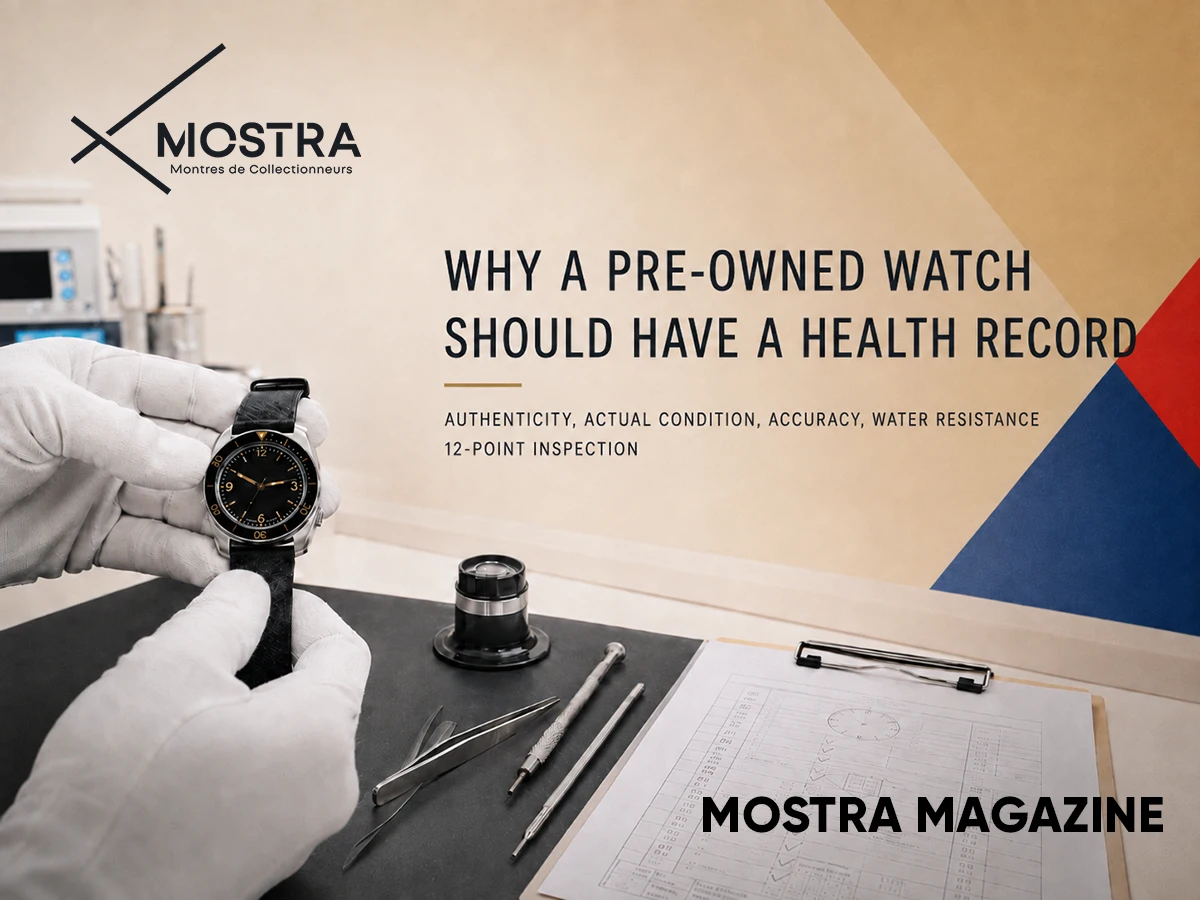
Why a Pre-owned watch should have a Health Record
By Thierry Serna and Jean-Baptiste Contini
Heritage and market perspective: Thierry Serna
Technical analysis and workshop methodology: Jean-Baptiste Contini
Data drawn from the Mostra Observatory 2026
A pre-owned watch can be authentic without being mechanically healthy, accurate without being water-resistant, and highly polished without having preserved the geometry of its case. Drawing on the findings of one hundred watches inspected by its workshop, Mostra proposes a twelve-point watch health report to better inform buyers, sellers and collectors.
A pre-owned watch worth several thousand euros can still be presented with three photographs, a reference number and two words: very good condition.
Those words may be sincere. They do not constitute a diagnosis.
They do not tell you whether the movement corresponds to the reference. They do not measure the power reserve, the efficiency of the automatic winding system or the water resistance. They do not specify whether the dial is original, whether it is a service dial or whether the hands have been replaced. Nor do they describe the polishing of the case, the fatigue of a spring bar, the wear of a clasp or the traces left by an old battery inside a quartz watch.
People often ask whether a watch is authentic.
They should also ask whether it is healthy, coherent, secure on the wrist and suited to the way its future owner intends to use it.
This is precisely the question raised by the Mostra Observatory 2026. Between 5 January and 3 July 2026, the Mostra workshop studied one hundred anonymised watches: 59 automatic, 18 manual-winding mechanical and 23 quartz watches, divided between 28 modern, 34 neo-vintage and 38 vintage or antique pieces. Every watch was inspected in order to compare its appearance with its technical reality.
This study led to one conviction: a pre-owned watch would benefit from being accompanied not only by a commercial description, a certificate of authenticity and a warranty, but also by a dated watch condition report, clear and detailed enough to allow the buyer to understand what they are actually purchasing.
Would you like to understand the true condition of your watch?
The Mostra workshop in Aix-en-Provence can examine its operation, coherence, accuracy, water resistance when the test is appropriate, and the interventions that may need to be considered.
Have my watch diagnosedDiscover the Mostra workshop Have a watch appraised Read the 2026 Observatory
Why the usual descriptions are no longer enough
The pre-owned watch market has an extensive vocabulary, but one that is often imprecise.
“Serviced” may mean that a movement has been completely dismantled, cleaned, lubricated, reassembled and regulated. The same word may sometimes refer to a simple inspection or rate adjustment.
“Water-resistant” may refer to the model’s historical specification, a test carried out several years ago, or a recent inspection whose conditions and date are not stated.
“Full original” may describe a watch that remains coherent with its period, while overlooking the fact that certain consumable technical components may legitimately have been replaced during its life.
“Never polished” may be important heritage information. It does not, however, guarantee the mechanical condition, the security of the bracelet or the absence of oxidation inside the case.
Mostra has already explored this essential distinction between authenticity, originality, conformity, servicing and restoration in its guide Pre-Owned Watches: Understanding the True Condition of a Watch Before Buying It.
A watch can be authentic without being composed entirely of the components fitted when it left the manufacture. It can be coherent, reliable and fully legitimate while containing authentic parts installed during a later service.
The problem is therefore not always the replacement itself.
The problem arises when that replacement is neither identified, explained nor placed within the history of the watch.
A true watch health record would not promise abstract perfection. It would provide the information needed to understand the piece using the right terms.
What the Mostra Observatory 2026 changed
The Mostra Observatory was not created to alarm buyers. It was created to replace impressions with findings.
100
watches inspected
77
mechanical and automatic watches
23
quartz watches
46
watches included in the water-resistance study
Among the 77 mechanical and automatic watches examined, 19 showed a rate considered satisfactory, 58 required regulation, 52 displayed insufficient amplitude or power reserve, and 11 showed magnetisation or unusual rate deviation. These findings may overlap on the same watch and therefore do not represent four mutually exclusive categories.
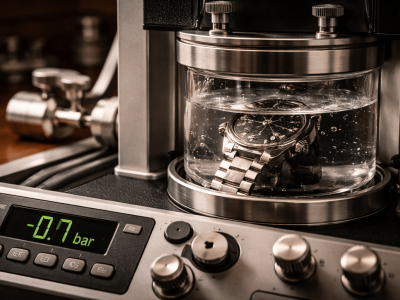
46 watches were included in the water-resistance assessment; 41 were actually pressure-tested, while 5 were excluded due to their age, condition or construction.
The 23 quartz watches also provided important information: thirteen required battery replacement and inspection, twelve showed signs of oxidation or leakage, eight required intervention on the movement or contacts, and only one required no additional work. Here again, several findings could apply to the same piece.
The bracelet, often reduced to the status of an accessory, proved just as important. Seventy-two watches showed significant wear to the bracelet or clasp, and 82 had at least one spring bar or fastening that needed replacing. At the same time, 69 retained an assembly considered coherent and sufficiently secure for the intended use: wear does not therefore always mean immediate danger, but it must be read and explained.
Finally, the study confirmed that the most important intervention is not always the one that is carried out. In 17 cases, the workshop recommended limited aesthetic work or advised against polishing. In 36 cases, the dial, hands or case were preserved despite visible marks precisely because those traces belonged to the coherence of the watch.
These figures do not represent the entire global market. They describe one hundred watches inspected by Mostra.
But they are enough to raise one essential question: why is such a significant part of this reality still absent from so many commercial descriptions?
Read more: Mostra Observatory 2026: What 100 Pre-Owned Watches Inspected by Our Workshop Really Revealed.
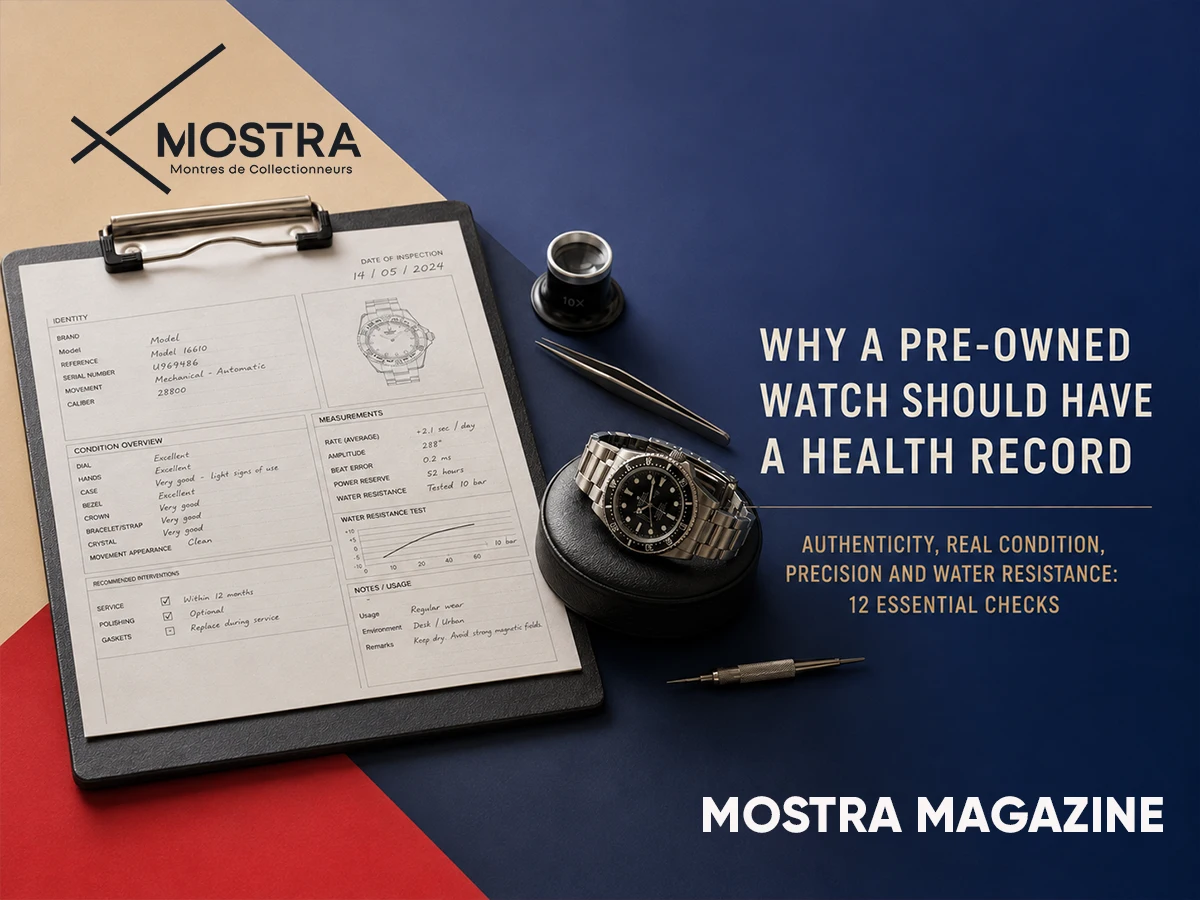
What is a watch Health Record?
A watch health record is a dated condition report.
It describes the identity of the watch, its coherence, its operation, its aesthetic condition and the interventions recommended on the date of inspection.
It cannot guarantee that a watch will retain the same accuracy or water resistance indefinitely. A watch is a living object: it is worn, wound and exposed to shocks, humidity, temperature changes and magnetisation.
The health record should therefore specify:
- the date of inspection;
- the measurements actually carried out;
- the checks not performed and the reason why;
- any conditions or limitations of use;
- the recommended interventions;
- the period during which certain measurements remain relevant.
A water-resistance test carried out today does not constitute a permanent promise. An accuracy measurement carried out in the workshop does not prevent the watch from evolving according to how it is worn or its environment.
A power reserve measured after full winding, however, provides concrete information that is far more useful than simply repeating the theoretical specification published when the model was launched.
The health record is therefore not a reassuring formula.
It is an evidence-based snapshot of the watch at a particular moment.
Watch diagnosis and Watch Health Record: what is the difference?
A watch diagnosis and a watch Health Record answer two different needs.
A diagnosis is generally carried out when a watch shows a symptom or malfunction, such as loss of accuracy, a stopped movement, a winding issue, moisture ingress or another abnormality. Its purpose is to identify the likely cause of the problem and determine the most appropriate intervention.
The Watch Health Record provides a broader overview. It documents the technical, aesthetic and heritage condition of the watch at the date of inspection, even when no specific fault has been identified.
It can include information about the watch’s coherence, mechanical condition, components, water resistance when it can be tested, bracelet safety and any recommended interventions or precautions.
If your watch is malfunctioning or you need to know what work may be required, discover our watch diagnosis and quote service in Aix-en-Provence.
The twelve pieces of information every buyer should be able to consult
In short: the Mostra Watch Health Report is a dated overview of a watch based on 12 technical, aesthetic and heritage checks.
1. Exact identification of the watch
The record should state the brand, model, reference, production period, type of movement and, when useful and appropriate, the available identification numbers.
A description such as “vintage Rolex Datejust” or “old Omega Speedmaster” is not enough. Depending on the reference, year, calibre, dial or case type, two apparently similar watches may occupy very different positions in the history of the collection and on the market.
Identification also makes it possible to verify that the observed characteristics correspond to what the reference is supposed to present: diameter, material, caseback type, crown, bracelet, movement or complication.
2. Authenticity and overall coherence
Authenticating a watch does not simply mean checking the name printed on its dial.
The case, caseback, dial, hands, crown, bezel, movement, bracelet and clasp must all be considered together.
A watch may be composed of authentic components that are incompatible in terms of period, reference or configuration. Conversely, it may contain an authentic component installed during a later service without losing its coherence as a watch intended to be worn.
Mostra therefore distinguishes authenticity from coherence. The first answers the question: are the components genuine? The second asks: do they form a logical whole for this particular watch?
The public process for Mostra pre-owned watch certification already includes an operational assessment, a component audit, a cosmetic examination, photographic documentation and a final inspection before sale.
3. Originality, conformity and service parts
An original part is a component fitted to the watch when it was manufactured. A service part is an authentic component installed later during servicing or repair. A conforming part meets the expected characteristics without necessarily being the component originally fitted to the watch.
A replacement crown can improve the water resistance and security of a watch intended for daily wear. A service dial may reduce the heritage interest of a rare vintage reference while remaining perfectly authentic. Replacement hands may be coherent with an official service and necessary for legibility.
The health record should therefore state what is considered original, what has been identified as a service part, what is conforming but not strictly contemporary with the watch, and what remains uncertain or requires further research.
4. The true condition of the case
The case is the first thing the eye notices. It is also one of the most difficult elements to read correctly from a photograph.
Flattering lighting can conceal rounded edges, an asymmetrical lug or a loss of material. A dull-looking case may, by contrast, have preserved exceptional geometry.
The record should describe the preservation of the volumes, the condition of the lugs and edges, signs of wear, any impacts, traces of polishing, the quality of previous aesthetic work and whether further intervention would be appropriate.
A proper diagnosis does not consist of applying one universal rule. It consists of assessing what the watch has preserved and what a further intervention might erase.
5. The condition of the dial and hands
The dial carries much of a watch’s desirability. It also carries many ambiguities.
Patina can be even and highly sought after. It may also result from water ingress or progressive deterioration. A dial may have been cleaned, restored, refinished or replaced. The hands may be coherent with the dial, more recent, relumed or fitted during a service.
The record should specify the state of preservation, the coherence between dial and hands, the nature of the luminous materials, possible traces of humidity, any identified restoration or replacement, and any limitations of interpretation.
6. measured mechanical condition
“It works” is not a diagnosis.
A watch can start after a few turns of the crown and still be mechanically tired. The report must therefore go beyond simply observing that the movement is running.
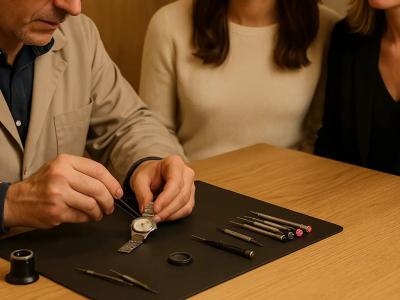
Depending on the calibre, it should include accuracy, amplitude, beat error, stability, differences between positions, the presence of magnetisation, unusual sounds or behaviour, and the visible condition of the movement after opening.
A single value can look flattering. The health of a movement is read through a combination of measurements and behaviours.
To understand the work that may be required, you can also consult the page dedicated to watch servicing in Aix-en-Provence.
7. Power reserve after full winding
The theoretical power reserve belongs to the model’s technical specifications. The actual power reserve belongs to the watch being purchased.
Between the two, several years or several decades of wear, servicing and use may have passed.
The record should therefore state the theoretical duration announced for the calibre, the duration actually measured, the conditions of the test and the result obtained after full winding.
A watch may display acceptable accuracy while running, yet stop too early because of a tired mainspring, an inefficient automatic winding system or insufficient amplitude.
8. Winding, crown and functions
The real experience of a watch also depends on everything that allows it to be used: manual winding, automatic winding, time setting, date change, quick correction, chronograph, alarm, second time zone, pushers and correctors.
A stiff crown, irregular date change or a pusher that feels less positive can indicate wear before a complete failure appears.
On a quartz watch, this section also includes the operation of the module, the condition of the contacts and the behaviour of the displays or motors.
The report should not merely say whether the watch tells the time. It should say whether it can be used with confidence.
9. Water resistance, with a date and clear limitations
Water resistance is one of the most misunderstood concepts in the pre-owned watch market.
A model originally rated to 100, 200 or 300 metres does not automatically retain that capability throughout its life.
The health record should distinguish between three situations:
- water resistance tested and satisfactory on the stated date;
- insufficient water resistance or intervention required;
- watch not tested, with an explanation of the reason.
Not testing an antique watch can sometimes be the most responsible choice. The record must never turn the absence of a test into an implied promise.
10. The bracelet and security on the wrist
A watch can be mechanically healthy and still fall because of a tired spring bar.
The record should examine the bracelet, clasp, links, screws, spring bars, attachments, sizing and compatibility of the bracelet with the watch.
The bracelet must not be treated as a matter of style alone. It is a mechanical part of the watch’s security.
The Mostra workshop also offers watch strap replacement, fitting and adjustment in Aix-en-Provence.
11. History and recommended interventions
A useful watch health record does not stop at the findings. It also states what should happen next.
The recommendation may be: no intervention, regulation, battery replacement, gasket replacement, future inspection, preventive maintenance, complete service, targeted repair, complex restoration or preservation in its current condition.
It is just as important to state what is not recommended.
A vintage watch may require a mechanical service without polishing being advisable. A marked dial may need to be preserved. An old bracelet may remain with the watch even if a second bracelet is fitted for daily wear.
When a malfunction is identified or further work appears necessary, a watch diagnosis can help determine the most appropriate next step.
Depending on the condition of the watch, the workshop may recommend simple monitoring, watch servicing or, when a specific fault is identified, watch repair.
12. The heritage perspective
Two technically comparable watches can have very different levels of desirability.
That difference is based on the configuration, the history of the model, the rarity of the version, the quality of preservation and the emotion conveyed by the piece.
The heritage perspective must answer several questions:
- what should be preserved?
- what can be replaced without compromising the watch?
- which intervention might reduce its interest?
- how does its condition influence its value and desirability?
- should the watch be worn, restored, preserved or passed on in its current condition?
For Thierry Serna, a collector’s watch cannot be reduced to a market value or its appearance. Its desirability is born from the meeting of coherence, preservation, history, rarity and emotion.
For vintage and antique watches, this assessment requires particular care: signs of wear, patina and original components may sometimes be more valuable when preserved than restored. You can also read our guidance for vintage and antique watches.
Are you considering buying a pre-owned watch?
A preliminary inspection can help you better understand its condition, previous interventions, limitations of use and the maintenance budget that may need to be anticipated.
Have a watch checked before buying Understand its true condition
Certificate, warranty, digital passport and watch Health Record: what is the difference?
These documents are sometimes confused. Yet they do not answer the same questions.
| Document | Main question | Role |
|---|---|---|
| Certificate of authenticity | Are the watch and the examined components authentic? | Identify the piece and attest to authenticity within the scope of the examination. |
| Warranty | What commitments does the seller make after the sale? | Define the conditions and duration of coverage. |
| Digital passport | How can the identity and documentary history of the watch be preserved? | Organise traceability, documents, interventions and transfers of ownership. |
| Watch health record | What is the true condition of the watch today? | Describe the technical, aesthetic and heritage condition on a given date. |
A watch may have a certificate of authenticity and still have insufficient power reserve. It may be under warranty without having been tested for a particular aquatic use. It may have a perfectly documented passport and still require maintenance.
The health record therefore answers the question that the other documents do not fully cover: what is the condition of this watch today?
To explore these differences further, consult the pages dedicated to Mostra pre-owned watch certification and the Mostra thirty-six-month warranty.
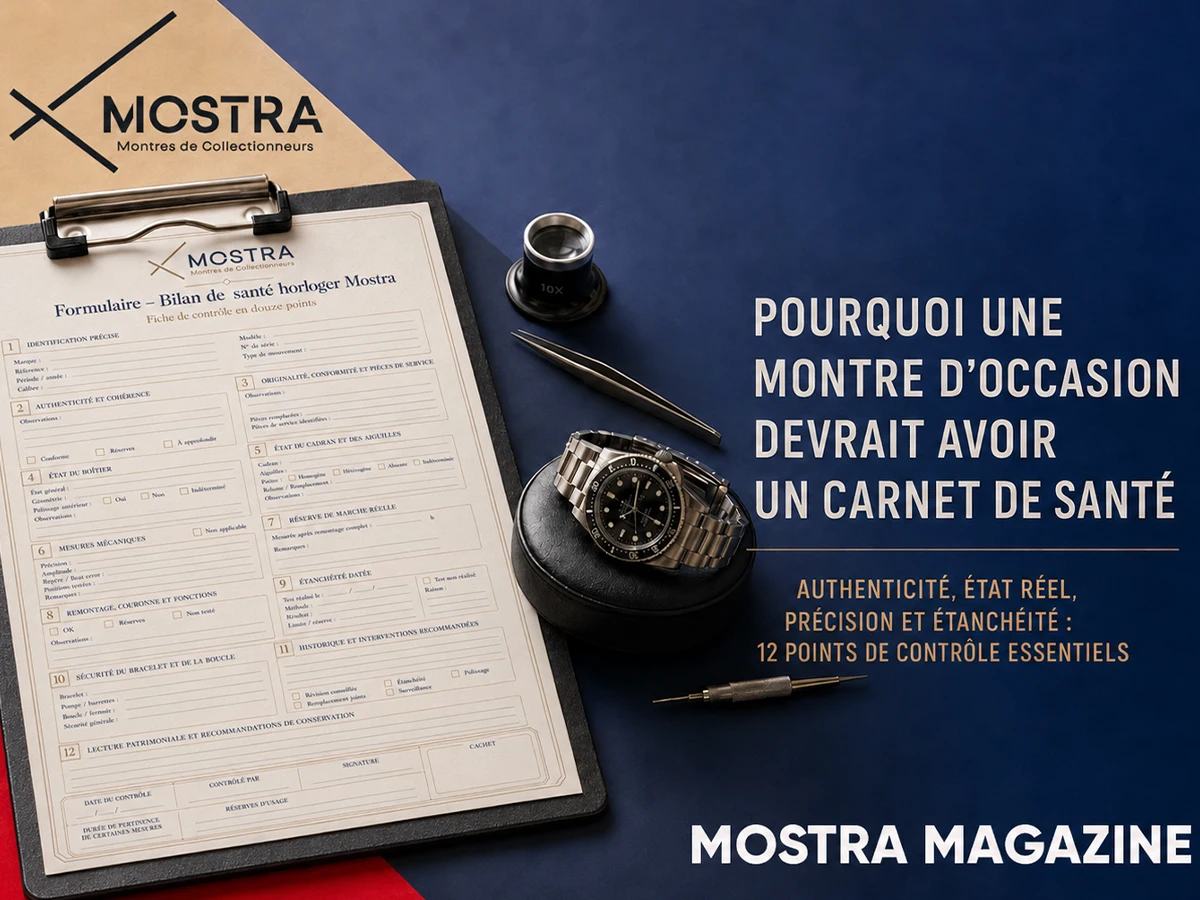
Three cases showing why this report is necessary
A Visually Healthy Rolex Submariner That Was Not Water-Resistant
The 2001 Rolex Submariner 14060-M examined as part of the Observatory appeared perfectly presentable. Its dial, bezel and operation gave no immediate indication of a problem.
The test nevertheless detected a leak around the crown. The crown tube had a damaged thread. Replacing it, together with the gaskets, followed by a new test, restored the water resistance.
A photograph would not have revealed this weakness. A health record would have made it immediately clear.
A Marked but Coherent Omega Speedmaster 861
The Speedmaster showed signs of use, a scratched acrylic crystal, a patinated bezel and a worn bracelet.
Extensive aesthetic restoration might have seemed logical.
The examination showed that the movement required servicing, but that the case, dial, bezel and tritium hands still formed a coherent whole. Mostra prioritised mechanical servicing, careful cleaning and polishing of the acrylic crystal without erasing the traces that formed part of its history.
The report did not recommend making the watch look newer. It recommended making it fully functional without removing its truth.
A Chanel J12 Whose Movement Did Not Need Replacing
The owner believed that the complete movement had to be replaced because the watch was no longer displaying the time.
The diagnosis revealed a hand-setting fault caused by a light impact. A targeted intervention was sufficient, followed by an inspection of the motion work and the overall operation.
The health record also protects against disproportionate interventions.
It begins by understanding before replacing.
What This Report Changes for Buyers, Sellers and Collectors
For the Buyer: Greater Clarity
It is no longer only a question of whether the watch is appealing, whether its price appears coherent or whether it comes with its box.
It becomes possible to understand what was inspected, what is working normally, what has been replaced, what should be monitored, what could not be tested, what intervention may be required and which precautions should be respected.
This knowledge does not remove emotion.
It gives emotion a framework.
For the Seller: Better Presentation and Value
A properly followed watch, whose power reserve, accuracy, water resistance and components are documented, becomes easier to present.
Transparency avoids misunderstandings. It distinguishes normal signs of use from genuine faults. It allows a legitimate service part to be explained rather than becoming a source of suspicion.
It can also prevent unnecessary work before a sale. A preliminary inspection helps determine what genuinely improves the watch and what might diminish it.
To prepare a sale, read the guide Selling Your Watch in Aix-en-Provence: Valuation, Trade-In and Consignment Sale, or submit your request directly through the Sell My Watch page.
For the Collector: A Deeper Reading
The collector does not always look for the newest or most perfect watch. They often look for the most coherent piece.
The health record helps distinguish wear from alteration, patina from deterioration, a service part from an incoherent part, legitimate maintenance from excessive transformation, and a healthy movement from a watch that has merely been regulated to look satisfactory in the short term.
It also makes it possible to follow the evolution of a piece over time. An initial report can become the reference point for a later inspection.
Would you like to document a watch before selling or passing it on?
Mostra can assist with identification, appraisal, condition assessment and guidance toward the interventions that are genuinely relevant.
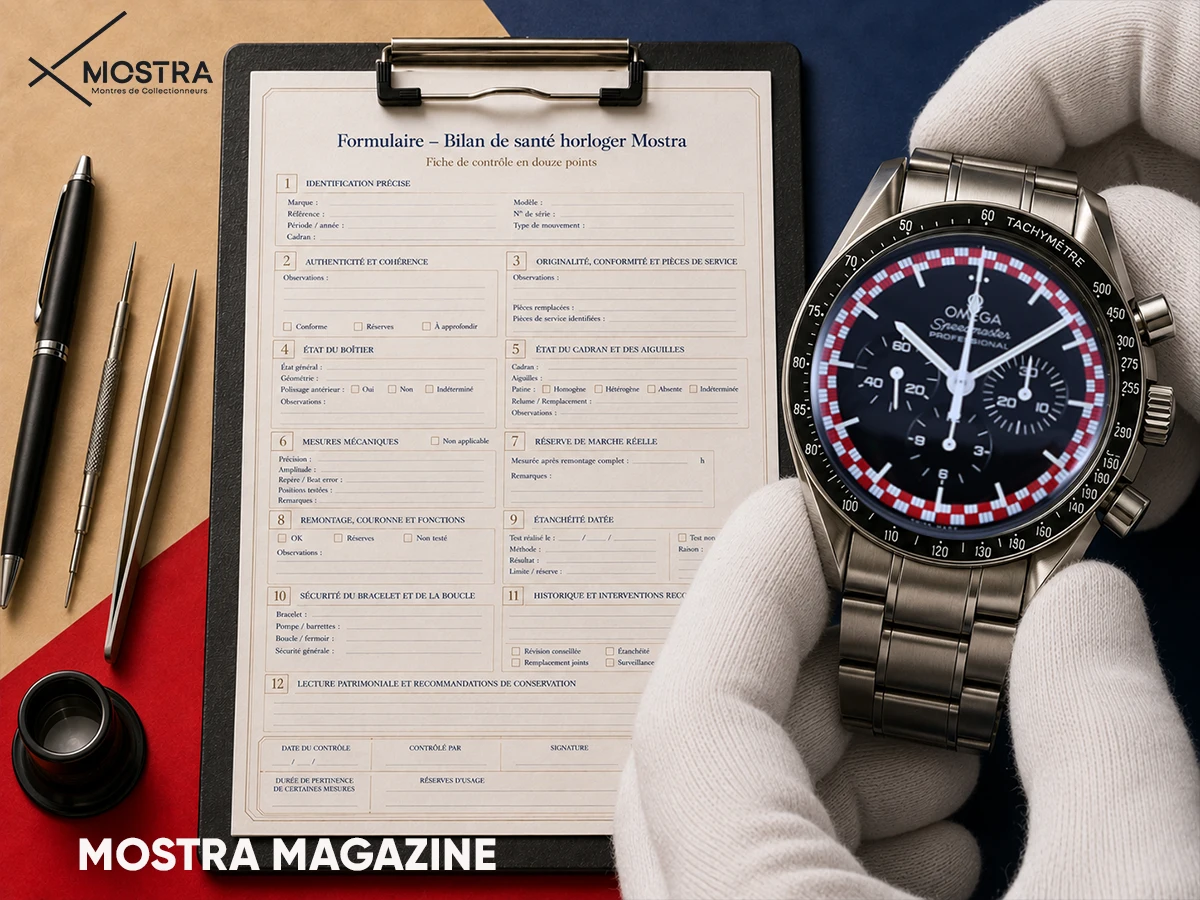
The twelve-point Mostra watch Health Report
In light of the Observatory, Mostra proposes organising the assessment of a pre-owned watch around twelve essential pieces of information:
- Precise identification of the brand, model, reference, period and movement.
- Authenticity and coherence of the principal components.
- Originality, conformity and service parts clearly distinguished.
- Condition of the case, its geometry and previous aesthetic interventions.
- Condition of the dial and hands, including an assessment of patina and replacements.
- Mechanical measurements suited to the nature of the movement.
- Actual power reserve measured after full winding.
- Winding, crown and functions inspected.
- Dated water-resistance result when the test is appropriate and technically possible.
- Security of the bracelet and clasp.
- History and recommended interventions.
- Heritage assessment and preservation recommendations.
Not every point necessarily produces a numerical result. Not every test is suited to every watch.
An antique piece may require greater caution than a modern dive watch. A quartz watch calls for a different reading from a mechanical chronograph.
The standard does not consist of applying the same procedure blindly.
It consists of explaining clearly what was checked, what was not, and why.
Transparency that also protects serious professionals
Requesting more information does not mean systematically distrusting sellers.
Quite the opposite.
A more precise market makes it easier to distinguish professionals who genuinely inspect their watches from those who rely on a photograph and a reassuring phrase.
Transparency protects the buyer. It also protects the serious seller, the conscientious workshop and the properly maintained watch.
The pre-owned market will not gain trust by promising that every watch is perfect.
It will mature by learning to describe honestly each watch’s qualities, interventions, limitations and potential.
A pre-owned watch does not need a certificate of perfection
It needs a history that can be understood.
It needs a readable technical condition.
It needs replacement parts to be identified.
It needs water resistance to be measured rather than assumed.
It needs the power reserve to be checked rather than repeated from a technical specification.
It needs someone to know when to intervene.
And when to stop.
A watch health record will never make a watch immutable.
It can, however, make the purchase more informed, maintenance more predictable and transmission clearer.
That is already a great deal.
And it may be one of the next necessary steps in the development of the French pre-owned watch market.
Have your watch inspected at Mostra in Aix-en-Provence
At 3 place Forbin in Aix-en-Provence, Mostra brings together its boutique, appraisal expertise and watchmaking workshop to assist with Watch Health Reports, diagnosis, servicing, repair and preparation for sale.
Have my watch diagnosed Have my watch appraised Have my watch valued or sell it Discover Mostra watches

FAQ - The Health Record of a Pre-Owned Watch
What is a watch health record?
It is a dated report on the operation, coherence, aesthetic condition and maintenance needs of a watch. It specifies the checks carried out, their results, the limits of the diagnosis and any recommended interventions.
Is it the same as a certificate of authenticity?
No. The certificate mainly concerns the identity and authenticity of the watch or its components within the scope of the examination. The health record describes its true condition on a given date.
Is it the same as a warranty?
No. A warranty defines the seller’s commitments for a given period and under specified conditions. The health record is a technical and heritage snapshot of the watch at the time of inspection.
Is it the same as a digital passport?
No. A passport mainly organises identity, documents, photographs and the history of ownership or maintenance. The health record describes the condition observed during a specific inspection.
Can an antique or vintage watch receive a health record?
Yes. The protocol must, however, be adapted to its age, construction, condition and heritage interest. Certain tests, particularly pressure tests, may be inadvisable.
Does the watch need to be opened to establish the report?
Opening is often necessary to identify the movement, look for signs of previous interventions and examine the internal condition. It must be carried out by a professional using appropriate tools and respecting the construction of the watch.
Is a watch that is not water-resistant necessarily in poor condition?
No. Some antique watches were never designed for aquatic use, and certain heritage pieces should not be subjected to pressure testing. The important point is that this limitation is clearly stated.
Is a serviced watch automatically healthy?
No. The term “serviced” should be clarified: date, nature of the work, parts replaced, inspection results and identity of the person or workshop that carried out the intervention. An old service does not necessarily describe the current condition.
How long does a watch health record remain valid?
There is no universal validity period. The measurements describe the condition on the date of inspection. Their relevance then depends on use, shocks, exposure to water, storage and subsequent interventions.
Can the health record make a watch easier to sell?
Yes. It helps explain the watch, anticipate objections and distinguish normal signs of use from more significant interventions or faults. It does not, however, determine market value on its own.
Is the report useful in an inheritance?
Yes. It can help heirs identify the watches, understand their condition and decide whether they should be preserved, maintained, appraised or sold.
Can Mostra inspect a watch purchased elsewhere?
Yes. The Mostra workshop can inspect modern, vintage and collector watches regardless of where they were purchased, for a Watch Health Report, diagnosis, servicing, repair or restoration.
Where can I have a watch health report carried out in Aix-en-Provence?
You can bring your watch to the Mostra workshop at 3 place Forbin in Aix-en-Provence. Depending on your needs, our team can guide you toward a targeted diagnosis in the event of a malfunction or toward a broader Watch Health Report designed to document the overall condition of the watch.
Also Read in Mostra Magazine
- Mostra Observatory 2026: What 100 Pre-Owned Watches Really Revealed
- Pre-Owned Watches: Understanding the True Condition Before Buying
- Why Have Your Watch Appraised in Aix-en-Provence?
- Selling Your Watch in Aix-en-Provence: Valuation, Trade-In and Consignment Sale
- Mostra Watchmaking Workshop in Aix-en-Provence
- Mostra Boutique in Aix-en-Provence
Share this content