Mostra Observatory 2026: What 100 Pre-Owned Watches Inspected by Our Workshop Really Revealed
The Mostra Workshop inspected 100 pre-owned watches to assess their true condition: accuracy, water resistance, authenticity, polishing, bracelets, and servicing requirements. The Mostra Observatory 2026 reveals what photographs and marketing descriptions do not always show.
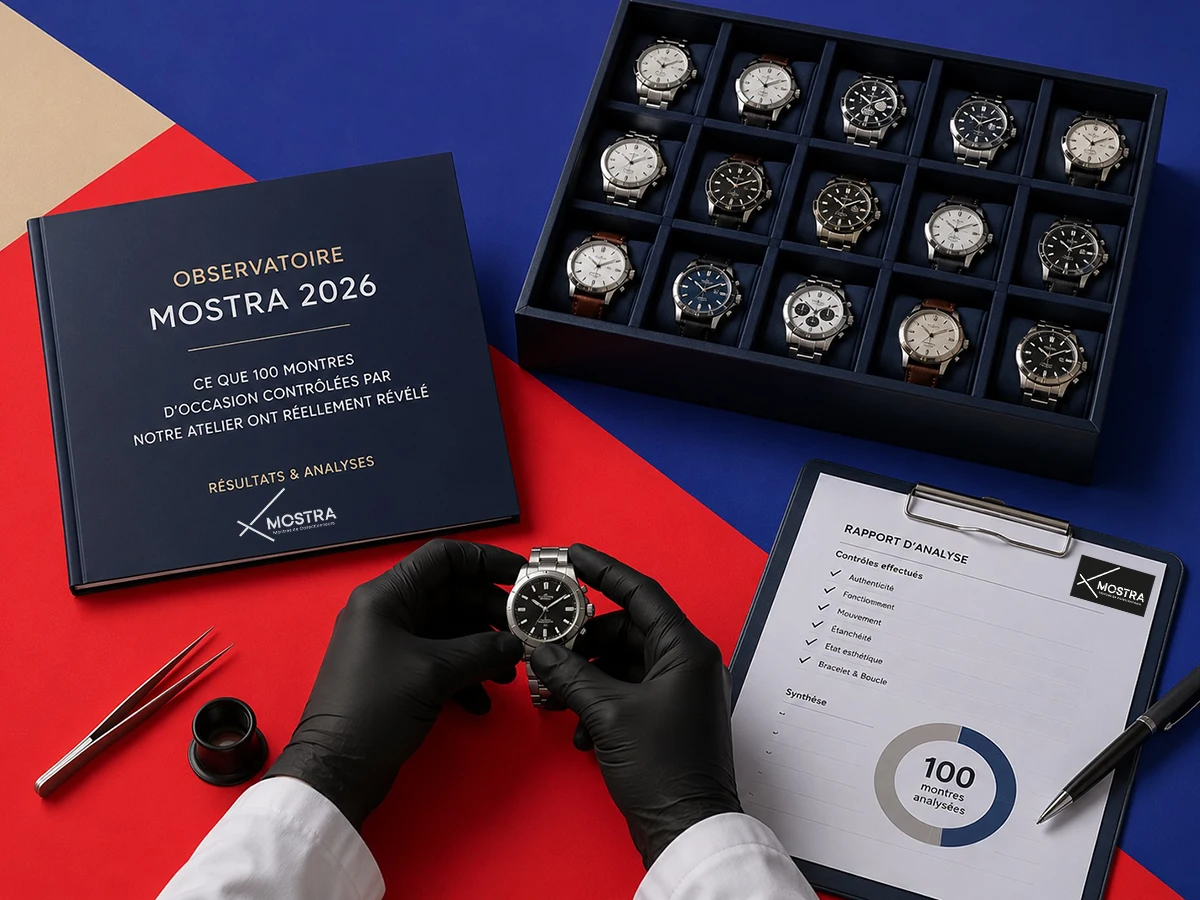
Mostra Observatory 2026: What 100 Pre-Owned Watches Inspected by Our Workshop Really Revealed
Study conducted by the Mostra Workshop from January 5 to July 3, 2026. Technical analysis: Jean-Baptiste Contini. Heritage assessment and market analysis: Thierry Serna. Sample: 100 anonymized watches. Data version: July 2026.
Some watches arrive at the workshop complete with their box, papers and a perfectly ordered history. Others arrive alone. They wear an attractive dial, a luminous case, a few marks left by time and, sometimes, a certainty repeated for years: “It runs well... but.”
Then comes the moment of inspection. The watch moves from the light of the boutique to the light of the watchmaker’s bench. It is examined, measured and listened to. Its accuracy is observed. Its power reserve is compared with reality. Its crown, bracelet, clasp and water resistance are checked whenever the nature of the watch allows it. Its dial, hands and case then begin to tell a story far more precise than the one contained in an advertisement or in a memory.
It is within this interval, between appearance and measurement, that the true work of Mostra begins.
For more than thirty years, the Mostra watchmaking workshop in Aix-en-Provence has assisted owners of mechanical, automatic and quartz watches with servicing, overhaul, repair and restoration. This daily practice, combined with the work of selecting, appraising and selling modern, vintage and collector's watches, naturally led to one question: what do we actually discover when we methodically examine one hundred pre-owned watches?
To answer that question, we decided to move beyond the impressions accumulated over the years. We wanted to measure, classify and document.
This is how the first Mostra Pre-Owned Watch Observatory was born.
Why Create a Pre-Owned Watch Observatory?
The pre-owned watch market readily uses reassuring expressions: very good condition, full original, serviced, never polished, collector's condition. These words and descriptions are not necessarily false or misleading. However, they become clearly insufficient when they replace a thorough analysis.
A watch may be authentic without being entirely original. It may contain parts that are perfectly conforming, yet installed during a later service (the service life of a mainspring is not the same as that of a movement component; like the headlight bulb of a classic car, it is a wear item that will inevitably be replaced during the life of a watch). A case may shine while having lost part of its original geometry. Conversely, a heavily worn watch may have preserved remarkable overall coherence. A watch may still keep time while lacking the expected power reserve, balance amplitude or water resistance.
Mostra has already devoted several articles to this essential distinction between authenticity, originality, conformity, servicing and restoration. The Observatory extends that approach by giving it a measurable dimension: the objective is no longer simply to explain how to read a watch, but to demonstrate what that reading reveals across a real-world sample.
Our Methodology
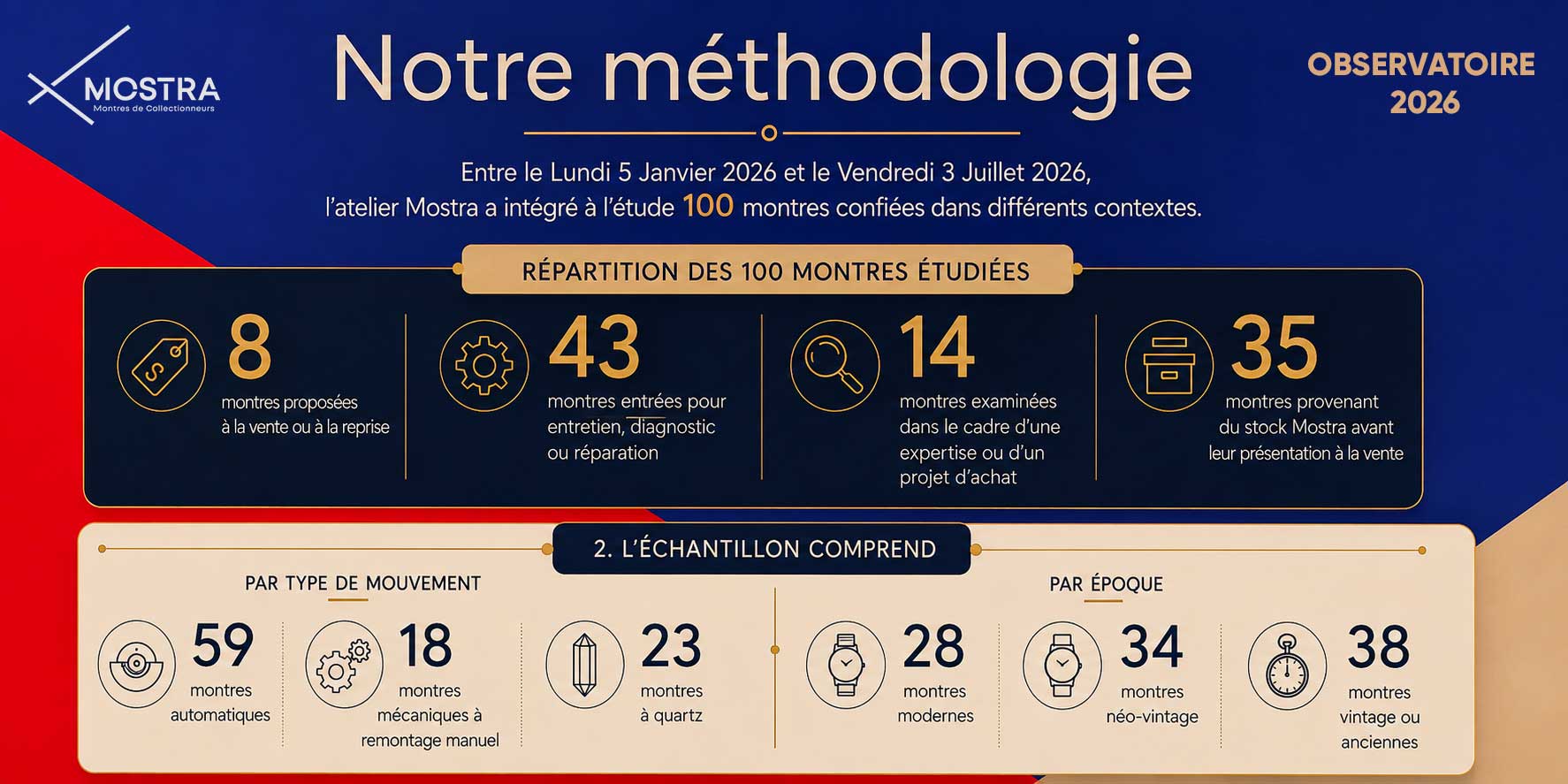
Between Monday, January 5, 2026 and Friday, July 3, 2026, the Mostra workshop included one hundred watches entrusted to us in a variety of contexts:
-
8 watches submitted for purchase or trade-in;
-
43 watches received for servicing, diagnosis or repair;
-
14 watches examined as part of an appraisal or acquisition project;
-
35 watches taken from Mostra's own inventory before being offered for sale.
The sample comprised:
-
59 automatic watches;
-
18 manually wound mechanical watches;
-
23 quartz watches;
-
28 modern watches;
-
34 neo-vintage watches;
-
38 vintage or antique watches.
Every watch was anonymised.
The objective was not to identify a brand, a seller or an owner, but to understand the mechanisms that influence the true condition of a pre-owned watch.
Not every watch necessarily underwent exactly the same tests.
A water-resistance test, for example, only makes sense when the construction, condition, age of the watch and the owner's request make it appropriate.
Likewise, a watch was opened only when the technical, commercial or heritage context justified doing so.
This study therefore does not claim to represent the global pre-owned watch market statistically.
It simply describes the one hundred watches that genuinely passed through the hands of Mostra during the selected period.
This limitation is also its greatest strength.
The observations are not theoretical.
They come directly from the watchmaker's bench.
What We Examined
The inspection protocol focused on five major areas of observation.
The Identity and Overall Coherence of the Watch
Reference, production period, movement type, and the coherence between the case, dial, hands, crown, bezel, bracelet and clasp.
Heritage Condition
Case geometry, quality of the edges, traces of polishing, condition of the dial, consistency of the luminous materials, and the presence of original, conforming or service components.
Mechanical Condition
Accuracy, amplitude where measurement was relevant, beat error, winding efficiency, power reserve, operation of the date, chronograph and other complications, possible magnetisation and signs of previous interventions.
Water Resistance and Operational Safety
Condition of the gaskets, crown, caseback, pushers, crystal, bracelet, clasp, links and spring bars.
Pressure testing whenever it could be performed safely and corresponded to the intended use of the watch.
Workshop Recommendation
No intervention.
Simple adjustment.
Preventive maintenance.
Complete overhaul.
Repair.
Complex restoration.
Or, conversely, a recommendation to preserve the watch in its present condition in order to maintain its historical coherence.
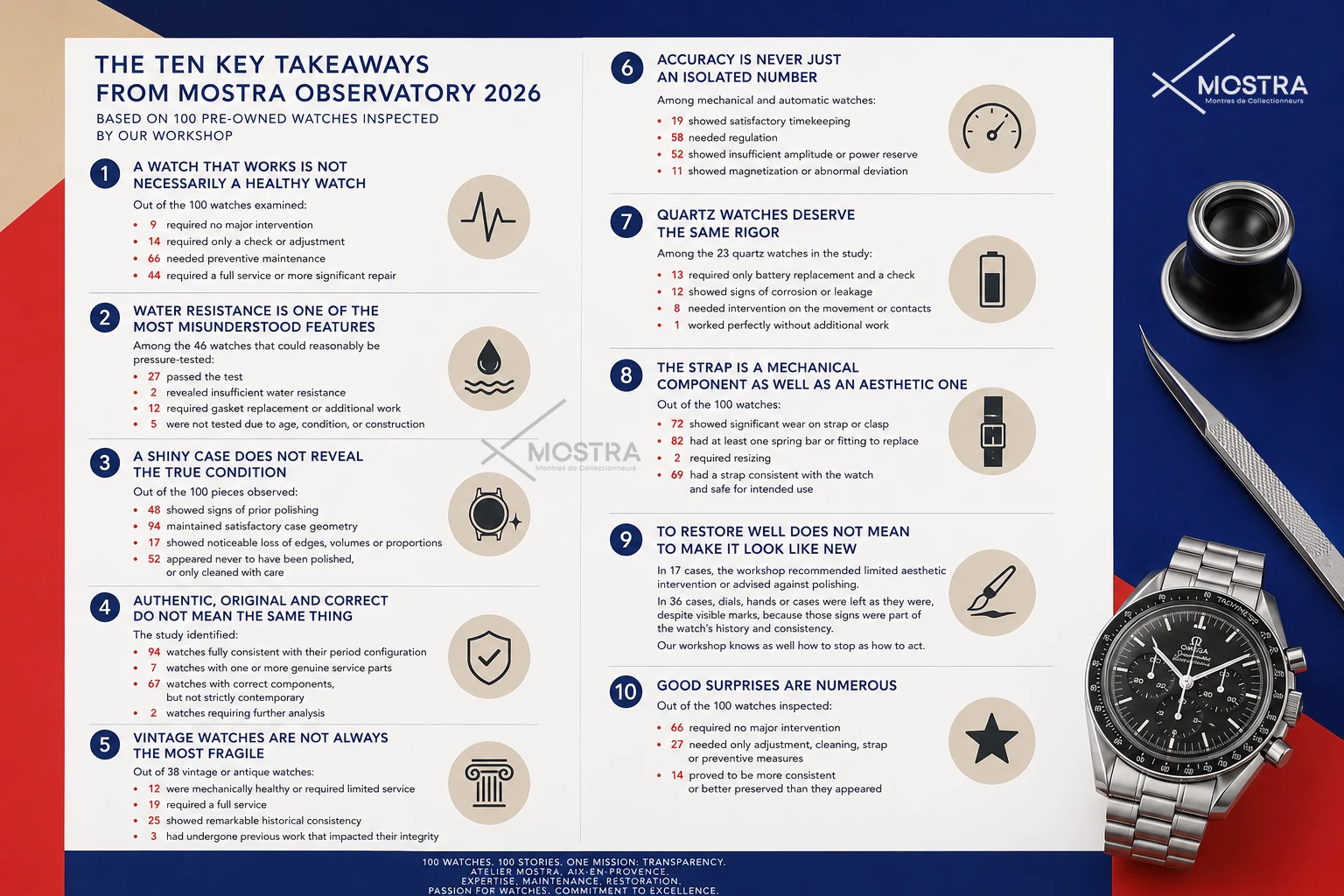
The Ten Main Findings of the Mostra Observatory 2026
1. A Watch That Runs Is Not Necessarily a Healthy Watch
Among the one hundred watches examined:
-
9 required no significant intervention;
-
14 required only inspection or adjustment;
-
66 justified preventive maintenance;
-
44 required a complete overhaul or more substantial repair.
The first lesson is therefore one of nuance.
A watch that runs is not automatically healthy.
Neither should an older or pre-owned watch automatically be considered problematic.
Between the perfect watch and the broken watch lies an entire diagnostic territory:
slight rate deviation,
insufficient power reserve,
degraded lubrication,
magnetisation,
imperfect adjustment,
or a crown requiring attention.
It is precisely within this territory that preventive maintenance becomes meaningful.
Very often, it preserves the movement before normal wear transforms a reasonable service into a complex repair.
2. Water Resistance Is One of the Most Commonly Misunderstood Characteristics
Among the 46 watches that could reasonably undergo pressure testing:
-
27 successfully passed the prescribed protocol;
-
2 revealed insufficient water resistance;
-
12 required gasket replacement or additional intervention;
-
5 were not tested because of their age, condition or construction.
An inscription on a dial or caseback never constitutes a lifetime or permanent guarantee.
Gaskets age.
Crowns wear.
An impact may alter an assembly.
A previous opening may never have been followed by a pressure test.
A dive watch may therefore retain every visual characteristic of a professional diving instrument while no longer providing the level of protection expected against water.
The most valuable conclusion of the study is not to alarm owners.
It is simply to remind them that a water-resistance test reflects the measured condition of a watch at one precise moment.
That condition must be verified again according to the real life of the watch, particularly after opening the case, servicing, battery replacement or before a period of regular exposure to water.
3. The Shine of a Case Does Not Reveal Its True Condition
Among the one hundred watches examined:
-
48 showed evidence of previous polishing;
-
94 had retained satisfactory case geometry despite cosmetic intervention;
-
17 displayed a noticeable loss of edges, proportions or overall volume;
-
52 appeared never to have been polished, or only lightly cleaned.
A bright, highly polished case may inspire confidence at first glance. It guarantees neither the preservation of the original lines nor the quality of previous work.
Conversely, a watch bearing visible signs of use may prove exceptional if its lugs, bevels, edges and proportions have remained faithful to the original design. In the world of collector's watches, the marks left by time are not always defects. They may instead demonstrate that a watch has lived naturally without being artificially transformed.
The role of the expert is therefore not to favour the brightest-looking watch. It is to distinguish honest wear from alteration, and carefully considered cleaning from excessive refinishing.
4. Authentic, Original and Conforming Do Not Mean the Same Thing
The study identified:
-
94 watches fully coherent with their period configuration;
-
7 watches fitted with one or more authentic service parts;
-
67 watches equipped with conforming components that were not strictly contemporary with the original production;
-
2 watches requiring further analysis before any conclusion could be reached.
An authentic service part is not a counterfeit component. It may have been legitimately installed to preserve the functionality or readability of the watch. Its impact depends upon the model, its production period, its rarity and the expectations of the future owner.
On a recent everyday watch, replacing a crown or a set of hands may represent perfectly logical maintenance.
On a rare vintage reference, the very same intervention may significantly alter the historical reading of the watch.
The essential point therefore lies not in an abstract obsession with originality.
It lies in transparency:
knowing what has been preserved,
what has been replaced,
what has been maintained,
and what has been restored.
5. Vintage Watches Are Not Always the Most Fragile
Among the 38 vintage or antique watches examined:
-
12 were mechanically sound or required only limited maintenance;
-
19 required a complete overhaul;
-
25 displayed remarkable historical coherence;
-
3 had undergone earlier interventions affecting their historical reading.
Among the 62 modern or neo-vintage watches:
-
37 required no significant intervention;
-
19 revealed wear or defects requiring more substantial work.
Age alone is therefore neither a reliable nor sufficient indicator for diagnosis.
An older watch that has been serviced regularly may prove mechanically healthier than a recent watch subjected to intensive wear, repeated exposure to water, shocks or magnetism, and subsequently neglected without inspection.
Vintage watches require greater discernment, but they should never be confused with systematic fragility.
A simple construction, a well-preserved movement and a consistent servicing history may carry a watch through decades with remarkable mechanical dignity.
6. Accuracy Can Never Be Reduced to a Single Figure
Among the mechanical and automatic watches examined:
-
19 displayed a rate considered satisfactory;
-
58 required adjustment;
-
52 showed insufficient balance amplitude or power reserve;
-
11 presented magnetisation or unusual rate deviation.
An instantaneous measurement never tells the whole story of a movement.
Jean-Baptiste Contini does not simply observe whether a watch is gaining or losing time.
He evaluates its stability, balance amplitude, beat error, power reserve, winding efficiency, positional variation and the watch's actual behaviour after a complete winding.
A watch adjusted to produce an impressive reading for a few minutes may still be mechanically tired.
Conversely, a slight rate deviation may sometimes be corrected without requiring a complete overhaul.
Accuracy is therefore not a score.
It is a collection of mechanical indications interpreted together.
7. Quartz Watches Deserve the Same Rigour as Every Other Watch
Among the 23 quartz watches included in the study:
-
13 required only battery replacement and inspection;
-
12 showed signs of oxidation or battery leakage;
-
8 required intervention on the movement or electrical contacts;
-
1 was functioning normally without any additional work.
Quartz watches sometimes suffer from a certain degree of indifference.
Because a quartz movement contains fewer moving parts than a traditional mechanical calibre, many assume that it requires no particular attention.
Yet a forgotten battery may become destructive.
Moisture infiltration may damage electronic circuits and contacts.
Ageing gaskets may compromise the protection of the case.
Vintage quartz watches, jewellery watches and certain collectible references therefore deserve genuine attention.
A battery should never simply be replaced.
The overall condition of the watch should also be carefully assessed.
8. The Bracelet Is as Much a Mechanical Component as It Is an Aesthetic One
Among the one hundred watches examined:
-
72 showed significant wear to the bracelet or clasp;
-
82 had at least one spring bar or fastening that required replacement;
-
2 required size adjustment;
-
69 were fitted with a bracelet that remained coherent with the watch and sufficiently secure for its intended use.
A movement may be in perfect condition while the watch itself remains vulnerable.
A worn spring bar, an unreliable clasp, a poorly tightened screw or a weakened leather strap are enough to cause the watch to fall—or even be lost altogether.
Yet the bracelet is often examined only after the dial, the case and the movement, as though it were merely an accessory.
At the Mostra workshop, it is considered an integral part of the inspection.
Its safety, adjustment, coherence with the watch and comfort on the wrist all contribute to the true condition of the timepiece.
9. Restoring Properly Does Not Mean Making a Watch Look New Again
In 17 cases, the workshop recommended only limited cosmetic intervention or advised against polishing altogether.
In 36 cases, the dial, hands or case were intentionally preserved despite visible signs of wear because those traces formed part of the watch's historical coherence.
This is one of the Observatory's most important conclusions.
A workshop is not simply the place where interventions are carried out.
It must also be the place where one knows when not to intervene.
A patinated dial does not automatically call for restoration.
A vintage watch does not need to recover the appearance of a piece freshly delivered from the factory.
A marked case does not necessarily need polishing.
Every intervention must be weighed against what it might erase.
The success of a restoration is therefore not measured by the number of traces removed.
It is measured by the amount of historical coherence that has been preserved.
10. Pleasant Surprises Are More Common Than One Might Think
Among the one hundred watches inspected:
-
66 required no major intervention;
-
27 required only adjustment, cleaning, a bracelet replacement or preventive maintenance;
-
14 proved to be more coherent or better preserved than their appearance initially suggested.
The Observatory is not a catalogue of defects.
It also demonstrates that many pre-owned watches have been properly maintained, carefully worn or simply built to last.
Some modest watches proved remarkably healthy.
Some heavily worn examples preserved greater integrity than visually more attractive pieces.
A pre-owned watch is therefore not a problem waiting to be solved.
It is an object waiting to be understood.
Three Watches, Three Stories Revealed by the Workshop
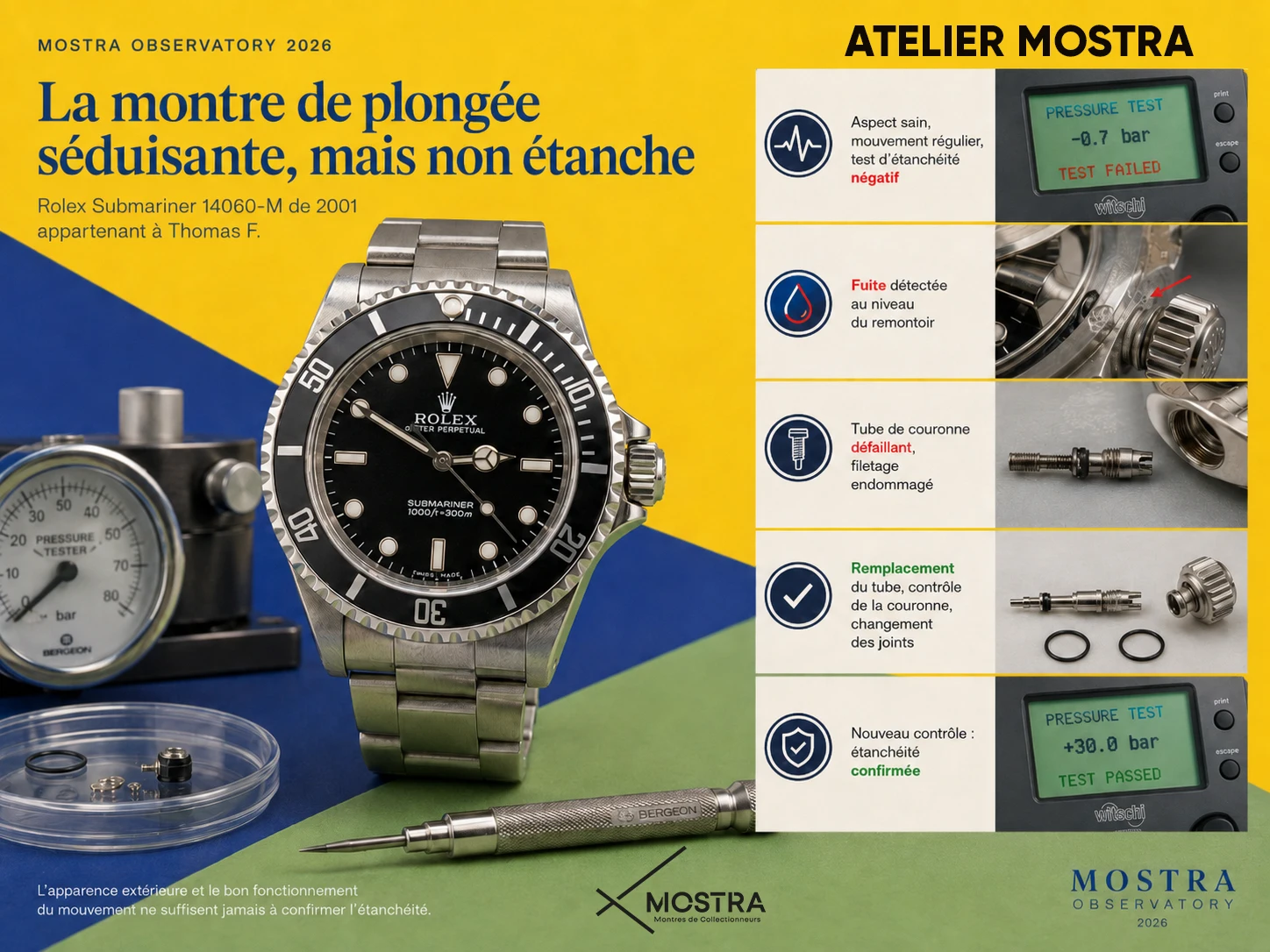
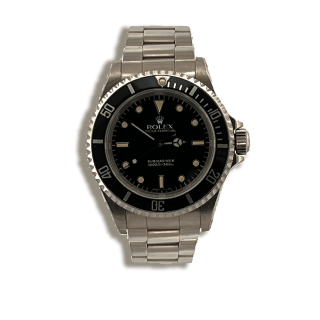
Case Study No. 1 — The Attractive Dive Watch That Was No Longer Water-Resistant
Rolex Submariner 14060-M (2001), owned by Thomas F.
When it arrived at the workshop, the watch appeared perfectly presentable.
The dial was clean.
The bezel operated correctly.
The movement performed consistently.
The case appeared visually sound.
The pressure test, however, produced a negative result.
Water-resistance testing revealed a leak around the winding crown, which was subsequently confirmed during diagnosis.
Further examination showed that the winding crown tube was defective and that its thread had become damaged.
The intervention consisted of replacing the crown tube, checking the crown threads, replacing the caseback, crown and tube gaskets, before carrying out a second pressure test that confirmed the watch had fully recovered its water resistance.
This watch illustrates a simple rule:
External appearance and proper movement operation are never sufficient to confirm water resistance.
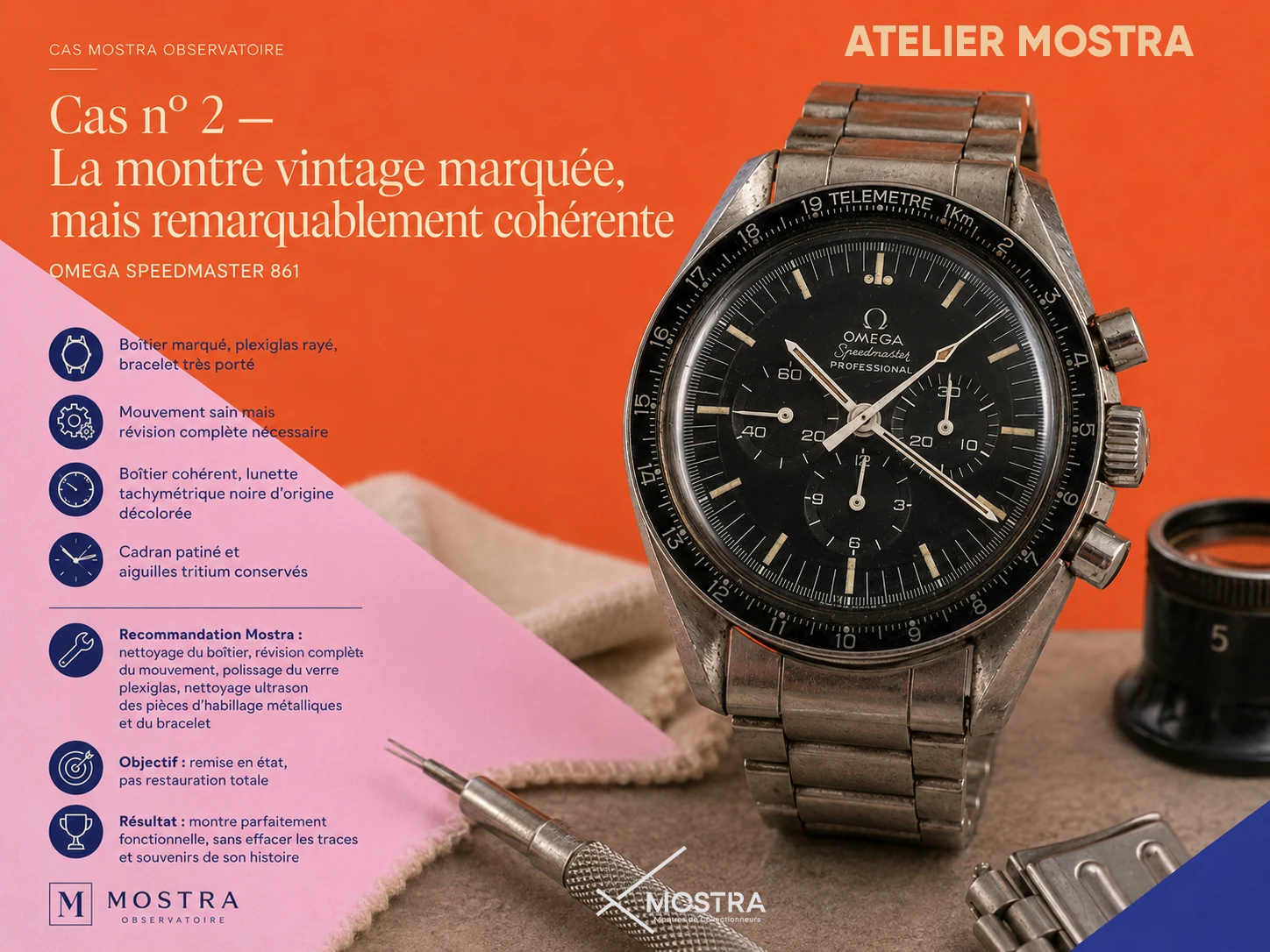
Case Study No. 2 — The Vintage Watch Marked by Time Yet Remarkably Coherent
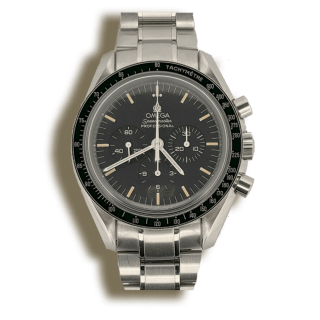
Omega Speedmaster Calibre 861
The case showed signs of wear.
The plexiglass crystal was scratched.
The bracelet clearly reflected decades of regular use.
A major cosmetic restoration might have appeared logical.
However, because the watch's history and its marks formed part of the owner's personal memories, it was decided, in agreement with him, to carry out a sympathetic refurbishment rather than a complete cosmetic restoration.
The examination nevertheless revealed that the movement remained fundamentally healthy, although it required a complete overhaul.
Despite its visible marks and signs of use, the case remained entirely coherent with the faded original black tachymeter bezel, the naturally patinated dial and its original tritium hands.
Mostra therefore recommended:
-
careful cleaning of the case;
-
a complete overhaul of the movement;
-
polishing of the plexiglass crystal;
-
ultrasonic cleaning of every external metal component, including the bracelet.
Once returned to service, the watch had not become newer.
It had simply become fully functional once again, while preserving every trace—and every memory—of the life it had already lived.
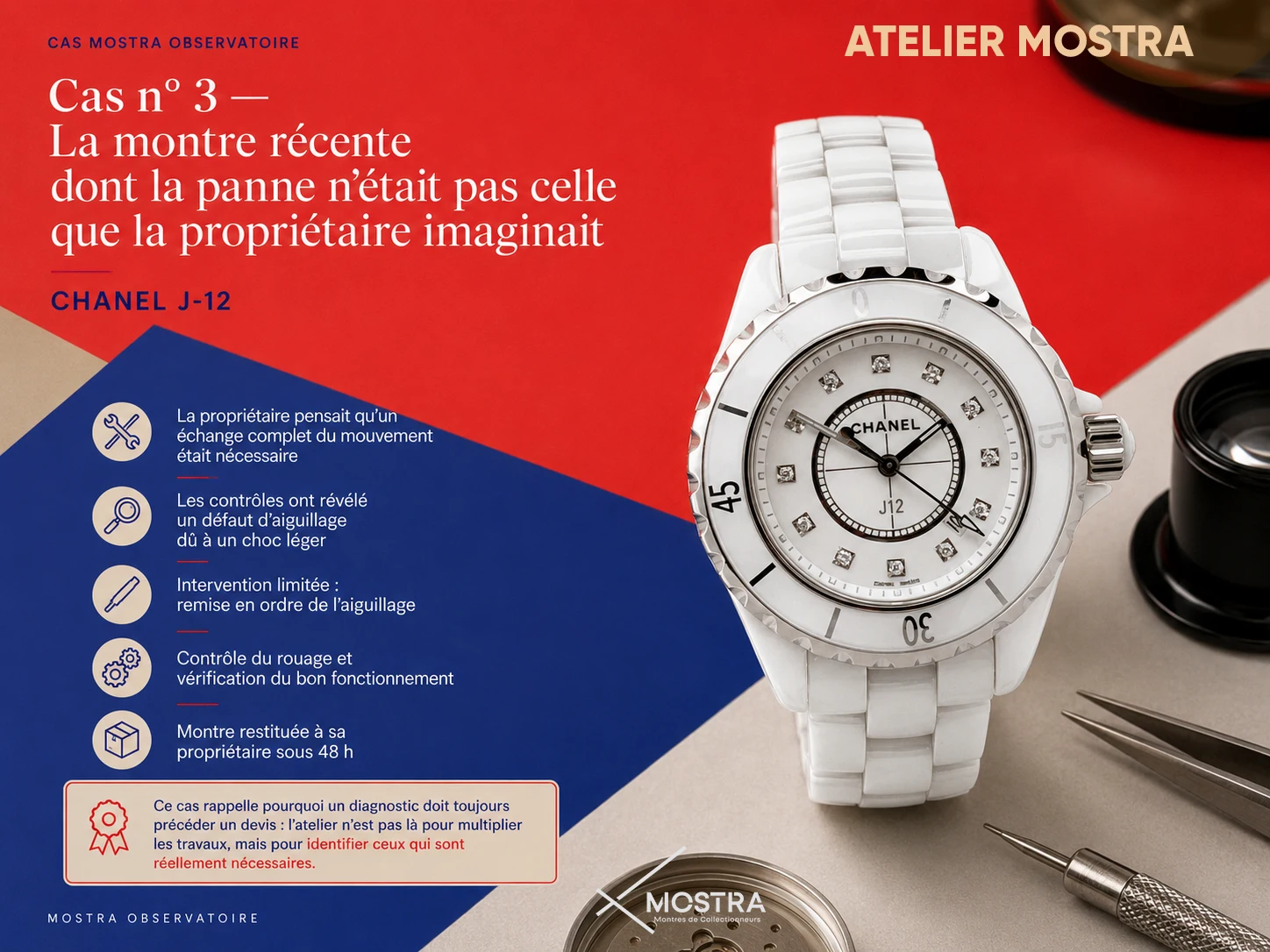
Case Study No. 3 — The Modern Watch Whose Fault Was Not What Its Owner Believed
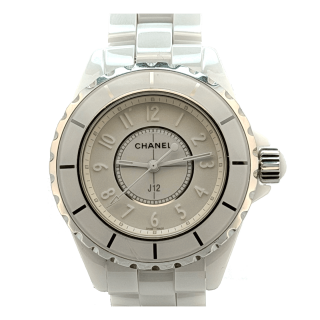
Chanel J12
Its owner believed the entire movement would need to be replaced because the watch had stopped indicating the time.
Inspection ultimately revealed a hand-setting fault caused by a minor impact.
A limited intervention solved the problem without requiring the unnecessary replacement of the complete movement.
Following inspection of the gear train and a complete functional check, the watch was returned to its owner within forty-eight hours.
This case reminds us why diagnosis must always precede an estimate.
The role of the workshop is not to multiply repairs.
Its role is to identify only those that are genuinely necessary.
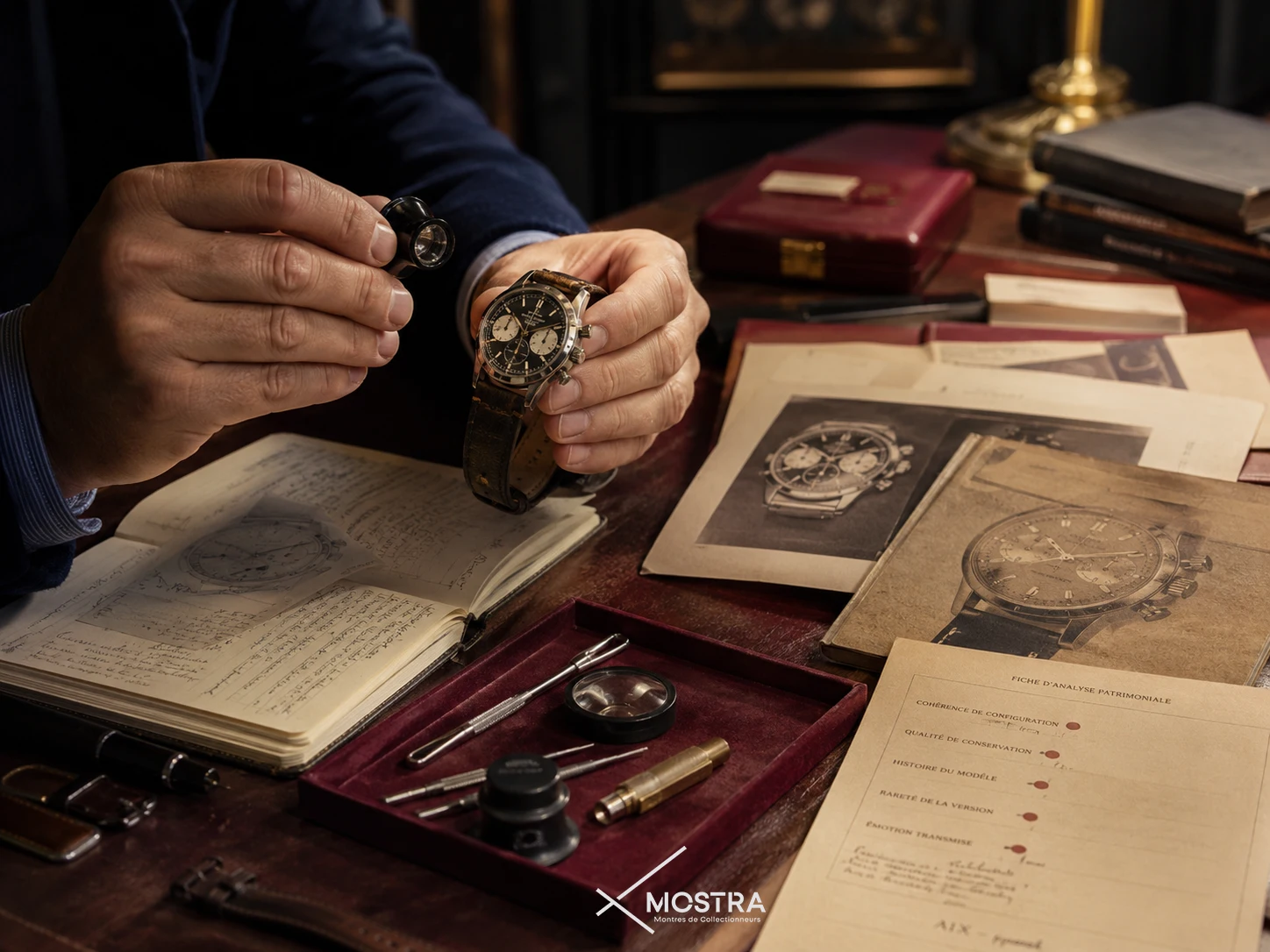
Thierry Serna's Heritage Perspective
A collector's watch can never be reduced to its market value or to its cosmetic condition alone.
For Thierry Serna, desirability is born from the meeting of several elements: the coherence of the watch's configuration, the quality of its preservation, the history of the model, the rarity of the version and the emotion the watch continues to convey.
This is why a lightly worn watch may prove far more interesting than an apparently perfect example.
The former may have preserved its original dial, hands, case and the personality of its period.
The latter may have been transformed by successive interventions until part of its original identity disappeared—for example, when highly radioactive radium hands were replaced by tritium hands on military watches of the 1950s and 1960s. Such a replacement does not necessarily diminish the watch's heritage value, since it represented a legitimate and mandatory safety upgrade for watches issued to military personnel.
Heritage expertise therefore does not consist in pursuing abstract perfection.
It consists in understanding what gives each watch its rightful place in history and within the collector's market.
This reading becomes particularly important before a sale, a restoration or a purchase.
A cosmetic intervention may improve daily enjoyment while reducing collector interest.
A genuine service part may be technically appropriate, but it should always be identified.
Patina may be desirable, neutral or problematic depending upon its nature.
There is never a universal rule applicable to every watch.
Each watch deserves to be considered individually.
Jean-Baptiste Contini's Mechanical Diagnosis
Mechanics impose another discipline.
A movement cannot be judged by the sound of its rotor, the smooth sweep of its seconds hand or the simple fact that it starts running after winding.
Jean-Baptiste Contini combines measurements with mechanical intuition:
accuracy,
balance amplitude,
beat error,
power reserve,
winding efficiency,
crown operation,
date change,
function of every complication,
water resistance,
and the general condition of all accessible components.
A single anomaly does not automatically justify a complete overhaul.
Conversely, an excellent timing-machine result is not always sufficient to declare a watch mechanically healthy.
Power reserve may remain insufficient.
Automatic winding may have become inefficient.
The crown may be weakened.
A watch may keep excellent time while no longer being water-resistant.
Diagnosis consists of bringing all these observations together in order to recommend an intervention that remains proportionate.
It is a form of measurement.
It is also a form of restraint.
What Buyers Should Remember
The Mostra Observatory does not encourage suspicion towards every pre-owned watch.
It simply encourages better questions.
Before purchasing a watch, it is useful to know:
-
whether the movement has been mechanically inspected;
-
whether the power reserve has been measured after a full winding;
-
whether water resistance has been tested—or cannot be guaranteed;
-
whether authentic service parts have been identified;
-
whether the case has been polished;
-
whether the bracelet and clasp remain secure;
-
whether any intervention is immediately required;
-
and precisely what is covered by the warranty and after-sales service.
Every pre-owned watch offered by Mostra is inspected, certified, supplied with a certificate of authenticity and covered by a thirty-six-month warranty.
This preparation does not transform a watch into an artificially perfect object.
It allows it to be presented with a clear and honest understanding of both its condition and its future use.
What Sellers Should Remember
Before selling a watch, making it shine at all costs is rarely the right decision.
Polishing, dial restoration, replacing hands or discarding an original bracelet may all influence its value.
It is generally preferable to gather every available element:
the original box,
papers,
invoices,
additional links,
the clasp,
the original bracelet,
and any replaced components,
before having the watch professionally examined.
The diagnosis then makes it possible to distinguish:
-
what genuinely requires repair;
-
what simply deserves to be mentioned;
-
what should be preserved;
-
what may truly improve the sale;
-
and, conversely, what would diminish the watch's historical value.
A proper valuation rarely begins with a price.
It begins with understanding.
What Owners Should Remember
A watch usually gives warning signs before it stops.
Unusual rate deviation,
reduced power reserve,
a crown that becomes difficult to operate,
condensation beneath the crystal,
a weak battery,
a worn bracelet,
or an unfamiliar mechanical noise
all justify an inspection.
The earlier these signs are recognised,
the more measured the response can remain.
In Aix-en-Provence, Mostra welcomes owners wishing to have their modern, vintage or antique watches inspected, serviced, appraised or restored.
By bringing together the boutique, the appraisal service and the workshop under one roof, each watch can be approached from every perspective:
mechanical,
aesthetic,
historical,
and commercial.
A Pre-Owned Watch Does Not Need to Be Perfect
It needs to be accurately described.
It needs to be mechanically inspected.
It needs to remain coherent with its own history.
It needs to be prepared for the life that still lies ahead.
This may well be the principal lesson taught by these one hundred inspections.
Visual perfection may conceal fragility.
Patina may preserve truth.
A service part may be entirely legitimate.
A vintage watch may prove mechanically excellent.
A recent watch may already require maintenance.
And sometimes, the most successful intervention consists precisely in not intervening any further.
The role of the workshop is therefore not to erase the passage of time.
It is to enable the watch to continue its life under the very best conditions.

Have Your Watch Inspected, Appraised or Sold at Mostra
Would you like to understand the true condition of your watch, obtain a professional diagnosis, prepare it for sale or secure a future purchase?
Mostra welcomes you at 3 Place Forbin, Aix-en-Provence, through four complementary services.
Have My Watch Inspected or Serviced
To assess its operation, accuracy, water resistance and everyday reliability.
Have a Watch Appraised
To understand its origin, coherence, condition, value and long-term heritage potential.
Have My Watch Valued or Sell My Watch
To determine what it truly is before choosing the most appropriate solution.
Discover Mostra's Selection of Pre-Owned Watches
To purchase a carefully inspected, certified watch supported over time.
FAQ — The Mostra Pre-Owned Watch Observatory
Must Every Pre-Owned Watch Be Serviced Before Being Sold?
No.
A systematic overhaul is neither necessary nor always desirable.
Some watches require only inspection, adjustment or no intervention at all.
The decision should depend upon the mechanical condition, intended future use and heritage interest of the watch.
Where a watch is sold by a professional dealer, however, that professional remains responsible for inspecting and servicing it before resale in order to provide a warranty.
Is an Accurate Watch Necessarily in Good Condition?
No.
A watch may keep excellent time while suffering from insufficient power reserve, inefficient winding, a weakened crown or poor water resistance.
Several measurements must always be considered together.
Does a Polished Watch Always Lose Value?
No.
A light, well-executed polish that removes only superficial scratches may be entirely appropriate—and even beneficial—for the regular use of a modern watch.
On a rare vintage collector's watch, excessive polishing may alter the original geometry and reduce its historical interest.
Is a Service Part a Defect?
Not necessarily.
An authentic service part may have been legitimately installed during maintenance.
Its significance depends upon the model, its production period and its rarity.
Above all, it should simply be identified and explained.
Is a Vintage Watch More Risky Than a Modern One?
Not systematically.
A well-maintained vintage watch may prove mechanically healthier than a recent watch that has been heavily used and never inspected.
Age never replaces diagnosis.
Can a Watch Be Inspected Without Requesting Restoration?
Yes.
A diagnosis does not automatically lead to cosmetic intervention or restoration.
For certain watches, the best recommendation is precisely to preserve their present condition.
Is Water Resistance Permanent?
No.
It depends upon the condition of the gaskets, crown, crystal, caseback and any pushers.
A pressure test measures the condition of the watch at a specific moment in time.
It must be repeated according to usage and following any intervention.
Does This Study Represent the Entire Pre-Owned Watch Market?
No.
It describes only the one hundred watches examined by Mostra during the selected period.
The watches entrusted to a workshop or offered for sale may differ from the overall population of watches in circulation.
This limitation should always be clearly acknowledged.
These products might interest you


Share this content