Pre-owned watches: understanding the true condition of a watch before buying It
Authentic, original, conforming, serviced or restored: a collector’s watch can never be judged at surface level. It must be read component by component, with the right words and the trained eye of the watchmaker. original watch part, original dial, service hands, serviced watch, vintage watch.
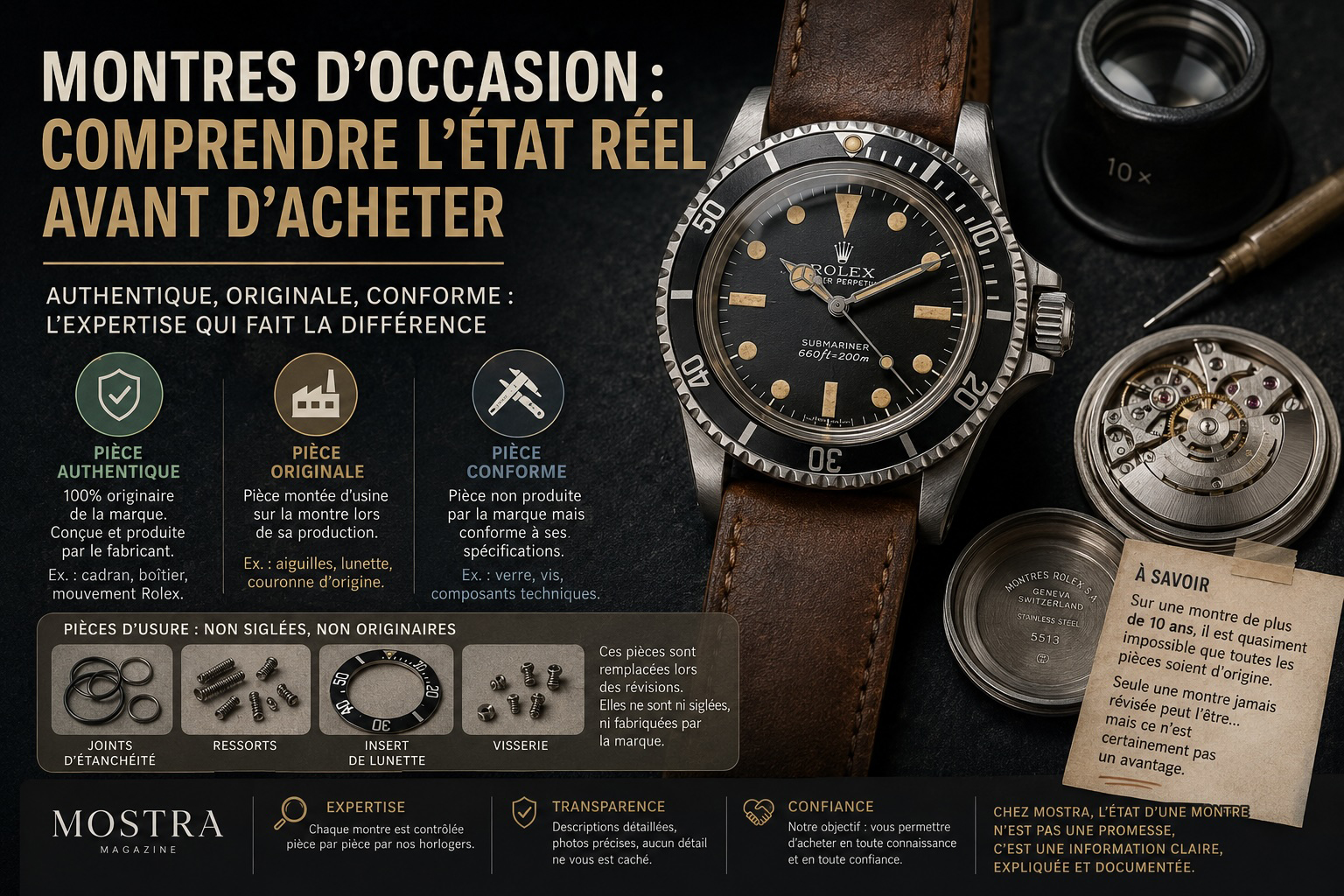
The true condition of a pre-owned watch can never be summed up by terms such as “good condition”, “full original” or “unpolished”. It must be assessed through the coherence of the case, dial, hands, movement, bracelet and past interventions. A watch can be authentic without being entirely original, technically correct without being strictly period-correct, and serviced without losing its interest. Before buying, the essential point is to understand what has been preserved, replaced, maintained or restored.
There is a profound difference between looking at a watch and understanding what it has been through. In the world of pre-owned watches, condition can never be reduced to a visual impression, an attractive photograph or a reassuring phrase placed at the bottom of a listing.
The condition of a watch must be read. This requires knowing how to examine the case, dial, hands, movement, bracelet, replaced parts, signs of servicing, traces of use and sometimes the gaps left by its history.
At Mostra, this interpretation is part of the profession. It requires a trained eye, experience, a memory of references and the ability to explain clearly what is being sold. A pre-owned watch is not a new watch. It has lived. It may have been worn every day, serviced several times, lightly polished, restored with service parts, preserved in its period configuration or adapted over the years to meet functional requirements.
This is precisely the reality that must be understood before buying, selling or having a collector’s watch appraised.
The condition of a pre-owned watch can never be judged in a single word
Expressions such as “good condition”, “very good condition”, “collector’s condition”, “full original”, “mint condition” or “unpolished” are frequently used. These terms can be meaningful when applied rigorously. They become dangerous when they replace proper analysis.
A watch may look superb on the wrist and have a replacement dial. Another may appear marked by time yet retain a remarkable historical configuration. A watch may be serviced, water-resistant, reliable and technically correct without being composed entirely of the parts fitted when it left the factory.
Conversely, a watch that has never been opened, never been serviced and is theoretically “original” may conceal dried oils, hardened gaskets, advanced mechanical wear and a significant risk to its movement.
The exact condition must therefore be understood component by component:
- the case reveals how the watch was used and whether it may have been polished;
- the dial often indicates the period, aesthetic coherence and collector interest;
- the hands may confirm or contradict the history suggested by the dial;
- the bezel, insert, crown and crystal provide information about use and maintenance;
- the bracelet, clasp and links contribute to the historical coherence of the watch;
- the movement reveals the quality of its mechanical maintenance;
- technical consumables reflect the interventions required to maintain reliability.
A watch is a complete ensemble. It cannot be reduced to its general appearance.
This is why Mostra descriptions seek to explain the quality, interest, coherence and sometimes the limitations of each watch. For both an experienced collector and a first-time buyer, this level of precision is the foundation of trust.
Authentic, original and correct: three concepts that should not be confused
In the vocabulary of pre-owned watches, the words “authentic”, “original” and “correct” are often used as though they meant the same thing. In reality, they describe different qualities.
An authentic part
An authentic part genuinely comes from the brand, its manufacturing network or its after-sales service. Authenticity therefore concerns provenance.
A Rolex crown supplied during a service, a service dial from Omega, a Cartier bracelet supplied by the Maison, a Breitling bezel fitted by an authorised workshop or a Jaeger-LeCoultre component from the official network may all be authentic, even if they were not present when the watch was first delivered.
An original part
An original part, in the strict sense used by collectors, is a component fitted to that particular watch at the factory or corresponding to its original production configuration.
A tritium dial originally fitted to a 1970s Submariner, hands consistent with the production period of a Speedmaster, the bracelet delivered with the watch or a bezel insert matching the exact era of the model all fall within this definition. Originality concerns the birth of the watch.
A correct part
A correct part complies with the technical, aesthetic or functional specifications of the model, even if it is not the component originally fitted at the factory.
An appropriate service crown, a replacement crystal corresponding to the reference, a gasket with the correct dimensions, a compatible mainspring or a more recent but suitable bracelet can make the watch completely coherent and usable. Correctness concerns technical suitability.
A part can therefore be authentic without being original. It can be correct without being period-correct. It can be technically appropriate without having been present when the watch was first sold. And an old part may still be incorrect for the reference concerned.
The service dial: the example that summarises the entire difficulty
Consider a diving watch from the 1960s or 1970s. Its original dial may have used tritium, with a beige, cream or slightly amber patina.
If that dial was replaced during servicing with a modern dial supplied by the brand, the new dial may be entirely authentic. It may even comply with the manufacturer’s official servicing policy. However, it will not be original in the collector’s sense, because it is not the dial with which that particular watch left the factory.
For someone who wishes to wear the watch regularly, this configuration may be reassuring: improved legibility, more stable luminous material, a clean appearance and recent maintenance.
For a collector seeking a strictly period-correct piece, the interest will be different. Both approaches are legitimate, provided that they are clearly explained.
Describing a watch as having an “authentic service dial” does not mean the same thing as saying that it has its “original dial”. A serious description must acknowledge this distinction.
The hands: small components with major consequences
The hands are often more revealing than one might imagine. On a vintage watch, they may have aged differently from the dial. A slight difference in tone between the hour markers and the hands is not necessarily suspicious, as the materials, exposure to light, humidity and storage conditions may vary.
A very pronounced difference can nevertheless indicate a replacement.
On a vintage Omega Speedmaster, white hands with modern LumiNova fitted over a warmly patinated tritium dial immediately change the overall appearance of the watch. On a Rolex GMT-Master, a service GMT hand may remain authentic without matching the exact production period of the piece. On a vintage Cartier Tank, newly blued hands can restore clarity while moving the watch away from its initial configuration.
The point is not to condemn replacements. A mechanical watch is designed to be maintained. The aim is to understand what one is looking at and not to describe an ensemble that has evolved as entirely original.
The case: geometry as memory
The case is one of the most difficult elements to assess. A carefully executed polish can make a watch very attractive. Excessive polishing can instead round the edges, reduce the thickness of the lugs, alter the bevels or erase part of the model’s original character.
On certain vintage Rolex sports watches, Omega Speedmasters, Audemars Piguet Royal Oaks, Patek Philippe Nautiluses, Cartier Santos watches or vintage Heuer models, the geometry of the case directly contributes to collector value.
An “unpolished” watch is often presented as an ideal. This claim must nevertheless be used with caution. Many watches have received light interventions during official or independent servicing, sometimes without documentation.
The real issue is not simply to repeat a phrase, but to observe:
- the quality and consistency of the surfaces;
- the presence of sharp edges and bevels;
- the thickness of the lugs;
- the clarity of the engravings;
- the coherence between visible wear and the age of the watch.
A marked but still substantial case may be more interesting than a shiny but over-thinned one. A watch that looks too perfect for its age should also be examined carefully.
Bezel and insert: use, service replacement and collector value
The bezel and its insert are particularly sensitive components on diving watches, chronographs and GMT watches. They may have been replaced because they were broken, excessively scratched, faded, cracked or no longer legible.
On a diving watch that has genuinely been used, this is not unusual. The insert is exposed to impacts, sunlight, salt water and friction.
On a vintage Rolex Submariner, a period bezel insert may have significant collector value. An authentic Rolex service insert will be perfectly correct and functional, but it will not tell the same story. On an Omega Seamaster, a replacement insert may restore excellent legibility. On a Tudor Submariner, an even patina can reinforce the character of the watch.
Not all parts are necessarily branded. The absence of a logo or engraving does not automatically mean that a component is unsuitable. It simply makes the claim “original part” more difficult to establish, particularly for components replaced during maintenance.
Wear parts: what many listings fail to mention
A mechanical watch is not a static object. It operates through components subjected to wear, friction, tension, compression, humidity and time.
These components notably include:
- water-resistance gaskets;
- springs and mainsprings;
- certain screws and tubes;
- crowns and winding components;
- crystals;
- spring bars;
- components related to water resistance.
These parts may be correct, perfectly suited and essential to the proper operation of the watch without being describable as “original” in the strict sense.
A gasket replaced during servicing is not the gasket fitted twenty or thirty years earlier. A new mainspring installed to restore amplitude and power reserve is not the original spring. A spring bar replaced to secure the watch on the wrist is not a historical component. This is entirely normal.
On a properly maintained watch more than ten years old, the expression “entirely original” must therefore be used with great caution. A watch that has never been serviced may retain more of its initial components, but that is not necessarily an advantage.
Dried oils, hardened gaskets, absent water resistance and accelerated mechanical wear can make a future intervention more extensive. In the real world of watchmaking, maintenance is part of the normal life of a watch.
A serviced watch is not a less interesting watch
Some buyers imagine that a serviced watch has lost part of its interest because it may have received newer components. This idea requires nuance.
A serious, documented service that respects the configuration of the watch and is limited to technical necessities can actually improve the practical value of the piece.
A vintage Patek Philippe Calatrava whose movement has been carefully cleaned, lubricated and adjusted becomes more pleasant to wear. A 1980s Rolex Datejust with replaced gaskets and tested water resistance offers greater peace of mind in daily use. An Omega Speedmaster whose calibre has regained healthy amplitude after the replacement of a tired spring can return to life on the wrist.
The problem is not servicing. The problem is a lack of explanation.
To understand the difference between preventive maintenance and an existing fault, you can consult the page dedicated to watch servicing in Aix-en-Provence. When a malfunction is already present, the watch repair in Aix-en-Provence page explains how the watch is assessed and handled.
The movement: authenticity, coherence and maintenance
The movement is the heart of the watch, but it is often less visible to the buyer. Its condition cannot be judged solely by how clean it appears.
The following points should notably be examined:
- the calibre reference and its coherence with the model;
- the condition of the screws, bridges and components;
- the rotor and winding system;
- the balance and escapement;
- amplitude and timekeeping;
- power reserve;
- traces of previous interventions.
A movement may be authentic while containing replacement components. It may be correct if it complies with the model specifications. It may lose a significant part of its interest if an incorrect calibre, bridges from a different generation or incompatible components have been used.
If the complete movement does not correspond to the reference, the issue goes beyond normal maintenance: it affects the identity of the watch itself.
Bracelet and clasp: the story continues on the wrist
The bracelet is often treated as a simple accessory even though it can strongly influence the coherence of a watch.
An original steel bracelet with the correct end links, a correctly dated clasp or a coherent reference can be highly sought after. On a Rolex Datejust, an Oyster Perpetual, a Submariner, a GMT-Master, an Omega Seamaster, a Tudor or a Cartier Santos, it contributes to the historical reading of the complete watch.
However, a bracelet is also a wear component. It stretches, becomes marked, loosens, sometimes loses links and may receive a more recent clasp or replacement elements.
A modern bracelet fitted to an older watch may be authentic, comfortable and correct without being original to that particular watch. Replacing a leather strap is entirely normal: leather is a consumable material, and it would be unreasonable to expect a thirty-year-old strap to remain suitable for daily wear.
An original Cartier, Jaeger-LeCoultre or Patek Philippe pin buckle may have value in its own right. A good-quality generic buckle may be perfectly acceptable, provided that it is described as such.
For adjustment, fitting or replacement of attachment components, Mostra also offers a watch strap replacement service.
Crystal, crown and gaskets: the invisible guardians of daily use
The crystal, crown and gaskets are often replaced to protect the watch. A scratched Plexiglas crystal can be polished or changed. A chipped sapphire crystal should be replaced. A worn crown can compromise water resistance. A dry gasket no longer provides protection.
On certain vintage watches, an original crystal may have aesthetic value, particularly when it has a distinctive shape, a characteristic magnifier or a discreet signature.
From a practical perspective, however, a correctly fitted replacement crystal is preferable to a cracked crystal that may endanger the dial. A service crown may be authentic, correct and protective even if it is not the crown fitted at the factory.
It is therefore important to move beyond an overly romantic vision of absolute originality. A watch is made to withstand the passage of time. To do so, it must sometimes receive new components. The question is not whether such interventions should be rejected, but how they should be described.
Patina: the beauty of time or genuine deterioration?
Patina is one of the most appealing words in watchmaking vocabulary. It may describe the warm colour of tritium hour markers, the subtle creamy ageing of a dial, the gentle fading of an insert or the harmonious transformation of a material over time.
But not every alteration is attractive patina.
A tropical dial can be magnificent when it has changed colour evenly. It may also be stained, pitted or damaged by humidity. Patinated markers can bring remarkable charm. Crumbling markers may, however, release particles that are dangerous for the movement.
The role of a professional is not to transform every trace of time into commercial poetry. It is to distinguish between:
- desirable patina;
- normal wear;
- an aesthetic defect;
- technical deterioration;
- a potential risk.
This distinction is what makes it possible to buy with a full understanding of the watch.
A “full set” never replaces an assessment of the watch itself
A watch sold with its box, papers, invoice, booklets, tags or accessories has an obvious appeal. A full set provides reassurance, context and may sometimes reinforce market value.
However, it does not guarantee the condition of the watch. A complete watch may have been heavily polished. It may retain its original box but have a replacement dial. It may have its original purchase invoice while being fitted with a more recent bracelet.
Conversely, a watch without papers may be remarkable in terms of condition, coherence and configuration. In the vintage market, many watches have lost their accessories over the decades. The absence of papers is not proof of inauthenticity. It simply requires a more careful assessment.
At Mostra, the set is described for what it contains: original box, service box, warranty card, invoice, archive extract, additional bracelet, links, pouch or accessories.
The purchase invoice remains an essential document: it contributes to the traceability of the watch, helps establish its legitimate provenance and, depending on the circumstances, may support evidence of its tax status.
Why the vocabulary used in listings must be precise
A serious description should avoid broad claims when they may create confusion. Saying that a watch is “original” is not sufficiently precise.
Does this refer to:
- the dial;
- the hands;
- the movement;
- the bracelet;
- the crown;
- an unpolished case;
- technical consumables;
- or the overall configuration?
It is more useful to state that a watch has its original dial, coherent hands, an authentic service crown, a later but correct bracelet and a serviced movement with the necessary consumables replaced than to use the vague expression “100% original”.
The second expression may sound more appealing. The first is more honest, more useful and often more reassuring.
Four examples for understanding how condition should be assessed
A 1980s Rolex Datejust
Imagine a 1989 Rolex Datejust with its steel-and-gold case, period dial, Jubilee bracelet, coherent clasp and correct Rolex movement.
If it has been maintained over the years, it has probably received new gaskets, perhaps a service crown, and possibly a replacement crystal or internal components. It can be authentic, coherent, correct and highly interesting without being seriously describable as consisting entirely of the parts fitted at the factory.
A vintage Omega Speedmaster
A vintage Omega Speedmaster may have an attractive tritium dial, coherent hands, a service bezel, a later bracelet and a serviced movement.
It can be highly desirable if its overall balance is good, but it will not be perceived in the same way as an example retaining its strictly period-correct dial, hands, bezel and bracelet.
The first may be an excellent watch to wear, both reliable and attractive. The second may appeal more strongly to the purist collector. The seller’s role is not to confuse these two narratives.
A vintage Cartier
On a vintage Cartier Tank, Santos or Must, condition must be read differently. The case, often made of gold, vermeil or steel, may have been polished. The dial may show cracking, patina or restoration. The blued hands may have been replaced. The leather strap is almost always later.
Describing a vintage Cartier as “original” therefore requires precision: is the dial period-correct? Is the buckle signed? Is the movement correct? Does the case retain its proportions? Is the cabochon crown appropriate?
A modern diving watch
On a RALF TECH, Tudor Pelagos, Omega Seamaster, modern Rolex Submariner or Breitling Superocean, the condition must also be assessed in relation to the watch’s intended use.
The gaskets, crown, bezel, bracelet, folding clasp and water resistance must all be considered seriously.
A diving watch that has never been serviced may appear closer to its original configuration. But if it is more than ten years old, its gaskets may no longer guarantee the expected water resistance. A checked watch with replacement gaskets and a completed pressure test will often be more appropriate for genuine use.
Maintenance and restoration: two different approaches
Maintenance must be distinguished from restoration.
Replacing a gasket, cleaning a movement, changing a worn spring or fitting a correct crystal are maintenance operations. Repainting a dial, rebuilding the hour markers, applying new luminous material to the hands, re-engraving a caseback, resoldering lugs or rebuilding a case belong to a different category.
A restoration can be admirable when it is disclosed and carried out skilfully. It can save a watch. It can also reduce its collector interest when it erases historical elements.
A restored dial does not have the same significance as a well-preserved original dial. Relumed hands do not tell the same story as naturally patinated hands. A re-cut engraving does not replace the original engraving.
The collector does not always demand perfection. The collector demands the truth.
Aesthetic condition and mechanical condition: two different realities
A watch may be aesthetically beautiful but mechanically tired. Another may be externally marked yet perfectly serviced.
Aesthetic condition concerns:
- the case;
- the dial;
- the hands;
- the bezel;
- the crystal;
- the bracelet;
- the overall impression.
Mechanical condition concerns:
- the movement;
- accuracy and amplitude;
- power reserve;
- winding and time-setting;
- date change;
- chronograph operation;
- water resistance;
- overall reliability.
A chronograph may have a superb dial and require extensive mechanical work. An automatic watch may appear perfect but have insufficient amplitude. A very clean quartz watch may have suffered damage from a previously leaking battery. A diving watch may look impeccable while no longer being water-resistant.
This is why a pre-owned watch appraisal can never be limited to a photograph or a general impression.
The trap of the “new old stock” appearance
The market appreciates exceptionally well-preserved vintage watches. But a watch that is thirty, forty or fifty years old and appears completely new must be examined methodically.
It may genuinely be exceptional, have been worn very little and stored in ideal conditions. It may also have been extensively restored, repolished, redialled or rebuilt with newer components.
Perfection is not impossible. It is simply rare. When it exists, it must be documented, coherent and credible.
The truth is often found in the details: the texture of the dial, typography, height of the hour markers, correspondence of the hands, depth of the engravings, wear on the clasp, logic of the bracelet and coherence of the serial number.
The assembled watch: authentic components, but an incoherent whole
A watch can be made entirely from authentic parts and still lack historical coherence.
A Rolex may combine an authentic case, movement, dial and bracelet from different periods. An Omega may bring together genuine components that do not correspond to its original configuration. A Cartier may have a later signed buckle, a restored dial and a correct movement.
In such cases, the question is no longer solely the individual authenticity of each component. It concerns the coherence of the watch as a whole.
A correct watch is not necessarily entirely original, but it follows an acceptable technical and historical logic. An incoherent watch, even when built from authentic parts, must be described accordingly.
Why a watch more than ten years old should not be judged like a new watch
After ten years, a watch has often already passed through one or more phases of use. It may have been serviced and received new gaskets, light polishing, a bracelet, a crown, a crystal, a spring or movement components.
Even when it has been worn very little, time still has an effect. Lubricants age. Gaskets harden. Luminous materials evolve. Leather straps deteriorate. Metal surfaces acquire micro-scratches.
The expectation that a watch should remain strictly “as it left the factory” must therefore be reserved for exceptional and thoroughly documented cases.
For most pre-owned watches, the real questions are:
- is the watch authentic?
- is its configuration coherent?
- is it mechanically healthy?
- is its condition clearly described?
- does its price correspond to its configuration?
- is its future use compatible with its condition?
A serious professional does not simply sell a watch. They provide a framework for understanding it.
Transparency as a collector value
In a market saturated with perfect images, transparency becomes a rare value. It does not diminish the watch. It makes it understandable.
Stating that a watch has a few micro-scratches, a later bracelet, a service crown, an authentic but non-original dial, evidence of previous polishing or a replacement insert does not necessarily reduce its interest.
It simply establishes an honest relationship between the watch, its history and its future owner.
The page dedicated to Mostra’s certification of pre-owned watches explains the checks carried out before a watch is offered for sale: operation, component authenticity, cosmetic condition, photography and final inspection.
This transparency also extends to the pre-owned watch guarantee, whose terms distinguish between operation, authenticity, normal wear and the limitations inherent in the use of a vintage or modern watch.
The role of advice: translating the watch for its future owner
Watchmaking expertise often consists of translating what the watch does not immediately reveal.
A customer may appreciate a patina without knowing whether it is healthy. They may seek a “full original” watch without understanding the mechanical consequences of never having it serviced. They may reject a service part even though it makes the watch safer to use. They may prioritise a full set over the actual condition or confuse authenticity with originality.
The purist collector will not seek the same thing as an enthusiast who wants to wear the watch every day. A vintage enthusiast will not assess a watch in the same way as someone looking for a modern, guaranteed watch that is ready to wear.
A coherent vintage watch with a period dial and hands may be ideal for a collector. A serviced watch with authentic service parts may be ideal for daily use. A modern full-set watch in excellent condition may be ideal for a secure first purchase.
All of these watches have their place, provided that they are described accurately.
The real question: what do we want to preserve?
The condition of a pre-owned watch can ultimately be understood through one simple question: what do we want to preserve?
- On a very rare watch, the priority will often be to preserve as much of the historical configuration as possible.
- On a watch intended for daily wear, reliability, water resistance, accuracy and bracelet security will take priority.
- On a family watch, certain traces of use may be preserved because they form part of its emotional history.
- On a collector’s watch, the objective will be to maintain coherence between the model, its period and its components.
There is no single answer, but rather a hierarchy to establish according to the watch, its age, rarity, intended use and the expectations of its future owner.
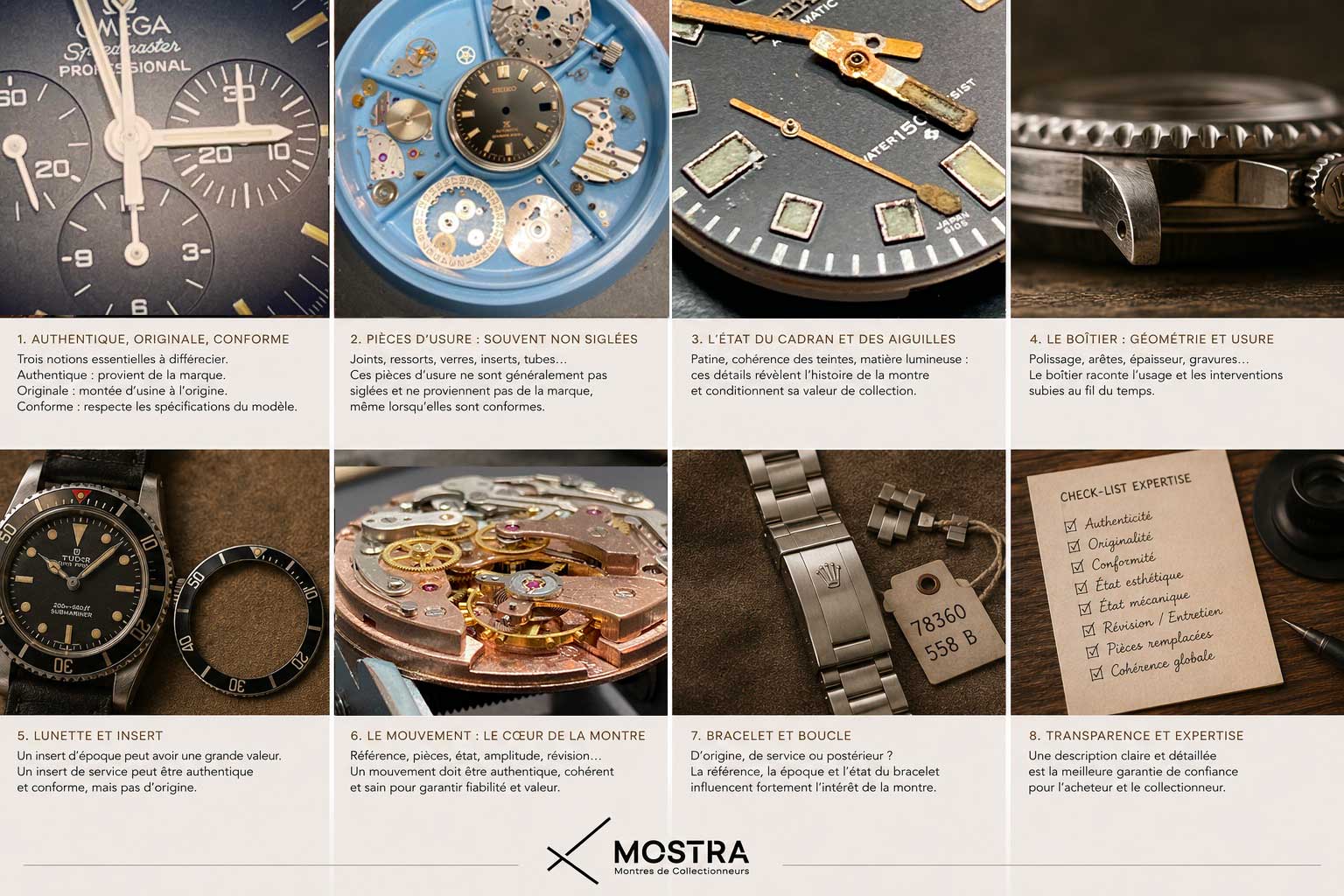
Buying a pre-owned watch means buying a story that has been explained
A pre-owned watch is never merely an object. It is an accumulation of time: the time of its manufacture, its first owner, its maintenance, its journeys, its replacement parts, its use and sometimes the time spent waiting before entering a new collection.
Understanding its exact condition means respecting that story. It means distinguishing an authentic part from an original part. It means accepting that a correct component may be entirely legitimate and that wear parts often make it impossible to claim with certainty that a watch consists exclusively of the elements fitted at the factory.
It also means understanding that a watch that has never been serviced is not automatically superior. It may be more untouched, but also more fragile. It may appeal to the collector because of its preservation while concerning the watchmaker because of its mechanical condition.
True luxury does not lie in the phrase “never touched”, but in knowing exactly what has been preserved, replaced, maintained or restored.
Conclusion: trust is built through precision
In the pre-owned watch market, trust cannot simply be declared. It is built through precise vocabulary, the quality of the assessment and the honesty of the description.
A watch can be authentic without being entirely original. It can be correct without being strictly period-correct. It may have been serviced without losing its interest. It can show traces of life and remain magnificent. It may have received service parts and still be an excellent collector’s watch.
What matters is knowing it, stating it and explaining it.
At Mostra, every watch is approached with this principle: understand before selling, explain before persuading, and pass on before concluding. A carefully chosen pre-owned watch is not simply a watch one buys. It is a watch whose condition, value, nuances and truth are understood.
You can discover our selection of pre-owned vintage watches, our antique watches or all the pre-owned watches available at Mostra.
```
Share this content