Antique watches vs vintage watches: definitions, decades, budgets and common mistakes
The terms antique watch and vintage watch are now widely used in the world of pre-owned watches. They are often treated as synonyms, even though they actually refer to very different realities in terms of age, style, value and intended use...
The terms antique watch and vintage watch are now widely used in the world of pre-owned watches. They are often treated as synonyms, even though they actually refer to very different realities in terms of age, style, value and intended use.
This confusion is all the more common as the pre-owned watch market has grown significantly in recent years. Between so-called “vintage” watches, antique pieces, retro-inspired models or simply second-hand watches, it can sometimes be difficult to understand what you are really buying, and at what price.
Understanding the difference between an antique watch and a vintage watch is not a matter of vocabulary, but a genuine tool for making better purchasing decisions. The period of production, rarity, condition, intended use and maintenance constraints vary greatly depending on the category the watch belongs to.
In this article, we provide clear definitions, place each term in its proper horological context, and help you identify what truly distinguishes an antique watch from a vintage watch, taking into account decades, budgets and the most common mistakes to avoid when buying.
Second-hand, antique or vintage watches: what’s the difference?
Before comparing decades or budgets, it is essential to clarify the terminology. In everyday language, and sometimes in marketing discourse, several notions are mixed together, even though they do not mean the same thing.
A watch can be second-hand without being vintage, vintage without being antique in the strict sense, and antique without necessarily meeting the expectations of modern daily use. Everything depends on its age, historical context and how these categories are defined.
Second-hand watches: the generic term
A second-hand watch simply refers to a watch that has already been worn and is no longer sold as new. It is a broad, neutral term that gives no indication of the watch’s actual age.
A second-hand watch can therefore be:
- 5 years old,
- 15 years old,
- or 60 years old.
In this sense, all vintage watches and all antique watches are second-hand watches… but the reverse is not true. A relatively recent pre-owned watch is neither vintage nor antique, even if it is sometimes presented as such for marketing purposes.
The term “pre-owned” is simply the English equivalent of second-hand. In French (and conceptually), it adds no additional nuance and should be understood as a straightforward synonym, not a classification.
Vintage watches: age, aesthetics and horological identity
A vintage watch generally refers to a watch produced several decades ago, but still compatible with relatively modern use. In the watch world, a piece is most often considered vintage once it is around 20 to 40 years old, although this boundary may vary depending on brands and models.
Beyond age, the term “vintage” primarily refers to an identifiable aesthetic. Distinctive dials, proportions different from today’s standards, specific typography, integrated bracelets or more compact cases: a vintage watch tells the story of a specific era in watchmaking.
Vintage watches are often appreciated for their balance between historical charm and modern wearability. They can be worn daily while offering strong personality and genuine horological heritage. This intermediate positioning explains their growing popularity, particularly among women looking for elegant, distinctive and less standardised watches.
In practice, a vintage watch:
- is generally repairable,
- can be worn regularly,
- offers an attractive compromise between style, usability and maintenance.
This is also why the term “vintage” is sometimes overused: it immediately evokes authenticity and character, even when a watch has not yet truly reached that age or identity.
Antique watches: a stricter age-based definition
The concept of an antique watch is generally more restrictive. It refers to much older watches, often produced before the 1960s, and in some cases before the Second World War.
Here, the focus is no longer simply on style, but on a genuine historical object. Antique watches reflect a different approach to timekeeping, movements and the very purpose of a watch. Smaller dimensions, different legibility, almost systematic manual winding, everything points to an era when the watch was primarily a functional instrument.
Unlike vintage watches, antique watches:
- are not always suited to modern daily wear,
- can involve significant maintenance constraints,
- may require rare or specific replacement parts.
This does not mean they are “less interesting”, quite the opposite. An antique watch can be extremely beautiful and carry strong heritage value. However, it is generally better suited to knowledgeable collectors or occasional use rather than as a first pre-owned watch.
The confusion between vintage and antique watches often stems from the fact that both are old in the everyday sense of the word. Yet their purchase logic, usage and budget considerations are fundamentally different.
Antique watches: 100 years old and beyond
The term antique watch is used less frequently than “vintage”, but it has a much stricter definition. In horological usage, a watch is generally considered antique once it is over 100 years old.
These are therefore watches produced in the early 20th century, or even the late 19th century in some cases. At this point, we are no longer talking about a vintage or antique watch in a general sense, but about a true heritage object, often from a time when wristwatches were still marginal compared to pocket watches.
Antique watches typically feature:
- almost exclusively manual-winding mechanical movements,
- very small dimensions by modern standards,
- often enamel dials, sometimes fragile,
- a design reflecting a very different relationship to time and usage.
These watches are generally not intended for modern daily wear. Their appeal is primarily historical, aesthetic or collectible. They require highly specific maintenance, sometimes complex, and the work of specialised watchmakers familiar with antique calibres.
As a first purchase, an antique watch is rarely recommended unless the approach is deliberately patrimonial. It is more suited to experienced collectors or enthusiasts of horological history who fully understand the constraints involved.
Retro & neo-vintage: when style matters more than age
Alongside strictly defined vintage and antique watches, the terms retro and neo-vintage are increasingly common. These notions are not based on the actual age of the watch, but on its aesthetic.
A neo-vintage watch is a relatively recent timepiece, sometimes even still in production, that deliberately draws inspiration from past design codes: vintage typography, period-style proportions, clean dials, retro hands or old-style bracelets.
Unlike authentic vintage watches:
- they are not chronologically old,
- they benefit from modern manufacturing standards,
- they often offer greater immediate comfort and reliability.
These watches can appeal to buyers attracted by a vintage look but unwilling to deal with the constraints of older pieces: more frequent servicing, rare parts, tighter mechanical tolerances or limited water resistance.
The main risk, however, is semantic. A neo-vintage watch is not a vintage watch in the horological sense, even if it adopts its visual codes. It does not carry the same history, heritage value or market logic.
When buying pre-owned, it is therefore essential not to confuse vintage style with a vintage watch. One relates to design, the other to the period of production. Both can be relevant depending on expectations, but they do not serve the same purpose.
How to determine a watch’s actual age
Determining whether a watch is truly vintage, antique or simply second-hand requires the ability to date its production with a reasonable degree of accuracy. Contrary to what one might think, a watch’s age is not always obvious at first glance.
Between references produced over long periods, assembled pieces, replaced dials or missing documentation, dating a watch often requires cross-checking several indicators. Fortunately, certain tools and visual cues can help clarify the picture.
Dating through serial numbers and brand archives
The most reliable way to date a watch remains identifying its serial number and, when possible, consulting the brand’s archives.
Over time, many watchmakers have implemented numbering systems that allow a watch to be placed within a relatively precise production period. Depending on the brand, this number may be found:
- on the case back,
- between the lugs,
- or directly on the movement.
When available, brand archives (or market-recognised serial number tables) make it possible to link a serial number to a specific year or production range. This is often the most reliable way to distinguish a true vintage watch from a more recent retro-inspired model.
However, caution is required. Some brands have:
- reused serial number ranges,
- produced models over very long periods,
- or lost part of their historical archives.
In such cases, serial numbers provide a general timeframe, but must be supplemented with other analytical elements.
Visual age indicators and stylistic characteristics
When documentation or archives are insufficient, careful visual examination becomes essential. Many visual details can help estimate a watch’s period of production.
The most common indicators include:
- the dial: typography, “Swiss” or “Swiss Made” markings, presence or absence of luminous material,
- the hands: shapes, lengths, early luminous treatments,
- the case: proportions, finishes, lug design,
- the movement: architecture, winding system, engravings,
- patina: natural ageing of materials and overall consistency.
A genuinely vintage watch usually displays strong overall coherence between these elements. Conversely, a dial that looks too new on an old case, or clearly replaced hands, may indicate a modified or partially restored watch.
These observations are not intended to automatically disqualify a watch, some restorations are perfectly legitimate, but they help clarify what you are actually buying: a fully original piece, a restored watch, or an assembly of components from different periods.
For buyers, this visual reading is invaluable. It allows the watch to be placed within its historical context and expectations to be adjusted accordingly, both in terms of use and value.
Antique watches vs vintage watches: a detailed comparison
If the terms “antique” and “vintage” are often confused, it is because both refer to watches produced in the past. Yet their purchase logic, usage and long-term perspective are very different. Comparing these two categories helps clarify who they are truly intended for.
Usage and buyer profiles
The first major difference between antique and vintage watches lies in intended use and, consequently, in the buyer profile.
A vintage watch is often chosen as a piece that can be worn regularly. It appeals to those looking for:
- a watch with character,
- a clearly identifiable aesthetic,
- a balance between historical charm and modern usability.
In many cases, a vintage watch can become a daily wearer, provided it has been properly checked and maintained. This explains its popularity among buyers who want to step away from contemporary standards while retaining ease of use.
An antique watch, on the other hand, follows a different logic. It tends to attract:
- collectors,
- enthusiasts of watchmaking history,
- buyers drawn to heritage value.
Its use is generally more occasional. It is worn with care, sometimes only on specific occasions, and is rarely conceived as a daily “tool watch”. Antique watches are often viewed as witnesses to a bygone era rather than as modern functional accessories.
Typical budgets by period
Budget is another key point of differentiation between vintage and antique watches. Contrary to popular belief, an older watch is not always more expensive, but pricing follows very different logics.
Vintage watches, particularly those produced between the 1950s and 1970s, offer a wide range of price points today. You can find:
- accessible models, often simple yet well-designed,
- iconic pieces that are more sought-after and significantly more expensive.
Pricing is primarily driven by brand, condition, dial rarity, movement quality and overall wearability.
Antique watches, by contrast, are more closely tied to rarity and state of preservation. Some may be relatively affordable, especially if they show significant restoration or are valued more for aesthetics than mechanics. Others can reach high price levels when they are rare, well-preserved or historically significant.
In all cases, additional costs must be factored in: specialised servicing, potential restoration, or sourcing compatible parts. These elements often weigh more heavily in the total budget of an antique watch than in that of a vintage watch.
Market, availability and rarity
The market itself is another essential point of comparison.
Vintage watches benefit from a relatively structured and active market. Many models were produced in sufficient numbers to offer:
- reasonable availability,
- price comparison benchmarks,
- easier access to information.
This makes purchasing, resale and servicing more straightforward. Vintage watches often allow buyers to find a piece that matches a specific style or budget without waiting for a rare opportunity.
Antique watches, by nature, are rarer. Their market is more confidential, sometimes less transparent, and heavily dependent on condition and provenance. Two seemingly similar watches can show significant price differences based on details not immediately visible.
This rarity can be part of the charm of antique watches, but it also requires greater caution. The lack of comparable references makes expertise and guidance even more important when purchasing.
Common mistakes to avoid
The distinction between antique and vintage watches is often misunderstood, leading to frequent mistakes at the time of purchase. These mistakes are not necessarily dramatic, but they can result in disappointment, unexpected costs or a gap between expectations and actual wear.
Here are the most common pitfalls, and how to avoid them.
Confusing “second-hand” with “vintage”
This is the most widespread, and most misleading, mistake.
A second-hand watch simply refers to a watch that has already been worn, regardless of its year of manufacture. A watch from the 2000s or even the 2010s can be second-hand… without being vintage.
By contrast, a vintage watch refers to a clearly defined period, generally between the 1920s and the late 1980s, with its own aesthetic, technical and cultural identity. The term therefore implies not only age, but also style and historical coherence.
Confusing the two can distort expectations:
- expecting patina or “old-world” charm from a merely second-hand watch,
- paying a “vintage” price for a recent watch with no historical interest,
- assuming heritage value where there is only secondary-market use.
Before buying, it is therefore essential to clarify what you are truly looking for: a previously worn watch, or a watch rooted in an identifiable era.
Underestimating restoration and servicing costs
Another frequent mistake is focusing solely on the purchase price without anticipating subsequent costs.
With a vintage watch, a mechanical service is often recommended even if the watch is running. Old lubricants, imprecise regulation or gradual wear can affect reliability over time.
With an antique watch, the stakes are even higher. Certain operations may require:
- specific parts that are difficult to source,
- a specialised watchmaker,
- long and costly interventions.
It is also important to distinguish between functional restoration (ensuring the watch runs properly) and aesthetic restoration (dial, hands, case). The latter can compromise historical value if poorly executed or overly invasive.
A watch that appears “affordable” can therefore become significantly more expensive once brought up to standard. Conversely, a more expensive watch that has already been properly serviced and is historically coherent may prove to be a better long-term choice.
Overlooking provenance, authenticity and coherence
Finally, one of the most sensitive mistakes concerns provenance and authenticity.
On the vintage and antique watch market, it is not uncommon to encounter:
- watches “reassembled” from parts of different periods,
- repainted dials without clear disclosure,
- approximate or poorly documented references.
This does not necessarily mean the watch is “bad”, but it must be clearly identified. A vintage watch with a restored dial can be very enjoyable to wear, but it will not carry the same value or legitimacy as a fully original example.
To limit risks, a few simple habits help:
- request detailed photographs,
- check consistency between case, dial, hands and movement,
- prioritise sellers who are transparent about history and interventions.
In the world of antique and vintage watches, trust and clarity often matter just as much as the watch itself.
Brands, models and periods to know
When discussing antique and vintage watches, terminology can remain abstract until it is linked to concrete models. These iconic references are what truly illustrate differences in era, style and intended use.
The Mostra catalogue reflects this diversity particularly well, offering both iconic vintage watches designed for daily wear and older pieces with a stronger heritage character.
Essential vintage icons (1930s to 1980s)
Vintage watches now form the core of the high-quality pre-owned watch market. They offer a rare balance between wearability, aesthetic identity and reliability, which explains their enduring success.
Among the major families of vintage watches regularly found at Mostra:
-
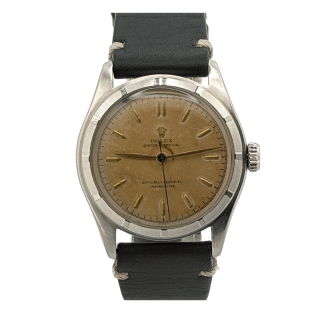
Rolex Datejust / Oyster Perpetual (1950s–1970s)
Emblematic examples of “wearable” vintage watches: balanced proportions, timeless design and excellent legibility. They perfectly embody the idea of a watch that is old in age, yet modern in use. -
Omega Seamaster & vintage Speedmaster
Widely present on the vintage market, these references reflect post-war watchmaking: robustness, clarity and strong identity. In vintage form, they maintain an excellent balance between history and reliability. -
Vintage Cartier Tank, Santos and Panthère
Particularly illustrative of the “jewellery vintage watch” concept. The designs span decades, but older proportions, dials and bracelets give them a personality distinct from contemporary versions. -
Early-generation Jaeger-LeCoultre Reverso
A perfect example of a vintage watch with a strong identity, designed in a specific era, with an instantly recognisable silhouette and genuine historical coherence.
What these watches share is the ability to tell the story of an era while remaining suited to everyday wear. This is precisely what makes them so compelling on the vintage market.
Notable antique watches (pre-1950 and early 20th century)
Antique watches occupy a different register. They are not necessarily designed for versatility, but offer a stronger heritage and emotional dimension.
In the Mostra catalogue, this includes in particular:
-
Watches from the 1900s–1930s
Smaller cases, enamel dials, painted or Breguet numerals, slender hands. These watches reflect a period when watchmaking was still closely linked to pocket watches and elegance was paramount. -
Military or civilian watches from the first half of the 20th century
Historically marked pieces, sometimes linked to specific professional uses. They tend to appeal more to enthusiasts and collectors than to buyers seeking an “easy” watch.
These antique watches generally require:
- greater care in daily use,
- acceptance of mechanical constraints,
- a more contemplative rather than purely functional approach.
They are ideal for those seeking a watch rich in history, but less suitable as a first everyday timepiece.
Vintage watches for women: proportions, elegance and period coherence
Vintage takes on a particular dimension when it comes to women’s watches. Unlike some modern productions, many historical women’s watches were designed with remarkable proportional accuracy.
At Mostra, this is reflected in:
-
Small rectangular or oval watches (1940s–1970s)
Perfect examples for understanding the difference between vintage and modern: slim cases, restrained dials, integrated bracelets or fine leather straps. -
Vintage quartz and mechanical jewellery watches
Models where the movement serves the design. These watches perfectly illustrate why quartz has always had, and still has, a legitimate place in women’s luxury watchmaking.
These pieces show that vintage is not defined by age alone, but by overall coherence: design, use, comfort and period aesthetics.
FAQ: antique, vintage and second-hand watches
What is the difference between a vintage watch and an antique watch?
The difference lies primarily in age, but also in use and intent.
A vintage watch generally refers to a watch around 20 to 40 years old, often produced between the 1930s and the 1980s. It is still designed to be worn, with proportions, materials and movements compatible with daily use.
An antique watch, by contrast, refers to much older pieces, often produced before the 1940s. Their appeal is primarily historical or patrimonial, and they require greater care in use.
In short: vintage is often a compromise between history and wearability, while antique watches are more about collecting and heritage appreciation.
Is a watch from the 1990s considered vintage?
This is a common question, and the answer depends on context.
From a strictly chronological standpoint, a watch from the 1990s can now be considered vintage. However, in watchmaking, the term “vintage” also refers to an identifiable period aesthetic: proportions, dial typography, bracelet style and overall design approach.
Some 1990s watches already display very contemporary aesthetics and are therefore perceived more as recent second-hand watches. Others, by contrast, extend older design codes and naturally fit within the vintage universe.
At Mostra, the approach is above all coherent: a watch is considered vintage when it genuinely embodies a recognisable era, beyond its simple production date.
Which vintage watch should you choose as a first piece?
For a first vintage watch, it is advisable to prioritise models that are:
- known for their reliability,
- easy to wear in terms of proportions,
- well understood in terms of maintenance.
References such as a vintage Rolex Datejust, an Omega Seamaster, or early-generation Cartier Tank or Santos models make excellent entry points. They offer strong vintage identity while remaining suitable for daily wear.
For a first experience, it is generally best to avoid very old, very small or mechanically fragile watches, which require greater involvement.
How can you tell if a watch is truly vintage or antique?
Several elements help place a watch in time:
- the serial number and brand archives,
- dial style (typography, indexes, logo),
- case proportions,
- the type of movement used.
Reliable dating rarely relies on a single criterion. It is the combination of these elements, along with the seller’s expertise, that allows a watch to be accurately placed.
This is also why guidance and transparency are essential when purchasing an antique or vintage watch.
Is an antique watch suitable for daily wear?
In most cases, no.
Antique watches were designed in a time when standards of robustness, water resistance and mechanical tolerance were very different from today’s. They can function perfectly, but they require:
- greater care,
- occasional rather than daily use,
- particular attention to servicing.
For everyday wear, a more recent vintage watch is generally a far more coherent choice.
Why are vintage watches often more sought after than antique watches?
Because they offer a rare balance between history, style and wearability.
Vintage watches allow wearers to enjoy a piece rich in meaning without sacrificing comfort or reliability. They also align more closely with contemporary expectations: moderate sizes, timeless designs and easy integration into modern lifestyles.
This versatility explains their lasting success on the pre-owned market.
Conclusion: understanding to choose better
Opposing antique watches and vintage watches only makes sense if one truly understands what these terms represent. Behind the words lie very different realities in terms of age, use, technical constraints and budget.
Vintage watches now occupy a central place in the pre-owned market. They offer a rare balance between horological identity, distinctive aesthetics and everyday wearability. They provide an entry into characterful watchmaking without sacrificing comfort or reliability.
Antique watches, rarer and often more fragile, are better suited to a patrimonial or collecting approach. They appeal through their history and authenticity, but require a more informed perspective, both in terms of use and maintenance.
Ultimately, the key issue is not the label, antique, vintage or second-hand, but the coherence between the watch, your real usage and your expectations. A well-chosen, well-explained and well-checked piece will always bring more satisfaction than a model bought solely for its designation.
Taking the time to understand decades, styles and the constraints specific to each category means giving yourself the tools to make an informed choice. And in watchmaking, it is often these thoughtful choices that turn a watch into a true wrist companion.
Related products


Share this content