Sea, heat, city life: how to care for your watch in Aix-en-Provence and Marseille
In Aix-en-Provence and Marseille, a watch lives between sunlight, sea air, office days and daily movement. Quartz, automatic, vintage or more contemporary, proper care does not need to be complicated; it simply needs to be thoughtful.

Between Aix-en-Provence, Marseille, heat, the sea, city life and everyday travel, caring for a watch mostly comes down to simple habits. Wiping it regularly, avoiding aggressive products, keeping an eye on the bracelet, not forgetting a weak battery, being cautious around water and consulting a watchmaker when warning signs appear can often prevent heavier interventions later on.
Between Aix-en-Provence, Marseille, the mountains and the coast, your watch does not live in a display case. It follows you through the bright Provençal sunlight, on a terrace, in the dry air of an air-conditioned office, during a city commute, sometimes in the salt of a return from the sea or in the heat of a summer day.
This is often where small problems begin: not in a major accident, but in the accumulation of neglected gestures. A watch placed next to keys, a leather strap exposed to perspiration, a crown handled too quickly, a quartz watch whose battery is forgotten, a watch worn near the sea without rinsing or wiping.
A well-cared-for watch does not require excessive attention. It mainly requires common sense: knowing when to wipe it, when to leave it alone, when to have its water resistance checked, when to replace a battery, when to change a worn strap and when to entrust the piece to a workshop rather than improvising yourself.
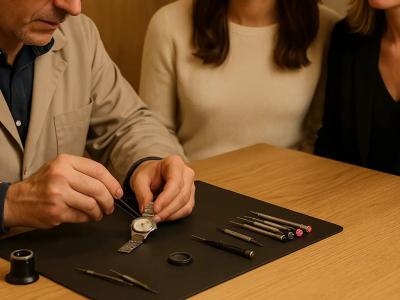
Discover at Mostra: the watchmaking workshop – the boutique in Aix-en-Provence – men’s watches – women’s watches – vintage watches
What makes watch care specific in Aix-en-Provence and Marseille
The real issue is not cleaning your watch until it shines. The real issue is caring for it according to the life you impose on it. A watch worn in the city is not exposed to the same constraints as a watch worn near the sea. A watch on a leather strap does not age like one on a steel bracelet. An older automatic does not react like a recent quartz watch. A fine watch, worn occasionally, does not have the same needs as a steel chronograph worn every day.
In other words, there is no single universal form of watch care, but several preservation habits. Understanding them helps avoid many costly repairs and, above all, many unpleasant surprises.
The sun and heat
Heat does not necessarily damage a watch in a single afternoon. However, it does accentuate what is already weakening the piece: drying out of a leather strap, fatigue in certain seals, discomfort from a bracelet adjusted too tightly, or condensation encouraged by sudden changes between a hot exterior and an air-conditioned interior.
A watch left for a long time in a car in full sun will appreciate neither the temperature nor the neglect. During a day by the pool or on a terrace, the dial and case can also rise quickly in temperature, especially on a dark or metal watch.
Salt, sunscreen and perspiration
A watch worn in summer accumulates more than one might imagine. Salt, dust, sunscreen, perfume, perspiration: none of this is spectacular, but it all eventually settles around the caseback, between the links, under the lugs or in the stitching of a leather strap.
That is why a simple gentle wipe in the evening is often better than a major clean-up later on. The aim is not to make the watch look new, but to prevent deposits from settling in over time.
The city, the office and everyday gestures
We often think about water. We forget about the city. Knocks against a table, a door handle, a computer, an entrance console or a tray all create their own kind of wear. It is less visible than an accident, but it exists.
A watch removed and put down carelessly, placed next to keys or always worn in the same conditions can gradually become marked. Care therefore also begins with the way you handle and store your watch every day.
Simple habits that prevent many problems
A well-maintained watch rarely requires complicated gestures. Regular reflexes are what make the difference, especially when you wear the same piece very often.

1. Wipe the watch instead of letting it dry by itself
After a hot day, a commute, a walk or time spent near the sea, a clean microfibre cloth is often enough. This is not about polishing. It is about removing what you can barely see anymore: fine moisture, greasy marks, dust, salt or sunscreen residue.
On a recent steel watch, this may seem insignificant. On a vintage watch, a leather strap or a piece worn regularly in summer, however, it makes a real difference over time.
2. Do not confuse “water-resistant” with “invincible”
A watch may cope very well with everyday life without liking hot showers, prolonged baths, hammams, jacuzzis or thermal shocks. Water is not only a question of depth; it is also a matter of seals, temperature, crown and overall condition.
To explore this point further without mixing it with daily care, you can read our article dedicated to watch water-resistance testing and pressure testing. It explains the situations in which a check becomes necessary, especially before regular exposure to water.
3. Respect the strap as much as the case
A leather strap dislikes continuous heat, sunscreen and lingering moisture. A steel bracelet also requires a minimum of care, as deposits easily settle between the links. A neglected strap ages quickly and can reduce the pleasure of wearing a watch that is otherwise still perfectly healthy.
You should also keep an eye on the spring bars that hold the strap in place. When they become worn, they can weaken the whole assembly and increase the risk of the watch falling. On a frequently worn watch, the strap is therefore not just an accessory: it is part of the safety and comfort of the piece.
4. Avoid aggressive products
A watch does not need perfume, scented wipes, household cleaning products or an obsession with shine. In watchmaking, too much is often the enemy of good. Proper care remains gentle, measured and adapted to the actual condition of the piece.
On an older watch, a plated piece, a fragile strap or a sensitive dial, it is better to refrain than to try too hard. Cleaning should always respect the nature of the watch.
5. Do not wait too long when a quartz watch weakens
On a quartz watch, the battery should not be forgotten. When it shows signs of weakness, or simply when time has passed, it is better to intervene properly rather than leave the watch unchecked for several months.
A simple, well-performed intervention protects the watch far more than an improvised replacement. To go further on this specific subject, you can read our article about quartz watch battery replacement at the Mostra Workshop.
Water resistance, battery, strap, accuracy: when should you consult a watchmaker?
A watch that suddenly loses time, stops when it used to run regularly, has a crown that becomes stiff, shows fog under the crystal, has a strap that is wearing abnormally or whose seconds hand changes behaviour deserves better than being postponed until later.
The longer you wait, the more a simple intervention can become a heavier one. Fog under the crystal, a forgotten battery, a crown that resists or a strap that is too worn should not be treated as minor details.
In the pre-owned and collecting world, maintenance is not an extra. It is part of the respect owed to the object. It also protects the quality of the purchase over time.
Men’s, women’s, quartz, automatic: same fundamentals, different nuances
The main principles remain the same: gentleness, regularity, caution around water, attention to the strap and consulting a professional when in doubt. But depending on the type of watch, the points to watch change.
For a men’s watch worn every day
An everyday men’s watch often takes more punishment: keyboard, steering wheel, table, door handle, weekend in the sun, occasional swimming and thermal shocks after long exposure. It therefore mainly needs consistency. Not necessarily many gestures, but repeated ones.
Frequent wiping, more careful storage and checking the strap already help limit a large part of invisible wear.
For a women’s watch or jewellery watch
A finer, more jewellery-like or dressier watch lives differently. It may be worn for shorter periods, but in an environment with more cosmetics, jewellery, handbags, clasps and friction.
Here, attention is often focused on the strap, crown, crystal and overall condition of the case. A jewellery watch requires less roughness and more care when handled.
For an automatic or mechanical watch
A mechanical watch likes consistency: real wear, calm handling, winding without force and attentive observation if it starts losing time, stopping for no reason or becoming irregular.
Mechanical charm never removes the need to listen. If the signs become repeated, a more precise diagnosis may be required. On this specific subject, our article on automatic watch servicing in Aix-en-Provence explains when a more complete intervention may be considered.
For a vintage watch or an older piece
The more a watch has crossed time, the more important it becomes to distinguish what should be preserved from what should be restored. An older piece does not need to be “like new” to be desirable. It needs to be healthy, coherent and supported with discernment.
Good care for a vintage watch often means doing as little as possible, but doing it at the right time. Too much intervention can alter its character. Doing nothing can, on the contrary, weaken its preservation.
Why maintenance also matters before buying a pre-owned watch
We often talk about maintenance after purchase. In reality, it should be considered before. A beautiful pre-owned watch is not only appealing because it is rare, well designed or well born. It is reassuring because you understand how it has been followed, what has been checked, what has been prepared and what its actual use will require.
This is where the difference between a simple seller and a watchmaking house becomes tangible. Advice does not stop at the reference. It begins when someone explains how the watch will live with you.
To better understand this dimension before buying, you can visit the page dedicated to the expertise of pre-owned watches.

Mostra advises you
A well-cared-for watch is not an overprotected watch. It is a watch that is understood. Good care begins with a simple question: how do you really wear your watch? Every day, only at weekends, at the office, in summer, in rotation with other pieces, as a single watch, as a jewellery watch or as a collector’s piece?
There is never one single answer. It is built from your real life. For some, the right advice will be to have the water resistance checked before summer. For others, to replace a tired leather strap. For others still, to avoid premature servicing while monitoring real warning signs.
Ideal maintenance is not the most spectacular. It is the one best suited to the daily life of your timepiece.
Mostra welcomes you in Aix-en-Provence
In Aix-en-Provence, Mostra brings together the boutique, the workshop and expertise in one coherent universe. This makes it possible to compare, try on, have checked, buy, maintain and better understand your watch in a consistent setting.
For both enthusiasts and collectors, this continuity changes everything: the watch does not simply pass from hand to hand, it passes through a place that knows how to situate it, follow it and help it last.
A watch is not merely a beautiful mechanical object. It is a personal object, one that should resemble you in the way it accompanies your life and brings you pleasure. In Aix as in Marseille, caring for it does not take away from its charm. It simply gives it the chance to last, whether it accompanies you through the city, up around Sainte-Victoire or back from a day in the calanques.
Share this content