Watch water resistance: pressure testing, when to do it, why it matters
Many watch owners believe that a watch described as water-resistant will remain so over time, without any particular checks. In reality, a watch’s water resistance is never guaranteed forever. It depends on several factors, including the condition of the gaskets, the case, the crown...
Many watch owners believe that a watch described as water-resistant will remain so over time, without any particular checks. In reality, a watch’s water resistance is never guaranteed forever. It depends on several factors, including the condition of the gaskets, the case, the crown, and any openings the watch may have undergone over time.
A pressure test is precisely what makes it possible to check whether a watch still offers a level of water resistance consistent with its intended use. This is not just a minor technical detail: a watch with insufficient water resistance can allow moisture to enter, sometimes with significant consequences for the movement and internal components.
In Aix-en-Provence, having your watch’s water resistance checked is therefore a useful step, whether after a battery change, before a period of summer use, or simply when in doubt. In this article, we will look at what a watch’s water resistance really means, what a pressure test involves, when it should be carried out, and why this check is essential to preserve your watch over time.
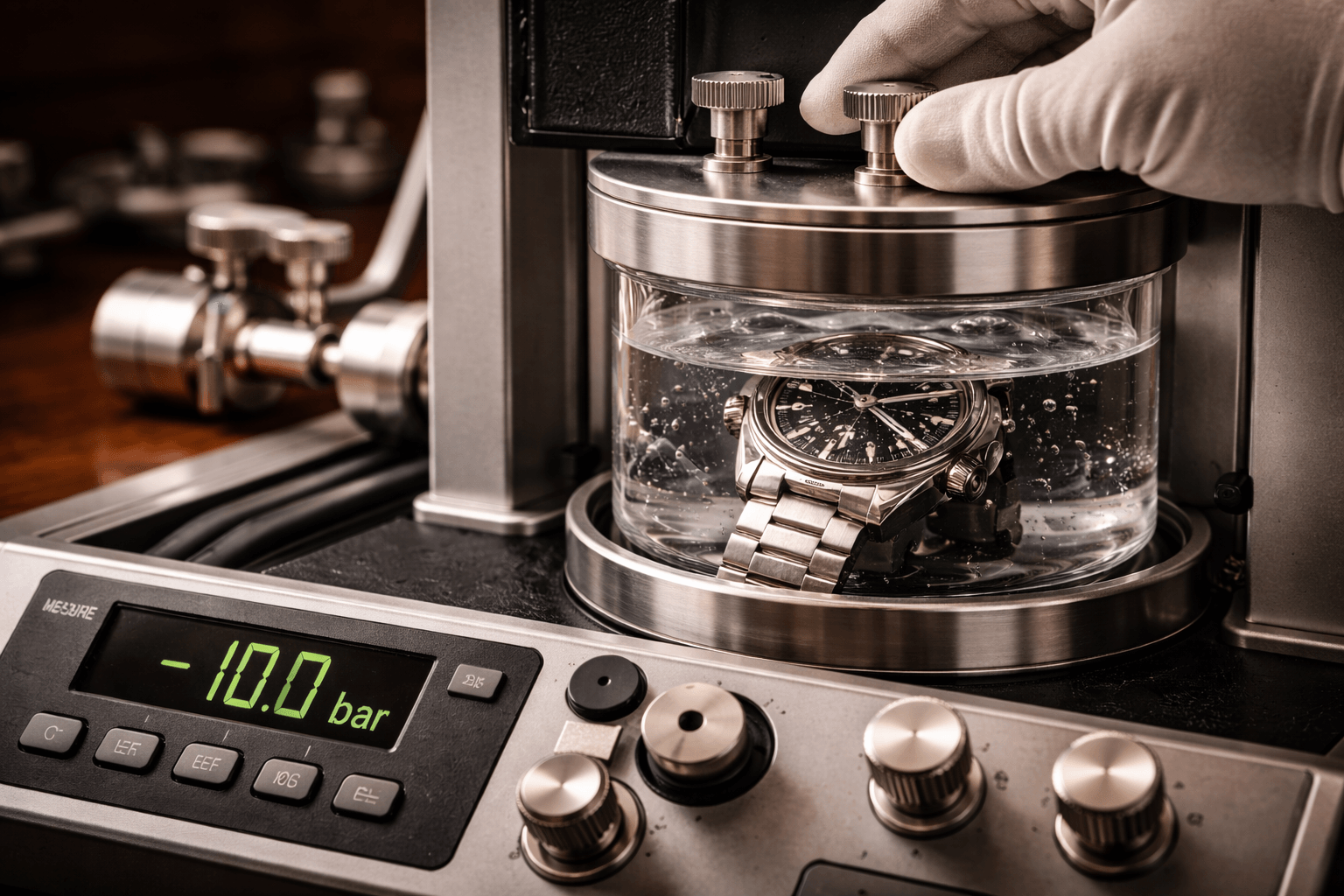
What does a watch’s water resistance really mean?
A watch’s pre-owned water resistance is often misunderstood. Many users rely only on the marking shown on the dial or caseback, without always knowing what it actually means in practical terms. Yet there can be a significant gap between the theory indicated by the manufacturer and the watch’s real condition in everyday use.
Water-resistant does not mean invulnerable
A water-resistant watch is not a watch that is absolutely protected against all exposure to water. Water resistance corresponds to a defined level of resistance under certain conditions, but it also depends on the watch’s actual condition at the time it is worn. Over time, gaskets can age, certain parts can lose effectiveness, and the watch may no longer offer the same level of protection as it did originally.
In other words, water resistance is not a permanent condition. A watch that was rated as water-resistant when it left the factory may no longer be so several years later if it has not been checked or maintained. So it is important to realize a diagnosis.
Bar, ATM, metres: what these markings mean
Markings such as 3 ATM, 5 ATM, 10 ATM, or 30 metres, 50 metres, 100 metres correspond to theoretical levels of pressure resistance. They provide useful guidance, but they should not be interpreted too literally in everyday use. A watch marked 30 metres is not necessarily suitable for repeated immersion, and a watch rated to 100 metres still needs to be in genuinely good water-resistant condition.
These indications therefore help identify the level originally intended by the design, but they never replace an actual check carried out in a workshop.
Why water resistance changes over time
A watch’s water resistance naturally changes over the years. Gaskets can dry out, compress, or deteriorate. A crown or caseback can lose effectiveness after repeated handling. A simple opening for a battery change, servicing, or repair can also alter the watch’s water-resistance conditions if no check is carried out afterwards.
This is precisely why a water-resistance test remains essential if you want to continue wearing your watch with confidence, especially in the presence of water, humidity, or temperature changes.
What does a pressure test for a watch involve?
A pressure test is the method used in a workshop to check whether a watch still maintains a satisfactory level of water resistance. Unlike a simple visual inspection, this test makes it possible to subject the watch to simulated conditions in order to assess its real ability to withstand pressure variations. It is an essential test whenever you want to confirm that a watch can still be worn in proper conditions around water or humidity.
The principle of a water-resistance test
A water-resistance test consists of placing the watch in a dedicated machine in order to measure its reaction to a pressure change. The aim is to detect any possible leak around the gaskets, crown, caseback, or crystal. This check makes it possible to determine whether the entire case remains sufficiently sealed.
The purpose of the test is therefore not to “guess” whether the watch is water-resistant, but to verify its behaviour in a controlled technical environment. That is what makes it far more reliable than a simple visual estimate or a subjective impression based on use.
Pressure test and vacuum test: what is the difference?
In a workshop, water-resistance checks can be carried out under both pressure and vacuum. These two methods complement each other, because they make it possible to assess the watch’s behaviour under different conditions. A vacuum test can in particular detect certain case variations or micro-leaks, while a pressure test simulates stress that is closer to real use in a humid or aquatic environment.
The benefit of using both approaches is that they provide a more complete check, better suited to the watch’s actual condition and intended use.
Why this test is more reliable than a simple visual check
A watch can appear to be externally in good condition while still having degraded water resistance. Gaskets may be worn without this being visible to the naked eye, and potential moisture ingress is not always detected before the first signs of damage appear. That is precisely why a simple visual check is not enough.
A pressure test, on the other hand, makes it possible to technically confirm whether or not the watch is still water-resistant. It provides a concrete answer to a simple question: can the watch still be exposed to water or humidity under conditions that are consistent with its intended use?
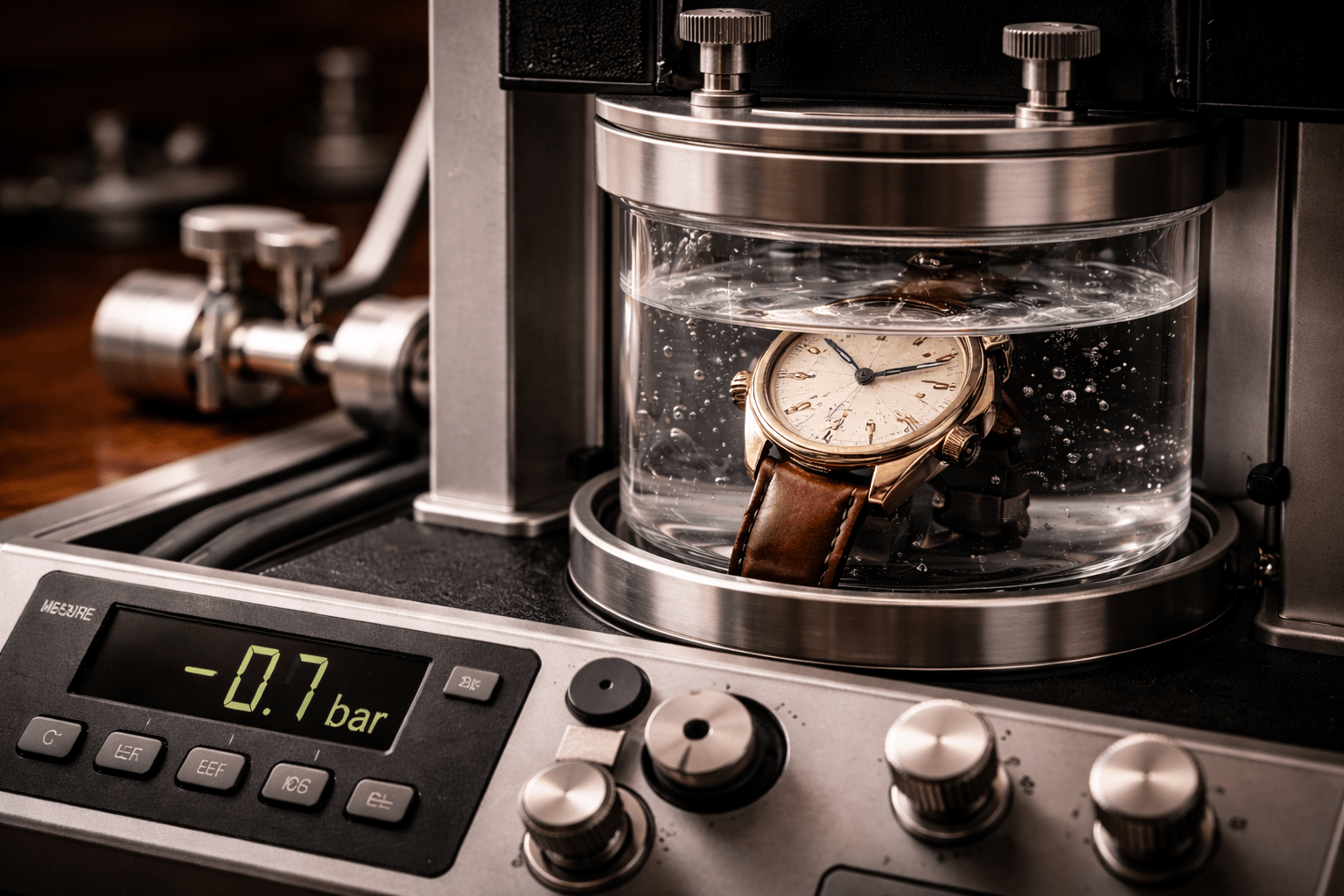
When should a watch’s water resistance be tested?
A water-resistance test should not be reserved only for breakdowns or diving watches. In practice, several situations justify a check, even when the watch seems to be functioning normally. The goal is to intervene at the right time, before moisture ingress causes more serious damage to the movement.
After a battery change
After a battery change, it is strongly recommended to check the watch’s water resistance. Opening the case does in fact break the original sealing, even when the intervention is carried out properly. If the gaskets are tired, poorly repositioned, or simply aged, the watch may no longer offer the same protection as before the intervention.
The test therefore confirms that the watch can be worn again under proper conditions, especially if it is exposed to humidity or water in daily life.
After the case has been opened or a workshop intervention
A water-resistance check is also relevant after any opening of the case, whether for servicing, repair, or a simple technical inspection. As soon as an intervention has required access to the movement, it makes sense to verify that the entire case retains its level of protection once it has been closed again.
This is particularly important for watches intended for regular, sports-related, or humidity-exposed use.
If condensation appears under the crystal
The appearance of condensation under the crystal is a clear warning sign. It may indicate that moisture has entered the watch, even in a small quantity. In that case, you should not continue wearing the watch as though nothing has happened. A prompt check is necessary, because moisture can affect the movement, the hands, the dial, or certain internal metal parts.
The water-resistance test then makes it possible to determine whether there is a sealing failure and to guide the next steps of the service process.
After a shock, a swim, or before summer
A shock can alter a watch’s water resistance without causing immediately visible damage. Likewise, a swim or repeated exposure to water can justify a check, especially if the watch has not been tested for a long time. Before summer, before a holiday, or before a period during which the watch will be more exposed to water, having a water-resistance test carried out is therefore a useful precaution.
This type of check helps avoid discovering too late that a watch assumed to be water-resistant was in fact no longer so.
On an older or rarely worn watch
An older or rarely worn watch may also require a water-resistance test. The fact that it has remained unused for a long time does not guarantee that the gaskets are still performing well, quite the opposite. On certain vintage watches, the issue must be approached with even greater caution, because their actual condition may be very different from their original specifications.
In this context, a water-resistance test is not only used to determine whether or not the watch can be worn in contact with water, but also to better understand the level of caution to adopt in daily life.
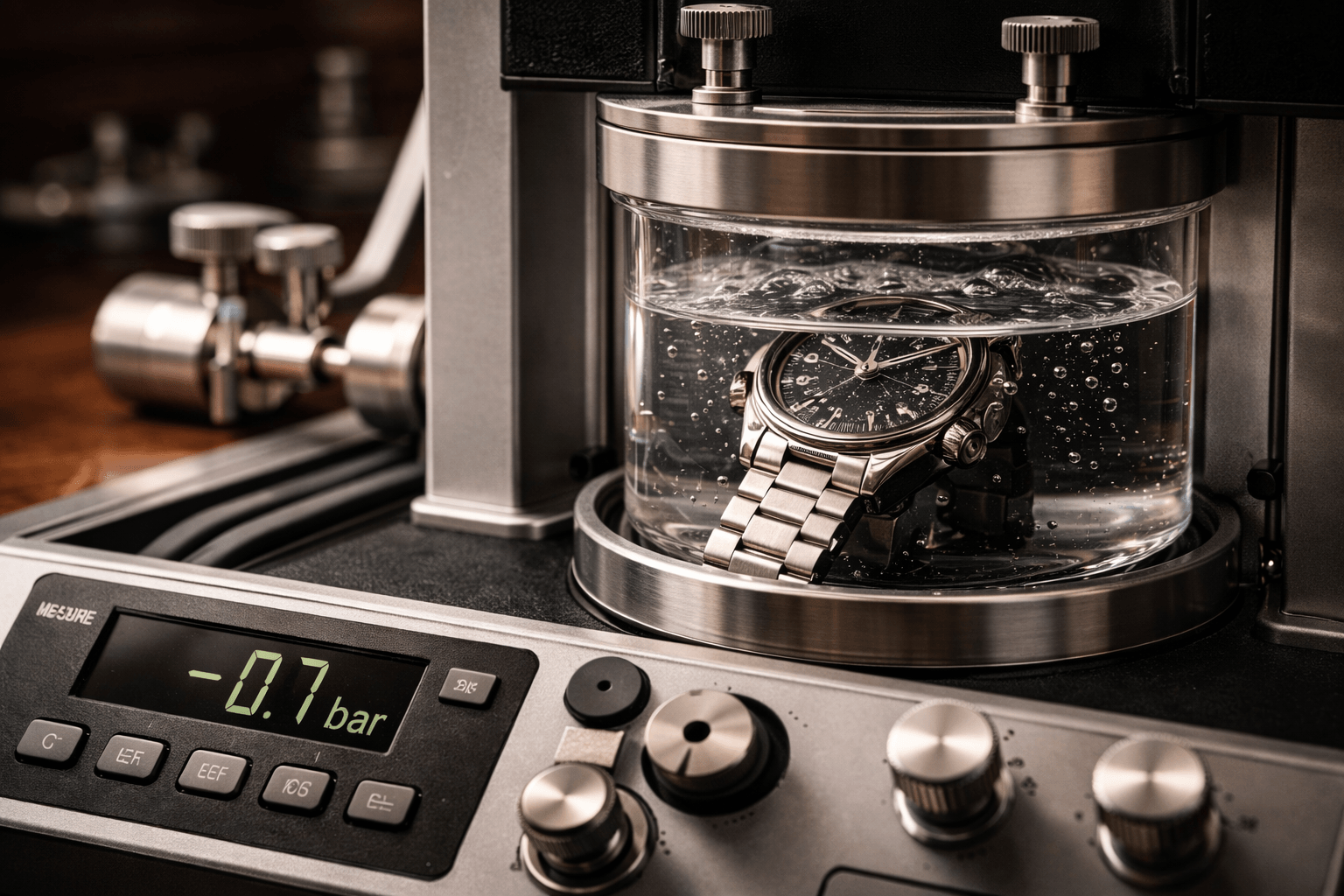
Why is this test so important?
A water-resistance test is sometimes seen as a secondary check, even though it actually plays an essential role in preserving the watch. Its value is not limited to confirming a technical characteristic: above all, it helps avoid damage that may be discreet at first, but potentially serious if not detected in time.
Avoiding moisture ingress
The first issue is of course preventing moisture from entering the watch. Even minimal ingress can be enough to disrupt internal functioning. Water or condensation does not always immediately result in a clear failure, but it can begin to damage certain elements long before the problem becomes visible.
The test makes it possible to verify that the watch can still properly fulfil its protective role against the external environment.
Preserving the movement and components
A watch movement contains sensitive components, steels, lubricants, and sometimes decorative or functional elements that react poorly to moisture. A loss of water resistance can therefore affect not only the running of the watch, but also the condition of the dial, the hands, the screws, or other internal parts.
Checking water resistance therefore means protecting the watch as a whole, beyond the sole question of aquatic use.
Avoiding heavier and more expensive repairs
When a watch has allowed moisture to enter, the consequences can quickly go beyond simply replacing a gasket. Corrosion, malfunctions, the need for complete disassembly, thorough cleaning, or replacement of components: a water-resistance failure can lead to a much more substantial intervention than a simple preventive test.
Having the water resistance checked at the right time therefore often helps avoid repairs that are more complex, longer, and more expensive later on.
Do all watches need to be tested in the same way?
Not all watches face the same water-resistance constraints. The type of movement, the intended use, the age of the watch, and its design all play an important role in how the check should be approached. A water-resistance test follows the same overall logic, but its relevance and interpretation may vary depending on the watch concerned.
Quartz, automatic, and mechanical watches
Whether it is a quartz, automatic, or manually wound mechanical watch, the need to check water resistance can arise. A quartz watch is particularly concerned after a battery change, since opening the case requires confirmation that the original protection has been properly restored. An mechanical or automatic watch may, for its part, require a check after servicing, repair, or in the event of regular exposure to humidity.
The type of movement does not therefore change the need for testing, but it can affect the context and frequency.
Diving watches, sports watches, and dress watches
A diving watch or a sports watch does not have the same usage requirements as a dress watch. When a watch is intended to be worn in humid environments, at the pool, at sea, or in a sporting context, checking water resistance becomes particularly important. By contrast, a dress watch with limited exposure to water may require greater caution in its use, even if it originally carried a water-resistance marking.
The test makes it possible to adapt recommendations and precautions to the watch’s real condition, rather than relying only on its original technical specifications.
The special case of vintage watches
Vintage watches must be approached with particular care. Their age, the condition of the gaskets, the history of previous interventions, and the possible fragility of certain components often require a more cautious approach. Even when testing is possible, the goal is not necessarily to consider the watch ready for the same kind of use as a modern model.
In such cases, the water-resistance check is mainly used to assess the level of safety in actual use and to determine how far the watch can be worn without excessive risk.
Where should you have your watch’s water resistance checked in Aix-en-Provence?
In Aix-en-Provence, having your watch’s water resistance checked should never be based on mere approximation. As soon as a watch has been opened, exposed to water, or there is any doubt about its condition, it is preferable to have a proper test carried out in a workshop. The right professional does not simply assume that a watch is still water-resistant: they verify it under proper technical conditions.
Why a real test is better than a simple assumption
A watch may seem to function normally while having already lost part of its water resistance. Conversely, the absence of visible symptoms does not guarantee that the case is still properly protecting the movement. That is why a serious check relies on suitable tools and an actual testing procedure, not on a mere impression or a superficial inspection.
When it comes to protecting a watch against moisture, it is better to rely on a measured result than on an assumption.
Water-resistance testing at the Mostra Store workshop
In Aix-en-Provence, the Mostra Store watchmaking workshop carries out water-resistance checks as part of the service process for watches entrusted to the workshop. This type of test makes it possible to verify the watch’s water-resistance condition after an intervention, when in doubt, or when its intended use justifies it.
When to combine a water-resistance test with another intervention
A water-resistance check makes the most sense when it is integrated into a broader intervention: battery change, opening of the case, servicing, repair, or a simple check after a shock. In these situations, the test helps avoid closing the watch again without making sure that its level of protection remains consistent with its future use.
This preventive testing approach is particularly useful for extending the life of the watch and limiting the risk of internal damage linked to moisture.
FAQ – Watch water-resistance test
Does a water-resistant watch remain so for its whole life?
No. A watch’s water resistance changes over time, depending on the condition of the gaskets, openings of the case, wear, and conditions of use. A watch originally rated as water-resistant can lose that capability if it is not checked regularly.
Should a test be carried out after a battery change?
Yes, it is strongly recommended. Opening the case changes the watch’s water-resistance conditions, and a test makes it possible to verify that it has retained a level of protection consistent with its intended use after the intervention.
Is a watch with condensation still water-resistant?
The appearance of condensation under the crystal should be considered a warning sign. It may indicate that moisture has entered the watch. In that case, it is preferable to have its water resistance and overall condition checked quickly.
Can you swim with an older watch?
Caution is required. Even if an older watch was originally designed with a certain level of water resistance, its actual condition may have changed over time. A test can provide useful information, but it does not automatically turn an antique watch into a swimming watch.
How long does a water-resistance test take?
The time required depends on the context in which the test is carried out and on the watch itself. When it is integrated into workshop servicing, it forms part of a technical control process intended to validate the watch’s water-resistance condition before return or continued use.
Share this content