My watch is losing time, stopping, or fogging up: 7 signs it should go to Mostra’s workshop in Aix-en-Provence
A watch rarely fails without warning. Losing time, stopping, condensation under the crystal, a stiff crown, a weak battery or a tired strap are often signs that it is time to bring it to Mostra’s workshop in Aix-en-Provence.

A watch does not always fail all at once. It usually gives warning signs. Loss of time, stopping, condensation under the crystal, a stiff crown, a weak battery, a tired strap: here are the 7 signs that should lead you to the Mostra workshop in Aix-en-Provence.
In this article
A watch speaks before it gives way.
It does not do so dramatically. It does not make a scene. It simply sends a few signs: unusual gain or loss of time, a power reserve that drops, a crown that feels less precise, condensation beneath the crystal, a bracelet that no longer inspires confidence. Most of the time, a watch does not “suddenly break down.” It warns you first. And it is precisely in that interval, between the first doubt and complete stoppage, that the real difference is made between simple maintenance and a far heavier intervention.
In Aix-en-Provence, the Mostra watchmaking workshop handles modern, vintage and collector’s watches with one simple principle: it is always better to understand a symptom early than to repair its consequences later. Loss of time, stopping, moisture, an unusual crown or a weakened strap can all justify an initial diagnosis before any intervention is decided.
Is your watch already showing one of these signs?
The simplest reaction is often the best one: bring it in. Mostra welcomes you in the heart of Aix-en-Provence, with an in-house workshop and the possibility of a first diagnosis in the boutique.
Why a watch that is still running may already need to be checked
This is probably the most common misunderstanding. A watch that still tells the time is not necessarily a healthy watch. It may keep running while slowly drifting away from its usual accuracy, losing amplitude, suffering from tired lubrication, letting in slight humidity, or developing wear that is not yet visible to the naked eye.
If you want to understand in greater depth what happens inside a movement, we have dedicated a full article to servicing an automatic watch in Aix-en-Provence: steps, lead times, and price ranges. It explains the maintenance logic, the role of oils, the progressive wear of components, and the right moment to intervene.
In other words, waiting for a complete breakdown is not always a sign of patience; it is sometimes a way of making the next intervention unnecessarily heavier. Preventive maintenance is often less expensive, takes less time, and preserves the watch’s coherence far better than an intervention made urgent by a fully developed failure.
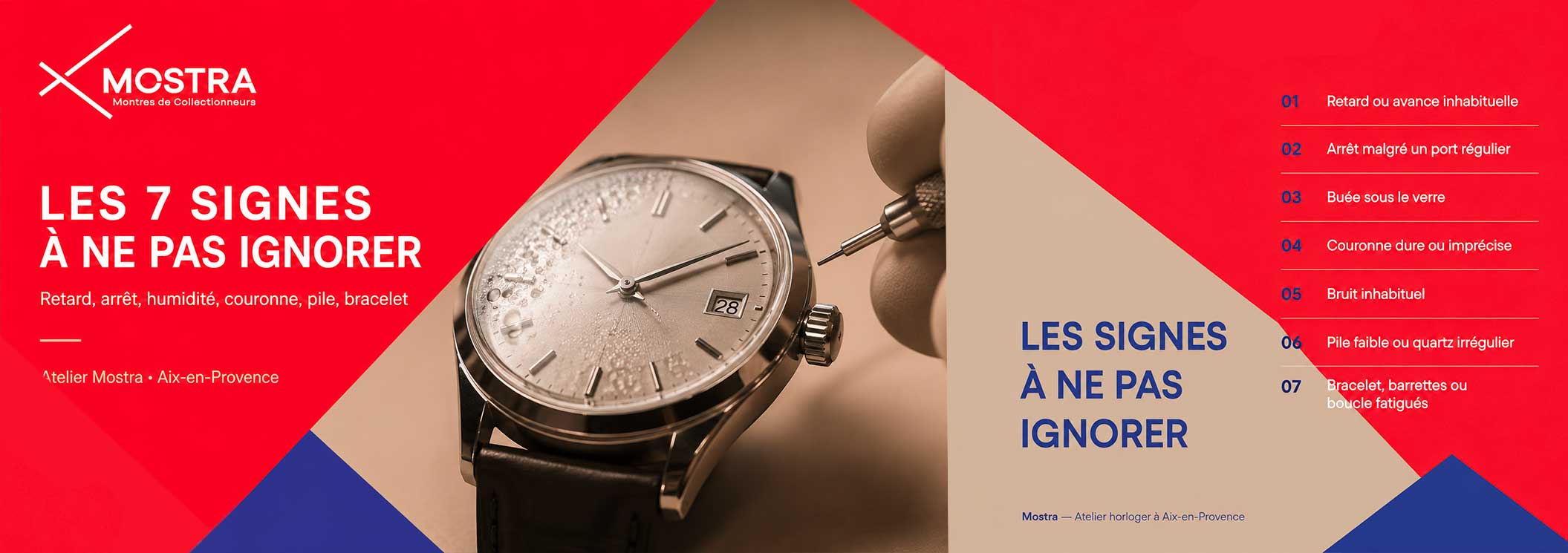
The 7 warning signs you should not ignore
1. The watch is losing or gaining time abnormally
An occasional variation is not dramatic. A persistent drift, however, deserves attention. When a mechanical watch begins to lose or gain time in an unusual way, it often signals that a check is becoming necessary: the general condition of the movement, lubrication, regulation, possible magnetization, or more advanced wear.
2. It stops even though you wear it regularly
An automatic watch that stops despite normal wear, or a watch that no longer holds its usual power reserve, should not be dismissed as a passing whim. It may indicate a decline in winding efficiency, a need for servicing, or a malfunction that is worth reading before it becomes more serious.
3. Condensation appears under the crystal
This is one of the clearest signs, and one of the most often underestimated when it disappears quickly. Temporary condensation is not a cosmetic detail: it indicates that moisture has found a way into the case, or that there is a serious doubt about the watch’s water resistance.
On this subject, we also recommend our dedicated article on watch water resistance testing in Aix-en-Provence, to understand when it should be done and why it matters before humidity leaves lasting traces.
4. The crown becomes stiff, vague or less precise
A crown that offers abnormal resistance, feels less precise when winding or setting the time, deserves attention. It is often something owners postpone, even though it directly affects both the pleasure of use and the security of the case.
5. An unusual sound appears
Not every sound is alarming. But a new noise, a more noticeable rotor, a click, or a mechanical sensation that differs from what you are used to should be treated as a clue. A watch well known by its owner always teaches its own normality. When that normality changes, the right move is not to force anything, but to show the watch to the workshop.
6. The quartz watch becomes irregular or the battery seems weak
Quartz watches speak too. A weakening battery, an irregular seconds hand or a stop for no obvious reason are all signs that should not be ignored. Replacing the battery also provides an opportunity to check the general operation of the movement and, depending on the watch and its intended use, to inspect the gaskets and consider a water-resistance test.
To understand how this routine service is handled, read our guide to quartz watch battery replacement at the Mostra workshop in Aix-en-Provence.
7. The strap, spring bars or buckle are wearing out
One often thinks about the movement and too little about the link between the watch and the wrist. Yet a worn strap, a less secure buckle, tired spring bars, or a poorly adjusted fit can put the watch itself at risk. That is also why the Mostra workshop takes care of straps, adjustments and custom fitting.
Special case: Rolex. If your watch is concerned, you may also want to read Where to service a Rolex in Aix-en-Provence?
What you should never try to do yourself
The first reflex to avoid is simple: forcing things. Forcing a crown, opening a case yourself, “testing” water resistance, improvising a wet cleaning without prior checks, or waiting to see whether the symptom disappears on its own are almost never good ideas.
In most cases, the right reflex is far simpler: bring the watch in. A vintage watch does not necessarily need to be restored. A modern watch does not always require a heavy intervention. But every watch benefits from being read at the right moment.

What the Mostra workshop can do quickly, and what requires a quote
Not every issue calls for the same level of intervention. Some needs belong to a quick check or an initial diagnosis: doubts about water resistance, battery replacement, general functional verification, reading a symptom, strap adjustment or fitting. Others require more in-depth care: automatic servicing, restoration, repair, work on an older piece, or intervention on a more complex watch.
A technical diagnosis should not, however, be confused with a full watch appraisal. The first aims to identify the cause of loss of time, stopping, moisture or another malfunction so that an appropriate intervention can be proposed. An appraisal looks more broadly at authenticity, the exact reference, component coherence, condition, provenance and market value.
When your request also concerns identification, valuation, a sale, insurance or transmission, discover our pre-owned watch expertise and appraisal service in Aix-en-Provence.
To review the services available, visit the Mostra watchmaking workshop in Aix-en-Provence. To discover the diagnosis, tools and methods used before and during an intervention, read our presentation of the Mostra Store watchmaking workshop’s know-how and methods.
For the client, the benefit is very concrete: not moving forward blindly. Knowing what belongs to a simple check, what deserves a quote, and what should be treated quickly before it becomes worse.
How a diagnosis works at Mostra in Aix-en-Provence
The simplest path is often to come with the watch. Mostra welcomes you in its boutique in the heart of the city, with an in-house workshop, to take a first look at the watch, its operation and its general condition.
To prepare your visit, consult the page for the Mostra boutique in Aix-en-Provence. It provides the practical information required to bring in your watch. The initial discussion can then clarify the symptom, the way the watch is used and the checks that may be useful before a quote or intervention is considered.
That is also what transforms uncertainty into a real boutique visit: instead of remaining in hesitation, you come, you show the watch, you understand, and then you decide.
Any doubt about your watch?
Loss of time, stopping, condensation, noise, or simply a feeling that something is no longer quite right: an early diagnosis often prevents a heavier intervention later.
FAQ
Can I come without an appointment?
Yes. The simplest option is to bring your watch directly to the Mostra boutique in Aix-en-Provence for a first look and, if necessary, workshop orientation.
Do you also work on quartz watches?
Yes. Quartz watches, battery replacements and functional checks are among the routine needs handled by the workshop.
Do you check water resistance?
Yes. The workshop can assess the water resistance of the watch according to its construction, condition and the context of the intervention. This check is particularly relevant after the case has been opened, following a battery replacement or impact, or when condensation has appeared under the crystal.
Can I come only for a strap or an adjustment?
Yes. Straps, fitting, adjustments and wrist security are fully part of workshop life.
Which guide should I read for my watch problem?
Continue with the guide that best matches the symptom or service you need:
- Watchmaker workshop in Aix-en-Provence: services and bringing in your watch
- Automatic watch servicing: steps, lead times and price ranges
- Quartz watch battery replacement at the Mostra workshop
- Water-resistance testing and checks after moisture ingress
- Having a Rolex serviced in Aix-en-Provence
- Having a watch’s authenticity, condition or value appraised
Mostra Workshop — Aix-en-Provence
Is your watch losing time, stopping, fogging up, or simply giving you the feeling that it no longer works as it used to? The simplest reflex is often the best one: show it.
These products might interest you

Share this content