Cartier Santos: the story of a French icon with softened corners, exposed screws, and purposeful elegance
The story begins with a friendship and a very practical need: Alberto Santos-Dumont, the Brazilian aviator, asked Louis Cartier for a watch he could read in flight without letting go of the controls.
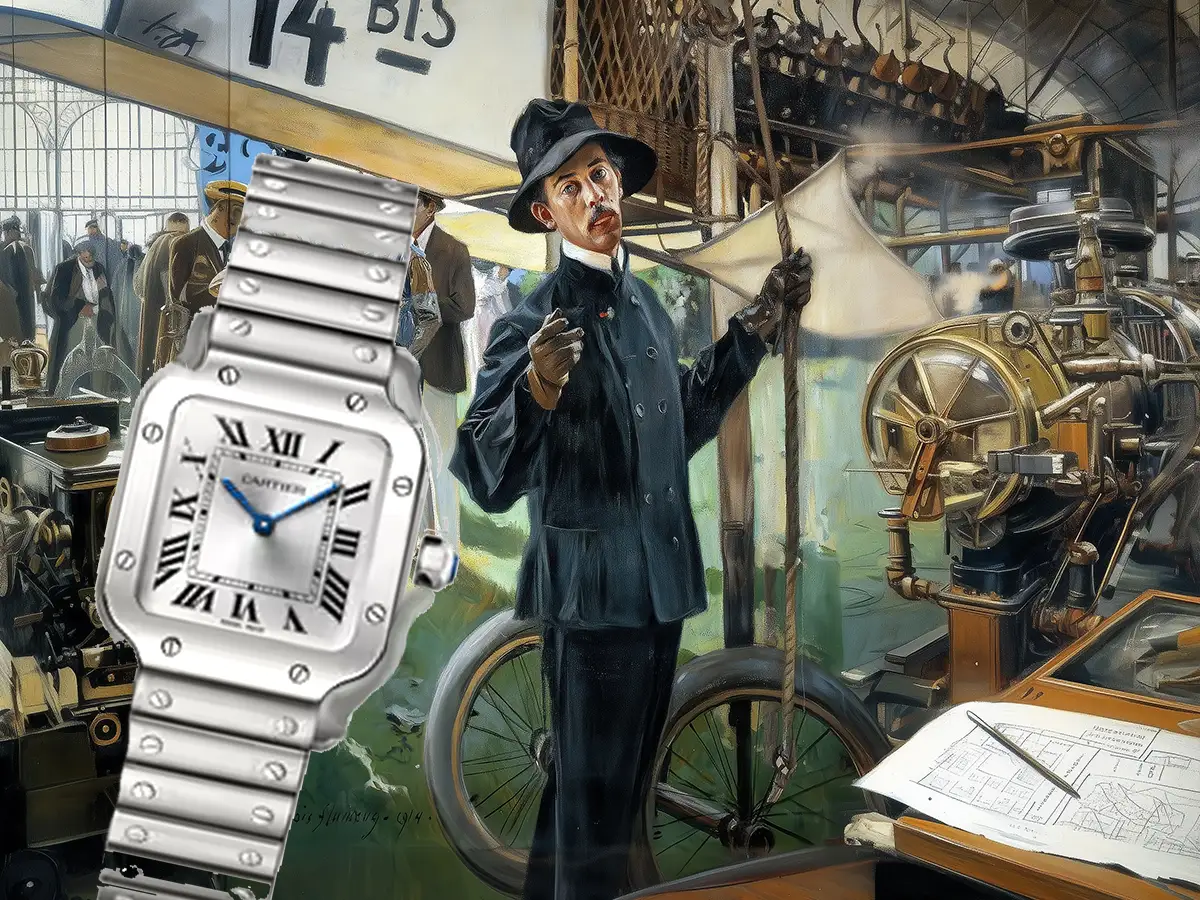
The Cartier Santos holds a unique place in watchmaking history. Born in 1904 to answer a very practical need, it has crossed the decades without losing what defines its identity: a case with rounded corners, a bezel with exposed screws, a design that is instantly recognizable, and an elegance conceived for real life. From the pioneering watch created for Alberto Santos-Dumont to the Santos Galbée, Santos 100, Santos-Dumont, and modern Santos de Cartier versions, the collection tells a story of style, function, and wrist presence all at once.
If you would like to discover the models currently available, you can also explore our selection of pre-owned Cartier Santos watches, curated for those looking for an iconic watch that can be worn every day and prepared with exacting standards.
Cartier Santos: the story of a watch born for use
In the Mostra imagination, the Santos is always born at the edge of a scene: a glass-roof light, a powdery scent, a self-assured silhouette crossing a hall as one crosses an era. In a Paris where Art Deco had not yet found its name, its alphabet already existed: geometry that reassures, a line that asserts itself, polished metal catching the light like jewelry. Clean lines, softened angles, geometry as elegance, metal as an obvious choice.
On the wrist, the Santos is not “feminine” because of an excess of detail; it is so through the intelligence of its design, its graphic presence, and that rare way of framing a gesture without weighing it down. And that is precisely what makes it a watch for active daily wear: an icon that does not ask to be preserved, but to be worn. A square, purposeful watch, with an almost insolent technical elegance. The Santos was born to free the hands, and perhaps that is why it moves so easily through eras and styles alike: it belongs to people who move, create, and decide.
The story begins with a friendship and a very practical need: Alberto Santos-Dumont, the Brazilian aviator, asks Louis Cartier for a watch that can be read in flight without letting go of the controls. In 1904, Cartier responds with a wristwatch whose look was radical for its time: a square case with softened corners, a pronounced bezel, and above all that “industrial chic” feeling that would become its signature. The Santos is not merely a luxury object: it is a solution, and therefore a form of modernity. In 1911, Cartier offers it to the public: the men’s wristwatch, and soon the unisex wristwatch, stops being a curiosity and becomes a language.
Within the Cartier galaxy, the Santos establishes itself as a different sister to the Tank: the Tank speaks the language of purity and rectangular architectural line; the Santos speaks of the power of the square, of solidity, of the idea of a bracelet conceived as a continuation of the case: a jewelry watch, yes, but a tool watch at heart. To extend that reading of the maison, it is only natural to connect it with the other great pre-owned Cartier watches that Mostra selects with the same care.
The “Santos code”: why you recognize it from three meters away
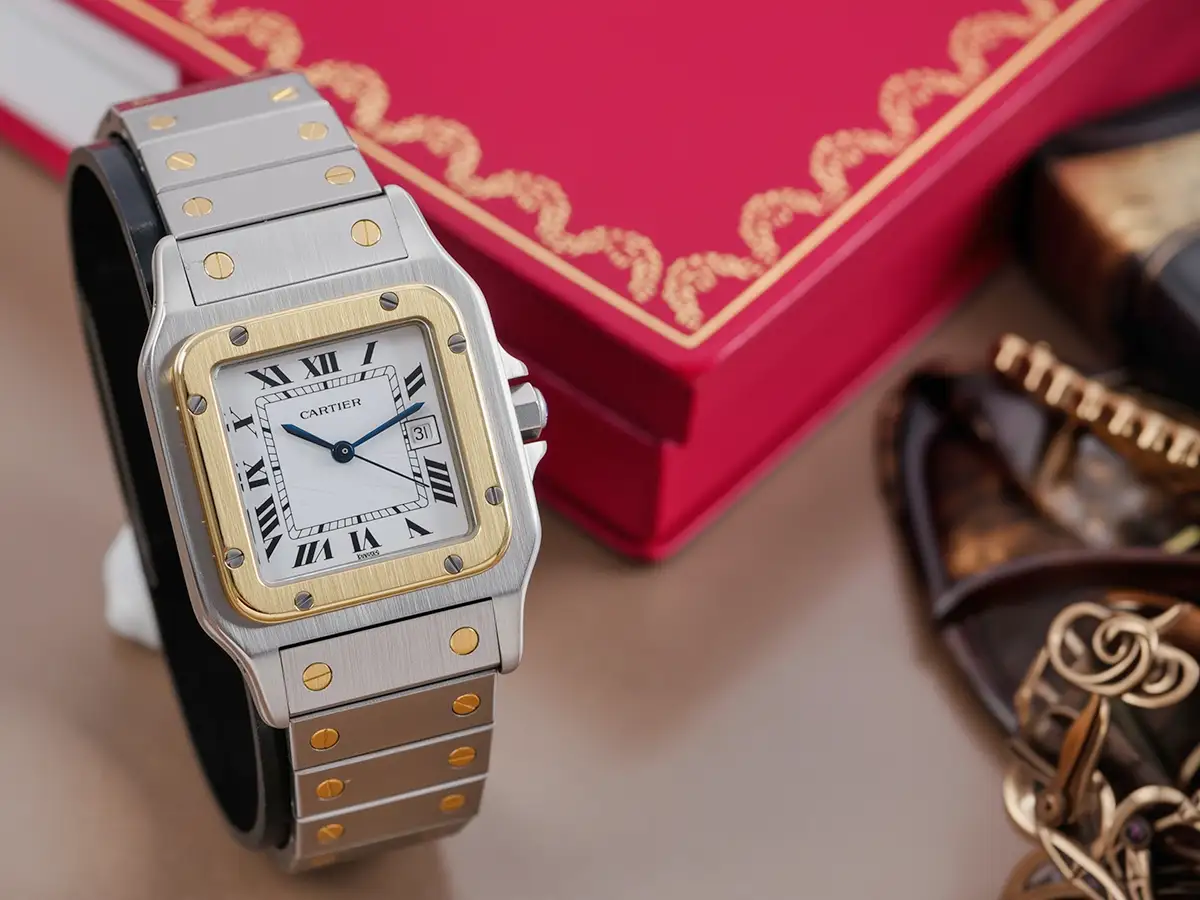
What makes the Santos, beyond its shape, is a set of instantly readable signs. First, the screwed bezel: those exposed screws are not a decorative whim, they speak of the age of machines, bridges, airplanes, and coachwork. The case brancards, the side flanks, structure the whole like two rails guiding the eye. The dial, often silvered or sunburst, animated by Roman numerals, gives the watch that typically Cartier duality: classical at first glance, subtly subversive in its construction.
The Santos is therefore one of the rare watches whose style is born from a perfect balance of jewelry, architecture, and function. That coherence explains why a Cartier Santos can feel just as right today as it did at the time of its creation.
1978: Santos de Cartier, the decisive relaunch
After decades of reinterpretation, Cartier relaunched the Santos in 1978 with a thoroughly contemporary vision: a watch designed to be worn every day, in steel, often in steel and gold two-tone, with an integrated bracelet extending the case and an even stronger identity. This was a key moment: the Santos became a “sport-chic” icon before the expression had even become commonplace.
This period also opened the door to more “industrial” movement choices in the noblest sense. The Santos would live through the quartz era, then the strong return of the automatic movement, with a simple philosophy: an elegant watch must also be easy, reliable, and effortless to wear. That 1978 relaunch also explains part of the current appeal of vintage and neo-vintage versions of the collection.
The major Cartier Santos variations
Santos Carrée / Santos Galbée (1980s–2000s): the Santos of everyday chic
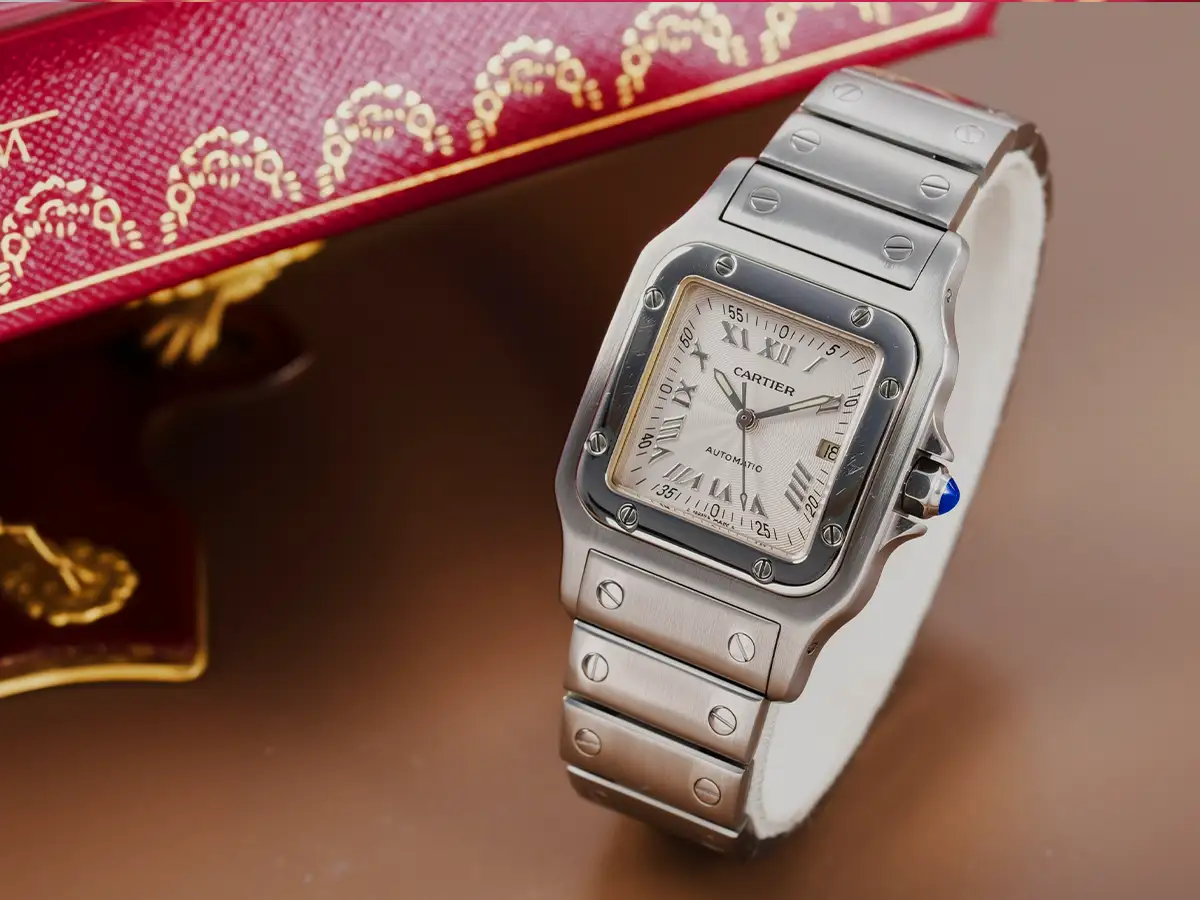
The Santos Carrée, often associated with references such as the 2960, imposes a highly structured case profile typical of the 1980s: an assertive square, an integrated bracelet, and immediate wrist presence. Dimensions of around 29 × 41 mm can be found depending on version and reference.
The Santos Galbée, meanwhile, wears its name perfectly: “galbée” for its softer, more ergonomic curves. It becomes the easiest Santos to live with: it hugs the wrist, refines the silhouette of the case, and turns the Santos into a watch that can be worn just as easily with a white shirt as with a minimalist black sweater. One very well-known reference, the Santos Galbée 2319, is frequently given in an automatic format of around 29 × 41 mm.
On the smaller, more feminine side, there are Galbée models such as ref. 1565, sought after for their compact elegance. At Mostra, for example, you may come across quartz configurations around 24 × 35 mm, perfect for a slender wrist without losing the Santos code. That is precisely why the Galbée remains one of the most sought-after variations for those who want to recover the historical balance of the collection.
Santos Ronde and shape variations
Cartier also played with the Santos vocabulary by offering round interpretations from the 1980s onward, with the Santos Ronde. The same screw-driven spirit, the same DNA, but with a more classical circular dial. Some older versions measure around 27 mm, while others are closer to 33 mm depending on reference and period.
2004: Santos 100, the Santos that takes flight
To celebrate its heritage, Cartier launched the Santos 100: larger, bolder, more twenty-first century. A widely seen reference such as the W20073X8 is often listed with a case around 51.1 × 41.3 mm, a thickness close to 10.34 mm, and an automatic Cartier movement, most often the calibre 049.
The Santos 100 is the Santos that pairs especially well with the contemporary men’s wardrobe. It also appealed to part of the cultural and music scene, where it is often cited as a watch with strong graphic presence.
Santos Demoiselle: the Santos seen as a Pop Art jewel

The Santos Demoiselle pushes the jewelry-watch reading even further: a more jewelry-like bracelet, slim proportions, often quartz-powered, conceived for a highly styled feminine everyday life. In listings and technical sheets, you will often find formats around 20 × 28 mm on certain references. It has also enjoyed renewed interest in pop culture, with several much-commented appearances.
2018: Santos de Cartier, the modern rebirth
In 2018, Cartier redesigned the Santos: more curved, more fluid, while preserving the code of the screws and integrated bracelet. Two sizes structure the collection: Medium 35.1 × 41.9 mm and Large 39.8 × 47.5 mm, with water resistance conceived for real life, up to 100 m on several versions.
The flagship movement in many modern Santos models is the calibre 1847 MC, an automatic fitted to models such as the medium size. Cartier also modernized usability with the QuickSwitch and SmartLink systems, turning the Santos into a true chameleon watch: metal by day, leather by night, without a trip to the workshop.
Alongside it, Cartier maintains and elevates the contemporary Santos-Dumont: dressier, thinner, often on leather, and faithful to the original spirit. In extra-large size, for example, dimensions can reach 46.6 × 33.9 mm, with a thickness of around 7.5 mm, powered by the hand-wound 430 MC. In small quartz format, Cartier announces a long battery life of around six years, in a 38 × 27.5 mm case with a thickness of roughly 7.3 mm.
Cartier also pushes virtuosity with the Santos Skeleton, where the bridges form the Roman numerals. It uses the hand-wound calibre 9611 MC, with a power reserve of around 70 hours, in a width around 39.8 mm depending on version. The modern Santos also embraces sportier complication with the extra-large Santos Chronograph, fitted with the calibre 1904 CH MC and listed at a width of 43.3 mm.
Cartier Santos: sizes, dimensions, and wrist presence
The question of Cartier Santos size comes up often, and understandably so: the collection exists in very different proportions depending on the era. A vintage Carrée or Galbée does not wear like a Santos 100, and a modern Santos-Dumont does not produce the same effect as a Large Santos on a steel bracelet.
Broadly speaking, a few useful benchmarks can be kept in mind:
- Santos Galbée / Carrée: around 29 × 41 mm on several emblematic references.
- Small quartz Galbée: around 24 × 35 mm.
- Santos Ronde: roughly 27 to 33 mm depending on version.
- Santos 100: much stronger wrist presence, around 51.1 × 41.3 mm for certain references.
- 2018 Santos de Cartier Medium: 35.1 × 41.9 mm.
- 2018 Santos de Cartier Large: 39.8 × 47.5 mm.
- Santos-Dumont XL: 46.6 × 33.9 mm.
The choice therefore depends less on a theoretical size than on the presence you want, your personal style, the bracelet, the thickness, and the period. That is exactly why it is useful to compare several generations of Cartier Santos before deciding.
Cartier Santos movements: from practicality to manufacture signature
The Santos passes through three major mechanical philosophies. First, the pioneering era: small watch movements adapted to the wrist, in the spirit of the collaborations of the time, when Cartier relied on the best available horological expertise. Then came the era of chic accessibility and reliability: quartz and automatic movements, often based on tried-and-tested architectures, with Cartier’s constant obsession for legibility and wearing comfort.
Finally comes the contemporary era: Cartier more clearly affirms its in-house or manufacture movements. The 1847 MC structures the modern automatic offering, the 430 MC powers the manual Santos-Dumont, the 9611 MC equips the Skeleton, and the 1904 CH MC brings the chronograph to life. In every case, the underlying logic remains the same: a Santos must remain elegant, wearable, and balanced, even when it becomes more technical.
Uses: who the Santos speaks to, and why it can become the watch of a lifetime
The Santos is one of the rare watches that can be, depending on the person, either a one-watch collection or a signature watch. For a woman, it plays a role that no round watch plays in quite the same way: it frames the wrist, draws a clear presence, and converses with jewelry instead of competing with it. On steel, it is architectural. On leather, it becomes almost literary. A Santos Demoiselle can be an everyday jewel; a Santos-Dumont, a dressing-piece for important days; a Santos Galbée, the watch that always feels right.
For a man, it is the alternative to expected sporty codes: it has graphic strength without being a tool watch in the strict sense. A Santos 100 brings a more contemporary power; a 2018 Santos on bracelet, an urban modernity; a Santos-Dumont, a non-conformist classicism.
For a collector, the Santos forms a historical timeline: pioneer of the modern wristwatch, 1978 steel-and-gold icon, 1980s monument with the Carrée and Galbée, 2000s statement with the Santos 100, 2018 rebirth, and then contemporary complications.
Santos and culture: cinema, fashion, music
The Santos has that rare quality: on screen, it is instantly recognizable. It becomes self-evident and signs an attitude. In cinema, it has often been identified as a symbol of success and power, especially in the Wall Street aesthetic of the 1980s, where luxury becomes a social language.
In recent pop culture, it is seen worn and commented on at the wrists of celebrities, which revives interest in certain variations. The Demoiselle in particular has generated a great deal of conversation through highly publicized sightings. The modern Santos also appears on red carpets and during film promotions, worn by actors, sometimes ambassadors, in documented appearances. In music, several mainstream watch publications regularly cite the Santos 100 within the hip-hop luxury aesthetic. And the Santos Carrée also appears in fashion selections, where it becomes as much an object of style as an object of horology.

Why the Santos is essential in the Cartier range
Cartier is the maison of shaped watches: Tank, Santos, Baignoire, Crash… The Santos is the most active of these forms. It is the Cartier watch that most fully embraces the integrated metal bracelet, versatility, and daily life, while remaining instantly jewelry-like in the way it is perceived.
The Tank is a line; the Santos is an architecture. The Tank is a stroke; the Santos is a volume. That is why it crosses genders, ages, and wardrobes. Finding a Santos is one thing. Finding the right Santos, the right size, the right era, the right presence on the wrist, the right bracelet condition, the right dial/hands/crown coherence, and a checked movement: that is where everything is decided.
How to choose a pre-owned Cartier Santos
Choosing a Cartier Santos is not just about choosing a design. It also means weighing an era, a bracelet construction, a size, a type of movement, and an overall condition. A Carrée or a Galbée will often appeal through compactness and historical accuracy. A Santos 100 will suit those looking for a stronger contemporary presence. A recent Santos de Cartier will bring greater comfort of use, modularity, and water resistance.
You should also look carefully at:
- the coherence of dial / hands / crown,
- the condition of the bracelet and any looseness,
- the sharpness of the case and bezel,
- the relevance of the size on the wrist,
- the type of movement, quartz, automatic, or manual,
- and of course the service history.
Frequently asked questions about the Cartier Santos
What is the origin of the Cartier Santos?
The Cartier Santos was born in 1904, when Louis Cartier designed a wristwatch for the aviator Alberto Santos-Dumont so he could read the time in flight without letting go of the controls. It was then offered to the public from 1911 onward.
Why is the Cartier Santos important in watchmaking history?
Because it is one of the earliest modern wristwatches conceived for real use. It very early combined function, legibility, a strong shape identity, and elegance, which explains its central place in the history of Cartier and the wristwatch itself.
What are the main versions of the Cartier Santos?
The best known are the Santos Carrée, Santos Galbée, Santos Ronde, Santos 100, Santos Demoiselle, the contemporary Santos-Dumont, as well as the modern Santos de Cartier, Skeleton, and Chronograph versions.
What are the dimensions of a Cartier Santos Galbée?
Depending on the reference, an automatic Santos Galbée such as the 2319 is often given at around 29 × 41 mm. On smaller quartz versions, formats close to 24 × 35 mm are also common. Exact dimensions vary according to generation.
Which Cartier Santos size should I choose?
The choice depends on your wrist, the style you want, and the generation you are targeting. A Galbée or Carrée will often suit those looking for a contained and elegant presence. A Santos 100 or a modern Large will be better suited to a more assertive wrist presence.
What is the difference between a Santos and a Santos-Dumont?
The classic Santos generally favors the integrated metal bracelet, a more everyday presence, and sometimes a sportier feel. The Santos-Dumont is generally thinner, dressier, and closer to the original spirit, often worn on leather.
Does the Cartier Santos exist in quartz and automatic versions?
Yes. Depending on the period and version, the Santos collection has existed in quartz, automatic, and manual forms. That is one of the reasons why it now covers a very wide range of uses and budgets.
At Mostra: finding the right Santos, in the right format, in the right condition
At Mostra, you benefit from that rare peace of mind: rigorous selection, genuine guidance, and a watch intended to be worn, not merely sold. Our integrated watchmaking workshop ensures technical and aesthetic coherence before any watch is offered for sale. Mostra also provides an exceptional three-year warranty on the watches it sells, a level of security that remains rare on the pre-owned market, so the icon can continue to deliver daily pleasure.
Do you already have a specific reference in mind, a Galbée, a Santos-Dumont, a Carrée, or a Santos 100, and would you like help finding the right example? Let us help you find your ideal watch.
These products might interest you


Share this content