Memphis Belle: history and watches of american pilots
...The A-11 and A-17 navigation hack-watches of the US Army Air Force
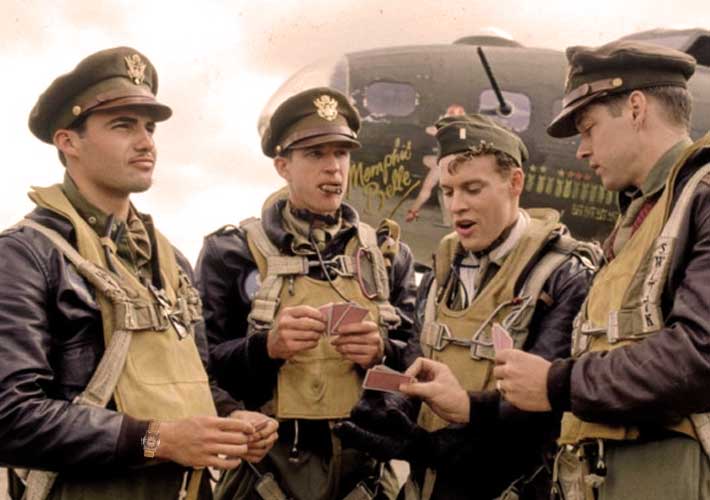
Memphis Belle, a legendary B-17 bomber, completed 25 missions during WWII and became a symbol of resilience for American crews. Immortalized in two films, it also showcases historic military watches worn by pilots, including the Elgin A-11 and Longines Weems. These timepieces, essential for navigation and coordination, represent the precision and ingenuity of wartime horology.
Memphis Belle’s Legendary Final Mission
With the attack on the Lorient submarine base on March 17, 1943, the crew of the B-17 Flying Fortress Memphis Belle from the 324th Bomb Squadron completed its final mission by landing at the Bassingbourn base southwest of Cambridge, England. This aircraft would be the first heavy bomber to allow its crew to return alive after completing their tour of twenty-five missions. The total flight time of these 25 missions amounted to 148 hours, with more than sixty tons of bombs dropped on the enemy.
A Dual Tribute in Film
Two films have been dedicated to its engagement: A 1944 documentary, lasting forty-five minutes, produced for the US Department of Defense by William Wyler, which recounts its 25 missions and its return flight to the United States. The second, directed by Michael Caton-Jones, is a blockbuster film released in theaters in 1990. The latter, relatively detailed and faithful to the realities and difficult conditions that American bomber crews endured during their deployment in the Bomber Wing. However, a slight liberty with historical accuracy should be noted: The target designated for the twenty-fifth and final mission in the film (instead of Lorient and its submarine base, the film depicts Bremen and the bombing of the Focke-Wulf aircraft factories)... A mission indeed carried out by the Memphis Belle and its crew but actually the twenty-first in chronological order of its missions.
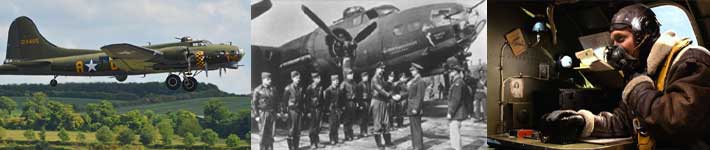
The 91st Bomb Group and the Fight Against the U-Boats
The Memphis Belle squadron was part of the 91st Bomb Group, itself integrated into the 1st Combat Bombardment Wing of the Eighth Air Force. The group's DF code is visible on the tail fins of the B-17s and on the aircraft's tail. (It was later accompanied by a large A-shaped logo inside a triangle after June 1943). The activity of this air group began in November 1942 and quickly focused on missions aimed at reducing the U-Boat threat by bombing German submarine bases built along the French Atlantic coast.
Other secondary targets: Luftwaffe airbases, industrial sites, and railway hubs to weaken Germany’s defense capabilities. This air group received an honorary citation in March 1943 following the bombing of Hamm for the remarkable heroism of the crews engaged in the face of strong enemy opposition coupled with atrocious weather conditions.

The Aircraft and its Crew
The B-17 Flying Fortress Memphis Belle is a Boeing aircraft, model B-17-F-10-BO. It bears the serial number 41-244585. Its first mission was the bombing of the submarine facilities in the port of Brest on November 7, 1942. It completed a total of twenty-five bombing missions, with a crew of eleven men, including a dedicated ground maintenance mechanic. The onboard crew included five turret and side gunners, a radio operator, a navigator, a bombing officer, and two pilots.
The pilot and commander of the Memphis Belle, portrayed by Matthew Modine, was in reality Captain Robert K. Morgan, born July 31, 1918, in Asheville, North Carolina. His co-pilot, played by Daniel Sweeney, was Captain Jim Verinis. Billy Zane played the bombing officer, Tate Donovan portrayed the navigator in place of Captain Charles B. Leighton. Singer Harry Connick Jr. played one of the crew’s gunners….
The watches of the Memphis Belle Film
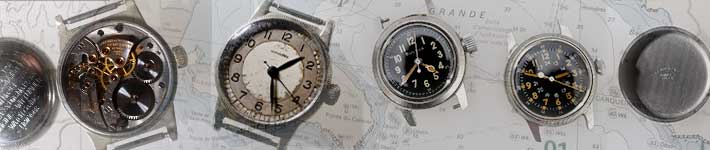
Regarding the watches in the film, different vintage military watches can be seen on the crew’s wrists, including an Elgin A-11 hack-watch or a Longines Weems 10L, a model generally reserved for early wartime pilots, produced by the American office of Longines Wittnauer in New York. It is an aviation navigation watch, a Hack-Watch type (synchronized by crown action), equipped with a rotating bezel lockable by a patented Weems system, which consists of locking the rotation of the bezel disc with a nut-shaped additional crown. A device usually located at four or five o'clock on the watch case.
This watch was used by many American and British pilots engaged in World War II aboard Mustang P51s, Spitfires, or B-17 or Lancaster bombers. In the case of British watches, Longines supplied directly to the Royal Air Force without going through its Wittnauer agent.
American Military Watch Contracts: A-11 and A-17
During wartime production, two military watch contracts were opened by the US Army and won by Elgin and Longines Wittnauer for the A-11 model, and by Waltham and Bulova for the A-17 model. From the beginning of its involvement in World War II, the USA needed to equip the numerous fighter and bomber crews that would bombard Germany, its occupation forces in Europe, and Japanese forces in Asia. The enemy’s industrial potential was the primary objective, with cities and their industries as secondary targets.
The A-11 Hack-Watch: Precision for Mission Safety
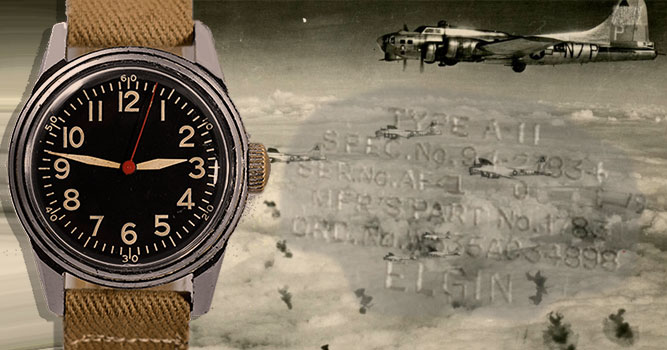
The A-11 watch contract was for a navigation hack-watch (or stop-second), allowing the second hand to be stopped via the winding crown to synchronize the watch with others (cockpit clock or teammates' watches) at a given time. This method was used by bombardment group officers to prevent accidents in "box formation" flying of B-17s (tight formation flying at different altitudes) and avoid dropping bombs on friendly aircraft flying below.
For fighter planes, synchronizing flight time enabled simultaneous squadron engagements on enemy targets and secured flight paths.
Why No Radium? A Practical and Technical Choice
Another key feature of the A-11 and A-17 watches, designed mainly for aircrews, was the use of painted hands instead of luminescent radium: The conditions aboard bombers were particularly turbulent. High-altitude flight, combined with the aircraft’s large wingspan (not to mention Flak explosions), caused significant turbulence and vibrations.
Over time, these factors caused the luminescent radium to break down, scattering debris across the dial and central axis of the watch, jamming the movement mechanism... and stopping the watch, rendering it unusable—leaving the pilot or crew member unable to complete their mission.
Legacy and Collectibility
You can find more details and the full specifications of these pilot watches in their individual description pages within the military and aviation watch collection of mostra-store.com.
The A-11 and A-17 models, a later generation than the Longines Weems 10L, benefited from the experience gained in the early months of the war and featured notable mechanical improvements that provided greater operational stability and better shock and temperature resistance during high-altitude flights and combat.
The size of these watches remained modest (28-24 mm) due to the chronic shortage of raw materials during wartime (and also for economic reasons). However, the use of such case diameters continued until the mid-1950s, when the first 36–38 mm watches became standard and continued evolving as an essential removable cockpit instrument, proudly worn on the wrist by pilots. An essential tool for pilots that also became a symbol of recognition within the aviation community.
Share this content