Watch Stories

Rolex Submariner: History, References and Collector’s Guide from the 6204 to the 126610

From the 1950s reference 6204 to today’s 124060 and 126610, discover the history of the Rolex Submariner, its references, dials, calibres, MilSub, COMEX, service parts and the criteria that determine its value.

rolex Submariner 70 Years Beneath the Surface

Rolex Submariner: 70 Years Beneath the Surface -  History, References and Collector’s Guide

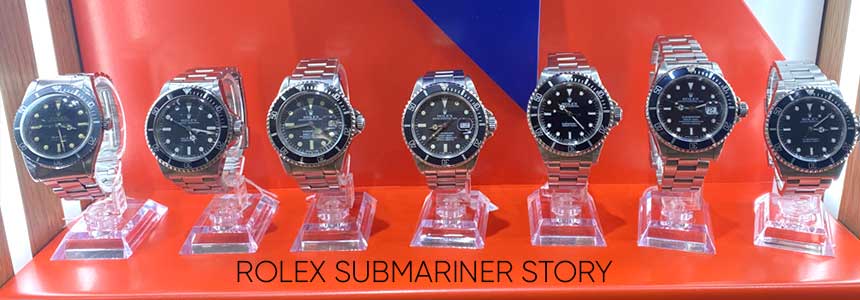
From reference 6204 to today’s 124060 and 126610, the Rolex Submariner has crossed more than seventy years of history while giving the impression that it has barely changed. Behind this continuity lies an extraordinarily rich genealogy: Small Crown and Big Crown, gilt or matte dials, meters first or feet first, Maxi Dial, Red Submariner, MilSub, COMEX, transitional references, tritium, Luminova, Super-LumiNova, aluminium inserts and later Cerachrom. For the collector, the difficulty is therefore not recognising a Submariner. It is understanding exactly which Submariner is being examined.

By Thierry Serna and Jean-Baptiste Contini
Historical, heritage and market perspective: Thierry Serna
Technical analysis and workshop methodology: Jean-Baptiste Contini

The Mostra Essential — for readers in a hurry

One Submariner may look like another Submariner and yet belong to a completely different market

The Rolex Submariner appeared in the early 1950s as a genuine professional diving watch. Very quickly, it also became a cultural object, worn on screen by James Bond, used in military and professional environments, associated with COMEX divers and later adopted by several generations of collectors. Yet the name Submariner now covers extremely different watches: a gilt 5513, a Red Submariner 1680, a tritium 16610, a 14060M or a contemporary 126610 cannot be assessed in the same way or according to the same criteria.

Professionals, collectors and prospective buyers will find in this dossier the principal references, the dials and movements to know, the differences between original components and Rolex service parts, the specific characteristics of MilSub and COMEX watches, the neo-vintage generations, the technical developments and the criteria capable of radically changing the value of two watches that nevertheless share the same reference number.

The article also explains why a serviced watch is not necessarily more desirable than a preserved example, why polishing should be assessed with caution, how to understand a service dial, why water-resistance testing still matters on an older diving watch and why a Submariner that appears to run perfectly may nevertheless require a mechanical diagnosis.

The essential question is therefore not simply: “Is this a genuine Submariner?” It is: “Which Submariner is this exactly, in what configuration, in what condition, with which parts and with what history?”

Enter the history See the 12 Mostra checks Discover available Submariners

“A Submariner may look almost identical to one produced ten, twenty or fifty years earlier. That is precisely what makes it difficult to collect: the most important differences are not always the ones you notice at first glance.”

Some watches change their appearance with every generation. The Rolex Submariner follows almost the opposite logic. Since the early 1950s, its dark dial, rotating bezel, large luminous hour markers, immediately recognisable hands and Oyster bracelet have formed a silhouette that Rolex has perfected through successive evolution rather than sudden rupture.

This continuity explains much of its power. A Submariner produced fifty years ago may still look familiar to the owner of a contemporary 124060. Yet it also explains the complexity of collecting it. Behind an almost unchanged appearance lie changes in dials, calibres, bezels, luminous materials, crowns, bracelets and construction, some of which can profoundly alter rarity, usability and heritage value.

This dossier complements our selection of pre-owned and vintage Rolex Submariners and our extensive history of Rolex and its professional collections. The aim is not simply to tell the story of an icon, but to provide the landmarks required to understand a Submariner before buying, appraising, servicing or selling it.

Before the Submariner: Oyster, Water Resistance and the Conquest of the Depths

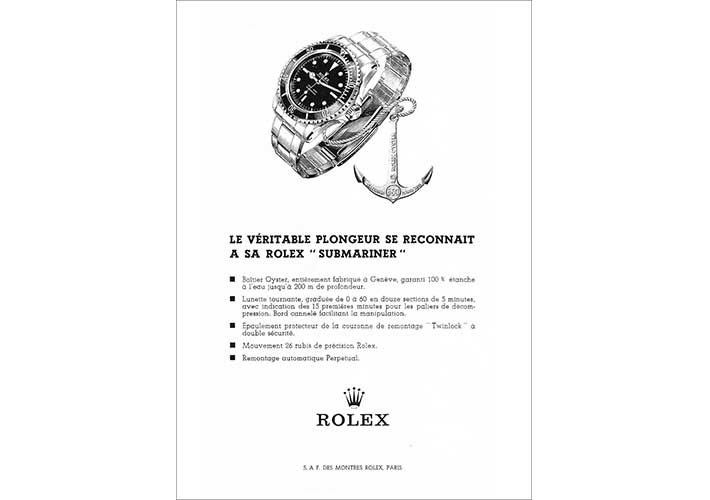
The Submariner did not appear in a technical vacuum. It was the result of several decades during which Rolex worked to protect the movement from water, dust and external aggression. The Oyster case, developed in the 1920s, laid one of the foundations of the modern water-resistant wristwatch. The caseback, bezel and crown contributed to an increasingly hermetic architecture, while the adoption of automatic Perpetual winding allowed the watch to remain running regularly without repeated manipulation of the crown.

In the early 1950s, autonomous diving was also entering a new era. It was gradually moving beyond strictly military, scientific and professional environments and becoming more widely practised. Divers needed to measure time underwater, maintain excellent legibility, withstand impacts and pressure and rely on a case sufficiently secure for repeated immersion.

It was in this context that the Submariner was born. But a common confusion must be corrected here: Rolex’s famous abyssal experiments were not conducted with a production Submariner. The watch attached to the outside of the bathyscaphe Trieste during its extreme dives was the Deep Sea Special, an experimental prototype with a case and crystal heavily dimensioned to withstand extraordinary pressure.

The Deep Sea Special therefore belongs to Rolex’s research into extreme water resistance and philosophically prepares the way for the future Sea-Dweller, Deepsea and Deepsea Challenge. It should not be presented as a Submariner that itself accompanied the Trieste into the abyss.

This distinction already summarises the difficulty of Rolex history: a legend can be true while frequently being attributed to the wrong model.

The Search for the Definitive Form of the Submariner

1953–1959: Rolex Is Still Searching for the Definitive Form of the Submariner

Rolex dates the birth of the Submariner to 1953. The first years are particularly fascinating because the watch we know today had not yet reached its definitive form. References 6204, 6205 and 6200 appeared within a very narrow period and show the manufacture experimenting with crown size, water resistance, movements, hands, typography and even the presence of the Submariner name on the dial.

6204: the original architecture

The Submariner 6204 is generally considered one of the very first versions commercially available to the public. Despite being more than seventy years old, its design appears surprisingly familiar: Oyster case, automatic movement, dark dial, large luminous hour markers, central seconds hand, Oyster bracelet and graduated bezel for timing an immersion.

Its diameter remains smaller than later generations and its crown is still relatively modest in size. Some early examples may also feature hands that differ from the later Mercedes style. Its original water resistance was around 100 metres, which may appear modest beside the 300 metres of contemporary Submariners but represented a genuine performance for a wrist-worn diving watch at the time.

6205: the Submariner gradually asserts its identity

The 6205 continued this evolution. Some early dials do not yet carry the Submariner name and the hand architecture gradually changed. What today appears to be a definitively codified Rolex language was then being built piece by piece. These early watches are therefore particularly sensitive to attribution errors: a dial, hand or bezel that appears “correct” may in fact belong to a different period.

6200: the first Big Crown

The 6200 followed a more radical direction. Its large crown of approximately 8 mm made manipulation easier and accompanied a higher stated water resistance than that of the smaller-crown models. Some examples also received the extremely rare so-called Explorer dials, recognisable by the Arabic numerals 3-6-9.

These dials are sought after because they correspond to unusual and historically fascinating configurations. They should not, however, automatically be interpreted as evidence of military provenance: the rarity of a dial and the operational history of a watch are two different subjects.

6536, 6538, 5508 and 5510: Small Crown or Big Crown

The second half of the 1950s saw several branches emerge. The 6536 and 6536/1 remained associated with smaller crowns. The 6538 and 5510 belonged instead to the large-crown family, the famous Big Crowns. The 5508 became one of the last small-crown Submariners produced without crown guards.

For the collector, these early references demand genuine attention to detail: crown size, typography, presence or absence of the Submariner name, depth rating, hands, bezel triangle, luminous material, bracelet and coherence of the dial with the period.

On a 1950s Submariner, there is no universal configuration that merely needs to be reproduced: there is a configuration that must be coherent with a reference, a period and a serial number.

007 when the submariner leaves the deapths

James Bond: When the Submariner Leaves the Depths and Enters Popular Culture

The reference 6538 Big Crown became inseparable from Sean Connery in the early James Bond films. This association profoundly changed the perception of the Submariner. A watch born for diving was now worn with a dinner jacket, in a casino, behind the wheel of an Aston Martin or at the heart of a secret mission.

This ability to move from a functional environment into an elegant world without losing credibility contributed greatly to the longevity of the model. The Submariner became one of the first tool watches whose technical character enhanced elegance rather than preventing it.

Cinematic history nevertheless deserves the same caution as military history. It is important to distinguish the watch actually visible on screen, the bracelets used in different sequences, the references attributed by historians and the mythology subsequently constructed by collectors.

To explore this chapter in greater depth, discover our dossier Sean Connery and the Rolex Submariner: the Iconic James Bond Watch.

5512 and 5513: The Submariner Finds Its Definitive Silhouette

From the end of the 1950s, the Submariner entered a new maturity. Reference 5512 introduced crown guards that profoundly changed the profile of the case. The earliest forms are now studied closely: square, pointed and progressively refined guards before the classic architecture became established.

In 1962, the 5513 appeared. Its career would last for almost three decades and would probably make it one of the most emblematic no-date Submariners ever produced. It retained the three-hand architecture, diving bezel and absence of a date window that gave the dial a particularly pure appearance. Roger Moore would do the role of James Bond justice in the first film he starred in during the 1970s, *Live and Let Die*.

Roger Moore, James bond et sa submariner 5513

The basic distinction between the 5512 and 5513 is well known, but requires nuance. The 5512 evolved towards chronometer-certified movements and adopted the corresponding dial inscriptions. The 5513 generally remained the non-chronometer version. Certain early 5512 watches nevertheless present intermediate configurations, so the dial, calibre and serial number must always be placed within their period before conclusions are drawn.

Gilt: when the golden inscriptions are born from the dial itself

Early 5512 and 5513 watches may carry glossy gilt dials. The term refers to the process through which the golden inscriptions appear during manufacture. These pieces possess a particular visual depth: glossy black surface, golden text, aged tritium and sometimes a natural evolution of the lacquer towards brown tones.

A gilt dial should never be judged solely by its colour. Typography, minute track, printed coronet, luminous material and coherence with the serial number are essential. A magnificent old dial that is incompatible with the year of the watch remains a configuration problem.

Meters first and feet first: a few characters can date a generation

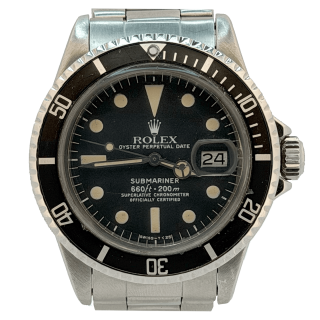
With the arrival of matte dials, the depth rating became one of the most closely followed details among collectors. On certain generations, metres are stated before feet: 200 m = 660 ft. These are known as meters-first dials. On later generations, the order was reversed and feet appeared first.

This detail may appear minor. Yet it matters because it must correspond to a specific production period. An early 5513 fitted with a later feet-first dial may be a perfectly genuine Rolex while nevertheless having received a replacement dial during servicing.

Maxi Dial: when the hour markers become more prominent

At the end of the 1970s and beginning of the 1980s, several matte-dial variants featured larger luminous hour markers. Collectors group these different generations under the term Maxi Dial.

There is no single Maxi Dial. Several variants are distinguished by the position of the text, the size and placement of the markers, the shape of certain letters and the relationship between the depth rating and the word Submariner. Once again, value does not come merely from a nickname: it comes from coherence between dial, year, case and movement.

The transition to glossy dials with metal surrounds

During the final years of the 5513, Rolex gradually adopted glossy dials with luminous hour markers surrounded by precious metal. Visually, the watch moved closer to the aesthetic language that would define modern generations.

This transition explains why two 5513 watches separated by fifteen or twenty years may possess completely different personalities while carrying exactly the same reference.

5513 when detail creates value : dial case patina

Collector File — Rolex Submariner 5513

Production: approximately 1962–1989.

Display: three hands, no date.

Crystal: acrylic.

Original water resistance: 200 metres.

Main dial families: gilt, matte meters first, feet first, Maxi Dial and later glossy dials with surrounds.

Determining elements: dial, hands, insert, case, crown, movement, bracelet and coherence with the serial number.

Common mistake: assuming that a 5513 is more desirable simply because it is old, without studying its actual configuration.

Rolex Service Dial: Genuine Does Not Necessarily Mean Original to the Watch

This is one of the most important distinctions for understanding a vintage Rolex.

Rolex has always serviced its watches to keep them functional. During a service, a dial, hands, crown, crystal, bezel insert or bracelet may have been replaced with Rolex components corresponding to the standards of the service period.

Such a part remains genuine Rolex. It is simply not necessarily the component fitted when the watch originally left the manufacture.

The distinction between authenticity, originality, conformity and service part is fundamental. A 5513 whose original matte dial was replaced in the 1990s or 2000s by a Rolex service dial remains a genuine Rolex Submariner. It may be mechanically excellent and perfectly usable. It simply no longer has the same heritage reading as a watch that retains a dial coherent with its production period.

This logic follows the Mostra Watch Health Report in twelve points: a watch cannot be reduced to the question “real or fake”. It is necessary to explain what is original, what is conforming, what has been replaced, why and during which period.

5513 submariner dial evolutions from gilt to service dial

MilSub: When the Rolex Submariner Becomes a Genuine Military Watch

The Military Submariner, commonly known as the MilSub, represents one of the most fascinating branches of the family. During the 1970s, Rolex supplied the British Ministry of Defence with Submariners adapted to precise military specifications.

The references encountered include the 5513, certain double-reference 5513/5517 watches and the 5517. The differences from a civilian Submariner go far beyond an engraving on the caseback. Military watches may feature fixed bars soldered between the lugs, large sword hands, a bezel graduated for the full sixty minutes, a circled T on the dial indicating tritium and military inventory markings on the caseback.

These characteristics also explain the large number of fake MilSubs or transformed civilian watches. Replacing the hands, engraving the caseback or fitting a fully graduated bezel is never enough to recreate the history of a military watch.

The case, fixed bars, dial, movement, bezel, numbers and markings must form a chronologically coherent whole.

This reading is directly comparable with the method developed in our Mostra Atlas of French Military and Mission Watches: an isolated element is an indication; several converging elements build provenance.

MilSub: four points an image alone cannot guarantee

Sword hands, a 60-minute bezel, fixed bars or an engraved caseback are important, but none of these elements is sufficient in isolation. On a Military Submariner, overall coherence and provenance matter as much as the rarity of the components.

from military milsub to civilian rolex comex

COMEX: Marseille, Professional Diving and Rolex Experimentation

The relationship between Rolex and the Compagnie Maritime d’Expertises — COMEX, founded in Marseille, forms another major chapter in the Submariner story. From the 1970s, saturation diving programmes imposed new constraints on professional divers. Helium used in breathing mixtures could enter the watch during saturation phases and then create internal overpressure during decompression.

Rolex worked on the helium escape valve, which would become inseparable from the Sea-Dweller. But the COMEX story is not limited to that family. Submariners were also used and supplied within the framework of this collaboration.

The most emblematic is reference 5514, closely associated with COMEX and equipped with a helium escape valve. Certain watches feature a COMEX dial, specific assignment numbers on the caseback and a configuration adapted to their professional environment.

COMEX 5513 watches also exist. The relationship between Rolex and the Marseille company must therefore be examined reference by reference rather than through a simplistic statement according to which every COMEX would be a Sea-Dweller or every Submariner carrying COMEX markings would necessarily be authentic.

For the collector, the determining points include:

  • the exact reference;
  • the Rolex serial number;
  • the COMEX assignment number where applicable;
  • the dial;
  • the caseback;
  • the helium escape valve on relevant references;
  • chronological consistency;
  • documents and provenance.

COMEX’s Marseille roots give this history particular resonance for Mostra in Provence, where professional diving watches have long formed one of the house’s specialist collecting territories.

1680: The Date Enters the Rolex Submariner

Submariner models received with the 1680 reference a date window

At the end of the 1960s, a discreet but fundamental change appeared: the Submariner Date reference 1680. For the first time, the family received a date window associated with Rolex’s characteristic Cyclops magnifying lens.

Early dials carried the word SUBMARINER in red, giving rise to the now universal nickname Red Submariner. The model later moved to entirely white text, creating the family commonly known as the White Sub.

But the term Red Sub alone is not enough to identify a watch. Several dial variants exist. Collectors distinguish different “Marks” according to typography, text position, the relationship between metres and feet, the shape of certain characters and printing techniques.

Early generations may display the depth rating with metres first, before feet gradually moved to the first position. Certain dials also undergo a natural surface evolution towards brown, creating the so-called tropical dials.

Once again, colour alone is never enough. A beautiful brown dial only acquires genuine heritage interest when its evolution appears natural, when it corresponds to the correct period and when it remains coherent with the hands and the watch as a whole.

Collector File — Rolex Submariner 1680

Period: approximately late 1960s to late 1970s.

Display: hours, minutes, seconds and date with Cyclops.

Crystal: acrylic.

Original water resistance: 200 metres.

Movement: Rolex 1570/1575 family with date function.

Sought-after variants: Red Sub, meters first, different Marks and naturally tropical dials.

Point of caution: coherence between dial, serial number, hands, bezel insert and service history.

Mostra regularly presents pre-owned and vintage Rolex Submariner 1680 watches, making it possible to compare dial variations, patina, cases and bracelets across different generations.

16800 and 168000: The Meeting Point Between Vintage and Modern

Reference 16800, introduced around the end of the 1970s and beginning of the 1980s depending on series, is one of the most interesting Submariners for understanding the transition towards the modern watch.

It brought several major changes: a sapphire crystal replaced acrylic, original water resistance increased to 300 metres, the bezel became unidirectional and the Rolex calibre 3035 allowed quick-setting of the date.

Yet early examples still retained a matte dial with painted luminous markers, continuing the visual language of the 1680. Later generations adopted a glossy dial with luminous hour markers surrounded by precious metal.

This coexistence of old and modern characteristics makes the 16800 a genuine transitional reference. It can offer the charm of a matte dial and aged tritium while benefiting from sapphire crystal, greater water resistance and a quick-set date.

The brief 168000, often known as the “triple zero”, continued this transition before the arrival of the 16610. It is notably associated with the adoption of 904L steel for the case, a material that would later become characteristic of modern Rolex production.

For a collector who genuinely wants to wear the watch, the 16800 family therefore represents a fascinating territory: old enough to possess strong generational differences, yet modern enough to remain highly usable when correctly maintained.

16610: The Great Neo-Vintage Rolex Submariner

At the end of the 1980s, the Submariner Date 16610 arrived, powered by the Rolex calibre 3135. Its production would extend for more than twenty years and it became one of the most widespread, robust and today one of the most interesting Submariners for understanding Rolex neo-vintage.

Its architecture appears stable: 40 mm case, sapphire crystal, date with Cyclops, original 300-metre water resistance, calibre 3135, Oyster bracelet and black aluminium bezel insert.

But this apparent stability conceals many developments. Early examples use tritium. At the end of the 1990s, Luminova dials appeared, often recognisable by the “SWISS” marking, followed by Super-LumiNova and the “SWISS MADE” signature. Lug holes gradually disappeared, bracelets evolved, solid end links appeared on certain generations and later series received Rolex engraving on the rehaut.

This is precisely what makes the 16610 interesting. It looks familiar, yet a watch from 1990, one from 1997 and one from 2008 do not present exactly the same configuration.

Tritium, Luminova, Super-LumiNova: three generations that should not be confused

16610 transition to the neo-vintage with 3 dials type

Tritium ages. It may develop cream, ivory or yellow tones, lose almost all of its luminous capacity and create a sought-after patina when homogeneous and coherent.

Luminova and Super-LumiNova work differently: they recharge under light and do not age in the same way. A 16610 produced during a transitional period can therefore be dated partly through its dial and luminous material.

However, Rolex also replaced many dials during service. A 16610 originally fitted with tritium may today carry a “SWISS MADE” service dial. This configuration remains authentically Rolex, but should be clearly identified as such in a serious heritage description.

Why is the 16610 becoming collectible?

Because it now occupies an intermediate territory. It has the reassuring construction of a modern Rolex, while retaining the aluminium insert, relatively slim proportions and, on early generations, tritium and lug holes characteristic of the twentieth century.

It is recent enough to be worn every day, yet old enough for its generational differences to have become collectible.

Collector File — Rolex Submariner 16610

Period: approximately 1988/1989–2010.

Case: 40 mm.

Crystal: sapphire.

Original water resistance: 300 metres.

Movement: Rolex calibre 3135.

Important developments: tritium, Luminova, Super-LumiNova, bracelet, lug holes, SEL and engraved rehaut.

Point of caution: distinguishing a period-correct configuration from a watch assembled with later Rolex service parts.

14060 and 14060M: The Last Old-School No-Date Submariner

14060 submariner heath check-up workshop

The 14060 succeeded the 5513 around the turn of the 1990s. It retained the purity of the no-date dial while introducing modern characteristics: sapphire crystal, Triplock crown, original water resistance of 300 metres and Rolex calibre 3000.

The presence of lug holes through much of its production, the aluminium bezel insert and the relative slimness of its case give it a personality that is particularly appreciated today.

Around 2001, the 14060M appeared. The “M” corresponds to the evolution of the movement, now the Rolex calibre 3130. Early 14060M watches retained a two-line dial in the lower half. Later, chronometer certification led to the appearance of four-line dials.

Production continued until 2012, when the 114060 introduced the ceramic no-date generation.

For many collectors, the 14060 and 14060M today represent an almost ideal balance: the visual simplicity of an old 5513 with the reassurance of a much more recent Rolex.

The Mostra Observatory 2026 notably documented the case of a 2001 Submariner 14060M that appeared perfectly healthy externally but whose water-resistance test revealed a leak around the crown system. This case reminds us that a diving watch may run correctly while no longer being water-resistant.

16610LV Kermit: Rolex Celebrates Fifty Years of the Submariner

In 2003, Rolex celebrated the fiftieth anniversary of the Submariner with the 16610LV. The principle appeared almost simple: retain a black dial while introducing a green bezel insert, accompanied by a dial with larger hour markers generally associated with the term Maxi Dial.

This first green-bezel Submariner quickly acquired the nickname Kermit. It now occupies a distinctive position: technically very close to the standard 16610, yet immediately recognisable by its colour and by several dial and insert developments.

Early examples are particularly sought after for so-called Flat Four inserts, referring to the shape of the numeral 4 in the “40” graduation. Yet this detail perfectly illustrates the risks of the vintage and neo-vintage Rolex market.

A Flat Four insert alone is not enough to transform a later 16610LV into an early series. The insert must correspond to the period, serial number, dial and the watch as a whole.

On a Submariner, a collectible detail only makes sense when it is in the right place, on the right watch and at the right time.

116610 and 114060: The Submariner Enters the Ceramic Era

The next generation more profoundly changed the feeling on the wrist.

The 116610, introduced in 2010, brought the Cerachrom bezel insert, a visually more substantial case despite a nominal diameter of 40 mm, larger hour markers and a profoundly modernised bracelet. The Oysterlock clasp combined with the Glidelock system allowed extremely precise adjustment of bracelet length.

The green 116610LV, quickly nicknamed Hulk, combined a green dial with a green bezel in a far more spectacular interpretation than the earlier Kermit.

The 114060, presented in 2012, applied the ceramic architecture to the no-date Submariner and retained the Rolex calibre 3130.

These watches marked a genuine change in personality. The Submariner remained immediately recognisable, but became denser, brighter, more resistant to bezel scratches and far more sophisticated in its bracelet construction.

For some collectors, this generation marks the end of the classic Submariner. For others, it represents the technical culmination of the 40 mm construction.

the rolex submariner green lineage kermi hulk and starbucks

Since 2020: 124060 and 126610, 41 mm and a New Generation of Movements

In 2020, Rolex redesigned the entire range. The diameter officially increased to 41 mm, but the proportions of the case sides, lugs and bracelet were reworked to rebalance the watch.

The no-date 124060 received the Rolex calibre 3230. The 126610 with date received calibre 3235.

Both movements notably use the Chronergy escapement and offer approximately 70 hours of power reserve after full winding. Water resistance remains stated at 300 metres.

The current generation also features a Triplock crown, unidirectional Cerachrom bezel, Oyster bracelet with Oysterlock and Glidelock and Chromalight display providing strong legibility in darkness.

Technically, a 2026 124060 has almost nothing in common with a 1950s 6204. Visually, their relationship is nevertheless immediate. This is probably where the true genius of the Submariner lies: changing almost everything without losing the essential design.

The Principal Rolex Submariner References to Know

Reference Approximate period Date Crystal Movement / family Original water resistance Key characteristic
6204 1953–1954 approx. No Acrylic Automatic Approx. 100 m First commercially released generation
6205 Mid-1950s No Acrylic Automatic Approx. 100 m Evolution of dials and hands
6200 1950s No Acrylic Automatic Approx. 200 m Big Crown, rare Explorer dials
6538 1950s No Acrylic Automatic Approx. 200 m Big Crown, associated with James Bond
5508 1958–early 1960s approx. No Acrylic Automatic Approx. 100 m Small Crown without crown guards
5512 1959–1980 approx. No Acrylic 1530 family / evolutions 200 m Crown guards, chronometer versions
5513 1962–1989 No Acrylic 1530 / 1520 200 m Gilt, meters first, Maxi Dial, MilSub in certain configurations
1680 Late 1960s–late 1970s Yes Acrylic 1570 / 1575 200 m First Submariner Date, Red Sub then White Sub
16800 Late 1970s–1980s Yes Sapphire 3035 300 m Matte / glossy dial transition, quick-set date
168000 Late 1980s Yes Sapphire 3035 300 m Very brief transitional reference
16610 1988/89–2010 Yes Sapphire 3135 300 m Major neo-vintage generation
14060 1990–2001 approx. No Sapphire 3000 300 m Modern No-Date, lug holes
14060M 2001–2012 approx. No Sapphire 3130 300 m 2-liner then 4-liner COSC
16610LV 2003–2010 Yes Sapphire 3135 300 m Kermit, green insert, Maxi Dial
116610 2010–2020 Yes Sapphire 3135 300 m Cerachrom, Maxi Case, Glidelock
114060 2012–2020 No Sapphire 3130 300 m 40 mm ceramic No-Date
126610 Since 2020 Yes Sapphire 3235 300 m 41 mm, approx. 70-hour reserve
124060 Since 2020 No Sapphire 3230 300 m 41 mm, symmetrical dial, approx. 70-hour reserve

The periods shown are general landmarks. Particularly among the earliest references, production dates may overlap. On a vintage watch, the serial number, caseback, movement, dial and characteristics of the individual example must always be studied together.

Two Submariners With the Same Reference Are Not Necessarily Comparable

This is probably the most important point in this dossier.

Take two Rolex Submariner 16610 watches from the same year. In a photograph, they may look identical. Yet the first may retain a period-correct dial, coherent hands, an older insert, a case with preserved proportions, its period bracelet, original papers and a recently serviced movement.

The second may have received a Rolex service dial, later hands, a replacement insert, been heavily polished, lost its original bracelet and require a complete service.

Both watches may be perfectly genuine.

Both may function.

Both carry the same reference.

Yet they do not occupy the same market.

This is why the article “What Is My Watch Really Worth?” insists on one fundamental rule: a comparable listing must genuinely be comparable in reference, generation, condition, configuration, documentation and selling context.

The Eight Elements That Most Influence the Value of a Vintage Submariner

1. The dial

The dial is often the most important heritage component. Gilt, matte, meters first, feet first, Maxi, Red Sub, tropical, surrounded markers or Rolex service dial: each configuration must correspond to a precise period. On certain references, a rare and well-preserved dial may represent a significant part of the total value of the watch.

2. The hands

Their shape and luminous material must be studied together with the dial. A colour difference does not automatically imply replacement: dial and hands can age differently. But significant inconsistency requires an explanation.

3. The bezel insert

An old, coherent and naturally patinated insert can have considerable interest. Replacing it with a new part may improve the appearance of the watch while reducing its collector appeal. On a Kermit, Red Sub, MilSub or COMEX, the insert therefore deserves particular attention.

4. Case geometry

A heavily polished case never fully regains its original geometry. Lugs, crown guards, bevels, edges and overall thickness form an important part of how a vintage Rolex is read. Shine alone is never a sufficient criterion for judging the quality of a case.

5. The movement

The movement must correspond to the reference and period, but it must also be mechanically healthy. A watch that tells the time is not necessarily in good mechanical condition. Accuracy, amplitude when relevant, winding, actual power reserve, magnetisation and component condition should all be checked.

6. The bracelet

Bracelet reference, end links, clasp, year, number of links and degree of wear all contribute to value. A very stretched vintage bracelet can also become a safety issue, regardless of its heritage value.

7. Papers and set

A Submariner without papers may be perfectly authentic and desirable. However, the original guarantee, invoice, service documents, box, booklets, tags and accessories reinforce traceability and may influence value, particularly for modern and neo-vintage generations.

8. Provenance

On a conventional Submariner, documented provenance reinforces confidence. On a MilSub, COMEX or watch connected with an identified wearer, it can completely change the collecting category and value.

Is a Serviced Submariner Necessarily Worth More?

Not necessarily.

Everything depends on what the word “serviced” actually means.

A documented mechanical service carried out without altering the dial, hands, case or important heritage components can be a considerable advantage. It allows the watch to be worn with greater confidence and reduces the risks associated with mechanical wear.

But an intervention accompanied by heavy polishing, dial replacement, replacement of old hands, substitution of a patinated insert or loss of period components may improve usability while reducing collector interest.

The correct objective is therefore not always to restore a vintage Submariner to new condition.

It is to return it to proper mechanical health while preserving what deserves to be preserved.

This philosophy is detailed in our guide How to Maintain a Vintage Rolex Submariner and in our presentation of the Mostra watchmaking workshop in Aix-en-Provence.

Before restoring a vintage Submariner

A patinated dial, faded insert, old service hand or marked case is not necessarily a defect that should be corrected. Before any aesthetic intervention, it is preferable to identify what still belongs to the history of the watch.

Request a diagnosis Discover watch servicing

Can You Still Dive With a Vintage Rolex Submariner?

The depth rating printed on the dial of a Submariner from 1968, 1985 or 1997 corresponds to the characteristics of the watch when it met its technical specifications. It never constitutes a permanent guarantee today.

Gaskets age. The crown tube may be damaged. A crown may no longer screw down perfectly. A crystal may have developed a weakness. The caseback may have been opened many times. A heavily polished case may also have undergone interventions affecting certain sealing surfaces.

Before any immersion, the following should therefore be checked:

  • the crystal;
  • the crown and crown tube;
  • the gaskets;
  • the caseback;
  • the case;
  • followed by an appropriate water-resistance test.

On certain rare watches — gilt, Red Submariner, MilSub, COMEX or particularly important heritage configurations — the best decision may be to stop immersing them altogether, even though they were originally designed as diving watches.

The paradox is entirely logical: the more historically important a tool watch becomes, the less reasonable it may be to continue asking it to perform its original job.

Which Rolex Submariner Should You Choose Today?

For the vintage collector

The 5512, 5513 and 1680 form the richest historical core. They offer acrylic crystals, tritium, evolving dials, vintage aluminium inserts and a wide diversity of configurations.

In return, they require greater knowledge before purchase. Two watches with the same reference may present major differences in preservation and value.

For someone who wants to collect and wear

The 16800, 16610, 14060 and 14060M probably represent the most rational territory. They offer sapphire crystals, robust movements, classic dimensions, good availability of service parts and enough generational differences to make them genuinely interesting to collect.

This is the heart of Rolex neo-vintage.

For someone who wants a contemporary everyday Submariner

The 114060, 116610, 124060 and 126610 offer the strongest modern usability: ceramic bezels, sophisticated bracelets, Glidelock, excellent legibility, strong robustness and recent movements.

The 124060 retains the symmetry of the original no-date dial. The 126610 adds the date that has become inseparable from the Submariner for a large part of its audience.

Is the Rolex Submariner an Investment?

A Submariner is first and foremost a watch.

Its price may rise, fall or remain stable depending on the period. There is no single Rolex Submariner market value. There are several markets according to reference, year, configuration, dial, condition, provenance, set, degree of originality, liquidity and demand at the time of sale.

A heavily restored 5513, a very well-preserved Maxi 5513 and a documented MilSub may share a related architecture while belonging to completely different value categories.

The right question is therefore not:

“Do Submariner prices always rise?”

But:

“Which Submariner, in which configuration, in what condition and at what price?”

To understand the differences between retail price, asking price, actual transaction price, insurance value, professional purchase price and net seller proceeds, read our dossier What Is My Watch Really Worth? The Twelve Criteria That Determine Its Value.

The Twelve Mostra Checks Before Buying a Pre-Owned Rolex Submariner

The Twelve Mostra Checks Before Buying a Pre-Owned Rolex Submariner

Before purchasing a vintage, neo-vintage or modern Submariner, the inspection should connect the identity of the watch with its actual condition. At Mostra, this reading follows the logic of the Mostra Watch Health Report in twelve points.

  1. Exact reference: verify the generation, case type and expected characteristics.
  2. Serial number: place the watch within a coherent production period.
  3. Dial: identify the variant, typography, luminous material and any replacements.
  4. Hands: verify their shape, period and coherence with the dial.
  5. Bezel and insert: check the generation, condition and chronological consistency.
  6. Case: inspect proportions, lugs, bevels and signs of polishing.
  7. Crown and tube: verify their operation and role in water resistance.
  8. Movement: identify the calibre, its conformity and mechanical condition.
  9. Actual power reserve: measure it after full winding rather than relying solely on a theoretical figure.
  10. Bracelet and clasp: check reference, period, links, end links, play and safety.
  11. Documents and history: guarantee, invoice, box, accessories, service invoices and replaced parts.
  12. Water resistance: test the watch when the procedure is relevant and technically reasonable.

This method makes it possible to move beyond a binary view. A watch may be authentic with a service dial. It may be highly original but mechanically tired. It may have been perfectly serviced while losing part of its historical configuration.

The quality of a pre-owned Submariner comes from the balance between authenticity, coherence, preservation, mechanics and use.

Why Buy a Pre-Owned Rolex Submariner From Mostra?

Buying a pre-owned Submariner is not simply a matter of choosing a reference and a year. It means understanding what is actually being purchased: original or service dial, replacement components, degree of polishing, bracelet condition, movement health, power reserve, water resistance and documentation.

At Mostra, selection combines the heritage reading of the reference and configuration with the technical examination carried out by the workshop. This dual perspective is particularly important with Rolex, where two apparently similar watches may have very different histories.

Each Submariner offered is therefore examined according to its generation and intended use. A vintage 5513 is not prepared according to the same logic as a recent 126610. A collector’s watch may require greater aesthetic restraint, while a modern Submariner intended for everyday use must provide mechanical and functional safety consistent with its purpose.

Watches prepared and sold by Mostra are accompanied by a certificate of authenticity and a three-year warranty, together with follow-up from our workshop.

Buy, Appraise, Service or Sell a Rolex Submariner

Do you own a 5513, 1680, 16610, 14060, Kermit, recent Submariner or another reference? Mostra can assist with identification, inspection, maintenance, valuation or sale.

View available Submariners Have my Rolex appraised Consult the workshop Offer my watch for sale

FAQ — Vintage, Neo-Vintage and Modern Rolex Submariner

What is the first Rolex Submariner?

Rolex dates the birth of the Submariner to 1953. Reference 6204 is generally considered one of the earliest commercially released versions, alongside references 6200 and 6205 produced during this formative period. The chronologies of the very first series may overlap and should be studied with caution.

Which Rolex Submariner did James Bond wear?

The reference 6538 Big Crown is the Submariner most closely associated with Sean Connery in the early James Bond films. The cinematic world played a major role in moving the Submariner beyond its strict identity as a professional diving watch and turning it into a cultural icon.

What is the difference between a Rolex 5512 and a 5513?

The two references share very similar architecture. The 5512 evolved towards chronometer-certified movements with corresponding dial inscriptions, while the 5513 generally remained the non-chronometer version. Early series nevertheless require the dial and movement to be checked before conclusions are drawn.

What is a meters-first Rolex Submariner?

On certain vintage dials, the depth rating begins with metres before feet. On later generations, the order was reversed. This detail is an important criterion for dating and coherence, particularly on references 5513 and 1680.

What is a Red Submariner?

The term refers to early Submariner Date reference 1680 watches on which the word Submariner is printed in red. Several dial variants exist, with differences in typography, depth rating and layout.

What is a Maxi Dial 5513?

The term groups together several generations of matte 5513 dials featuring particularly large luminous hour markers and specific typographical characteristics. Several variants exist and their coherence depends on the production period.

Is a Rolex service dial genuine?

Yes. A service dial supplied by Rolex is a genuine Rolex part. It is not, however, necessarily the dial fitted when the watch originally left the manufacture. This distinction between authenticity and originality may have a significant effect on heritage value.

What is a Rolex MilSub?

The Military Submariner is a Submariner adapted to British military specifications during the 1970s. Certain examples feature fixed bars, sword hands, a fully graduated bezel, a circled T symbol and military markings on the caseback. References include the 5513, 5513/5517 and 5517.

Do Rolex COMEX Submariners exist?

Yes. Rolex supplied different watches to COMEX, including Submariners. Reference 5514 is particularly associated with the Marseille company and with the use of a helium escape valve. COMEX 5513 watches also exist. Reference, number, dial, caseback and provenance should be studied together.

What is the first Submariner with a sapphire crystal?

Reference 16800 marks the transition to sapphire crystal in the Submariner Date family. It also introduced 300-metre water resistance and the calibre 3035 with quick-set date.

What is the difference between the 14060 and 14060M?

The 14060 uses Rolex calibre 3000. The 14060M later adopted calibre 3130. Early 14060M watches retained a two-line dial before the appearance of four-line dials associated with chronometer certification.

Why is the 16610LV called Kermit?

Reference 16610LV was presented in 2003 for the fiftieth anniversary of the Submariner. It combines a black dial with a green bezel insert, earning it the nickname Kermit. Certain early Flat Four generations are particularly closely followed by collectors.

What is the difference between tritium, Luminova and Super-LumiNova?

Tritium is a historical luminous material whose intensity decreases over time and which may develop patina. Luminova and Super-LumiNova are photoluminescent materials that recharge under light. Their presence helps date different generations, subject to the possibility of later service dials.

Can a vintage Rolex Submariner still be worn in water?

Only after its condition and water resistance have been checked. The depth rating on the dial corresponds to the original specifications and does not guarantee water resistance several decades later. Certain heritage watches should no longer be immersed.

Does a Submariner without papers lose all its value?

No. The absence of papers does not prevent authentication or sale. It does, however, reduce traceability and may influence value, particularly on certain modern, neo-vintage or high-provenance references.

Should a Rolex Submariner be polished before sale?

Not before appraisal. Polishing may improve its appearance but can also alter case proportions, lugs and bevels. On a well-preserved vintage piece, retaining the original geometry is often preferable.

Is a serviced Submariner automatically more desirable?

No. The nature of the service, its date, any components replaced and any aesthetic interventions carried out must be known. An excellent mechanical service can be positive, while dial replacement or substantial polishing may reduce the heritage interest of a vintage watch.

Which Submariner is easiest to wear every day?

The 16610, 14060 and 14060M offer an excellent compromise between classic dimensions, sapphire crystal, robust movements and original 300-metre water resistance. The 114060, 116610, 124060 and 126610 offer the comfort and performance of contemporary construction.

How can I know the real value of my Rolex Submariner?

Begin with the exact reference, then examine the year, dial, hands, case, insert, movement, bracelet, service parts, documents, provenance and mechanical condition. The price of a single listing is not sufficient to establish market value.

Where can I have a Rolex Submariner appraised in Aix-en-Provence?

Mostra welcomes vintage, neo-vintage and modern Rolex Submariners in Aix-en-Provence for identification, appraisal, diagnosis, valuation, servicing or preparation for sale. The boutique, appraisal service and workshop allow the watch to be assessed from technical, aesthetic, heritage and market perspectives.

Also Read in Mostra Magazine

Principal Documentary Sources

  • Rolex — official history of the Oyster, Submariner, Deep Sea Special, professional diving and contemporary generations.
  • Phillips Watches archives — documentation of early references, gilt dials, meters-first dials, Maxi Dial, 1680, 16800, COMEX and neo-vintage generations.
  • Christie’s — documentation of Rolex Military Submariners and early references associated with James Bond.
  • Sotheby’s — archives relating to early Submariners, MilSub watches and transitional references.
  • Mostra Magazine and the Mostra workshop — Mostra Observatory, Watch Health Report, real-value analysis, Rolex appraisal and military-watch dossiers.

Share this content

Related posts

Loading...