Rolex Explorer II: history and references from the 1655 to the 226570
The watch for globe-trotting raiders and adventurers
Launched in 1971, the Rolex Explorer II occupies a distinctive place in the history of the brand’s Professional watches. Originally developed for environments where natural day-and-night cues can disappear, it has been defined from the beginning by its 24-hour display and fixed graduated bezel. From the original 1655 “Freccione” to the white “Polar” dials and modern 42 mm generations, its evolution tells more than fifty years of exploration and technical development.
Origins: the birth of a tool watch for extreme exploration
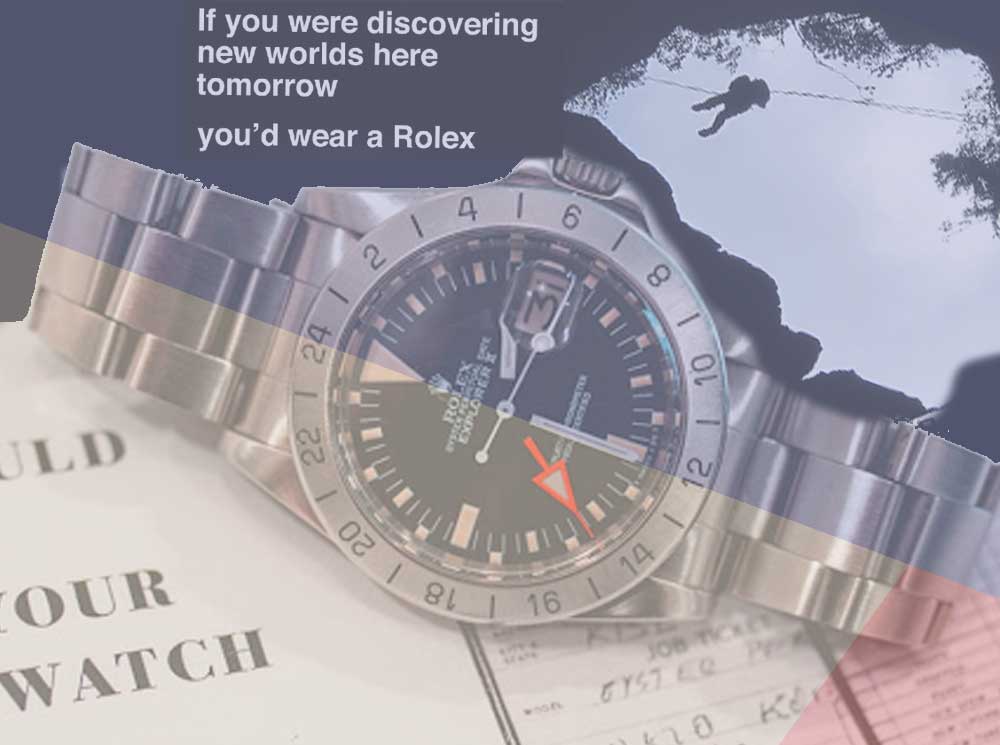
In the early 1970s, exploration was pushing into increasingly demanding environments, from underground cave systems and polar regions to remote mountain ranges. For professionals operating where sunlight could no longer provide a reliable indication of time, distinguishing daytime from nighttime could become a genuine challenge.
Rolex responded in 1971 with the Explorer II reference 1655. Its defining feature was an additional large hand completing one revolution of the dial every 24 hours and pointing to a fixed graduated bezel. Unlike later Explorer II generations, this hand could not yet be adjusted independently from the conventional time display. Its original purpose was therefore not to provide an independently adjustable second time zone, but to give explorers a clear indication of whether the displayed hour belonged to the day or the night.
Rolex Explorer II 1655: the original “Freccione”
The first Explorer II established an aesthetic of its own. Its highly graphic black dial, Tritium luminous markers, fixed steel 24-hour bezel and oversized coloured arrow-shaped hand made it immediately different from other Rolex Professional watches of the period. That distinctive hand later gave the reference its Italian nickname, “Freccione”, meaning “large arrow”.
Its approximately 39 mm Oyster case housed an automatic Rolex calibre 1575 with an additional 24-hour display. A date aperture beneath the Cyclops lens completed the functional layout. The emphasis was firmly on readability: conventional hands indicated local time while the prominent 24-hour hand and fixed bezel provided the additional day-or-night reference needed in environments deprived of natural light.
Steve McQueen and the “Freccione” legend
The 1655 is frequently referred to by collectors as the “Steve McQueen Explorer II”, but the nickname should not be confused with documented history. There is no reliable photographic evidence showing McQueen wearing or owning an Explorer II 1655. The actor remains much more firmly associated with other watches, notably the Heuer Monaco worn in the film Le Mans.
The enduring reputation of the 1655 ultimately comes from the watch itself rather than its celebrity nickname. Its unusual dial architecture, fixed bezel and oversized 24-hour hand make it one of the most immediately recognisable vintage Rolex Professional watches, and a reference whose identity differs substantially from the Explorer II models that followed.
Rolex Explorer II 16550: the technical turning point
In the mid-1980s, Rolex introduced the Explorer II reference 16550, a transitional generation that fundamentally changed the collection. The case grew to approximately 40 mm, sapphire crystal replaced the earlier acrylic construction, and both black and white dial configurations became available.
More importantly, the calibre 3085 changed the way the Explorer II could be used. The local hour display could now be adjusted independently from the 24-hour indication. This transformed the watch from an instrument primarily intended to distinguish day from night into one that could also follow a second time zone while retaining its characteristic fixed 24-hour bezel.
The 16550 is particularly important to collectors because of its relatively short production period and its dial variations. Some early white examples gradually developed an ivory or cream tone as they aged. What began as an ageing characteristic has since become one of the most recognisable and sought-after traits of certain vintage Explorer II references.
The 16570: Rolex modernises the Explorer II
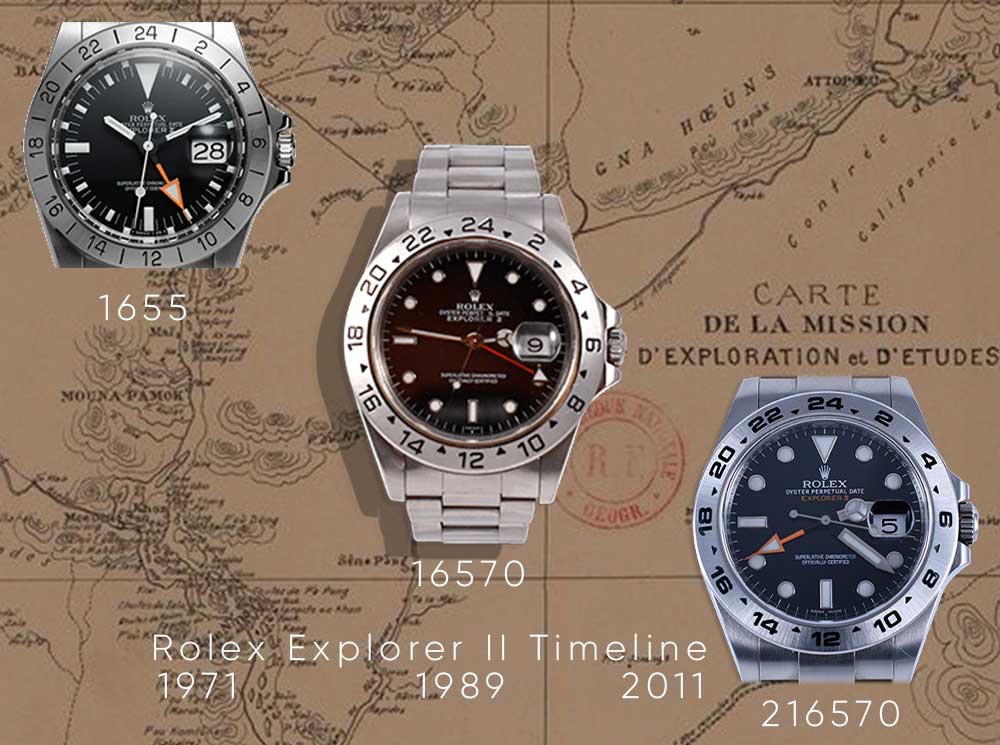
Introduced at the end of the 1980s, the Rolex Explorer II 16570 refined the architecture established by the 16550 and remained in the catalogue for more than two decades. Its 40 mm Oyster case, sapphire crystal, fixed 24-hour steel bezel and Cyclops date lens created a balanced silhouette that today sits between vintage and contemporary Rolex design.
The 16570 was initially powered by the calibre 3185, while later examples received the calibre 3186. The independently adjustable local hour hand made changing time zones straightforward without disturbing the minutes, seconds or reference time displayed by the 24-hour hand.
Compared with the 42 mm models that followed, the 16570 has a noticeably more restrained presence on the wrist. This combination of relatively compact proportions, modern reliability and traditional Rolex Professional styling has helped the reference develop a strong following among enthusiasts.
The Polar dial: a white signature for the Explorer II

The white-dial version of the Explorer II became widely known as the “Polar”. Although white dials had already appeared with the transitional 16550, the 16570 helped establish the configuration as one of the collection’s strongest visual signatures.
Its light background combined with contrasting dark surrounds on the hands and hour markers gives the Polar a character clearly distinct from the black-dial version. Over time, this contrast became so closely associated with the Explorer II that the white dial developed an identity almost inseparable from the model itself.
The Polar configuration also helped distinguish the Explorer II within the broader family of exploration and professional watches. Rather than simply offering another dial colour, Rolex created a visual language that has continued through subsequent generations.
From 40 to 42 mm: the Explorer II 216570 era
In 2011, forty years after the introduction of the original Explorer II, Rolex launched the reference 216570. Its case increased from 40 to 42 mm, giving the model a much stronger contemporary presence while retaining the fixed steel bezel and fundamental architecture of its predecessors.
The large orange 24-hour hand also returned as a clear visual reference to the original Freccione. The white-dial 216570-0001 continued the Polar tradition, while the 216570-0002 combined the black dial with the same prominent orange hand.
This was not simply a larger recreation of the 1655. The enlarged hour markers and hands, Chromalight display and modern construction placed the 216570 firmly in contemporary Rolex production while deliberately reconnecting the design with the visual identity of the first Explorer II.
Calibre 3187 and a new generation of performance
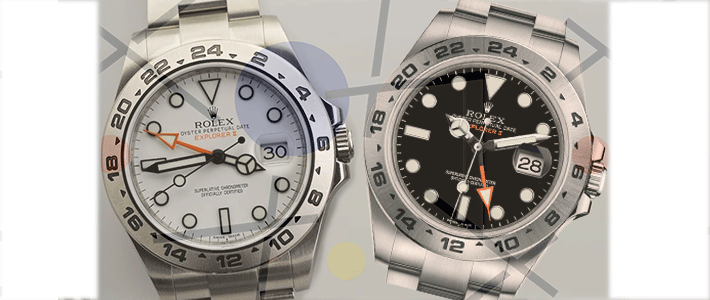
The 216570 introduced the Rolex calibre 3187, developed for the larger Explorer II case. It incorporated a blue Parachrom hairspring and Paraflex shock absorbers and offered a power reserve of approximately 48 hours. The independently adjustable local hour hand remained central to the watch’s functionality, allowing the wearer to change local time while retaining a separate reference on the 24-hour display.
The Oyster case remained water-resistant to 100 metres, while the sapphire crystal, Cyclops date lens and robust construction preserved the utilitarian character expected from the collection. In this generation, the Explorer II combined its original exploration credentials with functionality increasingly relevant to modern international travel.
A bracelet designed for everyday use and the field
The Oyster bracelet was also refined for the 216570. Its Oysterlock safety clasp helped prevent accidental opening, while the Easylink comfort extension allowed the bracelet to be lengthened by approximately 5 mm without tools. The system made small fit adjustments particularly simple, whether responding to changing temperatures or adapting the watch to different conditions throughout the day.
This mixture of robustness and everyday practicality reflects an important part of the Explorer II’s evolution. What began as a highly specialised instrument for extreme environments progressively became a Professional Rolex capable of moving naturally between outdoor use, travel and everyday wear without abandoning its functional identity.
Rolex Explorer II 226570: continuity rather than reinvention
In 2021, Rolex marked the fiftieth anniversary of the Explorer II with the introduction of the reference 226570. Rather than radically redesigning the watch, the brand refined the formula established by the 216570. The case remains 42 mm, the bezel is still fixed and graduated over 24 hours, and both black and white Polar dial configurations continue to be offered.
The proportions of the case and bracelet were subtly revised, while the orange arrow-shaped 24-hour hand remains one of the collection’s strongest visual signatures. On the white Polar version, the dark hands and hour-marker surrounds create the high-contrast appearance that has become emblematic of the Explorer II.
The most significant evolution lies inside the watch. The 226570 is powered by the Rolex calibre 3285, a self-winding movement offering approximately 70 hours of power reserve. The local hour hand can be adjusted independently and rapidly, while the additional 24-hour hand can either provide a day-and-night reference or display a second time zone.
The current Explorer II therefore illustrates how far the collection has evolved since 1971 without abandoning its original principle. The 1655 was primarily designed to help explorers distinguish daytime from nighttime. Later generations added independent local-time adjustment and genuine second-time-zone functionality, while retaining the fixed 24-hour bezel that continues to separate the Explorer II visually and conceptually from Rolex’s rotating-bezel GMT watches.
From the 1655 Freccione to the 226570: more than fifty years of Explorer II
The history of the Rolex Explorer II is not simply a succession of case sizes and calibres. Each generation represents a stage in the evolution of the same original concept. The 1655 established the day-and-night display and distinctive Freccione aesthetic. The transitional 16550 introduced modern construction and independent hour adjustment. The 16570 refined that formula and helped make the Polar dial an icon. The 216570 brought the collection to 42 mm and revived the orange arrow hand, while the 226570 modernised the movement and proportions without altering the watch’s fundamental identity.
This continuity explains why vintage and modern Explorer II references can look markedly different while remaining immediately connected. Fixed 24-hour bezel, additional arrow-shaped hand, date display and an uncompromising focus on legibility have defined the collection for more than five decades.
The Explorer II therefore remains a singular Rolex Professional watch: born from the practical requirements of exploration and progressively adapted to a world in which the ability to follow another time zone is as useful to travellers as day-and-night orientation once was to explorers underground or in the polar regions.
To discover the references currently available at Mostra, browse our selection of pre-owned Rolex Explorer II watches.
These products might interest you


Share this content