Corporate Watches: These Rare Timepieces That Became Collector’s Treasures
Certain corporate and presentation watches have become true collector’s rarities, from Rolex Domino’s Pizza models to Tudor Air France pieces. Engraved, produced in extremely limited numbers and deeply rooted in history, these watches reveal another side of vintage watchmaking.
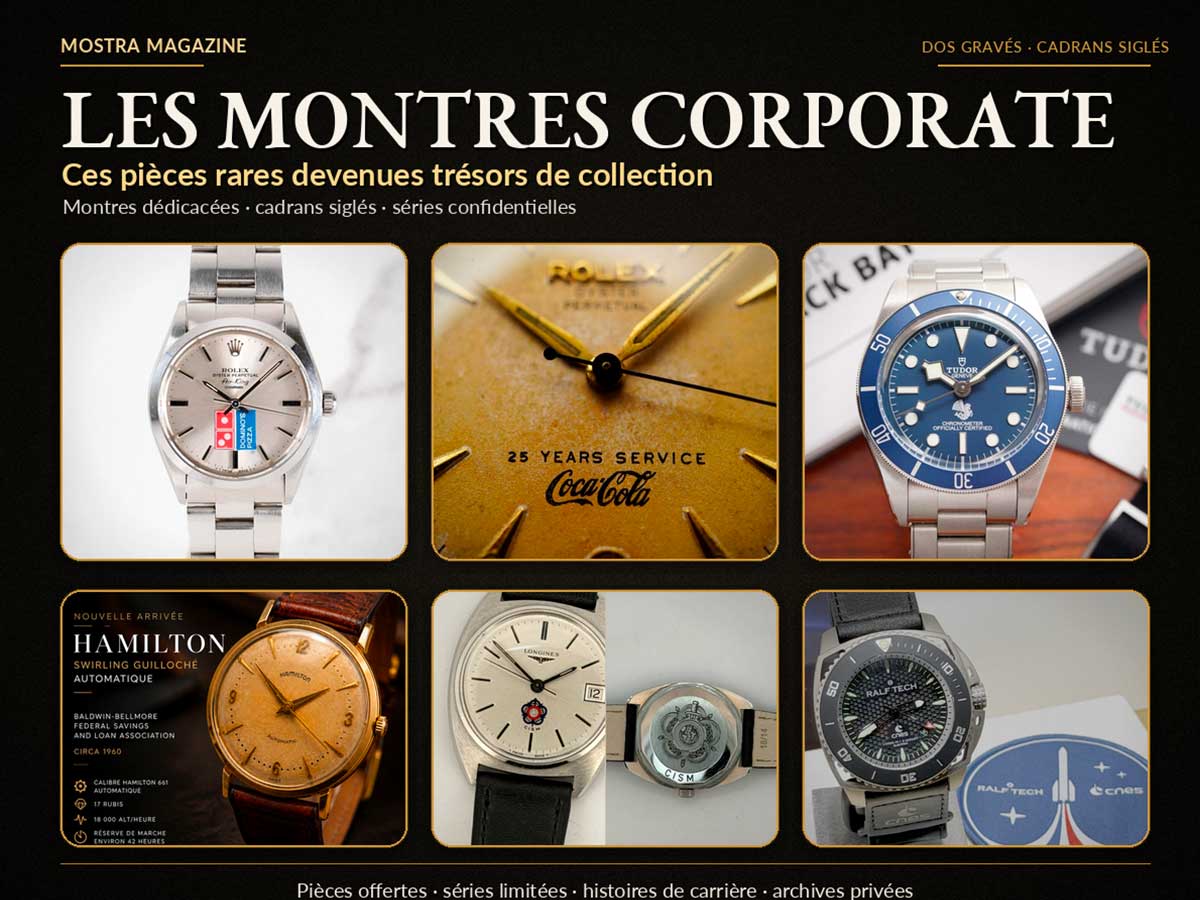
Corporate watches are not simply watches with a logo. Rolex Domino’s Pizza, Rolex Coca-Cola, Tudor Air France, engraved Hamilton watches, Longines CISM and RALF TECH x CNES tell another story of watchmaking: that of companies, institutions, careers, professions and belonging. Their collector interest comes as much from their rarity as from their provenance, engraving or the context in which they were offered.
There are watches one chooses, and others that choose you at the moment when a professional life passes into memory. Far from display windows and official launches, these pieces are born in the silence of long careers, discreet loyalties, exemplary paths or institutional collaborations.
Engraved, offered, co-branded, sometimes reserved for a restricted professional circle, they tell a story that classic production ignores. A corporate watch is not only a watchmaking reference: it is a watch associated with a company, a profession, an institution, a performance or a human journey.
At Mostra, these pieces occupy a special place among rare and limited-edition watches and vintage pre-owned watches. They require a different eye: one able to read an engraving, a provenance, a discreet logo or an original destination.
What is a corporate watch?
A corporate watch is a watch linked to a company, institution, administration, airline, military organisation, club, retailer or specific programme. It can take several forms: an engraving on the caseback, a double signature on the dial, a company logo, a series reserved for employees, or an edition created for a particular partnership.
Not all of them are equal, and not all are sought after for the same reasons. Some appeal through their rarity. Others through their cultural dimension. Others again through the precision of their provenance: a date, a name, a company, a mission, a career or an event.
This additional layer of context is what makes them so singular. Where a standard watch mainly tells the story of a model, a corporate watch also tells the story of the person, organisation or profession to which it was linked.
Company watches: when time becomes tribute
In America from the 1940s to the 1970s, offering a watch to an employee at the end of a long career was almost a ritual. Certain houses, such as Hamilton Watch Company, developed a true culture of presentation watches intended for companies, administrations or associations.
These watches were rarely chosen at random. Gold or steel cases, elegant dials, proven movements: everything had to reflect the respectability of the institution as much as that of the recipient. But it is often on the back that everything happens: an engraving, a date, a name, sometimes a function. The place where the object becomes memory.
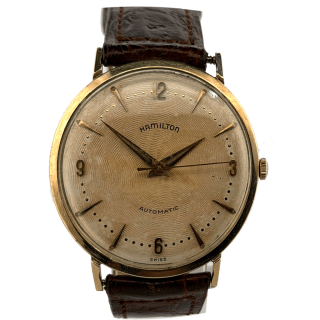
At Mostra, the Hamilton Thin-o-matic “Swirling Guilloché” Baldwin-Bellmore perfectly illustrates this tradition: offered for years of service, it embodies that America where recognition passed through a durable, almost intimate object.
Europe and institutions: a more discreet elegance
In Europe, the practice also exists, but with a more institutional restraint. The great Swiss houses occasionally produced series intended for official bodies, associations, airlines, retailers, administrations or military institutions.
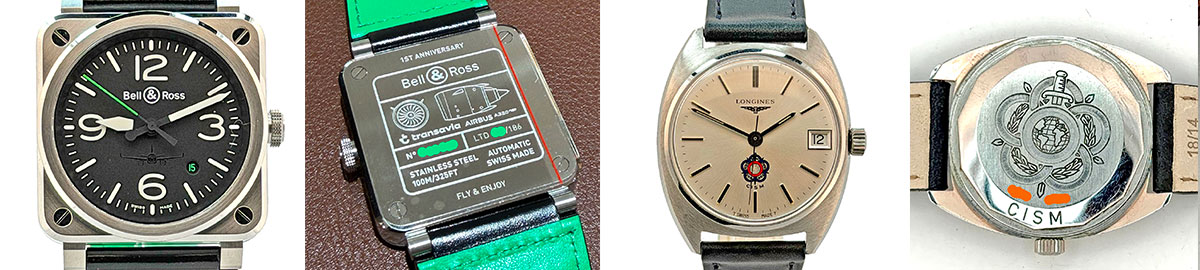
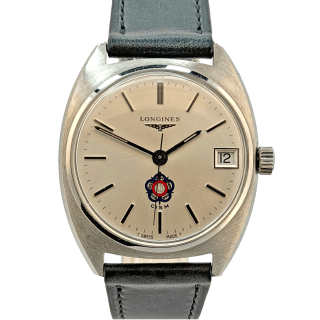
The Longines CISM is a strong illustration of this. The International Military Sports Council, an international organisation bringing together armies through sport, distributed watches to its members or on the occasion of particular events. Here, the watch becomes a symbol of belonging, almost a discreet insignia worn on the wrist.
This type of piece, often produced in very small quantities, escapes classic catalogues. One must search for them in personal histories, in inheritances, in stories passed down. It is precisely this invisible dimension that interests collectors.
Co-branded watches that became unexpected icons
From the 1980s onward, another aesthetic appeared: that of the co-branded watch, where the company logo invited itself onto the dial itself. In some cases, the effect can seem surprising. In others, it becomes instantly cult.
These watches are not always “beautiful” in the classical sense. They are interesting because they move the watch object into another universe: that of commercial performance, professional belonging, service rendered, loyalty to a house or popular culture.
Rolex Domino’s Pizza: the watch one could not buy
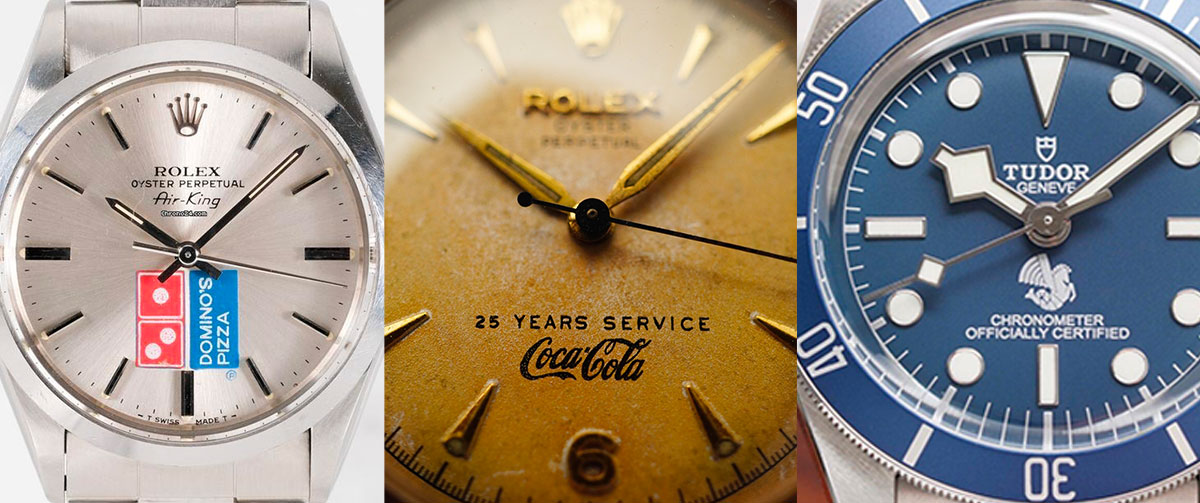
The Rolex Domino’s Pizza is without doubt one of the most surprising corporate watches ever to appear on the market. At first glance, the association seems almost unreal: the Rolex crown, symbol of Swiss watchmaking excellence, and the red and blue logo of an American pizza chain. Yet it is precisely this contrast that today gives it all its charm.
It was not a Rolex one bought in a boutique. It was a Rolex one earned. It rewarded a turnover reached, a commercial performance, a business managed with rigour. Where some collectors once saw an anomaly, the market now sees a rarity full of personality.
The Domino’s Pizza Rolex has become cult because it tells the story of an entrepreneurial, direct, almost popular America, where success was worn on the wrist with a touch of involuntary humour. It is collectible not despite its logo, but because of it.
Rolex Coca-Cola: twenty-five years in one house
The Rolex Coca-Cola belongs to another emotional family. It does not celebrate the instant commercial feat, but duration. Several documented pieces bear the mention “25 Years Service Coca-Cola”, sometimes on the dial, sometimes accompanied by an engraving on the back, offered to employees who had devoted a quarter of a century to the company.
Here, the Coca-Cola logo is not advertising. It becomes almost a civil medal. It speaks of loyalty, constancy, belonging to a house. On a classic Rolex, the dial indicates the time. On a service Rolex Coca-Cola, it also indicates a working life.
This extra soul changes everything. It transforms an already desirable watch into a human document, a fragment of American industrial history, a collector’s object whose value rests as much on provenance as on the brand.
Tudor Air France: aviation on the wrist
With Tudor Air France watches, the corporate universe takes on a more French, more institutional, almost aeronautical dimension. These special series, reserved for Air France personnel, were not intended for the general public. Among them we notably find recent variations of the Black Bay GMT or Black Bay Fifty-Eight associated with the airline.
For pilots and flight crews, the GMT has a natural obviousness: it speaks of time zones, crossings, rotations, departures before dawn and returns in the early morning. For ground staff, it remains a sign of belonging to a great national house, to a culture of travel, precision and service.
The Air France logo gives these Tudor watches an identity that standard models do not possess. They are not only rare Black Bays; they are corps watches, profession watches, crew watches.
Rolex GMT-Master Pan Am: the professional matrix
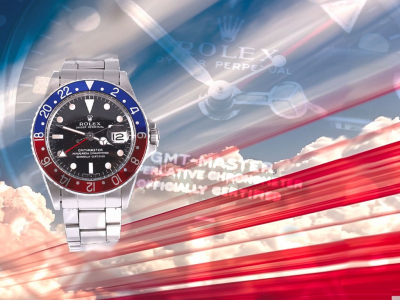
Before corporate watches even became sought-after collector’s objects, there was a founding, almost mythological example: the Rolex GMT-Master linked to Pan American World Airways. Here, the watch is not merely offered or signed by a company; it is born from a precise professional need, that of airline pilots crossing several time zones.
With its two-tone day/night bezel and its display of a second time zone, the GMT-Master was not a drawing-room watch. It was a cockpit watch, a watch of aeronautical charts, stopovers and crossed meridians. It accompanied a generation of pilots for whom time was no longer local, but global.
The Rolex GMT Pan Am is therefore not a corporate watch in the advertising sense of the term. It is rather its professional matrix: the one proving that a watch can become the emblem of a profession, a company and an era.
Hamilton Swirling Guilloché: the career engraved in gold
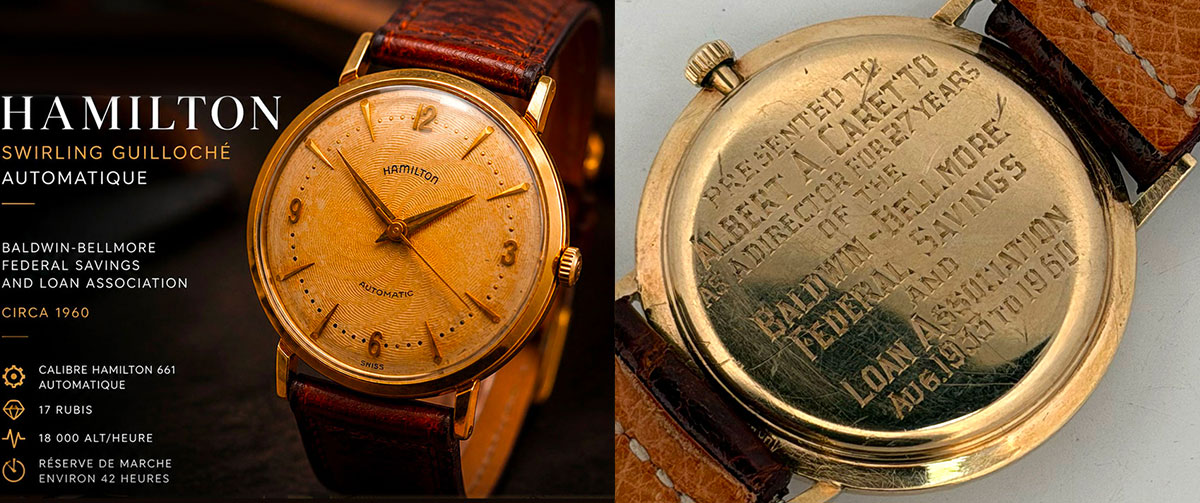
The Hamilton Swirling Guilloché Baldwin-Bellmore Federal, offered by Mostra, wonderfully illustrates the American golden age of presentation watches. Offered to Albert A. Caretta after twenty-seven years spent within the Baldwin-Bellmore Federal Savings and Loan Association, it carries on its back the exact trace of what it represents: a name, an institution, a duration, a recognition.
This Hamilton has nothing of a spectacular series. Its strength lies elsewhere. It resides in its restraint, in its dial worked like a surface of light, in that office and signature elegance specific to the 1960s.
This type of watch touches the collector in a particular way. One no longer collects only a reference or a calibre. One gathers a trajectory. The watch becomes the last material witness of a professional loyalty, sometimes even of a vanished institution.
Double signatures, special orders and provenance watches
The phenomenon extends far beyond the simple framework of retirement gifts. It also touches special editions, double signatures and institutional commissions: Patek Philippe for Gobbi Milano, Omega “Khanjar” watches commissioned for the Sultanate of Oman, certain Cartier watches signed Tiffany & Co, or Vacheron Constantin watches intended for specific markets or dignitaries.
In all these cases, the watch leaves the standard framework to become a contextualised object, almost geographic, always narrative. It no longer derives its value only from its reference, but from the precise story that accompanies it.
RALF TECH x CNES: a contemporary institutional watch
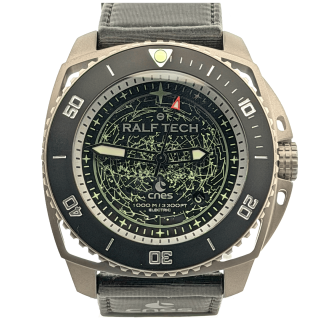
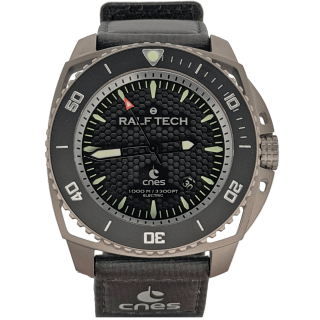
With RALF TECH x CNES, the corporate watch enters a contemporary, technical and spatial register. The RALF TECH WRX Electric Space Millenium x CNES, launched in 2024, is a limited series of 100 pieces. It is not merely a commemorative object: it belongs to a logic of institutional collaboration with the French space agency.
This passage should be read as an example of a contemporary corporate watch, not as a complete history of space watches. To explore that theme more broadly, you can read our article dedicated to space conquest watches. The RALF TECH page also allows you to discover the brand universe at Mostra.
These watches take on a rare dimension. They are no longer only associated with a company, but with a territory of exploration: that of engineers, technical teams, spationauts and all those who work to push back the limits of the known.
Longines CISM: international military elegance
The Longines CISM occupies a singular place in this story. Produced for the International Military Sports Council, it associates the classic elegance of Longines with a strong institutional dimension. The example presented by Mostra is an automatic Longines from the 1970s, reference 1586.1, powered by the calibre 890, with a sunburst dial and the CISM emblem.
On such a watch, the logo is not ornamental. It acts as a sign of belonging. It refers to international military competitions, to discipline, to effort, to this idea that sport can make those whom history may sometimes have opposed speak to one another.
The Longines CISM is therefore a discreet watch, but a deeply symbolic one. It speaks less of displayed prestige than of service, commitment and esprit de corps.
RALF TECH Académie Voyage Privé: the elegance of a travellers’ club
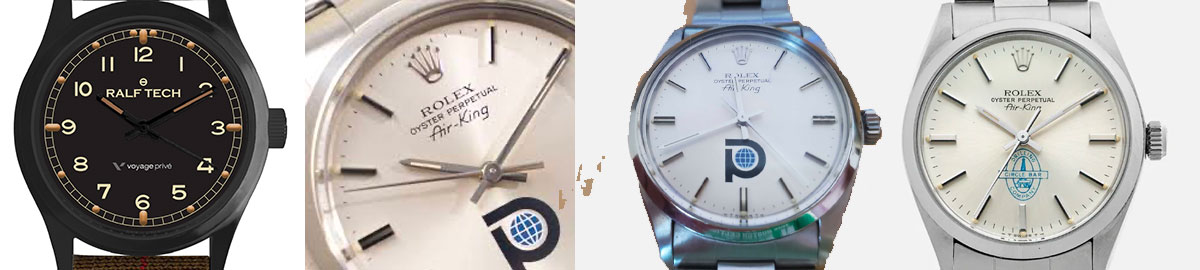
In a more contemporary register, the RALF TECH Académie Voyage Privé extends this idea of a watch associated with a house, a culture and a circle of belonging. In the attached photo, the watch is distinguished by its black case, dark dial, brown textile strap with a central red line and the Voyage Privé signature placed at six o’clock.
The choice of the Académie model is interesting. At RALF TECH, the Académie occupies a more elegant, more civilian place, far from the exuberance of overly visible logos. The presence of Voyage Privé adds a strong local and narrative dimension, since the group is associated with the world of travel and Aix-en-Provence.
In collection, this type of piece takes on all its interest when it escapes classic circuits. A standard RALF TECH Académie tells the story of a model. An Académie Voyage Privé tells something else: a meeting between an independent French watchmaking brand, an Aix-en-Provence travel company and a use probably reserved for a limited circle.
Why these watches fascinate collectors
These watches are highly collectible because they escape the ordinary logic of watch production. They are not only rare by number. They are rare by destination. Some were reserved for franchisees who had reached precise objectives, others for employees after twenty-five years of career, still others for personnel of an airline, a space agency or an international military organisation.
Their value comes from this double identity. They are both watches and archives. They carry a logo, an engraving, a date, a name, sometimes a function. They preserve the trace of those who wore them: pilots, entrepreneurs, engineers, military personnel, spationauts, loyal employees or men and women of career.
A standard watch can be replaced by another example of the same reference. A corporate watch can never quite be replaced. Its rarity does not lie only in its technical sheet, but in the person, the institution and the moment it embodies.
Another way of collecting
From the Rolex GMT-Master Pan Am worn by long-haul crews to the Tudor Air France reserved for aviation professionals, from the Rolex Domino’s Pizza earned by the best franchisees to the Rolex Coca-Cola offered after twenty-five years of service, from the Hamilton Swirling engraved with the name of a loyal employee to the Longines CISM linked to military esprit de corps, each watch tells more than a reference.
The RALF TECH CNES, linked to engineers, technical teams and spationauts, add another dimension: that of exploration, research and extreme professions. The RALF TECH Académie Voyage Privé, more urban and more confidential, reminds us in turn that travel, enterprise and belonging can also give rise to singular watches.
Collecting these watches is not only accumulating references. It is entering human trajectories. It is accepting that technical perfection sometimes gives way to a moving imperfection: a slightly faded engraving, a discreet logo, a name about which one knows nothing anymore, except that it mattered.
Identifying, appraising or selling a corporate watch
Because they rely on provenance, corporate watches often require an attentive eye. An engraving, a box, a document, a photograph, an invoice or a family story can change the understanding of the piece. The issue is not only to recognise a brand, but to understand the context in which the watch was presented.
If you own an engraved watch, a service watch, an institutional series or a piece linked to a company, Mostra can help you understand its interest, condition and potential value. You can visit our page dedicated to the appraisal of pre-owned watches or offer your watch through our Sell my watch service.
At Mostra, these pieces require a different eye, an almost archival attention, a sensitivity to what is not always written in catalogues. They remind us of a simple truth: in certain watches, time is not only measured. It is passed on.
These products might interest you

Share this content