History of the Rolex GMT Master: the iconic Pan Am watch
For pilots and world travelers
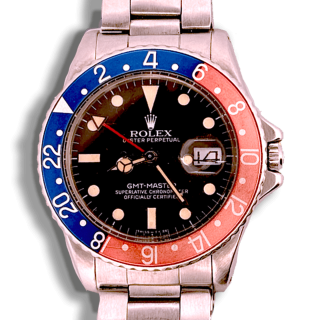
Designed in the 1950s for Pan Am pilots, the Rolex GMT Master quickly became a symbol of international air travel, luxury, and American prestige. Its legendary blue-and-red bezel and association with James Bond's Pussy Galore helped turn it into a global style icon.
Pan Am and the birth of an iconic watch
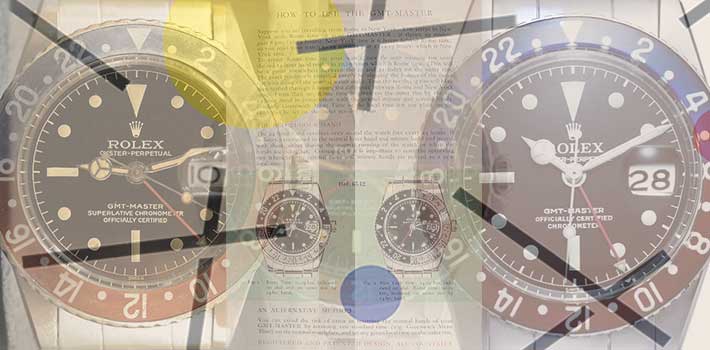
In the 1950s, at the peak of its prestige, Pan Am, the most powerful airline in the world at the time—sought to reinforce its leadership in modernity, technical innovation, and luxury. It changed its name from Pan American Airways to Pan American World Airways to reflect its global ambitions and began transforming both its fleet and its crews to embody elegance and security.
To meet the post-war demands for speed, safety, and comfort, Pan Am replaced its Douglas DC6 and Lockheed Constellation aircraft with a new generation of planes. In 1954, the Boeing 707 took its first test flight. Pan Am ordered a modified version with greater capacit, placing the largest aircraft order in its history.
To add symbolic weight to this transformation, Pan Am redesigned its pilots’ uniforms—less military, more luxurious—and added a striking new detail that would come to define the brand’s prestige: a unique wristwatch visible to every passenger upon boarding.
The brilliant idea of Juan T. Trippe
This was the brainchild of Pan Am’s founder, Juan T. Trippe, who wanted a luxurious, functional object that would reflect the airline’s modernity, excellence, and connection to the American fla, then a strong symbol of post-war power. The result: an exclusive Rolex watch designed for Pan Am’s pilots.
The technical specs were clear: an additional hour hand to show a second time zone, a high-performance movement, date window, white dial, and red-and-blue rotating bezel. The Rolex GMT Master was born, draped in the colors of the American flag. It stood out perfectly on short-sleeved white uniforms and was instantly adopted by crews as a mark of prestige.
GMT Master 6542: A technical and cultural breakthrough
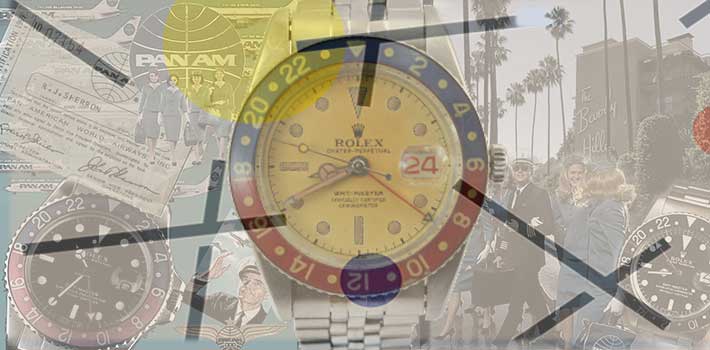
The first GMT Master, reference 6542, featured a 24-hour rotating bakelite bezel and a red GMT hand to indicate a second time zone. The case back bore the Pan Am logo. Initially produced in small numbers in 1955, Rolex launched a more durable version in 195, the reference 1675, with a metal bezel and black dial, manufactured until 1980.
Jet-setting status symbol
By the early 1960s, the GMT Master had become a passport to global travel and a coveted symbol of the elite Jet Set. Its bold red and blue “Pepsi” bezel exuded American confidence, catching the eye of style icons, including a certain James Bond Girl.
Hollywood spotlight: Pussy Galore and the GMT
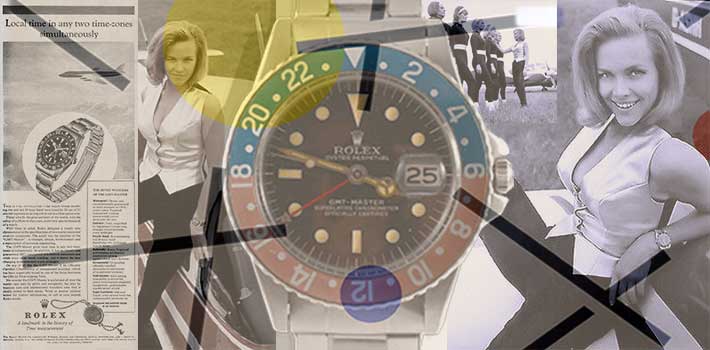
In the 1964 film Goldfinger, actress Honor Blackman, playing Pussy Galore, the lead pilot of her own flying squadron, wore a Rolex GMT Master 1675. It was an unprecedented move: a woman wearing a man’s watch onscreen, reinforcing her role as a powerful, seductive woman of action.The effect was striking. Much like the diving knife strapped to Ursula Andress’s bikini in Dr. No, the GMT Master became a tool of identity and empowerment. No longer just a sexy blonde, Pussy Galore became James Bond’s equal—bold, independent, and unforgettable.
Success, variations, and legacy
Riding the wave of success, the GMT Master 1675 graced magazine covers and found favor with astronauts (including Jack Swigert of Apollo 13) and celebrities alike. Over time, it evolved into multiple variants: the “Root-Beer” with a brown insert and gold numerals, the “Black-Guilt” with black dial and bezel, and the 1978 version with Tritium Maxi Dial markers.
Rolex also introduced bracelet diversity for the first time, offering both the Oyster 78360 and Jubilee 62510 bracelets—the latter particularly popular in the Americas.
Mechanical heart: Rolex calibers inside
The GMT Master originally ran on the Rolex 1036 movement (18,000 vph) between 1954 and 1959. It was later replaced by the 1065 and 1066 calibers for both the Pan Am and civilian versions of the 6542.
With the 1959 release of reference 1675, Rolex introduced the 1565 movement, beating at 19,600 vph. In 1971, this movement was upgraded with a “Stop-Second” function, allowing the seconds hand to be paused during time setting—an essential feature for pilots and precision-watch lovers who wanted exact synchronization.
These products might interest you

Share this content