Vostok: the Soviet watchmaking legacy, from propaganda to collectibles
the kommandirskie project
Created during World War II, the Vostok watch factory became a symbol of Soviet pride, propaganda, and resilience. From equipping high-ranking officers to becoming prized collectibles after the fall of the USSR, Vostok watches blend horological craftsmanship with ideological legacy.
A factory born out of war

Vostok, a brand unknown to most Westerners, has been manufacturing automatic and mechanical watches since 1942, following the proud tradition of Swiss Jura watchmaking. Remarkably, it is one of the few watchmakers in the world that produces its own movements entirely in-house, without relying on external suppliers.
Stalin’s strategic vision for Vostok
The creation of the Vostok factory was driven by Stalin and the Politburo during the Great Patriotic War. They sought Allied support to build this strategic manufacturing site, which would later serve as a powerful propaganda tool within the post-war Warsaw Pact.
The Hero of the Soviet Union: a powerful symbol
This prestigious decoration was awarded for extraordinary heroism and was the highest honor of the Soviet Union. Over 12,000 men and women received the Gold Star Medal during World War II. Among the most notable were fighter pilot Alexander Pokrychkine, Marina Raskova, and Ekaterina Zelenko — the only woman known to have achieved an aerial victory through a voluntary ramming attack.
The medal’s design — a red star — remained unchanged after the USSR’s dissolution and is now known as the Medal of the Hero of the Russian Federation.

A watch turned propaganda weapon
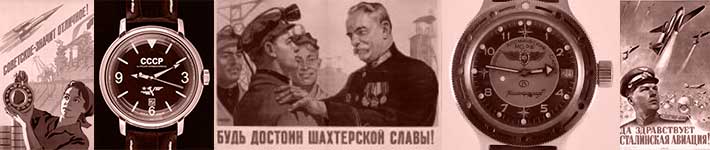
In 1941, Operation Barbarossa saw the Axis powers brutally pierce Soviet defenses. With over 30 million casualties, the USSR was on the brink of collapse. In this desperate context, propaganda became an essential tool, and the Vostok watch was its unexpected vector. The red star on the dial echoed the supreme military distinction and became a subtle yet powerful emblem used by the NKVD (People's Commissariat of Internal Affairs).
Symbol of patriotic engagement
The earliest Vostok models were highly sought after by party officials. They became tangible symbols of national commitment and pride. Wearing a Vostok was both a gesture of loyalty and a political statement. The brand quickly introduced themed dials — one early example celebrated dam engineers, featuring a dam motif on the left side of the dial.
Military and political prestige
After 1950, the Ministry of Defense placed large-scale orders to equip military personnel, as Poljot watches were too costly to mass-produce. In 1965, at the height of the Cold War, Vostok released the Komandirskie ("Commander") model. These were exclusively available to high-ranking military and scientific figures or given as official gifts to foreign dignitaries. As a result, many dials bear logos or insignias from military or governmental entities.
From secrecy to collector’s treasure
Vostok watches were virtually unknown in the West until the Perestroika era. After the fall of the Iron Curtain, they began to reach collectors, especially due to their affordability. In the 1990s, their widespread availability made them a popular entry point into vintage Soviet watch collecting.
A rising value on the second-hand market
Although still in limited production today in Russia, Vostok watches have seen their value soar. Over the last three years alone, prices on the second-hand market have increased more than fivefold. As availability decreases, now may be the last chance for collectors to acquire these historic timepieces at a reasonable price.
Share this content