Omega Speedmaster Moonwatch: NASA’s legendary chronograph
The Chronograph watch that walked on the Moon

Designed for motorsport, the Omega Speedmaster became the first watch worn on the Moon, approved by NASA for all manned space missions. From its legendary caliber 321 to today’s co-axial models, the Speedmaster Moonwatch is both a spacefaring icon and a collector’s dream.
The Apollo mission chronograph
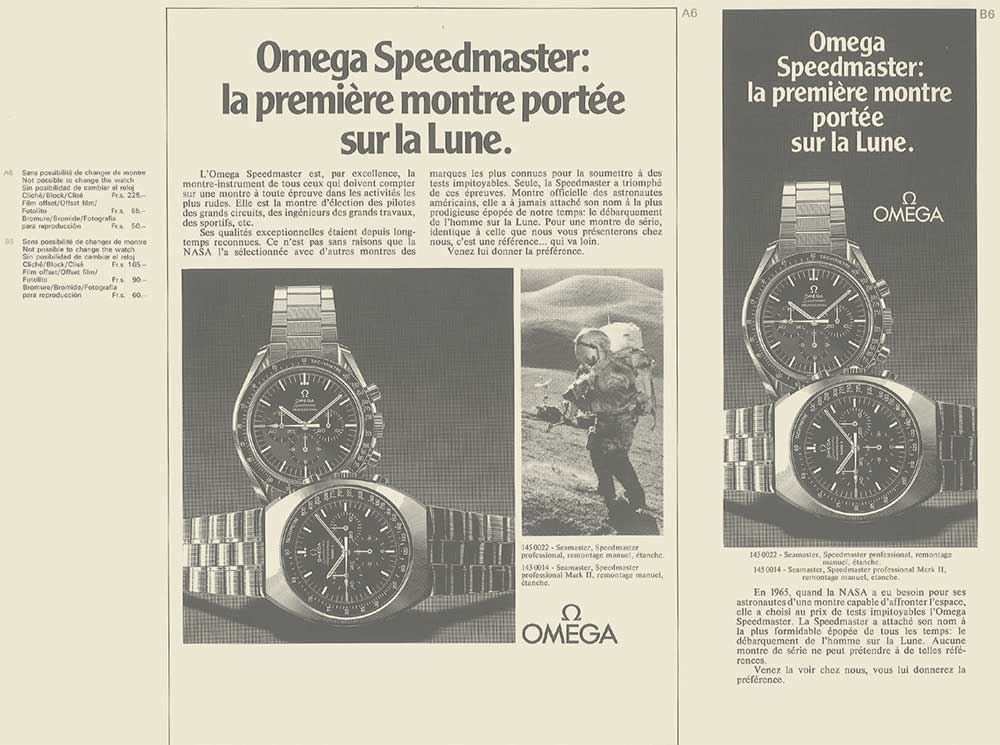
Originally introduced in 1957 for professional drivers and racing fans, the Omega Speedmaster was one of two watches selected by NASA in 1965 for lunar missions (the other being a Bulova with a piezoelectric movement, named “Astronaut”).
Its movement—developed in collaboration with Lemania—was the 17-jewel caliber 2310, beating at 18,000 vibrations per hour, equipped with a column-wheel chronograph mechanism and offering a 42-hour power reserve.
The Moonwatch legacy
No story of the American space conquest is complete without the Omega Speedmaster. Approved for all Gemini and Apollo missions, and later used in Skylab, Apollo-Soyuz, and the space shuttle program, the Speedmaster earned its “Moonwatch” nickname for accompanying Armstrong during the first moonwalk in 1969.
While its internals evolved—from the original caliber 321 to the 861—the external design of the Speedmaster remained nearly unchanged, a testament to its timelessness.
Variants and design evolutions
In the 1970s, Omega expanded the Speedmaster range with both technical and aesthetic updates. The Speedmaster Mark II featured rounded Space-Age curves, blending perfectly with the era’s Op-Art style. In the 1980s, Omega introduced automatic models with smaller cases to appeal to a broader audience.
Today, the Dark Side of the Moon series adds a modern, luxurious twist, powered by a co-axial movement housed in ceramic cases.
Vintage vs. Modern: a timeless rivalry
Rolex Daytona vs Omega Speedmaster
The Speedmaster was long considered a direct rival to the Rolex Cosmograph Daytona. Yet, the Daytona’s high-end image and luxury appeal disqualified it from NASA’s selection process. It was the Speedmaster that flew aboard Apollo 11, worn by Neil Armstrong when he set foot on the Moon on July 21, 1969.

Highly collectible limited editions
Omega soon released multiple limited editions to celebrate the Moonwatch legacy. Beyond the Apollo and Gemini missions, collectors chase references such as Skylab, Japan, Snoopy Award, and more recently the Speedy Tuesday editions: Tintin, Ultraman and True Blue.
A record-breaking investment
Back in 2002, a Speedmaster from the 1960s with a caliber 321 could be found for around €1,300. Today, collectors rarely find one in good condition for less than $15,000. Its rarity and prestige continue to drive value.
The Speedmaster now rivals icons like the Rolex Submariner, Daytona, Sea-Dweller, and Sky-Dweller at auctions worldwide. More than a watch, the Omega Speedmaster has become a cultural and historical artifact that transcends its original purpose.
Related products
Speedmaster Ad Astra Tritium & Sapphire
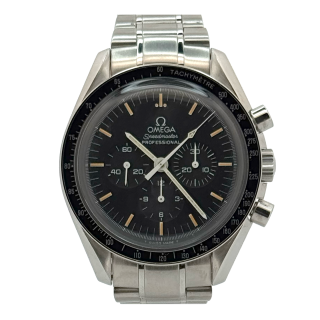
Speemaster 861 Space-Station Time
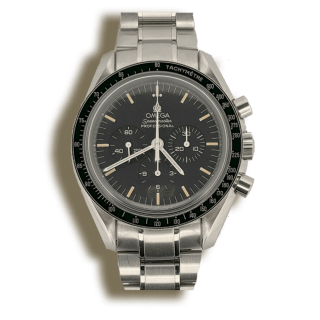
Speedmaster Mission Gemini 10

Speedmaster Gemini V Missions NASA

Speedmaster Apollo 17 Last Man on Moon Limited Edition

Speedmaster Apollo 14 NASA Missions Limited

Speedmaster Apollo 15 Full-set Anniversary Unworn

Speedmaster 321 Pre Moon Right-Stuff

Share this content