Oméga : spirit of conquest
The record's brand
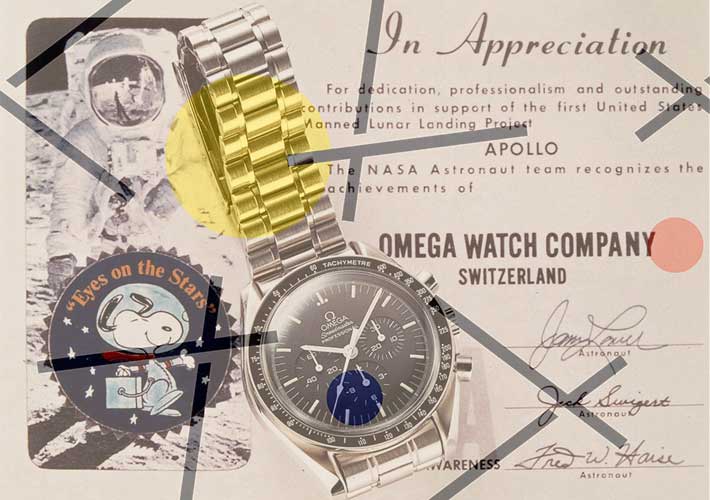
Omega is not just a watch brand — it’s a symbol of technical innovation and human adventure. From the early days of Swiss industry to the Moon landings, polar expeditions and deep-sea records, Omega has consistently pushed the boundaries of watchmaking. Here's a look at a legendary journey.
Origins: precision and ambition
Since 2015, Omega has shown the strongest growth in collector watch value. This is no accident: collectors treasure Omega timepieces and rarely part with them. The story began in 1848, when Louis Brandt founded a “comptoir d’établissage” in La Chaux-de-Fonds, Switzerland. His creations, marked “Louis Brandt,” quickly gained recognition for their quality.
By 1889, the company had become the largest watchmaking factory in Switzerland. In 1879, Brandt’s sons Louis-Paul and César launched bold automation programs, setting the path for full industrialization of Omega’s production processes.
The rise of a name: Omega
In 1903, the brand adopted the name Omega in honor of its successful 19-ligne “Omega” caliber from 1894 — the product of their founder’s relentless pursuit of mechanical perfection. From then on, Omega’s history would be shaped by relentless technical innovation, with many inventions that reshaped modern watchmaking.
Industrial leadership and mechanical breakthroughs
Omega was undeniably a pioneer of industrial watch production as early as 1879. With growing fame, the Bienne-based brand would go on to release an incredible number of models, each offering major innovations — from the silicon balance spring to the groundbreaking Co-Axial escapement introduced in 2007 by George Daniels. This new technology solved age-old issues like balance reversal and lubrication.
Omega: a human story too
At the turn of the 20th century, social movements began pushing for shorter working hours. Omega responded by joining forces with Tissot to optimize production: Tissot focused on the mid-range, while Omega continued to lead the high-end segment.
Military service and Olympic precision
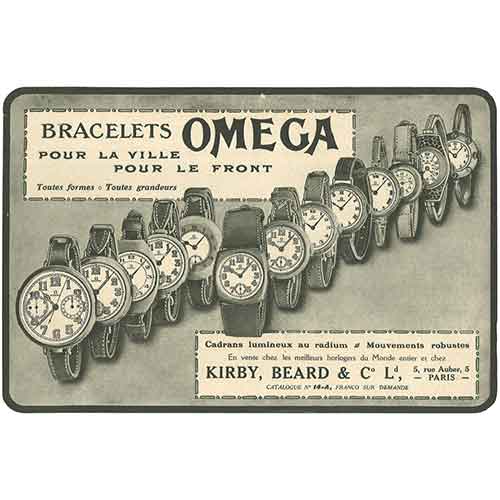
After WWI, many pocket watches made their way onto the wrists of soldiers out of necessity. Around 1917, Omega became the official supplier of the Royal Air Force. Praised for their toughness and precision, Omega watches became a benchmark — leading the brand to become the official timekeeper of the Olympic Games starting with Los Angeles 1932. By the London 2012 Games, Omega was celebrating its 25th Olympic appearance.

Omega was awarded the Olympic Cross of Merit for its outstanding service to the world of sports — a tribute to its dedication to creating ultra-precise timekeeping instruments for top-level athletic performance.
The explorer’s watch
From the skies to the Moon
Omega has long been associated with groundbreaking adventures. In 1934, Amelia Earhart wore an Omega chronograph when she became the first woman to fly solo across the Atlantic. In 1937, the brand introduced its first waterproof watches to catch up with Rolex’s Oyster (1926).

During World War II, Omega supplied several armies — most notably the British Royal Army, Navy and Air Force. The brand became the leading supplier of military watches to the RAF.
Icons of design and durability
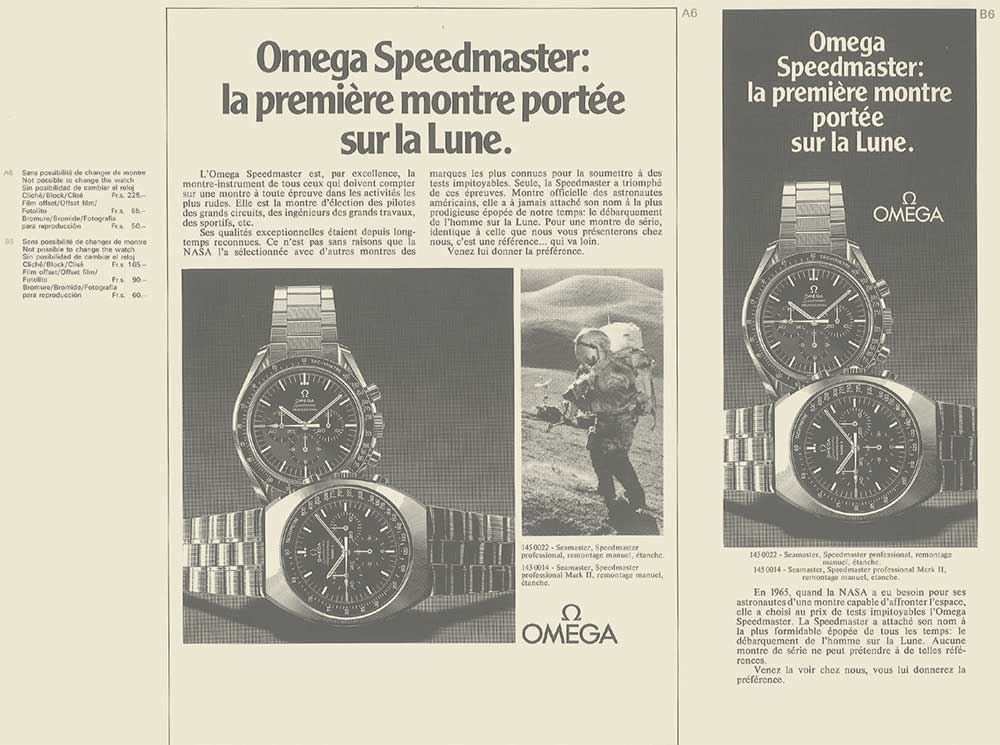
The post-war era brought a series of iconic models: the Seamaster (1948), used by Royal Navy and SAS troops, followed by the Constellation (1952), Speedmaster (1957), and the Flightmaster. In 1968, adventurer Ralph Plaisted brought a Speedmaster on a polar expedition to test performance in extreme cold — laying the groundwork for the legendary Speedmaster Alaska Project, built to resist temperatures near absolute zero (-270°C).
Landing on the Moon, diving into the deep
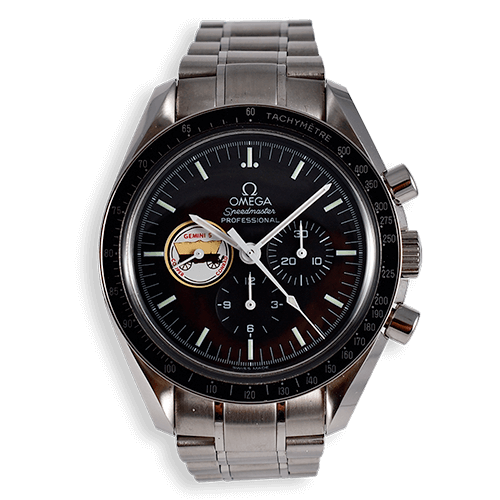
One year later, in 1969, Armstrong and his Omega Speedmaster stepped onto the Moon during Apollo 11 — “one small step for man, one giant leap for mankind.” Already beloved by pilots and personalities like Jacques Brel, the Speedmaster became the brand’s flagship bestseller.
Having conquered the skies, Omega turned to the oceans. Partnering with Jean-Yves Cousteau, the Seamaster 600 Ploprof (for “professional diver”) was designed to resist helium during deep dives. Said to be more waterproof than a submarine and more reliable than Rolex’s valve watches, the Seamaster 600 broke depth records during the JANUS I and II missions, reaching -253 meters with COMEX divers.

The 1980s and beyond
In 1981, a Omega Seamaster accompanied Jacques Mayol during his record-setting unassisted dive to 101 meters. The 1990s brought even more technical feats: in 1994, Omega presented the first self-winding wristwatch with a central tourbillon. In 1995, Pierce Brosnan wore an Omega in GoldenEye, cementing the brand’s association with 007. Celebrity ambassadors like Cindy Crawford and Michael Schumacher joined the brand in the same decade.
Legacy and limited editions
As part of the Swatch Group, Omega capitalized on its fame by launching multiple limited series to celebrate key moments in its history. Today, the Pre-Moon Speedmaster rivals the Rolex Daytona at auctions, and special editions like the Apollo and Skylab Speedmasters regularly reach sky-high bidding records.
Share this content