IWC Portugieser: the story of a navigation watch that became a collector’s iIcon
Conceived in the late 1930s as a precision wristwatch inspired by navigation instruments, the IWC Portugieser has crossed the decades without losing its personality. At Mostra, it can be appreciated both as an everyday watch and as a genuine piece of watchmaking heritage.
In this article
- The origins of the IWC Portugieser
- The collection’s revival in 1993
- The major developments of the Portugieser
- Key dates in its history
- Why own an IWC Portugieser?
- The Portugieser on the pre-owned market
- What influences its value?
- How to choose a pre-owned IWC Portugieser
- How to sell an IWC Portugieser
IWC Portugieser: the watch that thought big before everyone else
There are watches whose strength lies not only in their design, but in the idea that gave birth to them. The IWC Portugieser belongs to that rare family. When it appeared at the end of the 1930s, it did not seek to follow the codes of its time. It anticipated them.
At a period when wristwatches often remained discreet, restrained, almost withdrawn, IWC Schaffhausen created a large-diameter piece, legible, precise, inspired by the world of navigation instruments. The Portugieser was born from a singular request: to create a wristwatch capable of offering the precision of a marine chronometer, using the architecture and reliability of a pocket-watch movement.
This choice, daring for its time, gave the Portugieser its silhouette: a generous case, an open dial, readable Arabic numerals, a railway minute track, slender hands and that very particular impression of balance between elegance and instrument.
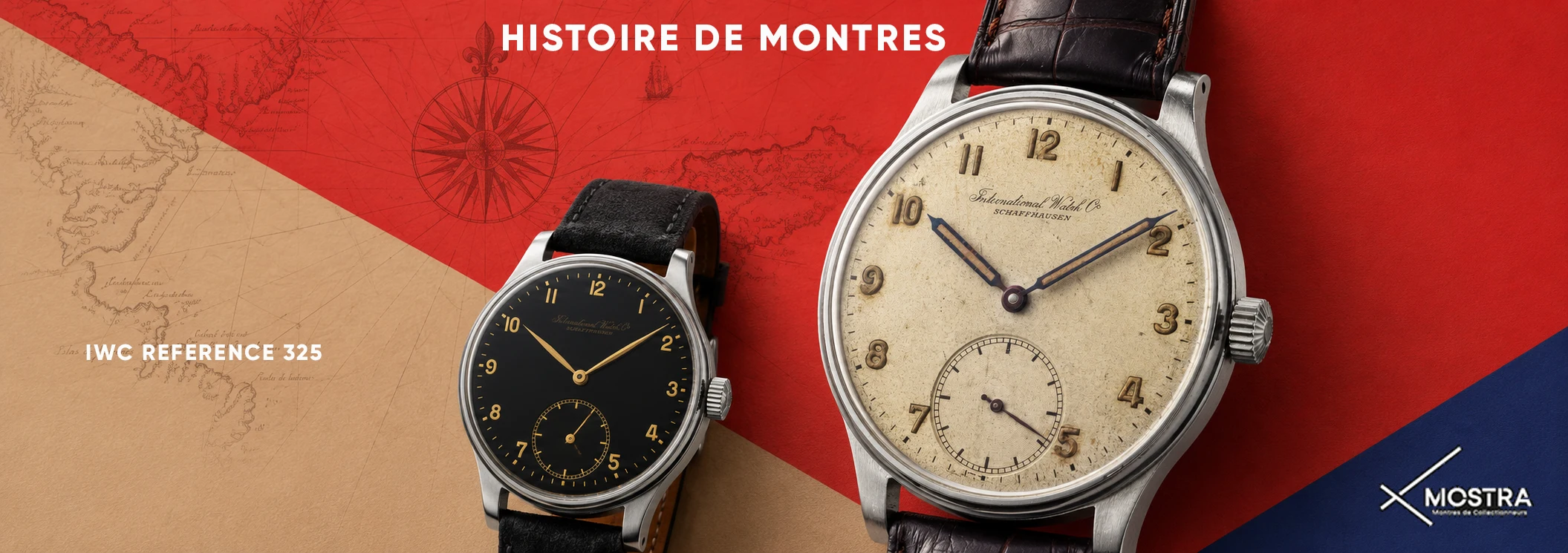
1939: the birth of reference 325
The story truly begins in 1939 with reference 325. IWC indicates that the first delivery of a watch now known as the Portugieser took place on February 22, 1939, before the first deliveries to Portugal in 1942. The first series of reference 325, equipped with calibre 74, was produced between 1939 and 1951 in 304 examples. Other series would later follow, notably with calibres 98 and 982, making this original reference a rare and highly sought-after piece.
The first-generation Portugieser was not yet a commercial line in the modern sense. It was almost a special order, a watch ahead of its time, too large for its own era but perfectly proportioned for the contemporary eye. It is precisely this shift that explains part of its strength today.
1993: the heritage revival
In 1993, IWC celebrated its 125th anniversary and brought the Portugieser back to the forefront with an anniversary watch, reference IW544101. This piece revived the historical language of reference 325: a large case, a restrained dial, marine inspiration and a hand-wound movement derived from the spirit of old pocket-watch calibres.
This return marked an important moment: the Portugieser ceased to be a historical curiosity and became a true watch family. It then established itself as one of IWC’s most identifiable pillars, alongside the Pilot’s Watches, the Ingenieur, the Portofino and the Aquatimer.
1995, 1998 and 2000: the modern age of the Portugieser
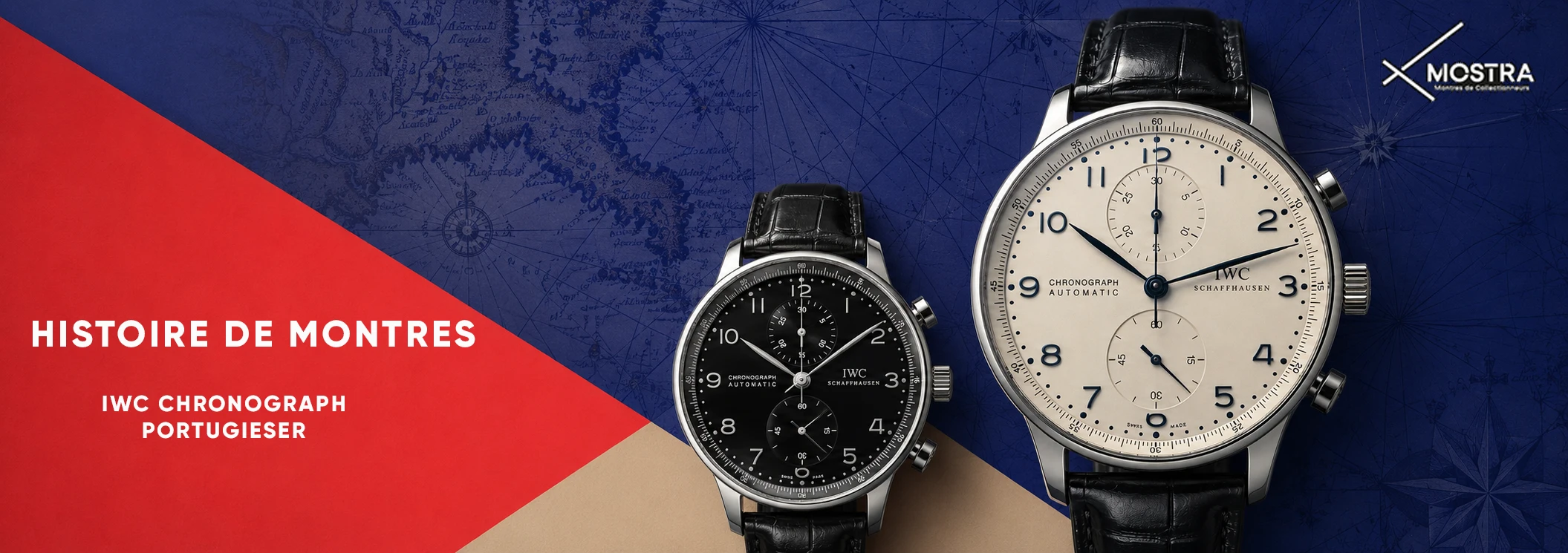
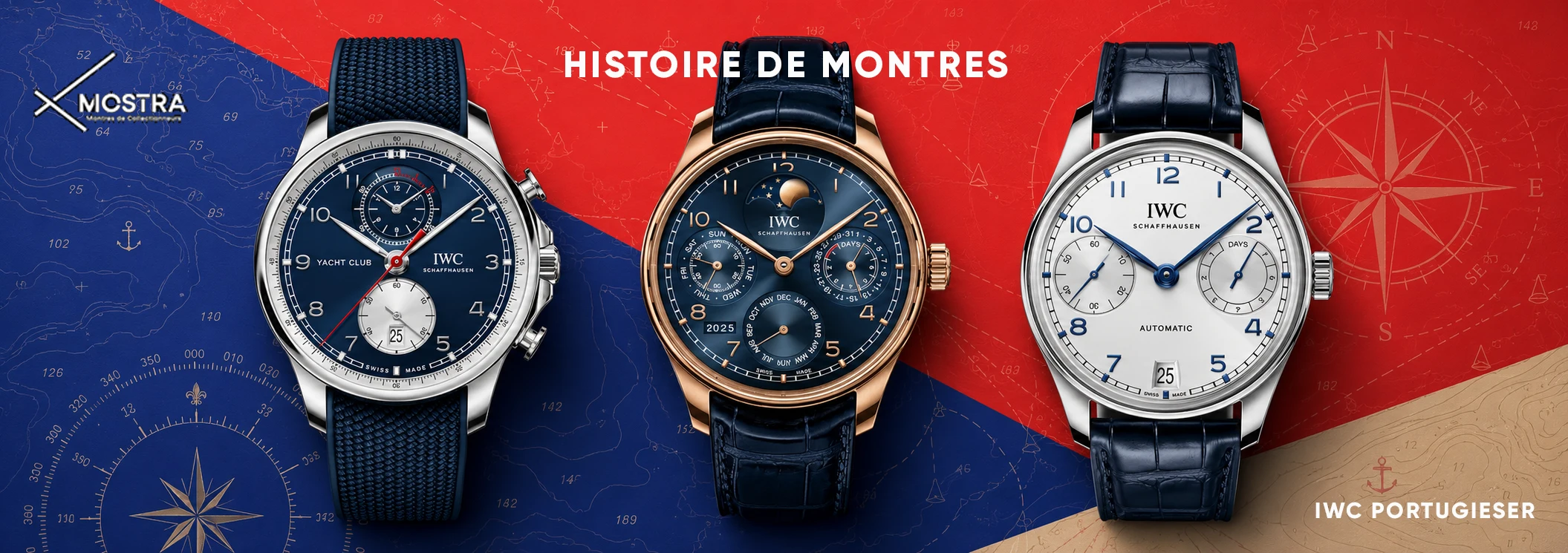
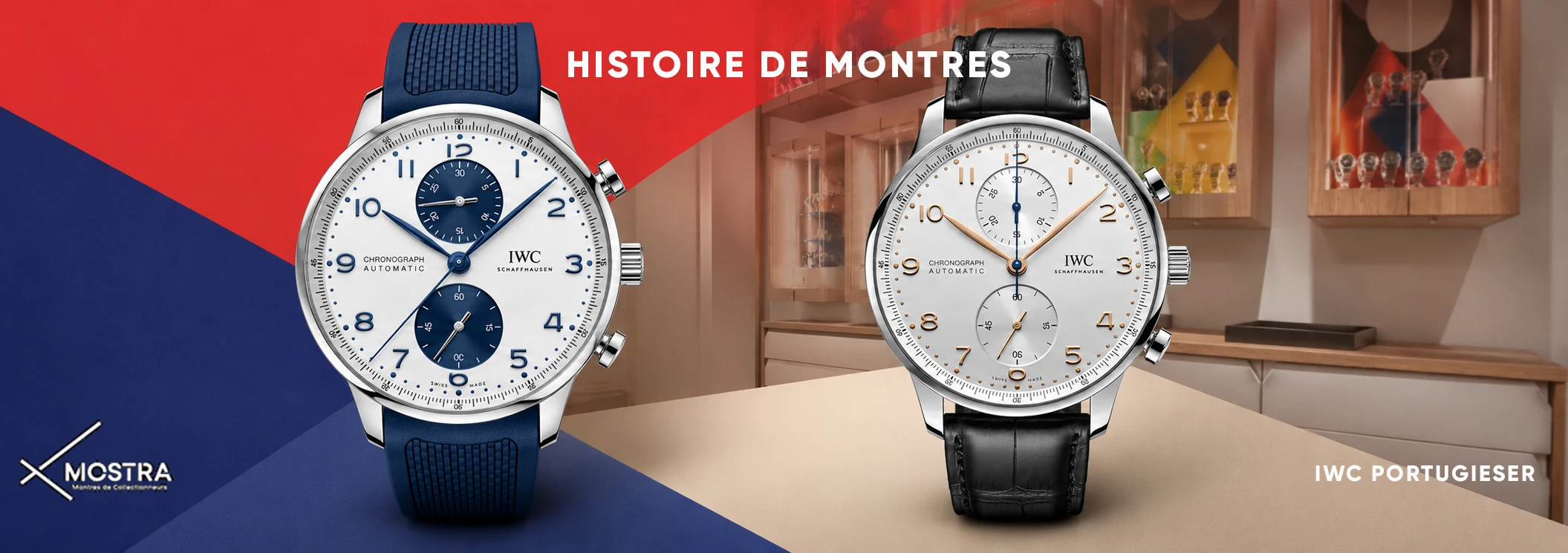
From the mid-1990s onward, the collection began to take shape. In 1995, the split-seconds chronograph brought a more technical dimension. In 1998, the Portugieser Chronograph became one of the most emblematic models in the family. IWC presents this chronograph as one of the most coveted members of the line since that date.
Its success rests on a very precise formula: two vertically aligned counters, a precise peripheral scale, a highly legible dial, a strong presence that never becomes heavy. It is a dress watch that remains alive, an elegant piece that does not renounce daily use.
The year 2000 marked another decisive step with the arrival of calibre 5000, an automatic manufacture movement with a long power reserve. IWC recalls that this calibre was the first movement entirely designed, manufactured and assembled in-house for many years, with Pellaton winding and an eight-day power reserve. This moment placed the Portugieser Automatic in another dimension: that of a long-distance everyday watch.
2003 to 2010: complications, perpetual calendar and Yacht Club
In 2003, the Portugieser welcomed the perpetual calendar with reference 5021. IWC then combined its calibre 5000 with the perpetual calendar module developed by Kurt Klaus. The Portugieser became the natural territory for Schaffhausen’s great complications: perpetual calendar, minute repeater, tourbillon, moon-phase displays and long power reserves.
In 2010, the Portugieser Yacht Club Chronograph introduced a sportier interpretation of the collection. It retained the overall elegance of the line, while associating it with a more robust, more nautical, more daily-wear presence. It was a logical evolution: the Portugieser, born from the navigation instrument, here reconnected with part of its maritime imagination.
2020 and 2024: the era of manufacture calibres and contemporary dials
In 2020, IWC strengthened the technical coherence of the collection with a family largely equipped with manufacture calibres. The Portugieser Chronograph reference 3716 notably received the IWC calibre 69355 and a sapphire caseback. The same period also saw the return of a Portugieser Automatic 40, more compact, with small seconds at 6 o’clock, in the direct spirit of reference 325.
In 2024, the collection evolved again with new cases, box-glass crystals, deeply worked dials and the arrival of colours such as Horizon Blue, Obsidian, Dune and Silver Moon. IWC also presented the Portugieser Eternal Calendar, the manufacture’s first secular perpetual calendar, whose moon phase claims a theoretical precision of more than 45 million years.
Key dates in the history of the IWC Portugieser
| Date | Evolution | Importance |
|---|---|---|
| 1939 | Birth of reference 325 | First large wristwatch inspired by marine chronometers |
| 1942 | First deliveries to Portugal | Confirmation of the historical order linked to Portuguese importers |
| 1993 | Anniversary reference IW544101 | Modern revival of the Portugieser |
| 1995 | Split-seconds chronograph | Entry into the world of modern complications |
| 1998 | Portugieser Chronograph | Birth of a contemporary icon within the collection |
| 2000 | Calibre 5000 | Long power reserve and strong return of the manufacture movement |
| 2003 | Perpetual Calendar reference 5021 | Combination of calibre 5000 and the Kurt Klaus module |
| 2010 | Yacht Club Chronograph | Sportier and more nautical version of the Portugieser |
| 2020 | Portugieser Chronograph 3716 and Automatic 40 | Generalisation of manufacture calibres and return of a more contained format |
| 2024 | Eternal Calendar and new generation | Contemporary haute horlogerie, new dials and extreme complications |
Why own an IWC Portugieser today?
The Portugieser is a watch of balance. It has the presence of a large piece, yet retains a rare restraint. It can accompany a suit, a more relaxed outfit, a professional day, a dinner or a collector’s meeting. It speaks without raising its voice.
Its first advantage is legibility. The dial breathes, the numerals are clear, the minute track offers immediate reading. It is a watch that can be read at a glance, like an instrument, yet worn as an elegant piece.
Its second advantage is the diversity of the collection. An owner may choose a Portugieser Chronograph for daily use, an Automatic 7 Days for its power reserve, an Automatic 40 for a more restrained fit, or a complication to enter a more patrimonial dimension.
Availability varies according to references and new arrivals. Browse the pre-owned IWC Portugieser watches currently offered by Mostra.
Its third advantage lies in its aesthetic consistency. The Portugieser has never needed a brutal break to remain current. Its design evolves through nuance: proportions, calibres, dials, materials, sapphire casebacks, yet the identity remains. This is precisely what reassures an enthusiast at the moment of purchase.
The Portugieser on the pre-owned market
On the pre-owned market, the IWC Portugieser occupies an interesting position. It does not always follow the most violent speculative movements of the watch market, but it benefits from genuine recognition, a strong identity and regular demand for the most legible references.
According to WatchCharts data consulted in June 2026, the Portugieser collection averaged around €6,000 on the secondary market, with a very broad range extending from approximately €3,000 to €35,000 depending on the reference, metal, complication and condition. Steel Portugieser Chronograph models from the 3714 and 3716 families often form the most active part of the market, while perpetual calendars, limited editions and gold pieces trade at significantly higher levels.
These indicators should be treated as a snapshot of the market at a particular moment rather than as a guaranteed valuation. Prices evolve according to availability, demand and, above all, the quality of the individual example.
At the same date, the WatchCharts index for the Portugieser showed a decline over one and two years, despite a recovery during the previous six months. This trend confirms that the Portugieser is not driven by pure speculation. It is a selective market in which the reference, condition, full set and history matter more than a broad collection average.
Discover the pre-owned IWC Portugieser watches selected by Mostra, as well as our watch appraisal service in Aix-en-Provence.
What influences the value of an IWC Portugieser?
The value of a Portugieser depends first on its reference. A Chronograph 3714, a 3716 with manufacture calibre, an Automatic 5007, an anniversary edition, a split-seconds chronograph or a perpetual calendar are not analysed in the same way.
It then depends on its real condition: an over-polished case, a marked dial, changed hands, crystal, crown, buckle, strap, service history. On a watch such as the Portugieser, whose design rests on the purity of its lines, a visible alteration can weigh heavily on perception.
The full set also plays an important role. Box, papers, original invoice, warranty card, service history, possible extract, number coherence and accessory conformity reinforce trust and facilitate a future sale.
How to choose a pre-owned IWC Portugieser
Choosing a pre-owned IWC Portugieser requires looking beyond the general appearance of the watch. A Portugieser may seem simple at first glance, yet its precise reference, movement, case condition, dial coherence, service history and position on the market should all be examined carefully.
At Mostra, each example is placed back within its history and assessed according to its configuration, condition and actual value. The aim is to allow the buyer to understand exactly what is being purchased: a reference, a level of preservation, a particular degree of desirability and a watch that can be worn, kept or passed on.
Local support in Aix-en-Provence also provides an identifiable point of contact. For a collector’s watch, this relationship matters both at the time of purchase and afterwards, whether for servicing, a replacement strap, follow-up or the development of a collection.
Looking for a pre-owned IWC Portugieser?
Discover the references available at Mostra, inspected and selected according to their condition, coherence and watchmaking interest.
View pre-owned IWC Portugieser watches Discover all pre-owned IWC watches
How to sell an IWC Portugieser
Selling a Portugieser requires as much precision as buying one. An estimate made too quickly may reduce a watch to a market average, when a single detail can change its reading: a dial colour, a series, exceptional condition, a complete configuration, a service invoice or a less common edition.
Mostra supports the seller in this process of enhancement. The watch is examined, documented, photographed and presented with the elements that justify its price. This approach avoids rushed sales, poorly oriented negotiations and hazardous comparisons with watches that are not equivalent.
For the seller, the advantage is twofold: securing the transaction and giving the watch the presentation it deserves. A well-explained Portugieser is a better-understood Portugieser. And a better-understood watch sells in a climate of trust.
To have your watch examined or valued, discover our pre-owned watch appraisal service.
The Mostra perspective: history, condition, coherence, value
An IWC Portugieser cannot be reduced to a price chart. It must be judged as a whole. The design, the movement, the proportions, the state of preservation, the coherence of the dial, the quality of the polishing, the presence of documents and the relevance of the price all form a single ensemble.
This is the ensemble that Mostra seeks to clarify. Not to turn every watch into a speculative object, but to restore its rightful place. Some Portugiesers are magnificent everyday watches. Others are already collector’s pieces. A few become true milestones in IWC’s contemporary history.
The Portugieser has crossed more than eight decades without losing its thread. It remains this watch born from an instrument, made elegant without becoming fragile, technical without becoming cold, patrimonial without ceasing to be wearable. Perhaps that is its greatest merit: reminding us that a great watch does not always seek to impress. It accompanies, it measures, it endures.
At Mostra, buying, selling or appraising an IWC Portugieser means taking the time to understand what this watch truly represents: a line, a story, a value and a presence.
Discover the pre-owned IWC Portugieser watches available at Mostra, or explore our complete selection of pre-owned IWC watches.
Further reading about IWC and collector watches
These products might interest you


Share this content