Éric Tabarly: legendary sailor and his iconic watches
Secrets of a winning sailing race under the stars
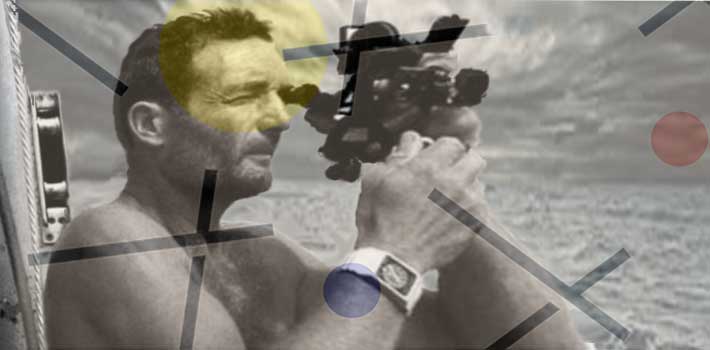
Before becoming a legend of solo sailing, Éric Tabarly was a naval pilot equipped with some of the finest military watches. From the Longines 5774 to the Omega Marine Chronometer, his timepieces reflect a lifelong pursuit of precision, innovation, and record-breaking performance.
Early days as a naval aviator
Navigating and following a defined course to reach one’s destination swiftly is an art that, like any discipline, requires a reliable tool. Just as an artist depends on the precision of their pencil, a navigator relies on their watch to chart their position using a sextant aimed at stars or constellations.
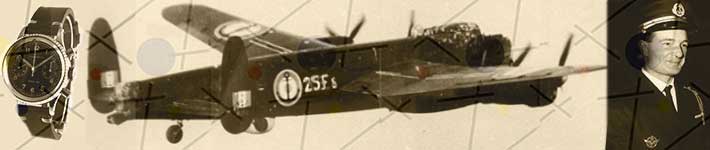
Little known to the general public, Éric Tabarly began his career covering vast distances not by sea, but as a naval aviator. Between 1952 and 1960, he joined the French Navy as a student pilot. He flew Stampe SV-4 biplanes in Khouribga, Morocco, and later trained on long-range aircraft in Agadir, piloting Beechcraft and the iconic Avro Lancaster bombers of Flotilla 25F, which equipped the post-war French Navy.
One of his first issued timepieces was the Longines 5774, a standard military watch used in Indochina and post-WWII operations, preceding the famous Breguet and Auricoste flyback chronographs.
Auricoste Type 20: a pilot’s tool
Wearing an Auricoste Type 20 flyback chronograph — one of the official models issued to French naval pilots in 1954 alongside the Breguet and Vixa Type 20 — Tabarly served during the Indochina War within the long-range maritime patrol squadron 28F, flying PB4Y Privateers.
During this period, he logged the equivalent of thirty circumnavigations by air. In 1958, he entered the Naval Academy, quickly standing out for his precision sailing skills during regattas in all weather conditions, supported by exceptional physical endurance.
Rising star in competitive sailing
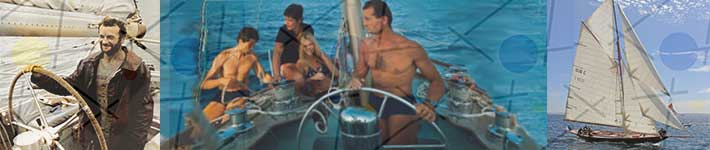
The Navy soon seconded him full-time to represent its colors in major international sailing competitions such as the solo transatlantic race and the Transpacific aboard Pen Duick 5. During these campaigns, Tabarly met and mentored future legends of French sailing, including Titouan Lamazou, Jean Le Cam, and Olivier de Kersauson.
From Lip Nautic to Omega Marine Chronometer
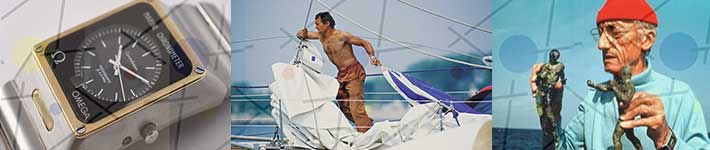
Throughout this golden period, Tabarly wore a Lip Nautic Ski, later replaced in the mid-70s by the revolutionary Omega Constellation Marine Chronometer. This ultra-precise quartz timepiece, also worn by Jean-Yves Cousteau, was among the few wristwatches to earn the prestigious Marine Chronometer title — previously reserved for large, ship-mounted clocks.
Innovation above all
Tabarly’s legacy is not only tied to his victories but also to his technical foresight. He lightened his Pen Duick boats using plywood, designed alloy hulls, pioneered rotating masts, planning hulls, ballasts, and even the now-common spinnaker sock. His masterpiece? The use of foils on the Paul Ricard, allowing his boat to literally fly across the water — a return to the airborne sensations of his early years.
A legacy that transcends sailing
His innovations revolutionized both pleasure and professional sailing. Many of his concepts now equip today’s racing yachts — the true “Formula One of the seas” that dominate races like the Vendée Globe and the America’s Cup.
More than a sailor, Tabarly was a visionary — a man obsessed with precision, performance, and progress. His mastery of cutting-edge tools made him a legend not just in navigation but in engineering and horology.
Horological excellence across decades
From his early days as a naval aviator with the Auricoste Type 20 — a bi-compax flyback chronograph with rotating bezel — to his Lip Nautic Ski in the regatta years, and finally the Yema Yachtingraf and the unparalleled Omega Megaquartz 2.4 Marine Chronometer in the 1970s, Tabarly always sailed with the finest instruments on his wrist.
Equipped with the high-frequency caliber 1516, this Omega remains the most precise wristwatch of its time. Just like the sailor who wore it, it was made to lead — not follow.
Related products

Share this content