Breitling Navitimer: History, References and Collector’s Guide
From AOPA and the earliest Valjoux 72 Navitimers to reference 806 with Venus 178, Scott Carpenter’s Cosmonaute, the Chrono-Matic and the B01, Mostra traces the complete history of the Breitling Navitimer and explains how to identify, date, appraise and choose a vintage or modern Navitimer.
From AOPA and the earliest Valjoux 72 Navitimers to reference 806 with Venus 178, Scott Carpenter’s Cosmonaute, the Chrono-Matic and the B01, Mostra traces the complete history of the Breitling Navitimer and explains how to identify, date, appraise and choose a vintage or modern Navitimer.
By Thierry Serna and Jean-Baptiste Contini
Historical, heritage and market perspective: Thierry Serna
Technical analysis and workshop methodology: Jean-Baptiste Contini
The Essentials: Understanding the Breitling Navitimer in Two Minutes
The Breitling Navitimer was born in the early 1950s from an idea as ambitious as it was representative of its time: to place on a pilot’s wrist not only a chronograph, but also a circular slide rule capable of performing multiplication, division, conversions and calculations involving speed, distance or fuel consumption. Breitling regards 1952 as the starting point of its development; the AOPA officially adopted the model two years later, and the earliest known generations appeared in the mid-1950s.
The Navitimer name would subsequently cover very different watches. The earliest generations notably used the Valjoux 72, before the Venus 178 became the emblematic movement of reference 806. All-black dials gradually gave way to contrasting subsidiary registers. AOPA dials coexisted with commercial Breitling signatures and then, around 1965, with the famous Twin-Jet. In 1962, Scott Carpenter took into space a Navitimer adapted to a 24-hour display: the Cosmonaute. In 1969 came the automatic Navitimer Chrono-Matic, followed by the quartz crisis, Breitling’s takeover by Ernest Schneider, the revival of the Old Navitimer and finally, in the twenty-first century, the era of the Breitling Manufacture Calibre 01.
Two Navitimers carrying the same reference 806 can therefore have very different values depending on their period, dial, logo, movement, luminous material, bezel, case condition and the coherence of their components. A vintage Navitimer has to be read as an ensemble. The reference identifies a family; the details tell the story of the individual watch.
Enter the history — How to date an 806 — The 12 Mostra checks — Browse pre-owned Breitling Navitimer watches — See all pre-owned Breitling watches
In this article
- Before the Navitimer: Chronomat and the birth of the circular slide rule
- 1952, 1954 or 1955: when was the Breitling Navitimer really born?
- 1954–1955: the first Valjoux 72 Navitimers and the birth of reference 806
- Reference 806 and the Venus 178: the movement behind an icon
- How does a Breitling Navitimer slide rule work?
- 1959: the classic Breitling 806 architecture takes shape
- 1962: Scott Carpenter, Aurora 7 and the Navitimer Cosmonaute
- The 1960s: reverse panda, serrated bezels and the Twin-Jet logo
- 1965: Miles Davis, when the Navitimer moves beyond the cockpit
- From Mk1.1 to Mk8: how to read the generations of Breitling Navitimer 806
- 1968: how to read a Breitling Navitimer 806 Mk7 Twin-Jet
- 1968–1969: 816 Big Case and 1806 Chrono-Matic, the Navitimer changes scale
- 7806 Mk11 and 8806 Mk10: the Navitimer enters the 1970s
- 1979–1986: Ernest Schneider and the rebirth of the Navitimer
- 2009 and beyond: Breitling Calibre 01 transforms the contemporary Navitimer
- The main Breitling Navitimer families to know
- How to date and identify a Breitling Navitimer 806
- AOPA, commercial wings or Twin-Jet: what a Navitimer logo tells us
- Why two Breitling Navitimer 806 watches can have different values
- Servicing, restoration and service parts: how far should restoration go on a vintage Navitimer?
- Which Breitling Navitimer should you choose today?
- The twelve Mostra checks before buying a pre-owned Breitling Navitimer
- Why buy a pre-owned Breitling Navitimer from Mostra?
- Is the Breitling Navitimer an investment?
- Breitling Navitimer FAQ
“A Navitimer is never quite looked at like another watch. At first, its dial appears to be an entanglement of figures; then the eye learns to distinguish the scales, registers, logos and generations. At that moment, what seemed complex becomes a language. And every Navitimer begins to tell the story of its era.”
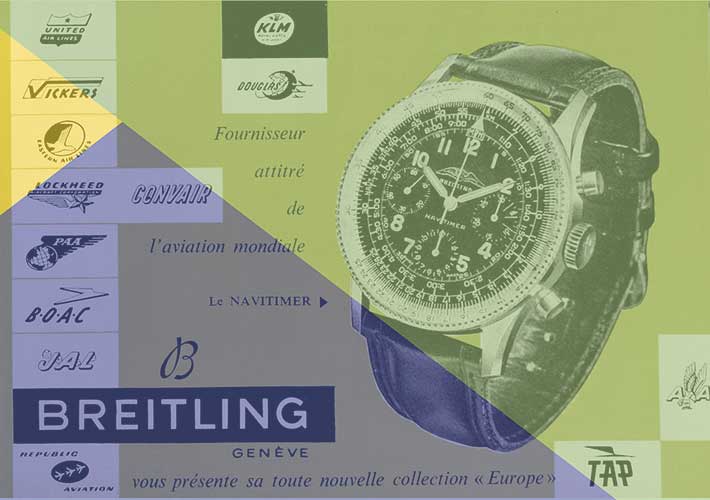
During the 1950s, commercial aviation entered a period in which the world suddenly seemed to shrink. Four-engined aircraft crossed continents, the first jets prepared to transform the great international routes and, inside the cockpit, calculation remained omnipresent. A speed had to be converted, a distance related to time, a fuel consumption estimated. Before modern onboard computers, these operations still relied heavily on analogue instruments, charts, tables and slide rules.
It was within this world that the Breitling Navitimer found its meaning. Its extraordinarily dense dial was not born from a decorative exercise. It resembles an instrument panel because it belongs to the same technical culture. This also explains its permanence: when its original function became less essential, its design remained instantly associated with the golden age of air travel.
This feature complements Mostra’s selection of pre-owned Breitling Navitimer watches and the broader pre-owned and vintage Breitling collection. It also connects with our pre-owned military and aviation watches, our pre-owned chronograph watches, our feature on watches of the space conquest from Mercury to Artemis and the methodology developed in our article on understanding the true condition of a pre-owned watch before buying it. The purpose is not simply to recount the Navitimer’s history, but to give collectors the tools to read, identify, compare and understand an individual watch before buying, selling or servicing it.
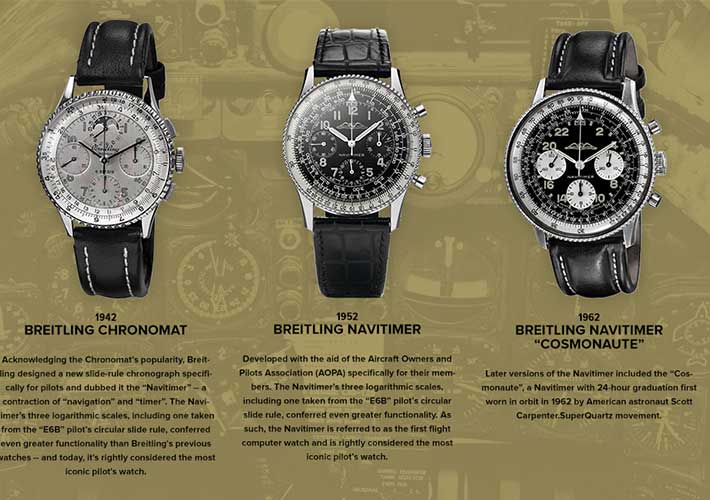
Before the Navitimer: Chronomat and the birth of the circular slide rule
The Navitimer did not appear from nowhere. Its architecture draws an essential part of its origins from the Breitling Chronomat developed during the 1940s. Breitling was already working on a watch fitted with a circular logarithmic slide rule. The idea was brilliant: two graduated scales moving in relation to one another allowed certain mathematical operations to be performed mechanically, without electronics and without requiring more space than the circumference of a bezel.
The Chronomat was initially aimed at a scientific, technical and industrial audience. Willy Breitling quickly understood, however, that a slide rule adapted to aviation requirements could become far more than a spectacular complication. It could constitute a genuine auxiliary instrument worn on the wrist.
The principle was therefore reorganised around the pilot’s needs. The chronograph measured elapsed time; the slide rule made it possible to derive a speed, distance, fuel consumption or conversion from that measured time. The future Navitimer thus brought together two ideas that had previously existed separately: measuring time and calculating from the time measured.
1952, 1954 or 1955: when was the Breitling Navitimer really born?
The question appears simple, yet it explains much of the debate surrounding the earliest Navitimers. Breitling today regards 1952 as the year in which development of the watch began. Willy Breitling set out to create for the Aircraft Owners and Pilots Association — AOPA — a chronograph capable of combining time measurement with the principal calculations required in flight. Two years later, in 1954, the AOPA officially adopted the model as a timepiece intended for its members. The earliest generations documented today appeared precisely during this period, while reference 806 became established during the middle of the decade.
The name itself sums up the project remarkably well. Navitimer is a contraction of “navigation” and “timer”: navigation for calculations involving speed, distance, fuel consumption or conversions; timer for the measurement of time by the chronograph. Two functions combined in a single word, just as they would be brought together around a single dial. The Navitimer was therefore not born simply as an aviation watch inspired by cockpits: its architecture derives directly from the way pilots worked and calculated in the early 1950s.
Collectors nevertheless encounter different dates depending on the documents consulted. Some histories retain 1952, others 1954 or 1955. They do not necessarily describe contradictory realities. 1952 corresponds to the development of the project, 1954 to its adoption by the AOPA, and the mid-1950s to the gradual establishment of the first generations and reference 806. The history of an industrially produced watch cannot always be contained within a single date: drawing, prototypes, production, restricted distribution and wider commercial release can each represent a different stage in the same birth.
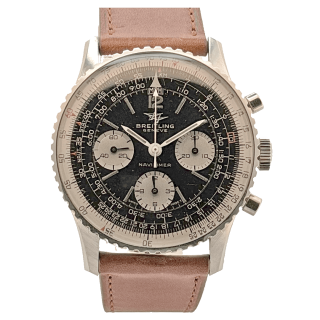
The earliest Navitimers associated with the AOPA can notably be recognised by dial configurations in which the identity of the association plays an essential role. The Breitling signature that would later become familiar on commercially distributed models subsequently evolved. From 1955 onward, reference 806 progressively established itself as the emblematic designation of the classic Navitimer and would pass through a succession of generations whose differences have now become essential to collectors.
Presenting all these watches simply as “old Navitimer 806s” would remove much of their interest. Between a very early Valjoux 72 from 1954, an all-black Venus 178-powered 806 from the late 1950s, a 1965 Mk5 reverse-panda Twin-Jet and a 1968 Mk7, the overall silhouette remains immediately recognisable, but the movement, dial, logos, bezel and historical context tell very different chapters of Breitling’s history.
1954–1955: the first Valjoux 72 Navitimers and the birth of reference 806
One of the misconceptions long repeated about the Navitimer consists of presenting the Valjoux 72 as a movement adopted later to compensate for insufficient availability of the Venus 178. The chronology documented today tells almost the opposite story. The earliest known generations of Navitimer used the Valjoux 72 as early as 1954. Breitling notably classifies a 39.7 mm Mk1.1 and a 39.8 mm Mk1.2 in that year, followed in 1955 by a Mk1.3 carrying reference 806. The Venus 178 appeared subsequently and became the calibre that would accompany most of the classic history of the reference.
These very early watches are sometimes described by collectors as “Pre-806”. The expression remains useful for distinguishing examples that predate the stabilisation of the reference, but it should be used with nuance. Breitling’s current heritage chronology integrates them directly into the Navitimer genealogy: Mk1.1 followed by Mk1.2 in 1954, then the Mk1.3 reference 806 in 1955. It is therefore more accurate to regard them as the earliest stages of the same family rather than as an entirely separate model that preceded the 806.
The Valjoux 72 belongs to the great family of manually wound column-wheel chronographs that shaped twentieth-century watchmaking history. Its presence inside the earliest Navitimers gives these watches considerable importance. They combine one of the most respected chronograph architectures of their time with a watch whose aesthetic identity was still taking shape. The dial was already extraordinarily dense and the slide rule had already established its peripheral language, yet the Navitimer had not completed the evolution that would lead to the great visual balances of the 1960s.
For collectors, these generations require an especially rigorous method. A Valjoux 72, an old dial or an AOPA emblem can never authenticate an early Navitimer in isolation. The case number, period, bezel construction, typography, calculation scales, register layout, hands, movement and various markings must all be compared. The rarer the watch, the more a seemingly minor inconsistency can significantly alter its heritage interest.
The same caution applies to restoration. On a watch produced more than seventy years ago, a slightly marked dial, a bezel bearing the traces of use or a case that retains the signs of its life are not necessarily defects that should be erased. On a very early Navitimer, preserving history can be more valuable than artificially restoring the appearance of a new watch. The issue is not simply to own a watch that works; it is to understand how much of 1954 or 1955 is still genuinely present before you.
Reference 806 and the Venus 178: the movement behind an icon
From the mid-1950s onward, the Venus 178 became inseparable from the image of the Navitimer 806. This manually wound column-wheel chronograph provides the tri-compax architecture that gives the dial its characteristic balance: running seconds, a minute totaliser and an hour counter are arranged around the central axis.
The movement runs at a comparatively unhurried frequency by modern standards. On many classic-period 806 watches, one finds a Venus 178 operating at 18,000 vibrations per hour, generally with 17 jewels. Power reserve naturally depends on condition, adjustment and generation; on a healthy and correctly maintained movement, it remains within the expected range for a manually wound chronograph of this architecture.
The beauty of the Venus 178 also lies in its mechanical relationship with the wearer’s hand. Winding is performed every day through the crown. Chronograph engagement can be felt beneath the fingertip. Reset is decisive. On an old watch, these sensations also provide information: excessively stiff operation, an imperfect reset or a jumping hand should immediately attract attention.
A Navitimer 806 may run and still require servicing. The fact that a movement has not stopped is not a mechanical health report. Amplitude, actual power reserve, lubricant condition, chronograph engagement and component wear all deserve examination when one wishes to understand the true condition of the movement.
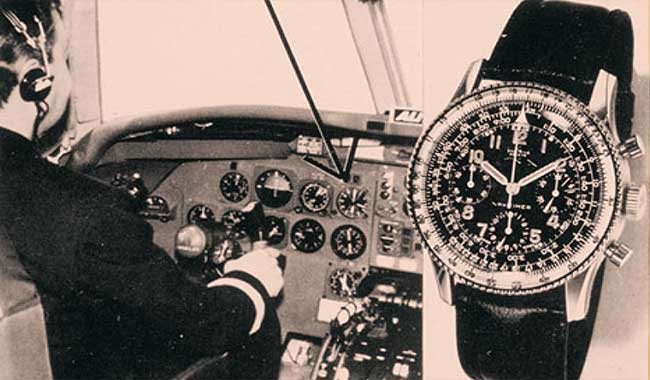
How does a Breitling Navitimer slide rule work?
This is often the question that transforms the way the watch is perceived. Until the slide rule is understood, the Navitimer can appear simply overloaded. Once its principle becomes clear, the dial immediately makes much more sense.
The Navitimer incorporates two circular logarithmic scales. One remains fixed; the other rotates with the bezel. By aligning specific reference marks, mathematical operations can be performed without carrying out the calculation mentally. The principle is comparable to that of a conventional straight slide rule wrapped into a circle around the dial.
Multiplication
To perform a simple multiplication, the reference corresponding to 10 on the rotating scale is positioned opposite one of the factors on the fixed scale, after which the result is read opposite the second factor. As with a traditional slide rule, the decimal point has to be determined mentally.
Division
The process can be reversed for division. The dividend and divisor are aligned and the ratio can then be read at the reference position.
Calculating speed, time and distance
This is where the Navitimer returns to its aeronautical purpose. If a distance and the time required to cover it are known, the slide rule can be used to derive an average speed. Conversely, speed and distance allow an estimated journey time to be calculated. The same principle can be applied to certain hourly fuel-consumption calculations.
Conversions
The slide rule can also be used to convert different units, notably certain relationships between miles, kilometres and nautical miles. These functions must always be used with an understanding of the units involved: the Navitimer performs the mathematical relationship; it does not determine the unit or order of magnitude on the wearer’s behalf.
A practical example: calculating average speed with a Navitimer
The slide rule becomes much more intuitive when applied to a simple situation. Imagine an aircraft covering 120 nautical miles in 30 minutes. We therefore know the distance and the elapsed time, and we want to determine its average speed. On a Navitimer, these two values are related on the logarithmic scales: the value corresponding to 120 is positioned opposite 30 minutes. The proportion can then be followed to the marker corresponding to one hour, or 60 minutes. The reading gives 240 in the relevant order of magnitude: the aircraft is therefore travelling at an average speed of 240 nautical miles per hour, or 240 knots.
120 nautical miles covered in 30 minutes = an average speed of 240 knots.
The Navitimer does not replace the pilot’s reasoning. It establishes the proportion mechanically and makes it possible to read the result almost instantly. The user must still understand the units involved and determine the correct order of magnitude. It is precisely this relationship between instrument, mental calculation and knowledge of flight that helps explain the technical culture in which the Navitimer was born.

The same principle can be applied in reverse. If the pilot knows the average speed and the remaining distance, the estimated flight time can be calculated. With a known fuel flow, time can also be related to fuel consumption. The slide rule is therefore not simply a spectacular complication added around a chronograph: together, they form a genuine miniature analogue calculation system. The chronograph measures time; the slide rule transforms that time into usable information.
Today, no airline pilot needs a Navitimer to replace onboard avionics. That does not make it obsolete. On the contrary, its slide rule has become the mechanical testimony of an era in which understanding an instrument was directly part of the profession. Its contemporary appeal lies as much in that history as in the fact that the function can still be used.
1959: the classic Breitling 806 architecture takes shape
By the end of the 1950s, the Navitimer had acquired a silhouette that would define its identity for decades. The case measures around 40 mm, a generous size for the period but entirely justified by the amount of information displayed. The beaded bezel facilitates manipulation. The dark dial, three registers and slide rule create the impression of a scientific instrument miniaturised for the wrist.
Examples from this period are particularly sought after when their configuration is coherent and well preserved. Breitling itself selected a 1959 Navitimer 806 as the basis for its first major modern historical re-edition, demonstrating the particular place occupied by this design in the history of the model.
Yet simply referring to “a 1959 806” remains insufficient. Collectors distinguish several evolutions of dials, logos, bezel beads and typographical details. The best reflex is never to begin with a nickname and then force a watch to fit it. Observe the watch first; classify it afterwards.
The 1960s: reverse panda, serrated bezels and the Twin-Jet logo
At the beginning of the 1960s, aviation changed pace. The Boeing 707, Douglas DC-8 and Caravelle firmly established the jet age. The Navitimer evolved as well. Contrasting registers appeared and profoundly changed the visual reading of the dial. The background remained black while the subsidiary counters became light: one of the architectures collectors now refer to as reverse panda.
The bezel evolved too. The fine beads of the earliest generations gradually gave way to more distinctly notched or serrated constructions depending on the series. Once again, these changes should never be isolated from the rest of the watch: a later bezel fitted to an earlier dial may be a perfectly authentic Breitling service part, but it no longer tells exactly the same story as a watch that has remained in its period configuration.
Around 1965, above all, appeared the famous Twin-Jet emblem, consisting of two superimposed stylised aircraft. AOPA markings continued to exist in parallel on certain versions. Today, these two logos represent valuable clues for collectors, provided they are interpreted alongside the typography, text layout and period of production.
The Twin-Jet belongs perfectly to the imagery of its time. Air travel was no longer merely a technical adventure; it had become an international culture. Airport terminals, crews, transatlantic routes, travel magazines and the silhouettes of jet aircraft created an instantly recognisable aesthetic. The Navitimer gradually left the cockpit alone and also became an outward symbol of this new mobility.
1962: Scott Carpenter, Aurora 7 and the Navitimer Cosmonaute

The Navitimer would already have fully deserved its place in watchmaking history had it remained within aviation. On 24 May 1962, however, it changed altitude.
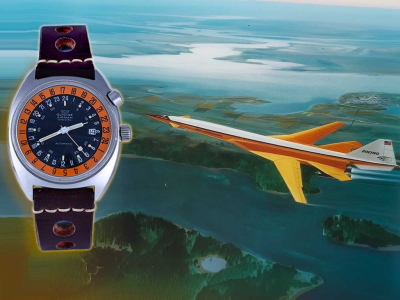
American astronaut Scott Carpenter, a US Navy pilot and member of Project Mercury, asked Breitling for a specifically adapted version of the Navitimer. In orbit, the usual alternation between day and night no longer carries the same meaning. Carpenter therefore wanted to be able to read a complete twenty-four-hour day.
Breitling developed an adapted Navitimer with a 24-hour dial, a bezel easier to manipulate while wearing gloves and a bracelet allowing the watch to be worn with flight equipment. Carpenter wore it during the Mercury-Atlas 7 mission aboard Aurora 7, which completed three orbits of the Earth.
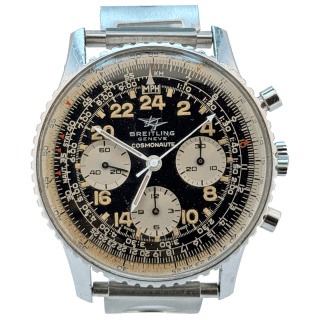
This watch gave rise to the Navitimer Cosmonaute reference 809. Its dial can be disorienting at first: the hour hand makes only one revolution every twenty-four hours. This is precisely what makes it interesting. The Cosmonaute is not merely a conventional Navitimer decorated with a space-flight story; its display itself resulted directly from the problem posed by orbital flight.
Breitling presents it as the first Swiss wristwatch worn in space. That wording must be retained precisely: Soviet timepieces had already accompanied the beginning of the space conquest. The Cosmonaute nevertheless occupies an unquestionable place in the history of mission chronographs and forms a natural link with Mostra’s major feature dedicated to watches of Mercury, Apollo, Mir, the ISS and Artemis.
1965: Miles Davis, when the Navitimer leaves the cockpit
In the history of certain watches, there comes a moment when the instrument moves beyond the function for which it was originally created. For the Navitimer, that transition became particularly visible during the middle of the 1960s. It remained profoundly associated with pilots, the AOPA and aeronautical calculation, but it also began appearing on the wrists of men who no longer chose it solely because it could calculate speed, distance or fuel consumption. The tool watch was beginning to become a cultural icon.
Miles Davis belongs directly to this story. The musician wore a Breitling Navitimer reference 806 Mk5 on stage, a generation that Breitling associates with 1965 and the Venus 178 calibre. This Mk5 is particularly important because it brings together two visual elements that would profoundly shape the image of the Navitimer: the reverse-panda dial and the Twin-Jet logo. The black background, light subsidiary registers and two stylised aircraft give the watch a graphic presence that works just as powerfully beneath stage lights as it does inside a cockpit.
The presence of the Navitimer on Miles Davis’s wrist is interesting precisely because it is unrelated to an aeronautical function. On a navigation table, the density of the dial is technical. On stage, that same density becomes aesthetic. The graduations, registers, black-and-white contrast and calculation bezel create a silhouette strong enough to be recognised independently of the purpose for which it was invented. The Navitimer discovers that it can survive the gradual disappearance of its functional necessity because the instrument itself has become a design.
“A tool watch truly becomes an icon on the day its function is no longer necessary for its form to remain desirable.”
This transformation explains an essential part of the Navitimer’s longevity. It remains the watch of pilots, but it also enters a broader culture shaped by music, travel, speed and personalities who adopt technical objects for what they represent. The watch that was created to calculate begins to say something about the person wearing it. And it is probably at this point that the Navitimer acquires the dual identity it still retains today: an aeronautical instrument through its history, and an object of style through the strength of its form.
From Mk1.1 to Mk8: how to read the generations of Breitling Navitimer 806
Simply saying “Breitling Navitimer 806” is not enough to identify a watch precisely. Behind the remarkable continuity of the model lies a succession of generations that Breitling today classifies using Mk designations. This genealogy is essential for collectors because it demonstrates how much an apparently stable reference can evolve in only a few years. Between the Mk1.1 of 1954 and the Mk7 and Mk8 of 1968, the diameter remains close to 40 mm, yet the movement, dial construction, registers, signatures, bezel and logos gradually change.
| Generation | Reference year | Calibre | Diameter | Collector reference point |
|---|---|---|---|---|
| Mk1.1 | 1954 | Valjoux 72 | 39.7 mm | At the origins of the Navitimer, extremely rare |
| Mk1.2 | 1954 | Valjoux 72 | 39.8 mm | Evolution of the very first generations |
| Mk1.3 ref. 806 | 1955 | Valjoux 72 | 39.8 mm | Reference 806 appears within the genealogy |
| Mk2.1 ref. 806 | 1955–1956 | Venus 178 | 40.1 mm | Transition to the calibre that would become emblematic of the classic 806 |
| Mk2.2 ref. 806 | 1959 | Venus 178 | 40.0 mm | The great classic architecture with a dark dial |
| Mk3.1 ref. 806 | 1963 | Venus 178 | 40.0 mm | Dial evolution towards greater contrast |
| Mk4 ref. 806 | 1964 | Venus 178 | 40.0 mm | Transition towards the identity of the second half of the 1960s |
| Mk5 ref. 806 | 1965 | Venus 178 | 40.2 mm | Reverse panda, Twin-Jet and the generation associated with Miles Davis |
| Mk7 ref. 806 | 1968 | Venus 178 | 40.2 mm | Late generation to which the example studied by Mostra belongs |
| Mk8 ref. 806 | 1968 | Venus 178 | 40.2 mm | Final evolutions of the classic 806 before the new architectures |
This classification makes it possible to understand why two Navitimer 806 watches that appear almost identical from a distance can belong to different generations. The transition from the Valjoux 72 to the Venus 178 constitutes the most obvious mechanical break. Dial developments are equally important: registers, typography, signatures and logos gradually take the watch from the earliest black architectures to the reverse-panda and Twin-Jet identity of the second half of the 1960s.
The Mk classification is a reading framework, not a certificate of authenticity. A Navitimer produced more than half a century ago may have received a replacement bezel, hands, dial or another component during a later intervention. The generation defines what one would normally expect to find; examination of the actual watch must then confirm, qualify or sometimes contradict that hypothesis.
This is precisely where appraisal of an individual watch takes over from encyclopaedic knowledge of a reference. Knowing that a Mk7 belongs to 1968 is information. Verifying that a case, Twin-Jet dial, slide rule, hands and Venus 178 still form a coherent ensemble is another task altogether. It is this second level of interpretation that makes it possible to understand why two Navitimer 806 watches from the same year do not necessarily have the same interest or the same value.
1968: how to read a Breitling Navitimer 806 Mk7 Twin-Jet
An individual watch can sometimes explain an era better than an abstract chronology. The 1968 Breitling Navitimer 806 Mk7 Twin-Jet “Boxed 10” studied and offered by Mostra provides an excellent example.
Its case measures approximately 40.2 mm. The black reverse-panda dial combines three light subsidiary registers with the Twin-Jet emblem, the Breitling Genève signature and the peripheral slide rule. Red framed “10” markings — the famous Boxed 10 — contribute to its identification. Inside, the manually wound Venus 178, with column wheel, 17 jewels and 18,000 vibrations per hour, reminds us that the sophisticated visual language of the watch rests upon a remarkably traditional chronograph mechanism.
This configuration sits squarely within the age of modern air travel. In 1968, the Caravelle, Boeing 707 and Douglas DC-8 had already transformed distances. Concorde was about to undertake its first flight. Cockpits, however, were still filled with electromechanical instruments, and navigators or pilots continued to work daily with maps, charts and calculations.
To identify this Mk7 correctly, no detail should be considered in isolation. The case number establishes the period. The Twin-Jet indicates a dial generation. The Boxed 10 markings, register size, signature layout, slide rule, case and Venus 178 must all tell the same story.
This is precisely the method that distinguishes serious identification from simple photographic matching. Many Navitimers have been serviced, repaired or partially updated over the past fifty years. A replaced part is not necessarily problematic. What matters is the ability to identify it, date it where possible and explain its impact on the interest of the individual watch.
If the individual 1968 watch shown above is no longer available, browse the complete selection of pre-owned Breitling Navitimer watches currently offered by Mostra.
1968–1969: 816 Big Case and 1806 Chrono-Matic, the Navitimer changes scale
The end of the 1960s did more than alter the dial. It transformed the entire silhouette of certain Navitimers. In 1968 appeared the reference 816, whose case reached approximately 46 mm. Its spectacular proportions announced a new decade in which sports watches would free themselves from traditional dimensions.
This size was not purely stylistic. It also responded to construction requirements and allowed the integration of the slide rule and water-resistance architecture to be reconsidered on certain models. The result is a watch that seems immediately associated with the 1970s before the decade had properly begun.
Then came 1969. Breitling took part, alongside Heuer-Leonidas, Hamilton-Büren and Dubois-Depraz, in the development of one of the first families of automatic mechanical chronographs. The system was unveiled in March 1969. Within the Navitimer family, it notably gave rise to the spectacular reference 1806 Chrono-Matic.
Its approximately 47 mm case, its crown positioned on the left on the relevant movement architectures and its enlarged dial make it one of the most immediately recognisable Navitimers. It did not instantly replace the 806: for a time, several philosophies coexisted. The collector could choose between the mechanical and historical refinement of the traditional manually wound chronograph and the technological boldness of the automatic.
This coexistence is one of the great strengths of the Navitimer family. Unlike a genealogy in which every new reference erases the previous one, Breitling often allowed several interpretations to live alongside one another.
7806 Mk11 and 8806 Mk10: the Navitimer enters the 1970s
At the beginning of the 1970s, the Navitimer continued adapting to a rapidly changing watchmaking and aeronautical world. Reference 806 was no longer the only way of interpreting the concept. Breitling was now exploring the date display, automatic winding and architectures capable of preserving the identity of the Navitimer while bringing it into a far more experimental decade.
In 1972, the Navitimer Mk11 reference 7806 used the Valjoux 7740 calibre inside a case measuring approximately 40 mm. The appearance of a date display subtly changed the historic balance of the dial without fundamentally altering the overall proportions of the watch. Today it represents a particularly interesting chapter for collectors because it remains immediately recognisable as a Navitimer while belonging to a period of mechanical transition that was for many years less sought after than the great 806 watches of the 1960s.
In 1974, the Navitimer Chrono-Matic Mk10 reference 8806 offered another answer. Its approximately 40.3 mm case housed the Breitling Calibre 12, an automatic chronograph derived from the Chrono-Matic family. The 8806 therefore made it possible to return to an automatic Navitimer in proportions much closer to the classic format than those of the spectacular Big Case models of the period. It perfectly represents an era in which several visions of the Navitimer coexisted: the tradition of the circular dial and slide rule remained intact while the movements and uses changed profoundly.
These references sometimes lived in the shadow of the 806, and that relative discretion now forms part of their appeal. They tell the story of a moment when the mechanical watch was gradually ceasing to be the only possible answer to timekeeping. Quartz offered greater precision, simplicity and accessibility. Industrial costs placed pressure on Swiss manufacturers and buyers’ habits changed dramatically.
The watchmaking crisis weakened Breitling, as it did many historic manufacturers. Yet the Navitimer already possessed something that a new technology could not render obsolete: a form that had become instantly recognisable. The slide rule, the density of the dial and the overall silhouette had already become a visual heritage. A few years later, when mechanical watchmaking recovered its cultural and emotional value, Breitling would be able to rely precisely on this identity to rebuild the Navitimer.
1979–1986: Ernest Schneider and the rebirth of the Navitimer
On 5 April 1979, Willy Breitling transferred the brand to Ernest Schneider, a pilot, entrepreneur and head of Sicura. Schneider understood quartz far better than many of his contemporaries and did not attempt to ignore it. Under his leadership, Breitling would develop highly capable electronic instruments while, a few years later, also taking part in the revival of the mechanical chronograph.
The Chronomat presented in the middle of the 1980s played an important role in that revival. The Navitimer followed. In 1986, the Old Navitimer reinterpreted the historic silhouette in an automatic watch using a Valjoux-based movement.
This rebirth coincided with a cultural shift. The mechanical watch was no longer selected simply because it was the normal way to make a watch. It began to be chosen precisely because it was mechanical. History, construction and the pleasure of use became arguments in their own right.
The Navitimer then crossed the 1980s, 1990s and 2000s through numerous references, sizes, dial variations and aviation-related editions. Certain watches made for squadrons or aerobatic teams are particularly interesting today when they are properly documented. At Mostra, this world naturally connects with that of military, aviation and mission watches, where provenance or assignment should never be inferred merely from the presence of a logo.
2009 and beyond: Breitling Calibre 01 transforms the contemporary Navitimer
In 2009, Breitling introduced its first chronograph movement developed in-house, the Breitling Manufacture Calibre 01. Its arrival represented an important stage for the company and, progressively, for the Navitimer itself.
The B01 is a modern automatic chronograph with column wheel and vertical clutch. It operates at 28,800 vibrations per hour, uses 47 jewels in its classic configuration, offers approximately 70 hours of power reserve after full winding and carries COSC chronometer certification.
For the owner, these differences are not merely theoretical. The vertical clutch favours a clean start of the central chronograph hand. The column wheel organises the commands with precision. The power reserve allows the watch to remain running through much of a weekend without being worn.
The contemporary Navitimer nevertheless retains the essential codes of the 806: slide rule, a dial organised around chronograph registers, rotating bezel and an immediately recognisable silhouette. It demonstrates that almost all of a watch’s internal technology can be replaced without destroying its visual language.
This also clearly separates two approaches to collecting. A Venus 178-powered 806 appeals to the collector seeking a direct connection with 1950s and 1960s aviation. A Navitimer B01 offers the same aesthetic lineage with the performance, reliability and everyday usability of a contemporary chronograph.
An important point for everyday use: the mechanical modernity of the Navitimer B01 does not transform this aviation chronograph into a diving watch. On contemporary Navitimer B01 models from the classic collection, Breitling states a water resistance of 3 bar, or 30 metres. This figure should never be interpreted as permission to actually descend to a depth of thirty metres. The crown is not designed like that of a diving watch and the fundamental vocation of the Navitimer remains aeronautical.
This characteristic is interesting because it reminds us that a modern watch should always be selected according to its actual intended use. The B01 calibre provides approximately 70 hours of power reserve after full winding, 28,800 vibrations per hour and 47 jewels, together with a modern chronograph architecture. But someone seeking a watch for regular swimming or water-based activities will find a more appropriate solution elsewhere. The Navitimer has become considerably more modern without abandoning what it has always been: a chronograph born to look towards the sky rather than the bottom of the sea.
For current and recent examples using this modern interpretation of the Navitimer, see our pre-owned Breitling Navitimer selection.
The main Breitling Navitimer families to know
The previous table devoted to the Mk1.1 to Mk8 generations provides a precise overview of the evolution of reference 806. It is therefore more useful here to take a broader perspective and place the principal Navitimer families within the model’s wider genealogy. This approach makes it possible to understand how Breitling moved from the classic manually wound Navitimer to the Cosmonaute, the Big Case models, the automatic Chrono-Matics, the transitional watches of the 1970s, then the revival of the Old Navitimer and finally the current B01 generation.
| Family / reference | Key period | Movement | What distinguishes it | Collector perspective |
|---|---|---|---|---|
| Navitimer 806 | 1954–1968 | Valjoux 72 then Venus 178 | Founding architecture, AOPA dials, all-black, reverse-panda and Twin-Jet configurations depending on generation | The historical heart of the Navitimer; Mk generation, dial and overall coherence are particularly important |
| Navitimer Cosmonaute 809 | From 1962 | Venus 178 then later developments | 24-hour display, directly linked to Scott Carpenter’s request for orbital flight | One of the most distinctive and historically important Navitimers, particularly sought after in strong configurations |
| Navitimer 816 Big Case | 1968 | Venus 178 | Approximately 46 mm case, spectacular proportions and a transition towards the aesthetics of the 1970s | A highly distinctive interpretation of the manually wound Navitimer, important for understanding the evolution of case sizes |
| Navitimer 1806 Chrono-Matic | 1969 | Breitling 11 then later developments | Automatic chronograph, oversized case and an immediately recognisable architecture | A major reference in the history of the automatic chronograph and in the stylistic transformation of the Navitimer |
| Navitimer Mk11 ref. 7806 | 1972 | Valjoux 7740 | Approximately 40 mm, date display and proportions close to the classic Navitimer | A transitional reference that was long underestimated and is particularly interesting for collectors of 1970s watches |
| Navitimer Chrono-Matic Mk10 ref. 8806 | 1974 | Breitling 12 | Automatic chronograph with date in an approximately 40.3 mm case | A more compact alternative to the large Chrono-Matic models, representative of the maturity of the automatic Navitimer |
| Old Navitimer | From 1986 | Valjoux-based automatic chronographs depending on reference | A deliberate return to the historical visual language during the Ernest Schneider era | Excellent neo-vintage territory, often easier to wear every day than a 1960s 806 |
| Navitimer B01 | 21st century | Breitling Manufacture 01 | 28,800 vph, approximately 70 hours of power reserve, 47 jewels, column wheel and vertical clutch | The contemporary synthesis: the historical identity of the Navitimer combined with the performance and usability of a modern chronograph |
Two tables, two purposes: the table devoted to the Mk generations provides a more precise understanding of the evolution of the Navitimer 806. This table, by contrast, places the principal families within the broader history of the model. An 806, a Cosmonaute 809, a 1806 Chrono-Matic or a B01 all belong to the Navitimer family, but they represent neither the same era, nor the same technology, nor the same approach to collecting.
The editorial genealogy above helps identify the family; the pre-owned Breitling Navitimer category is the stable commercial destination for watches currently available.
How to date and identify a Breitling Navitimer 806
Reference 806 perfectly illustrates the difficulty of vintage collecting. Two apparently similar dials may belong to different periods, while a watch that underwent an old Breitling service may combine a case from one generation with a legitimate but later service part.
1. Begin with the case number
On vintage Navitimers, the number stamped on the case is one of the first reference points for placing the watch within a production period. It should be recorded precisely and compared with known serial-number tables. It provides a chronological framework; it does not by itself validate everything fitted to the watch.
2. Identify the reference
An 806, a 809 Cosmonaute, a 816, a 7806 or a 1806 does not follow the same architecture. Correct identification of the case therefore comes before interpretation of the dial.
3. Read the dial
The logo, Breitling signature, position of the Navitimer name, subsidiary registers, peripheral scales, colours, typography, hour markers and specific details such as the Boxed 10 all deserve attention. On an 806, these details can often narrow down the production period considerably.
4. Examine the logo
AOPA, commercial wings or Twin-Jet: the logo must be coherent with the production period and the type of distribution. A historically plausible logo is not automatically the one expected on the rest of the configuration.
5. Observe the bezel and slide rule
Bead count, shape of the serrations, typography and scales evolve. The slide rule is also a functional component: it should rotate correctly without abnormal play or excessive resistance.
6. Check the hands and luminous material
The ageing of radium or tritium can produce very different shades. Perfectly identical patina across every component is not a requirement; a spectacular difference, however, deserves explanation. The shape of the hands should remain coherent with the generation being examined.
7. Open the watch when the examination justifies it
The movement provides essential information. Valjoux 72 and Venus 178 do not tell the same chronological story. Its condition, markings, traces of previous work and overall coherence should all be assessed.
8. Never date a Navitimer from a dial photograph alone
The correct method works in both directions: the serial number allows a hypothesis to be formed about what should be present; the dial, movement and components must then confirm or qualify that hypothesis.
This cross-reading is the method Mostra applies to vintage watches. It follows the same principles set out in our feature “Pre-owned watches: understanding the true condition before buying”: authentic, original, correct, serviced and restored are different concepts.
If you would like an individual watch to be examined rather than identified from photographs alone, Mostra offers a dedicated watch appraisal service for Breitling and other pre-owned watches.
AOPA, commercial wings or Twin-Jet: what a Navitimer logo tells us
On very few watches does the logo carry such historical importance. The earliest Navitimers intended for the AOPA can carry the association’s emblem without the Breitling signature familiar from commercial models. Other dials use stylised winged signatures intended for the general market. Then the Twin-Jet became established from the middle of the 1960s onward.
The mistake would be to reduce this development to three rigid categories. Transitional periods existed. Different markets did not necessarily receive all configurations at exactly the same time. Replacement parts may also have been fitted during an official service several years after the case itself was produced.
The logo must therefore be treated as converging evidence, never as a verdict on its own.
Why two Breitling Navitimer 806 watches can have different values
This question is fundamental because reference 806 can give the impression of a relatively homogeneous market. It is anything but. A very early Valjoux 72, a well-provenanced AOPA watch, an all-black 806, a 1968 Twin-Jet reverse panda or a watch fitted with a service dial do not offer the same rarity or respond to the same collector expectations.
Production period
The earliest generations are naturally far rarer than production from the second half of the 1960s. Rarity alone, however, is not enough: a rare but extensively restored watch may be less attractive than a slightly more common example that remains remarkably coherent.
The calibre and its consistency with the production period
The presence of a Valjoux 72 in a very early and coherent configuration can represent a major factor in value. The Venus 178 is by no means a secondary movement: it constitutes the historical heart of the great majority of classic 806 watches and carries its own legitimacy.
The dial
On a vintage watch, the dial concentrates a significant proportion of the heritage interest. Texture, typography, luminous material, registers, scales, signatures and preservation all deserve close attention. A repainted or heavily restored dial significantly changes the collector interpretation.
The logo
Certain AOPA configurations are particularly sought after. A Twin-Jet is not automatically inferior: it belongs to a specific era and forms one of the most attractive visual signatures of the 1960s Navitimer.
The case
Previous polishing does not erase the interest of a watch. Excessive polishing can, however, alter volumes, edges and the relationship between case and bezel. On a rare example, the preservation of proportions can create an important difference in value.
The bezel and slide rule
An authentic service component can make a watch perfectly functional while altering its degree of originality. Conversely, an extremely worn old bezel is not necessarily preferable if it prevents normal use of the slide rule. The collector’s priorities therefore need to be distinguished from those of someone primarily seeking a wearable watch.
The hands and luminous material
The relationship between dial and hands should be assessed without demanding artificial uniformity. Ageing depends on numerous factors. What matters is overall coherence and the absence of restoration intended to imitate an artificially aged appearance.
The mechanical condition of the movement
A vintage chronograph may look superb and still be mechanically tired. Conversely, a correctly maintained Venus 178 can continue to provide excellent service several decades after production. The cost and complexity of putting it right naturally have to be taken into account when assessing value.
Box, papers and provenance
A box can never transform an average watch into an exceptional one. On a very strong example, however, it adds coherence. Guarantee papers, old invoices, service history, accessories and family or professional provenance can all enrich the watch when they can be properly authenticated.
To go further into the distinction between asking price, market value, trade-in value and heritage value, read our feature “What is my watch really worth? The twelve criteria that determine its value”.
If you already own a Navitimer and want to understand its potential resale position, you can also submit your watch to Mostra for an initial review.
Servicing, restoration and service parts: how far should one intervene on a vintage Navitimer?
The Navitimer is a particularly interesting case because it combines a complex dial, a functional bezel, a mechanical chronograph and, on older examples, components that can be difficult to source.
A correctly performed mechanical service must not be confused with cosmetic restoration. Dismantling, cleaning, inspecting, lubricating and adjusting a Venus 178 is intended to preserve its mechanical operation. Repainting a dial, completely reluming the hands, replacing an historically significant bezel or heavily polishing the case belongs to a different category of decision.
Before any intervention, one has to decide what it is that should be preserved. On a rare and highly coherent 806, maximum conservation of historical components may be the priority. On a neo-vintage Navitimer intended to be worn regularly, mechanical reliability, bracelet security and proper chronograph operation may take precedence.
An authentic service part is not a false part. It simply means that the watch is no longer exactly in the configuration in which it left the factory. This information should be explained rather than concealed.
The Mostra watchmaking workshop in Aix-en-Provence therefore adapts its approach to the age, rarity and intended use of each watch. For an older collector’s piece, our vintage and antique watch workshop prioritises the preservation of historically significant components. A preliminary watch diagnosis and quote can establish what should actually be done, while the watch servicing service covers the mechanical work required when a full overhaul is justified.
Which Breitling Navitimer should you choose today?
For the historical vintage collector
The earliest 806 watches, AOPA dials, certain early variants and the extremely rare Valjoux 72 examples represent the documentary summit of the family. In return, they require considerable knowledge and particular vigilance before purchase.
For someone seeking the great 1960s classic
A Venus 178-powered 806 probably represents the ideal balance. All-black versions offer a particularly historic aesthetic; Twin-Jet reverse-panda watches provide more contrast and magnificently embody the jet age.
For the space enthusiast
The Cosmonaute 809 possesses a personality unlike any other. Its 24-hour display radically differentiates it from a conventional Navitimer and directly connects it with Scott Carpenter and Project Mercury.
For someone drawn to the 1970s
The 816, 1806, 7806 and 8806 offer more exuberant silhouettes and fascinating technical history. The 1806 Chrono-Matic, in particular, represents a very distinctive way of collecting one of the earliest chapters in automatic chronograph history.
For neo-vintage
Old Navitimer models from the Schneider era combine classical identity, automatic winding and easier everyday usability than most watches from the 1960s. They often provide an excellent entry point into Breitling collecting.
For a contemporary everyday Navitimer
The Navitimer B01 is the most rational answer. It retains the historical visual language while offering a modern automatic manufacture movement, substantial power reserve, chronometer certification and a level of construction suited to contemporary use.
To compare watches currently available across these generations, browse our pre-owned Breitling Navitimer watches; for the wider brand selection, see all pre-owned Breitling watches.
The twelve Mostra checks before buying a pre-owned Breitling Navitimer
- Exact reference: determine whether the watch is an 806, 809, 816, 1806, 7806, Old Navitimer, B01 or another generation.
- Serial number and period: place the case within a chronology that is coherent with the observed configuration.
- Dial: analyse typography, registers, scales, signatures, texture and any possible restoration.
- Logo: check the coherence of AOPA, commercial wings, Twin-Jet or a later signature.
- Luminous material and hands: inspect type, ageing, shapes and any replacements.
- Bezel and slide rule: identify the generation and check rotation, play and legibility.
- Case: observe proportions, wear, possible corrosion and traces of polishing.
- Crown and pushers: check winding, time-setting and the quality of the chronograph commands.
- Movement: identify the calibre, its coherence, condition and traces of previous intervention.
- Actual operation: check rate, amplitude where relevant, power reserve after full winding, chronograph start, stop and reset.
- Bracelet, buckle, documents and provenance: distinguish period components, replacements and documentary elements.
- Water resistance and future use: determine what can reasonably be expected from the watch. A vintage Navitimer should never be exposed to water solely on the basis of its historical specifications.
This method follows the philosophy of the Mostra watch assessment: a pre-owned watch cannot be reduced to “genuine or fake”. It may be authentic with a service part, highly original but mechanically tired, perfectly serviced but partially updated, or exceptionally preserved while still requiring preventive intervention.
These twelve Navitimer-specific checks complement the broader Mostra Pre-Owned Watch Health Record and its 12-control standard, which documents the overall condition of a watch beyond the identification of a particular reference.
Why buy a pre-owned Breitling Navitimer from Mostra?
Buying a vintage Navitimer requires more than recognising a reference on the back of a case. The 806 alone includes enough variations, transitional configurations and replacement components for an attractive photograph never to constitute an appraisal in itself.
Buying or owning a Navitimer with Mostra
Available watches: pre-owned Breitling Navitimer watches, with the broader Breitling selection as a secondary route.
Authentication and provenance: Mostra certification and authentication and watch appraisal.
Mechanical condition: watchmaking workshop, diagnosis and servicing.
Purchase protection: Mostra warranty and support from our pre-owned watch boutique in Aix-en-Provence.
Resale: sell your watch to Mostra.
At Mostra, selection begins with a historical reading of the individual watch: period, reference, serial number, dial type, logo, movement and visible components are placed within their context. That reading is then complemented by the technical examination required for the watch’s future use.
The movement, winding, time-setting, pushers, chronograph, reset and power reserve can therefore be checked by our integrated watchmaking workshop in Aix-en-Provence. Any intervention is adapted to the nature of the watch: preserving a 1960s 806 does not involve the same priorities as maintaining a contemporary Navitimer B01.
The description seeks, whenever possible, to distinguish between authenticity, originality, conformity and service parts. This transparency is essential on a watch whose value frequently depends on details invisible to a non-specialist buyer.
Watches sold by Mostra benefit from a certification and authentication process, after-sales support and a three-year warranty under the applicable conditions. For a watch requiring more extensive heritage analysis, the Mostra pre-owned watch appraisal service allows the configuration and value to be studied in greater depth.
Do you own a Navitimer 806, a Cosmonaute, an Old Navitimer or a more recent Breitling and wish to sell it? The Sell my watch page allows you to send the first information and photographs required for its assessment.
Is the Breitling Navitimer an investment?
The Navitimer should first be regarded as a watch, an historical instrument and a collector’s object. Referring to a single “Navitimer market” as though it were a homogeneous whole would be misleading.
An early Valjoux 72, an AOPA watch, a 1960s Twin-Jet 806, a Cosmonaute 809, a Chrono-Matic 1806, a 1990s Old Navitimer and a contemporary B01 do not share the same levels of rarity or appeal to the same buyers.
In the vintage market, preservation and configuration coherence can matter more than the reference number alone. Fine dials, well-preserved cases, documented sets and desirable variants are structurally rarer than heavily restored or assembled watches.
This rarity can support collector value, but no future increase in price can ever be guaranteed. The soundest approach remains to buy a Navitimer whose configuration you understand, whose price reflects its condition and which you would still want to own even if the market temporarily stopped rising.
Breitling Navitimer FAQ
Does the Breitling Navitimer date from 1952 or 1954?
Breitling regards 1952 as the year development began. The AOPA officially adopted the model approximately two years later. The earliest documented watches and the beginning of production for members therefore belong to the mid-1950s. The two dates describe different stages in the birth of the model.
What does reference 806 mean?
806 is the reference that became emblematic of the classic manually wound Navitimer. It nevertheless covers several generations and variants produced throughout the 1950s and 1960s.
Do all Navitimer 806 watches use a Venus 178?
No. The earliest generations notably include Valjoux 72-powered examples. The Venus 178 subsequently became the characteristic movement of the great majority of classic 806 watches.
Is a Valjoux 72 Navitimer automatically more interesting?
Its rarity makes it particularly important when it belongs to a coherent early configuration. A rare movement, however, cannot automatically compensate for an incorrect dial, a heavily altered case or an assembled watch. The complete ensemble has to be examined.
What is an AOPA Navitimer?
It is a Navitimer associated with the Aircraft Owners and Pilots Association. Certain early versions were distributed to members and carried the AOPA emblem. Dial details and production period must be checked in order to avoid oversimplified attribution.
What is the Twin-Jet logo?
The Twin-Jet represents two superimposed stylised aircraft. It appeared around the middle of the 1960s and became one of the most recognisable signatures of Navitimers from this period.
What is the slide rule actually used for?
It can perform multiplication, division, conversions and calculations connecting time, speed, distance or fuel consumption. It functions as a circular logarithmic slide rule.
Was Scott Carpenter’s Cosmonaute the first watch in space?
No, if all watches and all nationalities are considered. Breitling accurately presents it as the first Swiss wristwatch worn in space. Scott Carpenter wore it on 24 May 1962 during Mercury-Atlas 7.
Is a vintage Breitling Navitimer water-resistant?
The present-day water resistance of a watch several decades old should never be assumed. Many vintage Navitimers should be considered non-water-resistant and protected from water, steam and significant humidity unless a specific technical assessment establishes otherwise.
Which Navitimer is best for starting a collection?
For vintage collecting, a good 1960s Venus 178-powered 806 is highly representative. For regular wear with fewer constraints, an Old Navitimer or a modern B01 may be more appropriate. You can compare current examples in our pre-owned Breitling Navitimer selection.
What is the difference between a Navitimer 806 and a Navitimer B01?
The classic 806 is generally a vintage manually wound chronograph associated with the Venus 178. A contemporary B01 uses Breitling Manufacture Calibre 01, an automatic movement with column wheel and vertical clutch, approximately 70 hours of power reserve and a frequency of 28,800 vibrations per hour.
How can a Navitimer be appraised or valued?
A serious appraisal must begin with identification of the reference, period, dial, logo, movement and overall condition. On a vintage watch, physical inspection provides information that photographs cannot reveal. Mostra offers an appraisal service for modern and vintage Breitling watches in Aix-en-Provence.
Conclusion: Breitling Navitimer, When the Dial Becomes a Map
Few watches have preserved for so long an appearance born directly from technical necessity. A Submariner bezel recalls diving. A Daytona tachymeter evokes speed. On a Navitimer, function occupies almost the entire watch. Figures run to the very edge of the crystal, the registers visually overlap the scales and the bezel never attempts to disappear.
Perhaps this is why the Navitimer has travelled through time so successfully. It has never tried to be neutral. It carries with it Pan Am cockpits, maps folded across a navigator’s knees, the AOPA, the first commercial jets, Scott Carpenter watching the continents pass beneath Aurora 7, the automatic chronographs of 1969, and then that strange period when mechanical watchmaking, once thought destined to disappear, became heritage.
For the collector, the question is therefore not simply whether a Navitimer is old. It is about understanding which generation it represents, which components it has retained and what its present condition still allows us to read of its history.
A good Navitimer cannot be reduced to a reference engraved on its caseback. It is a concordance. A serial number, a dial, a movement, a bezel, a few traces of life and, when everything aligns, an entire era still contained within forty millimetres of steel.
Browse pre-owned Breitling Navitimer watches — Have a Breitling appraised — Consult the Mostra workshop — Sell a watch to Mostra — See all pre-owned Breitling watches

These products might interest you


Share this content