


Rolex
gmt master pepsi mat dial crown guards - cadran tritium
Rolex GMT-Master 1675 “Pepsi”, matte black dial, Pre-Owned 1969
| Case | Steel |
|---|---|
| Diameter | 40 mm |
| Strap | Steel Strap |
| Movement | Automatic |
|---|---|
| Caliber | Rolex 1575 |
| Content | Original box |
-
Diameter40 mm
-
MovementAutomatic
-
CaseSteel
-
StrapSteel Strap
-
ContentOriginal box
-
GenderMan
-
Gender for GoogleMan
-
AgeAdult
-
WaterproofingNot waterproof
-
Year1969
-
ModelSuperlative chronometer
-
Versioncadran tritium
-
Manufacturer reference1675
-
Certificate of authenticityYes
-
Mostra referenceMS0522387
-
CaliberRolex 1575
-
Number of rubies26
-
Lug Width (mm)22
-
Glass typePlexiglass
-
DialNoir index tritium
-
LoopBoucle deployante siglée
-
Strap typeBracelet oyster d'origine
-
Mini Bracelet Length (cm)12
-
Maxi Bracelet Length (cm)22
-
Strap colorAcier
-
Specificities19800 alternances par heure, réserve de marche de 48 heures, antichoc kif-ultraflex.
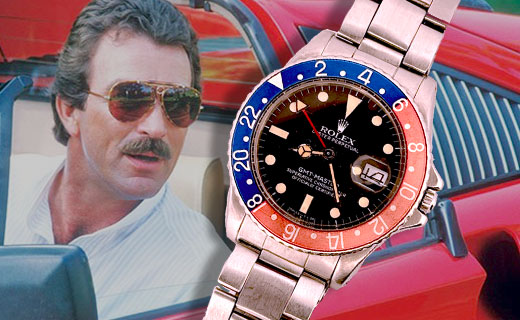
Rolex Oyster Perpetual GMT-Master reference 1675, 1969 example, approximately 40 mm stainless-steel Oyster case with drilled lugs and crown guards, matte black dial with white printing and tritium luminous markers, Mercedes hands and red arrow-tipped GMT hand, central seconds, date at 3 o’clock beneath the Cyclops magnifier, bidirectional rotating 24-hour bezel with red-and-blue “Pepsi” aluminium insert, acrylic crystal, screw-down Twinlock crown, screw-down Oyster caseback, historical water resistance of approximately 50 metres for this generation, Rolex stainless-steel bracelet, Rolex calibre 1575 GMT automatic mechanical movement — derived from the 1570 and sometimes carrying a 1570 bridge engraving — chronometer certified, operating at 19,800 vibrations per hour, 26 jewels, approximately 48-hour power reserve after full winding, non-quickset date and GMT hand coupled to the hour display on this generation, reference 1675 produced from 1959 to 1980, watch inspected and authenticated by the Mostra workshop, accompanied by a Mostra Certificate of Authenticity and covered by Mostra’s 3-year warranty.
“Before Pepsi became a colour, it was a function. Red and blue made a twenty-four-hour day readable at a glance, the additional hand retained the time somewhere else, and the GMT-Master followed people who were beginning to cross the world faster than their watches had previously been designed to do. Then cinema, aviation, astronauts and finally television transformed the instrument into a silhouette. When Magnum stepped out of his red Ferrari beneath the Hawaiian sun in the 1980s with a Pepsi GMT-Master on his wrist, the pilot’s watch also became a popular image. This 1969 1675 belongs to the chapter before that: the watch that had already drawn almost everything audiences would later recognise on Thomas Magnum’s wrist.”
The 1969 Rolex GMT-Master 1675 belongs to the founding age of Rolex professional watches. The first GMT-Master, reference 6542, appeared in 1955 in the context of rapidly expanding intercontinental air travel and Rolex’s historical association with Pan American Airways crews. In 1959, reference 1675 took that idea and gave it the form that would permanently enter the collective imagination: a larger case around 40 mm, crown guards, black dial, additional 24-hour hand and bi-colour rotating bezel. It remained in the catalogue for approximately twenty-one years, an exceptional production run for a professional Rolex, becoming the genuine template for almost every GMT-Master that followed.
On this 1969 example, the matte black dial provides much of the personality. Unlike the glossy and framed dials of modern generations, its surface absorbs more light and allows the white printing, tritium hour markers and hands to take centre stage. Over time, luminous material can evolve towards cream or ivory tones, giving each watch a subtly individual appearance. Such ageing becomes interesting only when it remains coherent across the dial and hands: on a vintage Rolex, age alone never creates quality; collector appeal comes from the harmony with which the different components have travelled through the decades.
The red GMT hand travels around the dial once every twenty-four hours and is read against the red-and-blue Pepsi bezel. On the 1675, this hand is not yet independently adjustable as it would become on the GMT-Master II: it remains coupled to the normal hour display. To follow a second time zone, the traveller therefore turns the bidirectional bezel according to the required offset. It is a more mechanical, almost tactile use of the GMT function: the watch asks the wearer to understand the system rather than merely pulling the crown and moving a hand. That simplicity is now a major part of the charm of the 1675.
The bezel itself became one of the most famous visual signatures in Rolex history. Its red-and-blue aluminium insert, long before “Pepsi” became universal collector vocabulary, visually separates the two halves of the twenty-four-hour scale. Over the decades, aluminium can change through exposure to light and wear, with reds sometimes moving towards raspberry or pink while blues become softer. Unlike contemporary Cerachrom inserts designed for exceptional colour stability, a vintage aluminium bezel physically records part of the life of the watch. Two GMT-Master 1675s that left Geneva with similar colours can tell completely different stories fifty years later.
The approximately 40 mm Oyster case is another reason for the remarkable modernity of the reference. At a time when many late-1960s watches were significantly smaller, the GMT-Master already offered dimensions comparable to a contemporary sports watch, yet with a slimmer case, more slender lugs and a domed acrylic crystal that softens the overall appearance. Drilled lugs make strap changes straightforward and remind us that these watches were conceived as instruments to be maintained and used. The screw-down Twinlock crown and Oyster caseback complete a construction historically rated around 50 metres of water resistance. On a 1969 piece, that figure naturally remains historical: any exposure to water today must depend upon recent testing, and Mostra deliberately adopts a conservative approach with vintage dials and movements.
The acrylic crystal with Cyclops magnifier contributes enormously to the visual character of the 1675. Its reflections are softer than sapphire and its edges can slightly distort the dial when viewed from an angle. It scratches more easily, but it can also be polished, perfectly matching the philosophy of a tool watch created when components were expected to be maintainable. The magnifier above the date already belongs fully to the Rolex identity, but the calendar is not yet quickset: if the watch has stopped for several days, reaching the correct date requires advancing the hands through successive twenty-four-hour cycles. That small ritual immediately reminds the wearer that this is a vintage GMT-Master rather than a modern watch recreating its appearance.
Beneath the caseback works the Rolex calibre 1575 GMT, an automatic movement developed from the 1570 family. On certain examples, the bridge may in fact be engraved “1570” without calling the GMT configuration into question. It operates at 19,800 vibrations per hour, contains 26 jewels and provides approximately 48 hours of power reserve after full winding. It is chronometer certified and uses a mechanical architecture designed for robustness and stable performance. The 1969 production year predates the general introduction of hacking seconds to this movement family in the early 1970s, so that feature should not automatically be attributed to early calibre-1575 GMT watches. The date is not quickset and the 24-hour hand is not independent: mechanically, this watch belongs completely to the original GMT-Master philosophy.
This is precisely what distinguishes a GMT-Master from a modern GMT-Master II. Today, we are accustomed to moving the local hour hand independently in jumps while retaining a home-time reference. On the 1675, the logic is more elementary: the twelve-hour display and twenty-four-hour hand operate together, and the bezel is used to display the second zone. It perfectly reflects its era, when long-haul crews primarily wanted to retain a reference to home time or GMT while travelling. The watch did not attempt to show the greatest possible number of time zones; it aimed to solve clearly a new problem created by modern aviation.
And this is where history meets popular culture. In the emblematic 1980s television series Magnum P.I., Tom Selleck played Thomas Magnum with a silhouette that became instantly recognisable: Hawaiian shirts, Detroit Tigers cap, red Ferrari 308, Hawaiian scenery and a Rolex GMT-Master Pepsi on his wrist. Other watches appeared during the early seasons, before the Pepsi became one of the accessories most strongly associated with the character. The watch now identified in screen images is a 16750, launched in 1980 and directly descended from the 1675. Visually, however, it continued almost seamlessly the language established by its predecessor: steel case, black dial, red GMT hand and red-and-blue bezel.
That distinction actually makes the story even more meaningful for a 1969 1675. Magnum did not create the GMT-Master Pepsi; he introduced its already established silhouette to a vast television audience more than twenty years after the 1675 had defined it. For millions of viewers, the red-and-blue bezel ceased to be merely the code of a pilot’s instrument and became associated with Hawaiian sunlight, adventure, travel and the relaxed elegance of the 1980s. Tom Selleck would keep his GMT after the series, reflecting the personal attachment he had developed to it. Television did not invent the icon; it gave the icon a face.
The 1675 had already built a formidable legend before Magnum. Pilots, travellers and personalities from very different worlds had worn the model during an era fascinated by aviation and the conquest of space. Its long production period between 1959 and 1980 generated numerous evolutions in dials, hands, crown guards, inserts and bracelets, turning the reference today into a field of collecting in its own right. A 1675 should therefore never be bought simply because “it is a Pepsi”: the production year, dial type, coherence of the tritium, bezel, case, bracelet and movement must all be read together.
It is also remarkably easy to wear today. Its approximately 40 mm diameter feels entirely contemporary, yet its slimmer architecture and acrylic crystal give it far less visual mass than a current GMT-Master II. The black dial works with almost any clothing while the Pepsi bezel adds just enough colour to prevent the watch from becoming austere. On a steel bracelet it naturally retains its travel-watch character; on leather or NATO it instantly becomes more casual. A shirt, jacket, denim or outerwear are enough: the 1675 possesses that rare quality of the greatest professional watches — historically distinctive without ever becoming difficult to wear.
Choosing this 1969 Rolex GMT-Master 1675 Pepsi from Mostra means benefiting from more than forty years of experience in collectible watches, our highly regarded integrated watchmaking workshop in Aix-en-Provence and one of the largest selections of high-end pre-owned watches in the South of France. Assessing a 1675 requires a very different approach from examining a modern Rolex: case and lug geometry, crown guards, matte dial, tritium, hands, aluminium insert, acrylic crystal, Cyclops, crown, bracelet and overall coherence are all studied. The calibre 1575 GMT is checked for rate, amplitude, automatic winding, power reserve and correct operation of the date and GMT display.
Mostra’s verified customer reviews carry a 5-star rating, reflecting a relationship built upon knowledge of vintage watches, transparency regarding condition and long-term after-sales support. The watch is accompanied by a Mostra Certificate of Authenticity and covered by our 3-year warranty, with continued support from our workshop in Aix-en-Provence. With a watch of this generation, our role is as much to preserve what time has made interesting as to guarantee what must function correctly: excessive restoration can erase in a few hours what several decades have created. The 1969 Rolex GMT-Master 1675 Pepsi ultimately captures the complete story of a great travel watch: born from aviation, shaped by two decades of evolution, transformed into one of the defining Rolex designs of the twentieth century and later extended into popular culture by the Pepsi GMT-Master worn by Tom Selleck in Magnum P.I. The Ferrari, Hawaiian shirts and Oahu sunshine belong to the 1980s; this 1675 predates them by more than a decade. And that is precisely its strength: by the time Magnum made the Pepsi recognisable in living rooms around the world, the 1675 had already drawn the shape of the legend.
You will also like
-
-
-
-
-
-
-
-


