


Omega
speedmaster panda apollo 11 - with original box
| Case | Steel |
|---|---|
| Diameter | 42 mm |
| Strap | Steel Strap |
| Movement | Hand-wound |
|---|---|
| Caliber | Omega c-1861 |
| Content | Mostra case |
-
Diameter42 mm
-
MovementHand-wound
-
CaseSteel
-
StrapSteel Strap
-
ContentMostra case
-
GenderMan
-
Gender for GoogleMan
-
AgeAdult
-
WaterproofingWaterproof
-
Year2004
-
ModelSpeedmaster Professional Limited Edition
-
Versionwith original box
-
Manufacturer reference3569.31.00
-
Certificate of authenticityYes
-
Mostra referenceMS0319001
-
CaliberOmega c-1861
-
Number of rubies18
-
Glass typePlexiglass
-
DialBlanc Nasa indication date de l'alunissage (Panda Dial)
-
LoopDéployante d'origine
-
Strap typeAcier
-
Strap colorAcier
-
SpecificitiesChronographe trois compteurs, Lunette tachymétrique, deux poussoirs
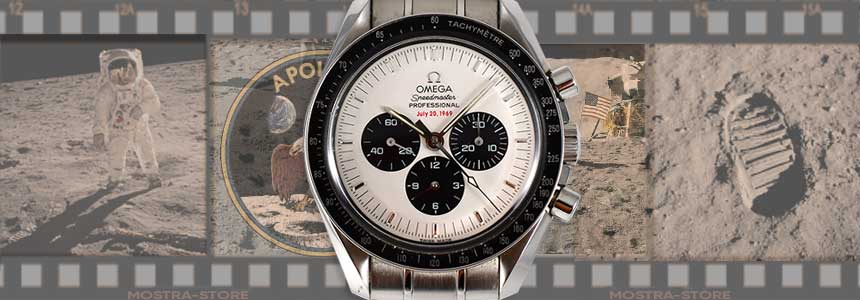
Omega Speedmaster Professional Apollo XI chronograph with panda dial, a rare collector’s chronograph released by Omega in 2004 to commemorate the Moon landing of NASA’s Apollo 11 mission. This legendary and most iconic NASA mission, with Neil Armstrong and Buzz Aldrin as pilot and co-pilot of the Lunar Module, marked humanity’s first steps on the Moon on July 21, 1969, at 2:56 AM UTC. A reference time in lunar hours, corresponding to July 20, 1969, at 8:17 PM and 40 seconds UTC. This heroic act remains engraved in history, placing these three men (with astronaut Michael Collins remaining in the Apollo capsule in lunar orbit) in the pantheon of great explorers. This watch is thus one of the most sought-after limited editions, alongside the other "Limited Edition" models of the Gemini and Apollo Missions series. Released for a very short time in 2004, only 3,500 pieces of this edition were sold within days due to its historical and aesthetic uniqueness. An essential tool for pilots, this watch symbolizes the technicality and precision required in their profession. At the start of the U.S. space program, Pre-Moon Speedmasters were commonly worn by test pilots and "Astronauts" selected in the space race; some also wore their personal favorites like the Bulova Astronaut or the Breitling Navitimer (Scott Carpenter’s choice) or the Glycine Airman Pilot Watch.
This watch belongs to the lineage of NASA Moonwatch Special Editions issued by Omega to honor space exploration. Given the testimonial nature of the event it celebrates, its historical context, the unique “Panda” dial design unlike traditional Moonwatches, and its exceptional condition, it is of outstanding interest to collectors.
A steel collector's chronograph with a 42 mm screw-down caseback, water-resistant to 5 ATM, featuring an exclusive Apollo 11 “Eagle has Landed” engraving on the caseback.
Manual-winding mechanical movement, Omega caliber 1861 with luxury rhodium finish. This movement underwent numerous reliability tests by NASA to select the timepiece worn by astronauts of the Mercury, Gemini, Apollo, Skylab, and Space Shuttle programs. To withstand shocks and accelerations during takeoff and orbit insertion, it was equipped with a "Delrin" brake — a material that protects it from magnetic interference, humidity, solvents, and chemicals, offering rigidity, endurance, and stability in zero gravity. Starting in 1994, to reduce movement weight, the gold finish was replaced with rhodium, and an additional ruby was added to the chronograph wheel, bringing the total to 18 rubies — allowing the chronograph to run continuously without harming the mechanism.
The movement operates at 21,600 vibrations per hour, delivered by a flat "Glucydur" hairspring — that’s 6 beats of the central “Flat second” hand per second. Developed by Omega based on the Lemania 1873, one of its notable features is the “hacking seconds” or stop-second function enabled by turning the hands counterclockwise. This very useful time-setting function in navigation, especially critical during space flight, allows synchronization to the exact second by halting the movement and aligning the hands with an instrument or reference time signal.
The cam-operated chronograph features three totalizer subdials and a "Stop & Go" mechanism — starting with the pusher at 2 o’clock, stopping with the lower pusher, resuming with the upper pusher, or resetting with the lower one. The tri-compax layout allows timing up to 12 hours, 59 minutes, and 59 seconds: a running small seconds subdial on the left, a 30-minute counter on the right, and a 12-hour navigation counter at 6 o’clock, all set against a black background.
Finally, this movement is responsive from the first turn of the crown and, once fully wound (around 20 turns of the crown), offers a power reserve of 42 hours.
Panda dial with white NASA-style background and GMT lunar landing time in red above the central axis. Central “Flat second” hand and baton-style hour and minute hands with Luminova inserts in steel. Fixed tachymeter bezel of type B5-dot Beneath 70-Style 1 surrounds the Plexiglas crystal. The three auxiliary counters for hours, minutes, and seconds are in matte black “Moonwatch” style.
The Speedmaster chronograph is a casual and sporty watch suitable for multiple uses: aviation, motor racing, sailing. Its functionality and vintage-chic aesthetic have made it a regular presence in film and television. This particular edition, with its classic lines, also suits a more elegant setting.
You can find an article retracing the history of the Speedmaster at the following link, and another article on the history of Omega and its Speedmasters on our “Watch Stories” page.
Discover the history of watch brands and their models on our Watch Stories page
You will also like
-
-
-
-
-
-
-
-


