


Omega
speedmaster mk-2 urgences - pulsometre bezel
| Case | Steel |
|---|---|
| Diameter | 42 mm |
| Strap | Steel Strap |
| Movement | Hand-wound |
|---|---|
| Caliber | Omega c-861 |
| Content | Mostra Travel Pouch |
-
Diameter42 mm
-
MovementHand-wound
-
CaseSteel
-
StrapSteel Strap
-
ContentMostra Travel Pouch
-
GenderMan
-
Gender for GoogleMan
-
AgeAdult
-
WaterproofingNot waterproof
-
Year1969
-
ModelCalibre 861
-
Versionpulsometre bezel
-
Manufacturer reference145.014.3
-
Certificate of authenticityYes
-
Mostra referenceMT0118024
-
CaliberOmega c-861
-
Number of rubies17
-
Lug Width (mm)20 mm
-
Glass typeMineral
-
DialTri-compax à lunette pulsomètre
-
LoopBoucle déployante d'origine
-
Strap typeBracelet d'origine
-
Mini Bracelet Length (cm)14 cms
-
Maxi Bracelet Length (cm)25 cms
-
Strap colorAcier
-
SpecificitiesRare cadran pulsometre bezel, bracelet grande taille avec tous ses maillons
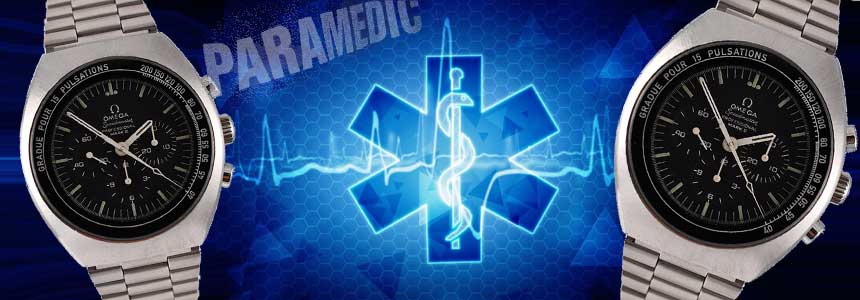
Omega Speedmaster MK II Pulsometer Chronograph, Emergency version circa 1969 – a vintage 1970s timepiece powered by a manual-winding mechanical movement with a rare dial featuring a 15-second pulsometer bezel. This model became a favorite among medical professionals of the time and can be seen worn by the iconic Dr. Ross, played by George Clooney, in several episodes of the 1990s TV series *ER*.
This vintage 42 mm stainless steel watch features a black tritium dial with three subdials, a minute track, and white painted inscriptions. The tonneau-shaped case has a screw-down back, softened contours, and comes with its original adjustable bracelet, complete with all removable links. Inside, it houses the Omega Calibre 861 stop-seconds movement with 17 jewels — a robust and high-performance analog movement designed in 1968, based on the upgraded Lemania 1873 calibre. It beats at 21,600 vibrations per hour and offers a 40-hour power reserve.
This tri-compax chronograph is a 1970s reimagining of the legendary Speedmaster Moonwatch worn by NASA astronauts. Thanks to its C-861 calibre, it retains all the functions of its predecessor, but with a fixed pulsometer bezel, making it especially useful for healthcare professionals. Its proven reliability and more accessible winding mechanism (compared to the standard round Speedmaster) enhance its usability. This improvement is due to the innovative case design that allows direct finger access to the crown—ideal for users wearing gloves.
Thanks to its water resistance and modern lines, this watch earned a place of honor in various professional fields. It was widely adopted by government rescue services, and Omega actively promoted this use in the early 1970s. Released in five specialized versions with distinct bezels — Yachting (nautical sports), Tachymeter (motorsports), Telemeter (military and outdoor), Decimal (industry and finance), and Pulsometer (medical and paramedical) — this chronograph was seen on the wrists of countless race drivers, sailors, trainers, traders, soldiers, and healthcare professionals. Its predecessor's fame during the space odyssey helped the MK II gain immediate media attention and public esteem when launched in 1967.
The Omega Speedmaster MK II Pulsometer chronograph features three totalizers: 30-minute counter on the right, 12-hour counter at the bottom, and small seconds on the left. It has a central sweeping seconds hand and stick-shaped hour and minute hands. Chronograph operation is classic: start via the upper pusher, stop with the same, and reset using the lower pusher. It features stop-seconds (hacking) functionality via the pulled-out crown for synchronization with another watch or time signal.
This model emerged just as Japanese quartz watches began to appear, in a world eager for a new era and broader horizons. Pop-art designers were shaking up the 1960s, paving the way for new functions and aesthetic languages. The birth of “space-art” brought psychedelic visuals and colorful, creative lifestyles. Softer forms and a focus on usability became widespread — think egg chairs and the AMC Pacer X. The Speedmaster Mark II was one of Swiss watchmaking’s most notable responses to this cultural shift. With its "space age" 70s-style steel case, this fashionable design fit perfectly within the Pop Art ambiance of the time. It was even considered a trendy choice, worn by avant-garde fashion designers such as Yves Saint Laurent and Paco Rabanne.
Thanks to its success, the MK II would eventually be released in five distinct evolutions. The final version, the Speedmaster 4.5 (or “Four-Ever”) launched in 1975, would mark the end of this successful series — just before Omega shifted its focus to quartz by the decade’s end...
You will also like
-
-
-
-
-
-
-
-


