Rolex 6424: the origin of the Explorer, Airking, and Pro range.
Looking back on a historical transition
In the 1950s, Rolex faced a shift in perception. The 6424 model marked a turning point — a discreet but key evolution towards tool watches designed for explorers, professionals, and adventurers. From this reference would grow some of the brand’s most iconic lines: Explorer, Air-King, GMT Master, and Daytona.
A turning point for Rolex
At the beginning of the 1950s, Rolex offered a refined and opulent Oyster range, suited to a bourgeois lifestyle. But the symbols of luxury had lost their relevance in a post-war world undergoing reconstruction. Rolex’s image faded, its sales stagnated, and unlike rivals like Breitling, Longines, Omega, and Waltham — whose military production during WWII brought them prestige — Rolex was at a crossroads.
These competitors had modernized their production lines and could now create a wide range of watches for professional use, with various technical specifications. Rolex needed to adapt or risk falling behind.

The rise of the adventurer spirit
After the war, the perception of the watch shifted. No longer just a luxury item, it had become a symbol of identity — much like a uniform. The difficult reconstruction years gave rise to the romantic image of the adventurer pushing human limits.
Wartime innovations in transportation also played a role: planes, cars, and boats became more accessible. Air travel went transcontinental. Submarine warfare revealed a hidden world under the sea. Veterans' tales described distant horizons. Rolex understood that watches now needed to reflect these new desires for discovery and adapted its range accordingly.
From urban chic to utility: a quiet evolution
True to the Swiss motto “evolution is better than revolution,” Rolex transitioned from the urban Oyster Datejust to a more versatile tool model. It didn’t break with tradition — it refined it.
A new movement: Caliber 1012
As is often the case in watchmaking, change began with the movement. Rolex developed the compact Caliber 1012, with a double anti-shock system and a robust 17-jewel construction that was easy to maintain. This reliable foundation would power future icons: the Explorer, Air-King, GMT Master — and eventually, the legendary Rolex Daytona.
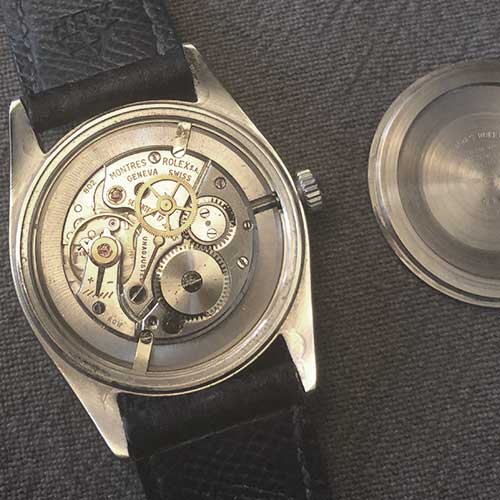
Rolex 6424: the transitional model
Rolex Precision 6424 served as the bridge. The case was distinctive — larger than most Oysters at 36 mm (versus 34 mm), with 20 mm lug width and a screw-down crown without crown guards (similar to later Explorers). It had undrilled lugs (as seen on modern Rolexes), and a vanilla-colored dial featuring the crown logo at 12 o'clock.
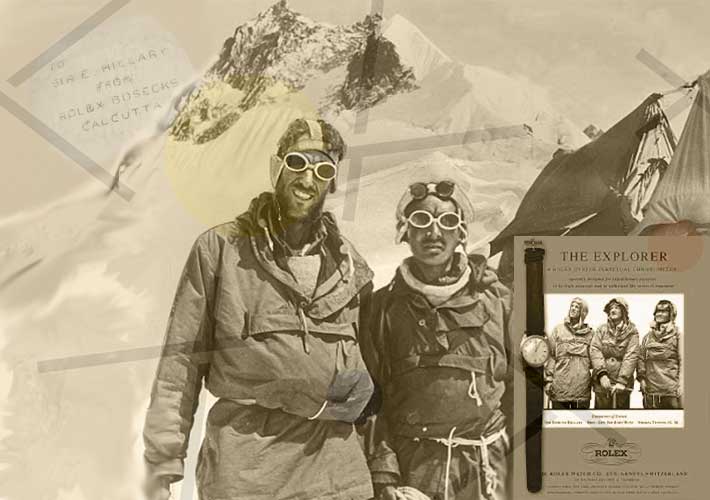
This dial mirrored that of a prototype never marketed but worn by Edmund Hillary during his 1953 ascent of Mount Everest. Notably, the indication “Swiss” appears under the minute track at the bottom of the dial.
Elegance meets utility
Despite its larger dimensions, the 6424 remained thin and elegant. A wider strap gave it a robust presence, without losing the refinement of the Oyster Precision. It was — and still is — a successful mix: stylish, versatile, and ready for adventure.
The legacy of a discreet pioneer
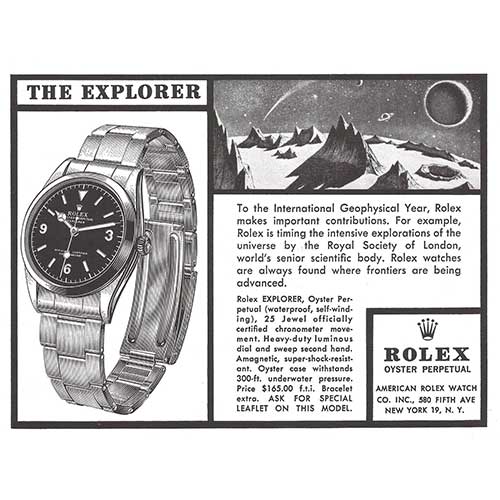
This transitional model, produced in limited quantities, laid the groundwork for Rolex’s future icons. After the Submariner, Explorer, and Air-King came the GMT Master and the Daytona — all inspired, directly or indirectly, by the unique philosophy of the Rolex Oyster Precision 6424. A reference often overlooked, yet crucial to the brand’s identity.
Share this content