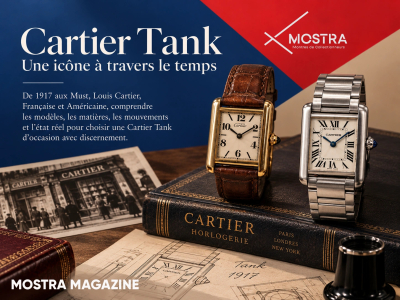
The return of small jewellery watches (cocktail watches): how to wear them in 2026
Long seen as a formal accessory or a “jewel from the past”, the cocktail watch is making a noticeable comeback in 2026. Small, precious, sometimes set with stones and often effortlessly elegant, it is once again claiming its place as a true style object...
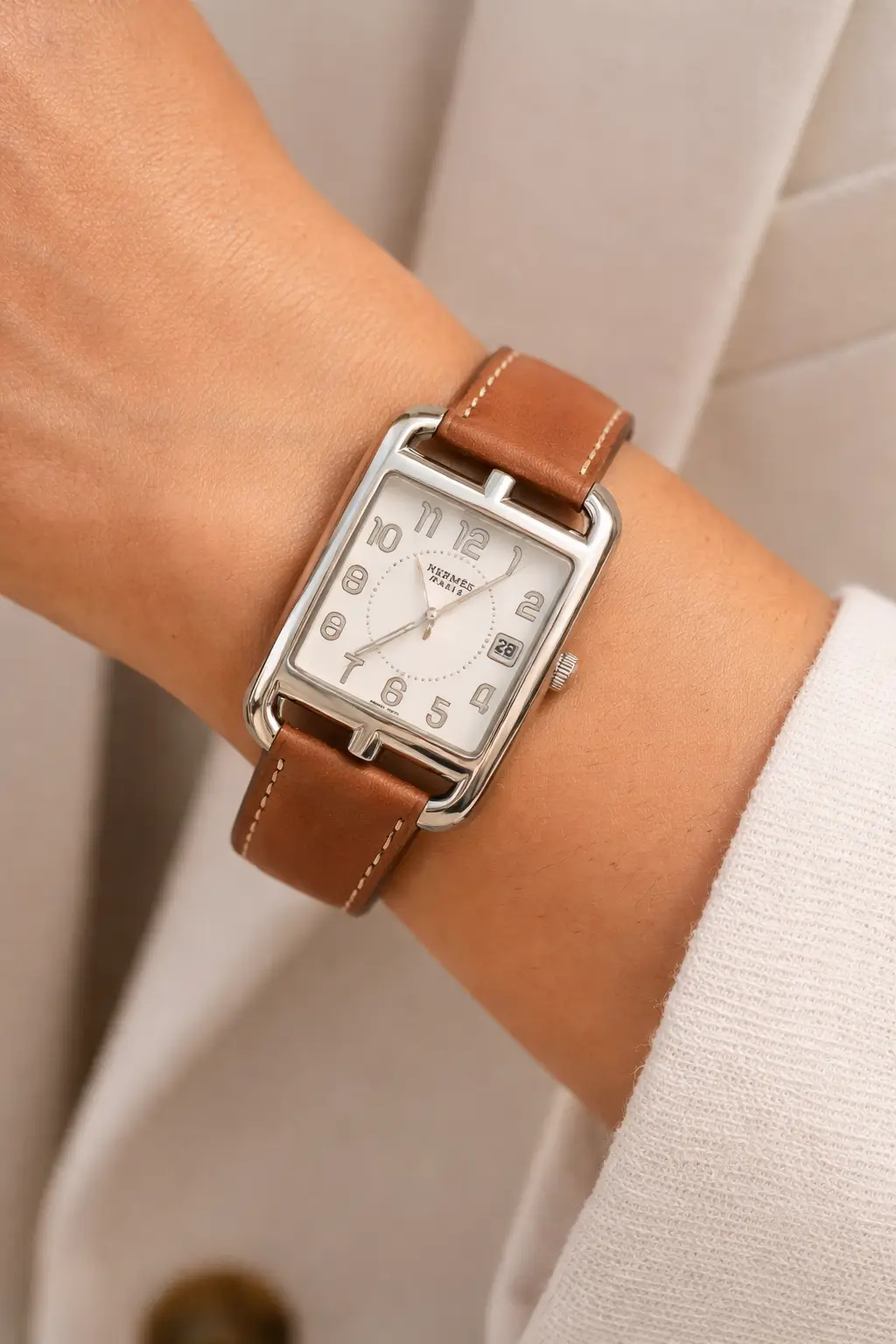
Long seen as a formal accessory or a “jewel from the past”, the cocktail watch is making a noticeable comeback in 2026. Small, precious, sometimes set with stones and often effortlessly elegant, it is once again claiming its place as a true style object, far beyond the simple function of telling time. In a context where fashion values self-expression more than technical performance, the jewelry watch is back at the center of women’s wrists.
This revival is no accident. It sits at the crossroads of two trends: on the one hand, the return of smaller case sizes, oval or square shapes and integrated bracelets; on the other, a growing interest in pre-owned and vintage watches, which are often the only way to access this richness of styles, proportions and jewelry-like details that have become rare in modern collections.
But what exactly is a cocktail watch? Where does the term come from, and why is this aesthetic so appealing in 2026? Before explaining how to wear one and how to choose the right pre-owned piece, it’s essential to set the foundation.
Cocktail watch: what are we really talking about?
A definition between watchmaking and jewelry
The cocktail watch, sometimes called a jewelry watch or a jeweled watch, originally refers to a women’s watch designed first and foremost as an elegant accessory. Emerging in the early 20th century and widely popular from the 1920s to the 1960s, it is defined by an aesthetic approach in which design matters more than visible technicality.
Unlike sports or utilitarian watches, the cocktail watch typically stands out through:
-
a small case, often under 34 mm,
-
unconventional shapes (oval, rectangular, cushion, asymmetric),
-
a refined bracelet (chain, bangle, cuff, metal ribbon),
-
and sometimes gem-setting, either subtle or more expressive.
In many cases, the dial itself becomes secondary: it can be minimalist, almost hidden, or even integrated into a piece of jewelry. The watch isn’t trying to assert itself as a tool, but as a style statement.
Why cocktail watches are back in a big way in 2026
The return of jewelry watches is part of a broader shift that has been visible in fashion and watchmaking for several seasons. After years dominated by large, sporty watches, the codes are moving toward more restraint, a confident femininity and greater stylistic freedom.
Several factors explain this renewed interest:
-
the rise of quiet luxury, where subtle details replace overt display,
-
a taste for timeless pieces, often sourced vintage or passed down,
-
and the desire to wear a watch the way one would wear jewelry, regardless of technical trends.
In 2026, the cocktail watch is no longer reserved for special occasions. It’s worn day to day, paired with modern silhouettes, and becomes part of a personal style approach, far from traditional watch-world “rules”.
The essential design codes of the jewelry watch
While every cocktail watch has its own identity, certain constants appear again and again. In particular:
-
slim, small cases that naturally follow the wrist,
-
integrated bracelets that blur the line between watch and jewelry,
-
luminous materials (gold, polished steel, two-tone),
-
and a constant search for balance between elegance and simplicity.
This is precisely what makes the cocktail watch such a perfect playground for pre-owned and vintage pieces, where past creations offer a diversity that is now difficult to find in contemporary collections.
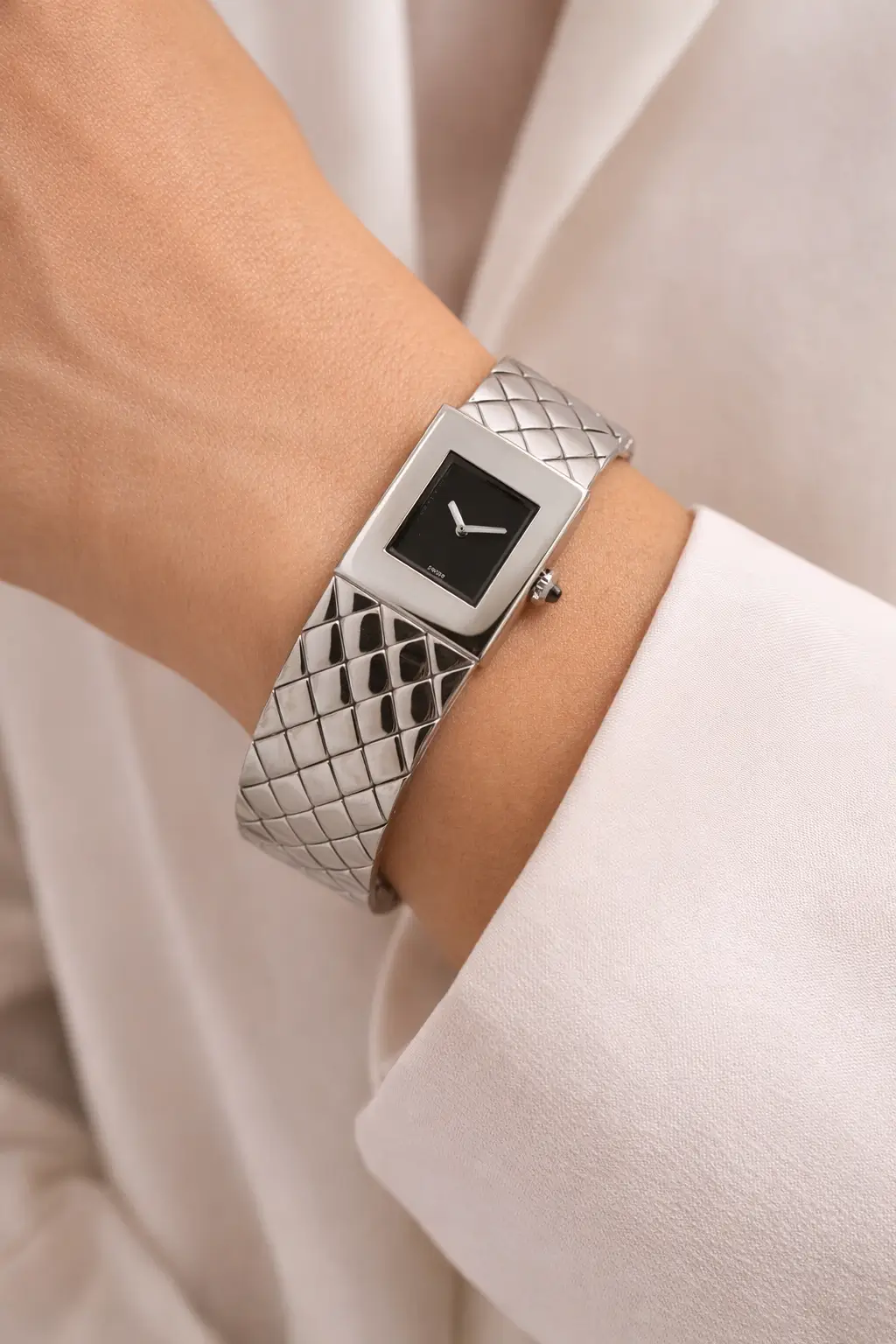
Why smaller sizes are becoming desirable again
For a long time, a watch’s size was associated with modernity or even horological legitimacy. Large cases—often over 40 mm—became the standard, including in women’s collections. In 2026, that logic is clearly being challenged. Smaller diameters are no longer seen as dated or fragile, but as a deliberate aesthetic choice.
Comfort and proportions: what a small diameter really changes
Wearing a 29, 31 or 34 mm watch is far from insignificant. On a woman’s wrist, these dimensions often create a natural balance that larger sizes struggle to achieve. The watch integrates visually with the wrist instead of dominating it, which reinforces a sense of refinement and elegance.
In everyday life, the benefits are tangible:
-
a lighter watch that you quickly forget you’re wearing,
-
better stability on the wrist,
-
improved compatibility with fitted sleeves, bracelets or nearby jewelry.
These proportions also allow the watch to fully play its role as a styling detail, without pulling too much attention.
The return of “bracelet first”: the watch as jewelry above all
One of the major shifts of recent years is the way watches are designed and worn. In 2026, you no longer choose a watch only for its dial or movement, but for the overall line it draws on the wrist.
This is the “bracelet first” approach:
-
the bracelet becomes a central design element,
-
the watch can read like an articulated jewel,
-
the case fades in favor of the overall silhouette.
This naturally favors smaller watches, whose proportions work better with integrated bracelets, rigid bangles or finely crafted chains. It’s also one of the reasons why vintage and pre-owned watches are so appealing: they were created in an era when the boundary between watch and jewelry was far more fluid.
Small sizes and modernity: a question of style, not era
Contrary to common assumptions, wearing a small watch doesn’t mean adopting a fixed retro look. Quite the opposite. Paired with contemporary clothing, a small-diameter watch often creates an elegant contrast that strengthens the modern feel of an outfit.
That is exactly what appeals in 2026: a discreet, almost precious watch, worn confidently across contexts, from the office to the evening. Small size becomes a marker of taste rather than a simple legacy of the past.
Quick size guide: finding the right balance
To avoid guesswork, here are a few simple reference points to choose the right jewelry watch size:
Slim wrist (under 15 cm)
Recommended diameter: 26 to 30 mm
Visual effect: very elegant, clearly jewelry-like, ideal for classic cocktail watches.
Average wrist (15 to 17 cm)
Recommended diameter: 30 to 34 mm
Visual effect: perfect balance between legibility and finesse, the most versatile choice.
Wider wrist or bold style
Recommended diameter: up to 36 mm
Visual effect: more presence while remaining refined, often perceived as “unisex”.
These are not strict rules, but useful starting points. With jewelry watches, case shape and bracelet design matter just as much as the stated diameter.
How to wear a jewelry watch in 2026: 7 looks that actually work
One of the biggest shifts behind the return of cocktail watches is that they are no longer confined to formal settings. In 2026, the jewelry watch isn’t limited to dressed-up evenings or special occasions. It blends into a wide range of looks—sometimes very contemporary—and becomes a real tool for personal expression.
Here are seven ways to wear it with precision, without going overboard.
Look 1: minimalism and quiet luxury
With a clean outfit—white shirt, fine knit, well-cut trousers—the jewelry watch acts as a discreet point of light. The goal is not to grab attention instantly, but to add a subtle touch of refinement.
A small oval or rectangular watch on a slim metal bracelet or smooth leather strap fits perfectly here. It highlights the wrist without ever weighing down the silhouette.
Look 2: feminine power dressing
Paired with a suit or a structured jacket, the cocktail watch creates an appealing contrast between structure and delicacy. Where a sports watch would reinforce strictness, a jewelry watch brings controlled softness.
This works especially well with small watches that still have visual presence: a gold-toned case, a crafted bracelet, confident lines. The watch becomes a style element that asserts personality without breaking the balance.
Look 3: eveningwear and the “cocktail” spirit, obviously
In a more dressed-up context, the cocktail watch naturally returns to its original territory. Worn with a dress, an elegant jumpsuit or an evening outfit, it can replace a classic bracelet beautifully.
Here, you can allow yourself more boldness: a bangle bracelet, a cuff watch, fine gem-setting or sculptural shapes. The watch is no longer just an accessory, but the jewelry piece that structures the wrist.
Look 4: everyday casual chic
This is probably one of the most interesting uses in 2026. A jewelry watch worn with jeans, a sweater or a relaxed outfit creates an elegant twist that feels very current.
That contrast adds character without effort. A small vintage watch with timeless design can transform a simple silhouette into a polished, personal look.
Look 5: controlled stacking (watch + bracelets)
Stacking—layering watches and bracelets—has become common, but it needs a few rules to remain elegant.
A few simple principles:
-
avoid multiplying chunky volumes,
-
stay consistent with metals (gold with gold, steel with steel, or an intentional two-tone mix),
-
let the watch breathe: it should remain readable and identifiable.
A jewelry watch works best as the central piece, surrounded by finer bracelets, rather than lost in excessive accumulation.
Look 6: mixing vintage and modern
Pairing a vintage cocktail watch with contemporary elements is one of the most successful style signatures. A modern bag, current shoes, minimalist jewelry… the watch brings historical depth and a singular charm to the overall look.
That conversation between past and present creates the impression of a thoughtful style, far from short-lived trends.
Look 7: playing with colors and textures
In 2026, warm tones and luminous materials are replacing overly sharp contrasts. A jewelry watch with a champagne, ivory or brown dial, paired with clothing in natural textures, creates a very current harmony.
In this register, the watch doesn’t just tell time: it becomes part of the outfit’s aesthetic palette.
Iconic models (and their alternatives) to look for pre-owned or vintage
When we talk about cocktail watches in 2026, we rarely mean a “watch” in the strict sense. We mean a style object that lives on the wrist like jewelry: a line, a shine, a balance between proportions and details. And that is exactly what pre-owned and vintage pieces offer more easily than new watches: oval shapes, slim cases, integrated bracelets, silhouettes designed for elegance.
For this aesthetic, a handful of references clearly dominate, because they have that rare ability to be iconic, easy to wear, and instantly recognizable—without ever being too much.
Cartier Baignoire: the perfect oval, between jewelry and signature
The Cartier Baignoire is probably the watch that best embodies the return of jewelry watches. Its oval shape isn’t trying to “look like a watch”: it draws a silhouette first—almost a curve—that catches the light and elongates the wrist. It’s one of those pieces that feel obvious with a minimalist outfit, yet become striking in the evening simply because their presence is naturally elegant.
In 2026, the Baignoire works especially well in two registers. First, quiet luxury: white shirt, blazer, fine knit… and that small gold or steel oval that says everything without trying too hard. Second, the fully embraced jewelry watch, worn as a central piece, alone on the wrist, with a dress or a very pared-back outfit.
What makes pre-owned particularly appealing here is the range of looks: some versions feel more like a dress watch, others more jewelry-driven depending on the bracelet and the balance between case and lugs. And that is exactly what you want from a cocktail watch: character, a distinct line, and a unique way of sitting on the wrist.
Cartier Panthère: “bracelet first” elegance, incredibly wearable
If the Baignoire is a silhouette, the Cartier Panthère is a motion. On the wrist, you feel it as much as you see it: the fluidity of the links, the light on the metal, immediate comfort. It’s one of the best examples of the “bracelet first” return we talked about: the watch reads like an articulated jewel, which explains why it moves so easily across styles.
In 2026, the Panthère is perfect for anyone who wants a jewelry watch without having to think about it. It works at the office, on weekends, and at night. Where some cocktail watches can feel “occasion-only”, it stays easy to live with, while keeping that jewelry twist that makes the difference.
Stylistically, it’s formidable with a suit (instant chic), but also with jeans and a sweater: that casual + jewel contrast is one of the most modern combinations. It’s also a watch that stands on its own: it doesn’t need to be “helped” by bracelets—it already fulfills its role.
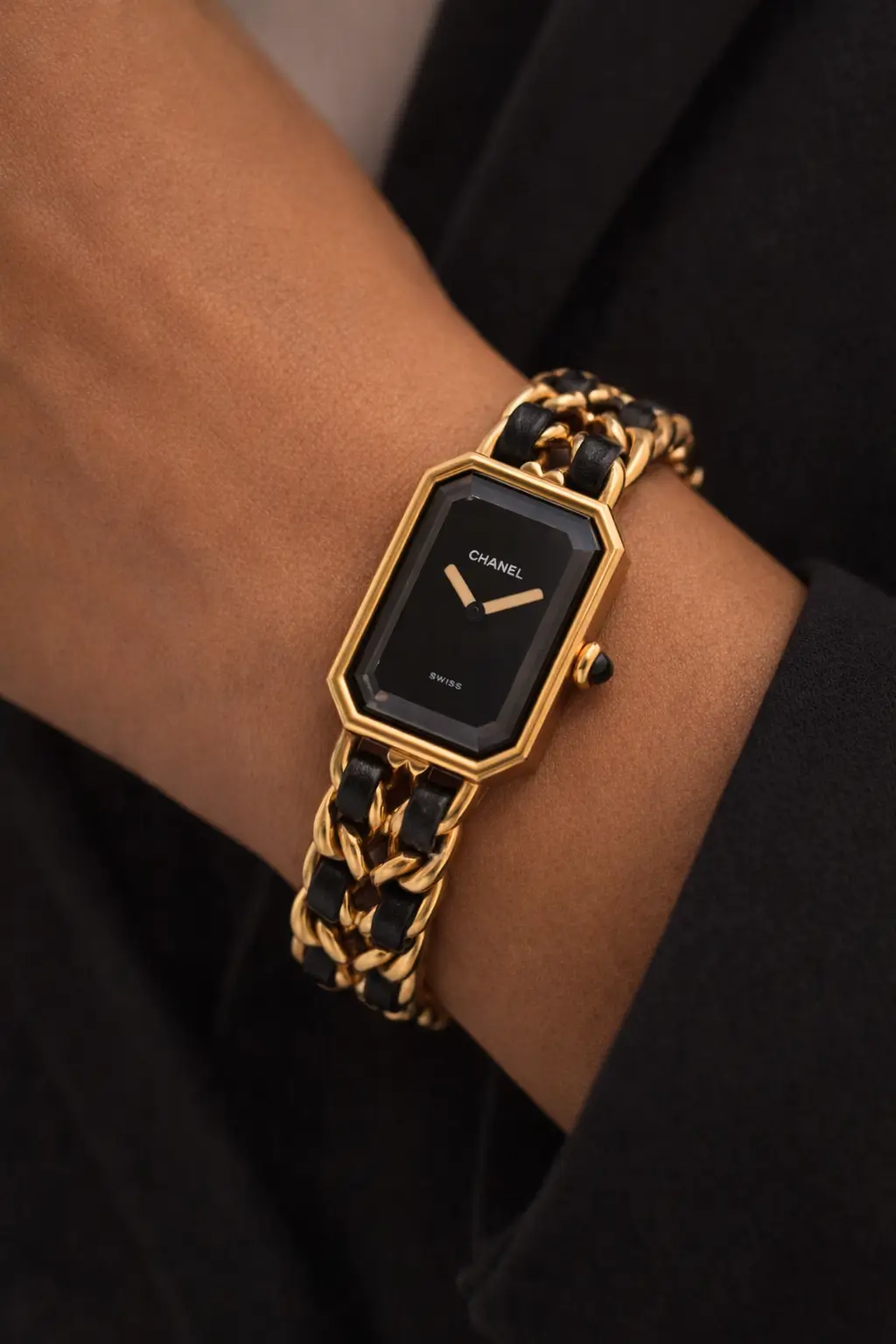
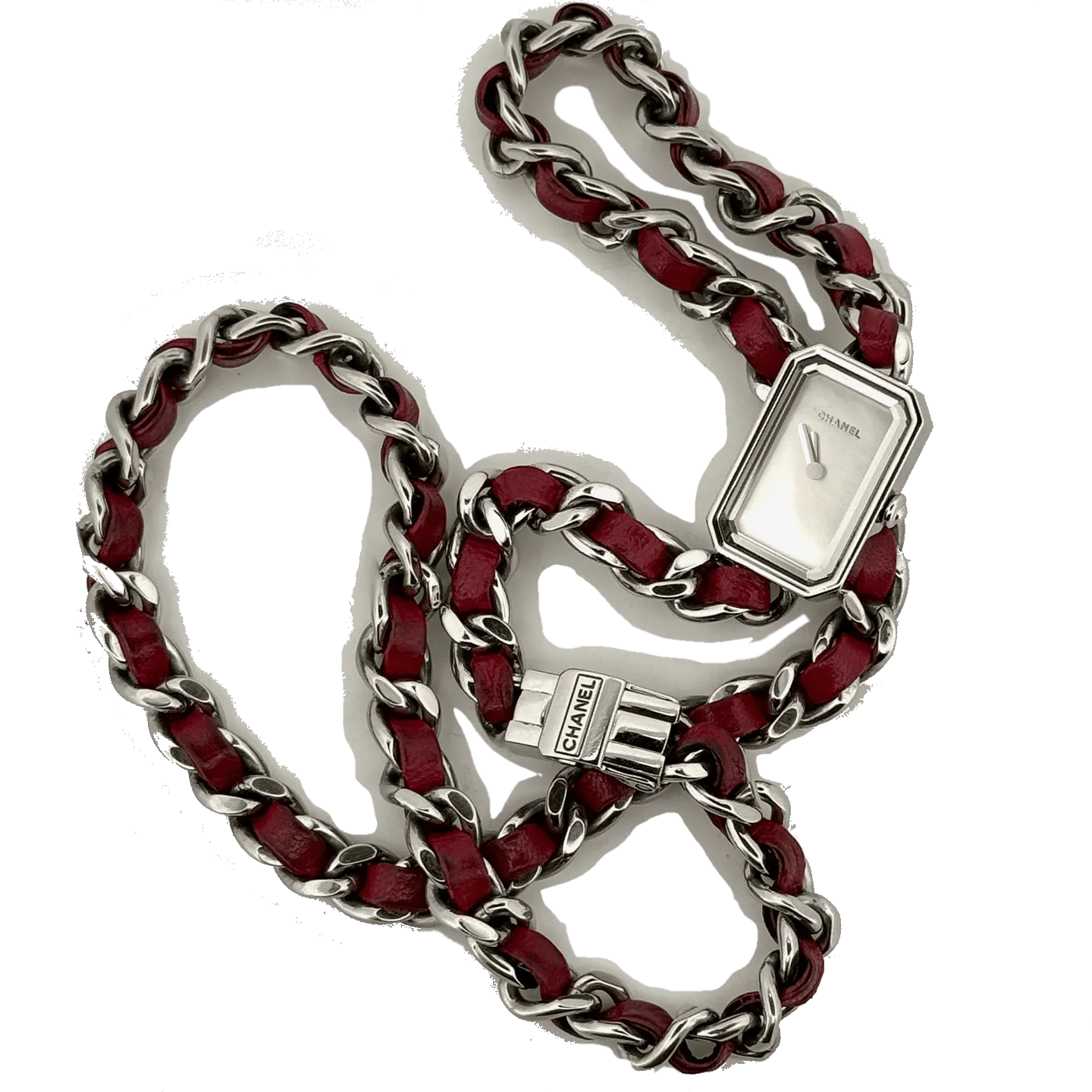
Chanel Première: the couture watch that replaces a bracelet
The Chanel Première plays a different tune. Where Cartier often builds its identity through watchmaking lines, Chanel brings a more fashion-led, couture reading: the graphic case, the chain reminiscent of an iconic bag, the almost instinctive “jewel” attitude. It’s a cocktail watch in the modern sense: it doesn’t try to be sporty, it doesn’t try to be technical, it fully embraces its role as a premium accessory.
In 2026, it’s typically the model that elevates a monochrome silhouette: black, white, cream, grey… and that chain becomes the visual accent. It also pairs beautifully with fine jewelry—rings, small hoops—because it already gives structure to the wrist. In the evening, it can even replace a statement bracelet: the effect is clean, elegant, and “just right”.
And this is where pre-owned makes perfect sense: you can find size variations, different chain finishes, and above all that light patina that makes the watch feel more alive than a piece that’s too new, too perfect.
Hermès Cape Cod: the “smart” jewelry watch, and the double tour option
The Hermès Cape Cod is less jewelry-like in the classic sense, but it checks the boxes of the 2026 cocktail watch perfectly: recognizable design, discreet elegance, and above all the ability to become jewelry thanks to the strap. In the Hermès universe, the watch is often an extension of leather and style, and the Cape Cod is a great example.
What makes it especially relevant in an article about jewelry watches is the double tour version: the strap literally does the styling. With a simple outfit, it dresses the wrist like several bracelets at once, while keeping perfect visual coherence. It’s exactly the kind of watch you wear “without trying”, yet it still looks considered.
With a shirt and slightly rolled-up sleeves, the result is instantly chic. And as a day-to-day jewelry watch, it’s one of the easiest: no need to accumulate, no need to add more.
A more accessible cocktail watch… without losing the spirit?
Not all jewelry watches are heavily jeweled or signed by the most obvious maisons. In vintage, you can also find pieces that capture the essential codes—slim case, small size, elegant lines, discreet bracelet—and offer excellent style-for-money value.
The best approach is to look for a watch that “reads like jewelry” through balance rather than showiness: a clean dial, a slightly oval or rectangular shape, genuine finesse on the wrist, and a bracelet that sits just right. In this segment, the magic often comes from details: proportions, patina, and overall coherence.
Buying guide: choosing a pre-owned cocktail watch without mistakes
Buying a pre-owned cocktail watch is not only about an aesthetic crush. Because it’s small, often slim and sometimes jewelry-driven, this type of watch demands a careful eye for details. Chosen well, it becomes a piece you wear for years, almost instinctively. Chosen poorly, it can lose its charm very quickly.
Here are the key points to keep in mind before you commit.
Small doesn’t mean fragile
First misconception to correct: a small watch isn’t necessarily more fragile than a larger one. What matters is proportion, build quality and overall condition.
On a cocktail watch, you should pay attention to:
-
the slimness of the case and how even it looks (no visible distortions),
-
the condition of edges and curves, especially important on oval or rectangular shapes,
-
the coherence between case, bracelet and clasp.
A well-made, well-maintained small watch often ages better than a bulkier model that has been poorly treated.
Quartz or mechanical: what makes most sense for a jewelry watch?
In the cocktail watch segment, quartz is far from a bad choice—quite the opposite. Historically, many iconic jewelry watches were designed around quartz movements: slimmer, more discreet and better suited to this kind of design.
In practical terms:
-
quartz allows flatter cases,
-
it requires fewer technical constraints,
-
it’s often simpler to live with day to day.
Automatic or mechanical watches can of course make sense, but with a jewelry watch, the priority is usually the line, comfort and readability rather than pure watchmaking performance. In 2026, choosing quartz for a cocktail watch is coherent, confident and perfectly aligned with the intended use.
The bracelet: the most important element (and the most neglected)
On a jewelry watch, the bracelet is not secondary. It often represents half of the watch’s presence—sometimes more. It’s also the part most exposed to wear.
In pre-owned, pay close attention to:
-
the fluidity of metal bracelets (especially articulated links),
-
the condition of clasps, which should remain crisp and secure,
-
wear on leather straps, especially double tour straps or straps worn snugly.
A tired bracelet can completely change the way a watch looks on the wrist. Conversely, a well-preserved bracelet instantly signals quality, even on a very discreet watch.
Gem-setting and jewelry details: restraint above all
Some cocktail watches incorporate stones or decorative elements. In that case, the rule is simple: less, but better. Original gem-setting that is discreet and well proportioned ages far better than overly expressive decoration.
In pre-owned, make sure to check:
-
the uniformity of stones (size, color, alignment),
-
the absence of missing stones or micro-chips,
-
coherence with the original model.
A successful jewelry watch remains elegant even from a distance. If a detail pulls too much attention, it’s often not a good sign.
Size, wrist reality and overall impression
Last but not least: stated size doesn’t tell the full story. Two watches with the same diameter can look very different depending on:
-
case shape,
-
bracelet width,
-
the way the watch sits on the wrist.
This is especially true for cocktail watches, whose shapes often depart from standard round cases. In pre-owned, you should think in terms of overall impression, not just millimeters. A slightly smaller-than-expected watch can be perfect once worn, simply because its proportions are right.
The most common style mistakes with a jewelry watch
The cocktail watch is a subtle piece. Worn well, it elevates a silhouette immediately. Worn poorly, it can create a sense of imbalance or overload. In 2026, as the jewelry watch returns to center stage, certain mistakes still show up again and again.
Doing too much: excessive stacking
Layering watches, bracelets, bangles and chains can work… as long as the balance is controlled. The most common mistake is to drown the watch in excessive accumulation. A jewelry watch is often designed to be the focal point of the wrist.
When stacking, it’s better to:
-
limit the number of bracelets,
-
play with finer volumes,
-
let the watch breathe visually.
In practice, a cocktail watch often looks best with a single discreet bracelet—or completely on its own.
Mixing metals without intention
Yellow gold, steel, two-tone, pale gold… jewelry watches play with light. Mixing metals isn’t forbidden, but doing it without visual coherence can quickly blur the message.
In 2026, the trend is more about controlled harmony than systematic mixing. A gold watch with silver jewelry can work if the rest of the outfit is very clean. But multiplying contrasts without a clear thread weakens the watch’s natural elegance.
Choosing a “theoretical” size instead of a real-world impression
Another classic trap: relying only on stated dimensions. On a jewelry watch, case shape, bracelet width and how the watch sits on the wrist often matter more than the diameter.
A watch can look too small if the bracelet is extremely thin. Conversely, a slightly larger watch can look perfect if proportions are right. The right choice is always made with the eye, never just on paper.
Over-accessorizing a piece that stands on its own
Some cocktail watches—through their bracelet, shape or presence—are already jewelry in their own right. Adding too many elements around them often dilutes their impact.
The rule is simple: if the watch naturally draws the eye, you don’t need more. In 2026, elegance often comes down to restraint.
Why pre-owned and vintage are the best playground for cocktail watches
If the jewelry watch is back in the spotlight, it’s also because pre-owned and vintage offer a stylistic richness that has become rare in contemporary collections. For decades, maisons explored shapes, proportions and bracelets that are now less frequently produced.
In the secondary market, you can find:
-
smaller formats better suited to women’s wrists,
-
non-standard shapes (oval, cushion, rectangular),
-
integrated bracelets designed like true jewelry.
Pre-owned also offers access to pieces with an excellent style-to-price ratio, especially when you’re looking for a watch whose value lies more in design than in complications.
Finally, wearing a vintage cocktail watch is also a way to affirm a taste for singular pieces—objects with history—far from uniform trends. In 2026, that singularity becomes a real style signature.
Frequently asked questions about jewelry watches and cocktail watches
What is a cocktail watch exactly?
A cocktail watch is a women’s watch designed first and foremost as jewelry. It typically features a small case, an elegant design and often a refined bracelet, sometimes with jewelry elements. It prioritizes style and wrist presence over technical performance.
What size should you choose for a jewelry watch?
Most cocktail watches sit between 26 and 34 mm. The right choice depends on wrist size, but above all on the overall impression: case shape, bracelet width and visual balance. There is no universal “ideal” size—only the right proportions.
Can you wear a cocktail watch every day?
Yes—and that is one of the biggest trends of 2026. Paired with modern, clean outfits, a jewelry watch can easily be worn daily, at the office and beyond.
Quartz or mechanical: what should you prioritize?
For a cocktail watch, quartz is often the most coherent choice. It enables slimmer cases, strong reliability and a straightforward everyday experience. Mechanical movements can work too, but they are not essential for this style.
Is a vintage cocktail watch a good investment?
Beyond financial value, a vintage cocktail watch is primarily a style investment. Chosen well, it stays timeless for years and retains strong day-to-day value and pleasure.
Conclusion: the jewelry watch is more relevant than ever
In 2026, the cocktail watch is no longer an accessory from another era. It is becoming an elegant answer to a fashion world looking for meaning, finesse and singularity. Small, precious, sometimes discreet and sometimes bold, it supports women across every dimension of daily life.
Thanks to pre-owned and vintage, it is now possible to find jewelry watches with true character, the right proportions and timeless elegance—pieces designed to last, to be worn and to be passed down, far from short-lived trend effects.
These products might interest you


Share this content