Omega Seamaster: from its origins to today
...At the service of all professionals

Launched in 1948, the Omega Seamaster quickly became a benchmark for waterproof watches. From the Seamaster 300 of 1957 to the Ploprof worn by COMEX divers and Jacques Mayol, all the way to James Bond’s wrist in the 1990s, this iconic line represents Omega’s spirit of technical innovation and exploration.
The Origins of the Seamaster
The Seamaster project began in 1946, with the goal of allowing Omega to join the elite group of watchmakers mastering waterproof watch cases. Like many innovations of the era, it started from practical observation: During World War II, of the 110,000 watches produced by Omega for the British Ministry of Defense, over a third ended up out of service, and most were returned for repair more than three times.
This wasn’t due to manufacturing defects — whether the “Weems” watches for the RAF, the Omega “Dirty Dozen” for the Royal Army, or Royal Navy timepieces — the main culprit was water exposure. Full waterproofing for all troops wasn’t feasible due to cost constraints, unlike elite Italian naval units equipped with Panerai watches.
From the Marine Model to the Seamaster Concept
A potential solution came from Omega’s 1932 Marine model, a rectangular watch with a sliding case to protect the crown. However, the design was too complex and expensive to meet commercial demand. Omega engineers had to overcome significant challenges: sealing the case, the caseback, the crown, and the dial-glass interface. The Marine’s development cycle would prove invaluable for future advancements.
1957: Birth of the Seamaster 300
The first Seamaster 300 was introduced in 1957, alongside the Omega Speedmaster and the Railmaster. Omega responded to growing demand for specialized wristwatches adapted to land, sea, and air. These three models were launched with heavy publicity, as the watch industry increasingly focused on water resistance. Blancpain's Fifty Fathoms had already gained credibility among divers, and Rolex had just introduced the Submariner.
Technical Advancements and Urban Expansion
The original Seamaster 300 used the 28 SC-501 caliber with 20 jewels and featured a screw-down caseback with a double seal, ensuring water resistance up to 200 meters. This architecture extended into more urban-oriented lines, like the Constellation and Seamaster dress watches of the 1950s and 60s, while a professional diver range continued evolving in parallel.
The Ploprof and Deep Diving Prowess
In 1970, Omega released the Seamaster 600 “Ploprof,” designed for COMEX’s Janus deep-sea missions, even before the Rolex Submariner and Sea-Dweller models were adopted. Commander Cousteau also wore the Ploprof for numerous deep dives.
What made it revolutionary was its architecture: a monobloc case, an isolated winding crown, and a crystal sealed by a unique system of super-compressed gaskets. All of this was machined with cutting-edge methods of the time. Thanks to this, the watch achieved a guaranteed water resistance of 600 meters — placing it among the elite professional diving watches.
Record-Breaking with Jacques Mayol
On November 4, 1981, freediving legend Jacques Mayol descended to 101 meters off Elba Island wearing his Omega Seamaster — breaking the world record at the time and proving the model’s capabilities in extreme conditions.
Seamaster 300 Reborn and Embraced by 007
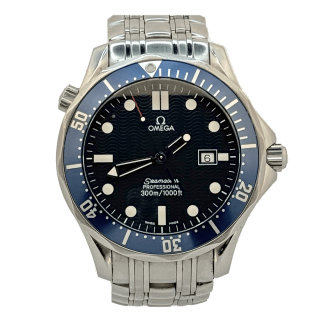
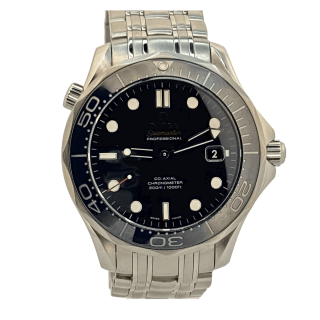
In 1993, Omega introduced a new Seamaster 300 with water resistance up to 1000 meters and a helium escape valve, shaped like a secondary crown placed at 11 o’clock. This distinctive design caught global attention by appearing in GoldenEye, worn by James Bond. Since then, the Seamaster has become synonymous with 007, appearing in every film thereafter.
In 2019, Omega revived the iconic “Broad Arrow” symbol on the dial, a subtle tribute to its British military heritage and a nod to the adventurous spirit that continues to make the Seamaster a collector favorite.
Related products

Share this content