History of Panerai: from Radiomir to Luminor watches
... From radiomir to luminor... Sempre stare il migliore
From its origins as a Florentine watch store to its pivotal role with the Italian Navy, Panerai's history is one of innovation, precision, and military-grade engineering. Discover how iconic models like the Radiomir and Luminor helped shape modern dive watches, and how the brand transitioned from secrecy to global acclaim.
Origins of the “Orologeria Svizzera”
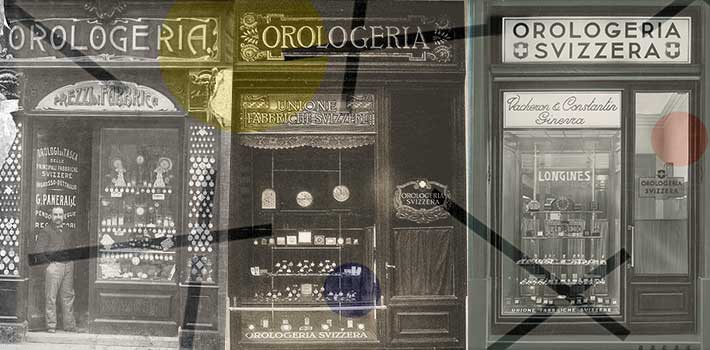
Semper Modum Tempus, Semper Melior — "Always measure time, always be better" — a motto embraced by Giovanni Panerai, founder of the “Orologeria Svizzera” in Florence. This elegant store offered clocks, regulators, and pocket watches, alongside a repair workshop. He chose to locate his shop on the “alle Grazie” bridge, overlooking the Arno River, rather than the textile-focused Ponte Vecchio.
To meet the rising demand for skilled watchmakers, Giovanni opened a watchmaking school and began developing custom regulators using components from brands he distributed, such as Angelus, Rolex, and Omega. As business grew, he relocated the boutique to the prestigious Piazza San Giovanni.
The Birth of Radiomir
Panerai's partnership with the Italian Navy marked a turning point. The Radiomir — before it was a watch — was a radium-based luminescent substance patented in France in 1916, designed for visibility underwater and at night. By the late 1920s, Guido Panerai and his father produced waterproof watch cases, culminating in the 1936 Radiomir prototype — a 47mm cushion-shaped wristwatch with welded strap lugs. It became a foundational design for the brand.
A Military Legacy with the Decima MAS
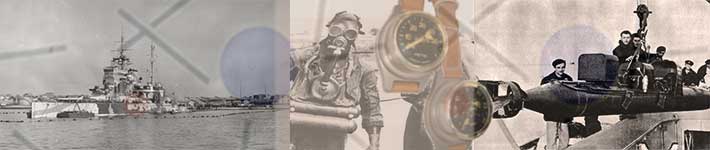
Now known as "G. Panerai e Figlio," the company supplied equipment to Italy’s elite underwater combat unit, the "Somozzatori" (torpedo men) led by Prince Valerio Borghese. Their daring missions, including the attack on the British fleet in Alexandria, required extreme precision.
The Radiomir evolved with a “sandwich” dial construction — two stacked plates for improved readability — and a more robust case in 1940, featuring integrated lugs, a screw-down crown, and larger waterproofing structures. The signature Havana-colored strap with a square buckle became a recognizable hallmark.
Luminor and Technological Advancements
In the post-war years, Panerai sought a safer luminescent alternative to radium. The result was Luminor, a tritium-based compound launched in the 1950s. It gave birth to a new generation of dive watches: the Luminor line, easily identified by its patented crown-locking system.
The 1956 “Egiziano” model, commissioned by the Egyptian Navy, introduced a rotating bezel to track dive time — an innovation quickly adopted by Rolex. At 60mm, it was the world’s largest wristwatch at the time. It featured a Plexiglas crystal, baton hands, and an Angelus-derived 8-day movement with small seconds at 9 o'clock.
Secrecy and Expansion in the 1970s
After Guido Panerai’s passing, Dino Zei took over and expanded operations, though many developments remained confidential due to military secrecy. Zei, an engineer, oversaw the production of left-handed diver’s watches and naval instruments such as depth gauges and compasses for the Italian Navy.
From Cult to Global Fame
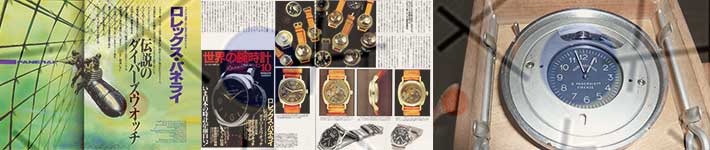
In 1992, Panerai was thrust into the spotlight thanks to a Japanese article in TimeSpec by Stephan Ciejka and Thierry Serna. The brand responded in 1993 by releasing three limited edition watches: Luminor, Luminor Marina, and Mare Nostrum — all based on 1940s models.
The oversized designs gained popularity among Hollywood stars like Bruce Willis, Arnold Schwarzenegger, and Sylvester Stallone, giving rise to the rugged "Pre-Vendôme" era and establishing Panerai’s cult status.
Richemont Era and Return to Florence
In the late 1990s, Richemont Group (then Vendôme Luxury Group) acquired Panerai, beating out Rolex and Swatch Group. The brand’s manufacture moved to Neuchâtel, and boutiques opened globally, including in Hong Kong. A “Manufacture” collection was launched, leading to the 2005 release of Panerai’s first in-house movement, the P.2002 — inspired by WWII Angelus calibers and designed for 8-day power reserve.
This renaissance included the restoration of the historic boutique in Florence and the release of GMT and limited reissue models, captivating a new generation of collectors and enthusiasts.
Related products

Share this content