


Longines
a-11 flying tigers - us army air corps pacific pilot watch
| Case | Steel |
|---|---|
| Diameter | 34 mm |
| Strap | Leather Strap |
| Movement | Hand-wound |
|---|---|
| Caliber | Longines 12 L Hack |
| Content | Mostra Travel Pouch |
-
Diameter34 mm
-
MovementHand-wound
-
CaseSteel
-
StrapLeather Strap
-
ContentMostra Travel Pouch
-
GenderMan
-
Gender for GoogleMan
-
AgeAdult
-
WaterproofingNot waterproof
-
Year1941
-
ModelWatch navigation hack
-
Versionus army air corps pacific pilot watch
-
Manufacturer referenceLW-A-11
-
Certificate of authenticityYes
-
Mostra referenceMS0221243
-
CaliberLongines 12 L Hack
-
Number of rubies17
-
Lug Width (mm)14 mm
-
Glass typePlexiglass
-
DialCadran 2 tons beige, chemin de fer en noir
-
LoopArdillon
-
Strap typeBracelet de remplacement de type pilote us
-
Mini Bracelet Length (cm)14 cms
-
Maxi Bracelet Length (cm)19 cms
-
Strap colorNoir
-
SpecificitiesMontre militaire des groupements aériens du début de la guerre en dotation à Pearl Harbor
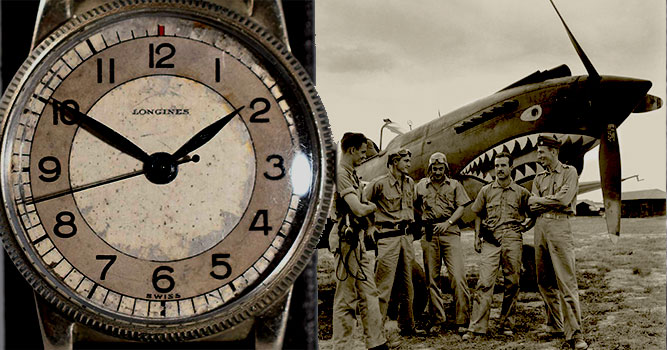
Longines A-11
Longines A-11, a U.S. Army Air Corps military pilot’s watch used in the Pacific in 1941. This aviation navigation “hack watch” was employed at the beginning of WWII by fighter squadrons flying P-40 Warhawks. The serial number (below 150 for the year 1941) indicates it was issued before the United States officially entered the war — most likely to squadrons based at Midway, Pearl Harbor, or Kunming.
This version, made in the United States by Longines Wittnauer, is an evolution of the earlier Longines A-11 with 10L Weems movement (without rotating bezel). It is powered by the Longines calibre 12L, a 17-jewel shock-resistant movement operating at 18,000 vibrations per hour, with a power reserve of 41 hours. The stainless steel case measures 34 mm in diameter with 14 mm lug width. It is mounted on a brown leather replacement strap in the style of those used by U.S. Air Force pilots — designed to be worn either over or under the flight suit.
The A-11 model, initially developed for the U.S. naval aviation forces, began its career around 1938. Longines was the first manufacturer to win the initial U.S. Department of Defense contract for these watches. Two versions were produced: one with a Weems rotating bezel and calibre 10L, and the model presented here. As a “hack watch,” it featured a stop-seconds mechanism for synchronization and came with a white or cream dial with black printed numerals. Light-colored dials were also common on naval military watches. Combined with dark hands, this configuration made time-reading easier during twilight or sunrise maneuvers, especially when facing the sun. The hands were heat-blued steel.
From the end of 1942, the A-11 underwent a major evolution: dials switched to black backgrounds with white railway tracks, white numerals, and white-painted hands — all to achieve maximum contrast. This new specification excluded Longines Wittnauer, whose supply chains relied on European parts, and brought in U.S.-based manufacturers Elgin, Waltham, and Bulova to produce these next-generation black-dial A-11 navigation watches at scale on American soil.
From a collector’s standpoint, early aviation A-11 watches with light dials are far rarer than their black-dial counterparts. Longines also supplied small quantities of A-11s to the British Royal Air Force (ref. 6B/234), to the Canadian RCAF, and to the Soviet Union through Lend-Lease programs and the Russian War Relief. Because they were produced before the U.S. entered the war, very few survived due to high aircraft losses early in the conflict. American fighter planes initially struggled to counter Japan’s fast and modern naval aircraft, such as the Mitsubishi A6M2 Zero and Nakajima B5N2 Kate. The famous “Flying Tigers” squadron formed by C.L. Chennault — which included ace pilot Greg “Pappy” Boyington (later of the *Baa Baa Black Sheep* TV series) — was equipped with these watches at its inception. (See the Mostra Mag article at this link.)
You will also like
-
-
-
-
-
-
-
-


