


Hamilton
W10 British Army Calibre 649 Tritium 1973 - Fist Serie
Hamilton W10 British Army “Watch, Wrist, General Service”, first series, Tritium Dial, calibre 649, 1973
| Case | Steel |
|---|---|
| Diameter | 36 mm |
| Strap | NATO Strap |
| Movement | Hand-wound |
|---|---|
| Caliber | Hamilton 649 |
| Content | Mostra Travel Pouch |
-
Diameter36 mm
-
MovementHand-wound
-
CaseSteel
-
StrapNATO Strap
-
ContentMostra Travel Pouch
-
GenderMan
-
Gender for GoogleUnisex
-
WaterproofingSplashproof
-
Year1973
-
ModelHand Wounded
-
VersionFist Serie
-
Manufacturer referenceNSN 6645‑99‑523‑8290
-
Certificate of authenticityYes
-
Mostra referenceMS08261420
-
CaliberHamilton 649
-
Number of rubies17
-
Lug Width (mm)18
-
Glass typePlexiglass
-
DialBlack Tritium Dial
-
LoopBuckle
-
Strap typeReplacement Strap
-
Mini Bracelet Length (cm)12
-
Maxi Bracelet Length (cm)22
-
Strap colorGreen
-
Specificities21 600 BPH Power Reserve 48h.
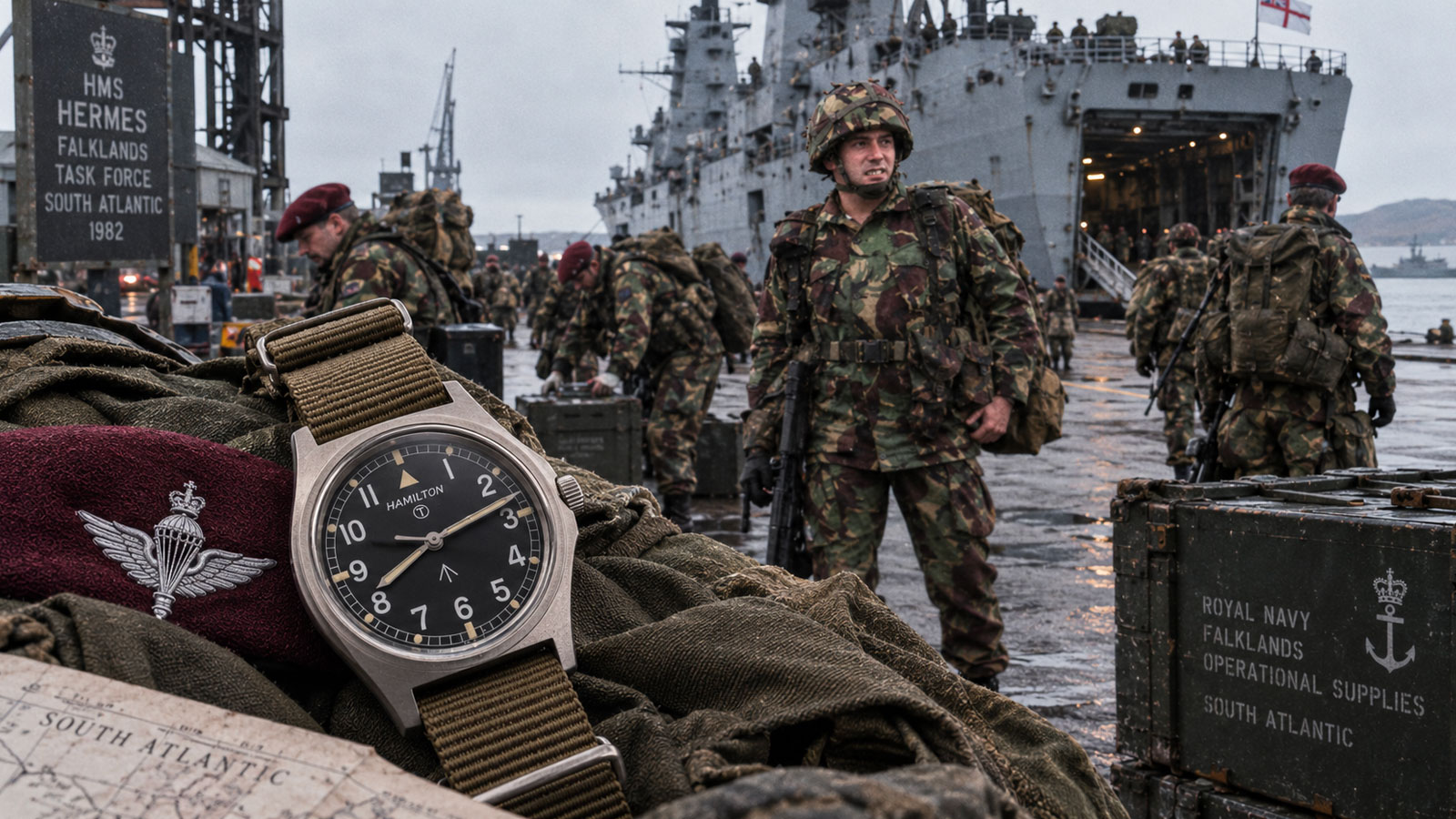
Hamilton W10 British Army “Watch, Wrist, General Service”, first series manufactured and issued in 1973, stainless-steel monocoque case measuring approximately 35 to 36 mm excluding the crown, close to 41 mm long and around 10 to 11 mm thick, front-loading construction with two-piece winding stem, fixed bars, domed acrylic crystal, unsigned crown, matte-black Hamilton-signed dial without the Genève wording, large Arabic numerals, outer minute track, inner military 24-hour scale, Broad Arrow above 6 o’clock, circled T indicating the use of tritium, luminous military hands and hacking central seconds, Hamilton calibre 649 hand-wound mechanical movement derived from the ETA 2750, operating at 21,600 vibrations per hour, 17-jewel construction, approximately 48 to 50-hour power reserve after full winding, replacement beige NATO strap fitted to the fixed bars, regulation caseback carrying the W10 prefix, NATO Stock Number 6645-99-523-8290, Broad Arrow and /73 production year, issued watch attributable with certainty to the British Army, sold pre-owned by Mostra, inspected, authenticated, supplied with a certificate of authenticity, offered without a water-resistance guarantee and covered by a 3-year warranty.
“A military watch never asks its wearer where he is going. It simply provides a clear and immediately available time when terrain, fatigue, cold or urgency leave no room for approximation.”
The 1973 Hamilton W10 British Army belongs to a generation of watches whose design was shaped not by style but by a succession of practical requirements. It had to remain instantly legible, endure field use, stay attached to the wrist if a strap was damaged and allow a soldier to synchronise movement, relief, guard duty or an operation without relying upon a larger instrument. Every component answers that logic. The black dial absorbs reflections, large white numerals stand out immediately, central seconds confirm that the movement is running and the hacking mechanism stops the seconds hand while setting, allowing several watches to be synchronised to a common reference time. The W10 does not attempt to tell a military story: it genuinely belonged to military equipment, as confirmed by its regulatory markings and British government Broad Arrow.
The W10 prefix identifies the watch unequivocally as a British Army issue. Royal Air Force watches carried a 6BB designation, while Royal Navy pieces used the 0552 prefix. The correct description therefore remains “Watch, Wrist, General Service”, issued for broad use within the British Army. NATO Stock Number 6645-99-523-8290 identifies the equipment type within Ministry of Defence inventories, while the /73 suffix records the year of manufacture and issue. The individual issue number is deliberately omitted from this commercial description, although its presence on the caseback naturally contributes to the military traceability of the watch.
The year 1973 is especially important because it represents the first production year of this Hamilton W10 version, supplied to the British Army until 1976. The watch belongs to a period when British forces still relied upon simple, repairable mechanical instruments entirely independent from electrical power. It comes from a world of folded maps, radio communications, orders given for a precise time, night movement and field exercises during which the wristwatch remained one of the few instruments available without any gesture beyond turning the wrist. There is no date and no unnecessary complication. Hours, minutes and hacking central seconds are sufficient, because a successful service watch must remove hesitation rather than accumulate functions.
The Hamilton-signed black dial, without the Genève designation, is correct for the first 1973 series. Large Arabic numerals provide conventional twelve-hour reading, while the inner 24-hour scale preserves military notation, where thirteen hundred hours remains thirteen hundred hours and an announced time must leave no ambiguity between morning and evening. The Broad Arrow above 6 o’clock visually connects the dial with the government markings on the back. The circled T records the use of tritium on hands and hour markers, a luminous material whose original output has naturally faded but whose presence remains historically essential. The visible patina appears broadly consistent across hands and markers, creating the warm ivory tone that genuine ageing alone can produce. Mostra will nevertheless examine the luminous material under ultraviolet light before final presentation.
The military hands, unsigned crown and fixed bars are equally coherent with the model. On a civilian watch, an unsigned crown might appear austere; on the W10, it confirms that function took precedence over branding. Fixed bars provide an essential security measure. The textile strap passes beneath the case and continues to hold the watch if one side becomes damaged. The beige NATO strap fitted today is a replacement consistent with current wear but is not described as the strap issued in 1973, which was generally grey. Military textile straps were consumables intended to be soaked, stained, worn and replaced, making their renewal part of the normal life of the equipment.
The stainless-steel monocoque case is one of the most technically interesting features of the Hamilton. It has no conventional removable back: the movement is extracted through the front after the acrylic crystal is removed, using a two-piece winding stem that releases the crown. This construction limits openings in the case and protects the movement effectively, but requires a precise method whenever the watch is serviced. The domed acrylic crystal extends the compact silhouette and produces a warmer visual effect than modern sapphire. Superficial marks can generally be polished without replacement, a genuine advantage on a watch designed for field use.
Inside is the Hamilton calibre 649, a hand-wound movement derived from the ETA 2750 and adapted to military requirements. It operates at 21,600 vibrations per hour, contains 17 jewels and delivers an approximately 48 to 50-hour power reserve after full winding. Its hacking device stops the central seconds hand when the crown is pulled, allowing accurate synchronisation. Manual winding remains central to the experience: several turns of the crown restore energy to the mainspring until firmer resistance indicates that full winding has been reached. This mechanical simplicity is one of the greatest strengths of the W10. The movement remains understandable, repairable and entirely autonomous, without rotor, calendar or unnecessary complication.
Front opening will allow the Mostra workshop to confirm the presence and consistency of the Hamilton calibre 649, inspect the inside of the case and establish the precise mechanical condition of the example. This examination complements the highly coherent visible configuration: correct 1973 dial, appropriate military hands, unsigned crown, fixed bars, monocoque case and even ageing across the luminous material. No obvious evidence of a refinished dial or parts taken from another variant is visible, but the authenticity of a military watch must always be built through the agreement of dial, movement, markings and case rather than through general appearance alone.On the wrist, this first-series Hamilton W10 offers the distinctive pleasure of a genuine military instrument that became collectible without losing its ability to be worn. Its size remains discreet, its dial is read instantly and the NATO strap allows precise adjustment across many wrist sizes. It works naturally with a field jacket, workwear, shirt or urban clothing without appearing like a military-inspired fashion accessory. Its authenticity comes precisely from the absence of effect. Case, numerals, fixed bars and acrylic crystal exist because they answered a specification rather than a trend.
Within a collection of British military watches, the 1973 Hamilton W10 occupies an essential place. It represents the first year of a short production, preserves the mechanical language of General Service watches and precedes the arrival of quartz in British military issue. It therefore helps explain the transition between earlier mechanical watches and later electronic CWC G10 models. The collector acquires an identifiable and documented piece that can be attributed directly to the British Army without inventing a particular unit or operation.Because of its age, the watch is offered without a water-resistance guarantee. Its monocoque construction and acrylic crystal answered protective requirements during the 1970s, but a military watch more than fifty years old should never be immersed on the strength of its historical construction alone. It must be protected from water, substantial humidity and sudden temperature changes.
Choosing this Hamilton W10 British Army from Mostra means benefiting from more than forty years of experience in collectible watches, a highly regarded in-house watchmaking workshop in Aix-en-Provence and one of the largest selections of pre-owned watches in the South of France, with particular expertise in military, aviation, diving and instrument watches. Before sale, the monocoque case, acrylic crystal, fixed bars, crown, markings, dial, hands, tritium, movement, hacking function, rate and power reserve are carefully examined.
Mostra’s verified customer reviews carry a 5-star rating, reflecting an approach based upon transparent descriptions, informed advice and long-term support. This Hamilton is supplied with a Mostra Certificate of Authenticity and the Mostra 3-year warranty. That warranty has particular value with a 1973 military mechanical watch whose servicing requires knowledge of the front-loading case, split stem and Hamilton 649 calibre.
A 1973 Hamilton W10 is ultimately not chosen to display a prestigious name or spectacular complication. It is chosen for the honesty of its design, the precision of its markings, the presence of its manual calibre and its direct connection with British Army history. It reminds us that before becoming a collector’s object, a military watch was first an instrument entrusted to a soldier so that, whatever the circumstances, he could always know exactly what time it was.
You will also like
-
-
-
-
-
-
-
-


