


Fortis
Flieger Astronaut ESA Nasa STS 99 Endeavour Mission STRM - Limited Edition
An emblematic watch of modern space exploration, the Fortis 595.10.46 Flieger STS-99 SRTM embodies a rare connection between watchmaking and a scientific mission in orbit. Produced in a limited series of 999 pieces.
| Case | Steel |
|---|---|
| Diameter | 40 mm |
| Strap | Leather Strap |
| Movement | Automatic |
|---|---|
| Caliber | ETA 2824-2 |
| Content | Mostra Travel Pouch |
-
Diameter40 mm
-
MovementAutomatic
-
CaseSteel
-
StrapLeather Strap
-
ContentMostra Travel Pouch
-
GenderMan
-
Gender for GoogleMan
-
AgeAdult
-
WaterproofingWaterproof
-
Year2000
-
5-year warrantyYes
-
ModelFlieger Automatic
-
VersionLimited Edition
-
Manufacturer reference595.10.46
-
Certificate of authenticityYes
-
Mostra referenceMS0621270
-
CaliberETA 2824-2
-
Number of rubies25
-
Lug Width (mm)20 mm
-
Glass typeMineral
-
DialNoir avec logo mission nasa endeavour
-
LoopArdillon
-
Strap typeBracelet d'origine
-
Mini Bracelet Length (cm)15 cms
-
Maxi Bracelet Length (cm)23 cms
-
Strap colorNoir
-
SpecificitiesMontre étanche 200, série limitée à 999 exemplaires
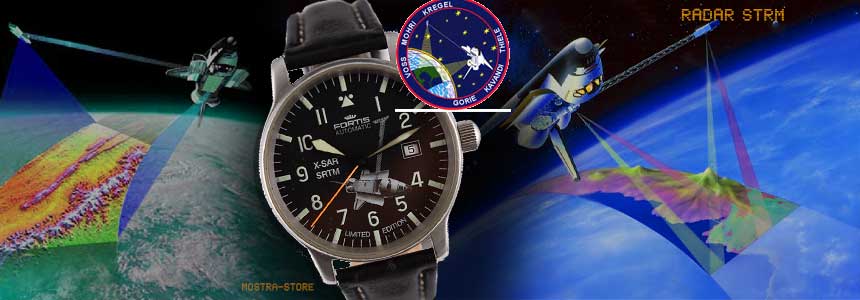
Fortis Flieger Limited Edition NASA STS-99 SRTM Mission
A collector’s watch from around 2000, limited to 999 pieces, created for NASA mission number ninety-nine and the fourteenth spaceflight of the Space Shuttle STS Endeavour. Its objective was to deploy the SRTM topographic radar in orbit around Earth, in order to map the planet’s landmasses with unprecedented precision. The mission carried a crew of six astronauts, including German ESA astronaut Gerhard Thiele, who wore a Fortis Flieger X-SAR SRTM during this spaceflight.
The Space Shuttle mission STS-99 launched from pad 39-A at Cape Canaveral, Kennedy Space Center, on February 22, 2000 at 23:22:30 UTC. The mission lasted eleven days, five hours, and thirty-nine minutes, concluding with a landing on runway 33 at the Kennedy Space Center. During this mission, Endeavour completed 181 orbits around Earth. The mission was a success: the use of the topographic radar enriched NASA’s cartographic databases, enabling a three-dimensional altimetric survey of the Earth’s land surfaces with an accuracy of approximately one meter, enhancing both air navigation safety and our understanding of the planet.
The mission was commanded by American astronaut Kevin R. Kregel, from the fourteenth Space Shuttle astronaut class, of civilian background. STS-99 marked his fourth spaceflight, following missions aboard Discovery in 1995 (STS-70) and June 1996 (STS-78), and Columbia in November 1997 (STS-87). The shuttle was piloted by Dominic Lee Pudwill Gorie, a NASA astronaut (class of 1994) and former U.S. Navy pilot, who had previously participated in the ninth and final docking of an American Space Shuttle with the Soviet space station Mir Space Station during mission STS-91 in June 1998 aboard Discovery. He would later fly two additional missions on Endeavour (STS-108) and in March 2008 (STS-123). The rest of the crew included two American mission specialists, one Japanese scientist (Mamoru Mohri of NASDA), and Gerhard P. J. Thiele representing the European Space Agency.
The Fortis X-SAR SRTM is a vintage automatic watch powered by the ETA 2824-2 movement with 25 jewels, beating at 28,800 vibrations per hour. It features a stop-seconds mechanism (hack system), renowned for its reliability and precision. This well-proven movement has been used in numerous prestigious watch models by renowned brands such as Patek Philippe, A. Lange & Söhne, and Audemars Piguet. The movement is equipped with an ETA shock protection system and a Nivarox hairspring made from an anti-magnetic alloy.
The stainless steel case measures 40 mm in diameter and features a screw-down caseback engraved with commemorative markings of the mission and the individual limited-edition number (out of 999 pieces). The watch is fitted with a Fortis leather strap (NOS), 20 mm wide. The black dial displays the Endeavour space shuttle deploying the X-SAR SRTM radar at the lower part of the dial, with a railroad minute track enhanced by tritium, arrow hands, and a triangle index at 12 o’clock. It also features a date window and the “Limited Edition” inscription at 6 o’clock. The watch is water-resistant to 20 ATM, or 200 meters.
From a collecting perspective, this watch belongs to the history of space exploration alongside icons such as the Omega Speedmaster or the Yema Spationaute, with which it coexisted in space during shuttle missions. A rare vintage piece, it represents a distinctive, original, and still accessible addition to any collection of European or military aerospace timepieces. It is also worth noting that it is one of the rare watches to have flown aboard the now-retired American STS space shuttles.
You will also like
-
-
-
-
-
-
-
-


