


Elgin
US marine corps pacific forces - okinawa infantry units
| Case | Steel |
|---|---|
| Diameter | 34 mm |
| Strap | Textile Strap |
| Movement | Hand-wound |
|---|---|
| Caliber | Elgin grade 554 |
| Content | Mostra Travel Pouch |
-
Diameter34 mm
-
MovementHand-wound
-
CaseSteel
-
StrapTextile Strap
-
ContentMostra Travel Pouch
-
GenderMan
-
Gender for GoogleMan
-
AgeAdult
-
WaterproofingNot waterproof
-
Year1942
-
ModelOrdnance departement watch
-
Versionokinawa infantry units
-
Manufacturer referenceORD-554
-
Certificate of authenticityYes
-
Mostra referenceMS0422349
-
CaliberElgin grade 554
-
Number of rubies15
-
Lug Width (mm)16
-
Glass typePlexiglass
-
DialBlanc tropicalisé avec index luminescents
-
LoopArdillon
-
Strap typeBracelet us d'origine en état proche du neuf
-
Mini Bracelet Length (cm)12
-
Maxi Bracelet Length (cm)24
-
Strap colorVert olive
-
SpecificitiesSub second, 18000 alt/h, reserve de marche de 38h. boitier dustproof.
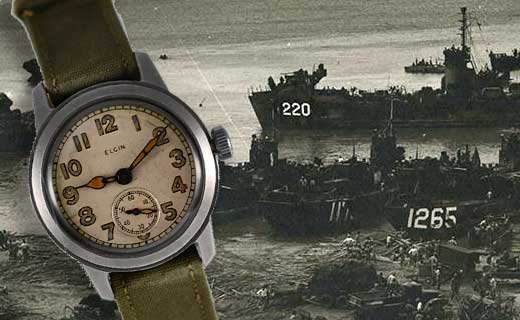
Military Elgin 554 watch of the U.S. Army Ordnance Department type, a watch issued to the Marine Corps (except aviation) in the Pacific before the assault on the Solomon Islands. Comparable to the Bulova models supplied to GIs on the European front, this watch features a similar mechanical construction, but manufactured with greater resistance to humidity, given the climatic conditions endured by troops on the Pacific islands front. An emblematic watch of Okinawa, it appears in many archival photographs documenting the battles of the Solomon Islands and the reconquest of the Asian front against the Japanese Empire.
The brand Elgin, whose full name is Elgin National Watch Company, is a highly renowned American manufacturer of watches, gauges and aviation instruments. Based in the town of Elgin, Illinois, its industrial facilities were, during the second half of the twentieth century, the largest in the world dedicated to watch manufacturing.
Since 1864, Elgin has produced both a civilian range (classic watches for women and men) and numerous pieces intended for the armed forces, government institutions (US Coast Guard, FBI, etc.) and the powerful railroad companies that helped transport goods from every production hub across the American continent to the ports shipping manufactured products to Europe and the rest of the world (before, during and after the Second World War). With an annual output of around sixty thousand watches and measuring instruments, Elgin was in the 1950s the most productive watch company in the world. Elgin closed its doors in 1968, unable to find a balance in the face of the tsunami caused by the arrival of Japanese quartz on the market — a frequently seen twist of history in which those who once won by force later become, on their own soil, the vanquished on the economic front.
This regulation military watch is fitted with the Elgin grade 554 movement with 15 jewels, beating at 18,000 vibrations per hour and offering a power reserve of 38 hours after a full wind. The movement is protected by an anti-magnetic shield positioned between the screwed caseback and the movement. The steel case has a diameter of 34.2 mm (including crown); the winding crown is slightly oversized so it can be easily operated while wearing gloves. The dial features luminous Arabic numerals and hands on a light background, a minute track graduated to sixty minutes, and a small seconds sub-dial at six o’clock (allowing the wearer to check at any moment that the watch is running).
From a collector’s standpoint, this watch, like the Ord Dept models manufactured during the war by Hamilton, Waltham or Bulova, is slightly harder to find in Europe, since it was primarily issued to units deployed in the Pacific theater. It therefore holds particular interest for a European collector, who will find it less commonly available locally. Built and serviced with great rigor in line with the directives set out in the Watch Ordnance Maintenance Book published by the U.S. Department of Defense, this watch, which was considered waterproof in its time, is no longer suited today (after roughly eighty years) to immersion. However, its operation and its resistance to dust (dust-proof) remain fully relevant.
You will also like
-
-
-
-
-
-
-
-


