


CWC
G-10 Fat Boy First Serie British Ministry of Defence - Military Service Tritium Dial
CWC Military Watch G10 “Fatboy” first generation, UK MoD General Service Issue, service Tritium Dial, quartz, 1980
| Case | Steel |
|---|---|
| Diameter | 36 mm |
| Strap | NATO Strap |
| Movement | Quartz |
|---|---|
| Caliber | ESA 536.121 |
| Content | Mostra Travel Pouch |
-
Diameter36 mm
-
MovementQuartz
-
CaseSteel
-
StrapNATO Strap
-
ContentMostra Travel Pouch
-
GenderMan
-
Gender for GoogleUnisex
-
WaterproofingSplashproof
-
Year1980
-
ModelQuartz
-
VersionMilitary Service Tritium Dial
-
Manufacturer referenceG10
-
Certificate of authenticityYes
-
Mostra referenceMS08261419
-
CaliberESA 536.121
-
Number of rubies3
-
Lug Width (mm)18
-
Glass typePlexiglass
-
DialTritium Service Military Dial
-
LoopBuckle
-
Strap typeReplacement Strap
-
Mini Bracelet Length (cm)12
-
Maxi Bracelet Length (cm)24
-
Strap colorGreen
-
SpecificitiesService Dial, First séries of military CWC
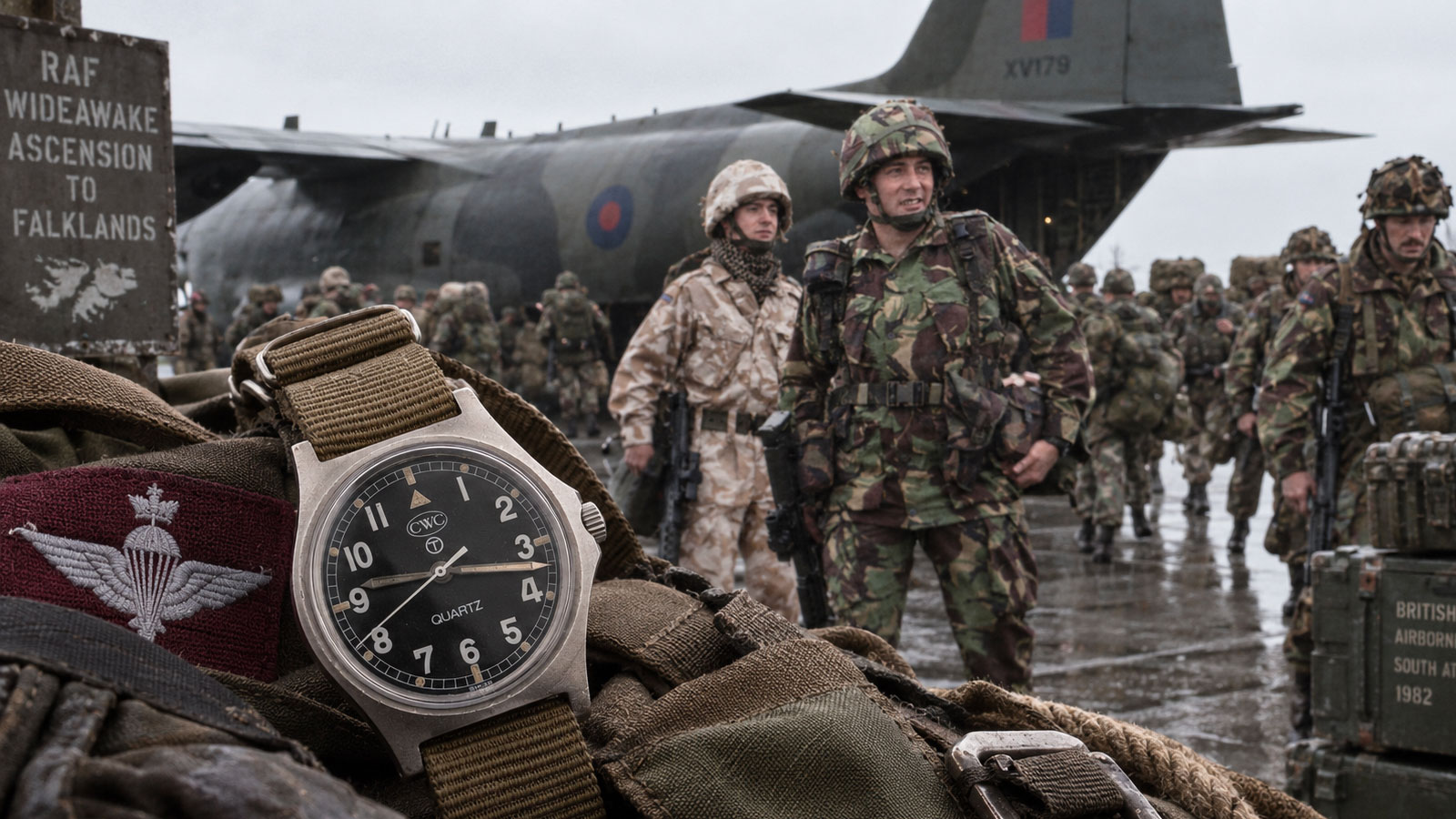
First-generation CWC G10 “Fatboy”, British Ministry of Defence General Service quartz watch manufactured in 1980, approximately 36.5 mm stainless-steel case excluding the crown and close to 13 mm thick, domed acrylic crystal, fixed bars, approximately 18.5 mm lug width, large screw-down battery hatch characteristic of the earliest examples, matte-black dial with large Arabic numerals, military 24-hour scale, luminous hands and markers, circled T indicating the use of tritium, later CWC service dial bearing the oval logo introduced from 1982, Swiss ESA 536.121 quartz movement, replacement olive NATO strap, caseback marked with NATO Stock Number 6645-99-541-5317, British Broad Arrow and individual number XXXX/80, General Service issue watch that cannot be attributed specifically to the British Army, Royal Navy or Royal Air Force, sold pre-owned by Mostra, inspected, authenticated, supplied with a certificate of authenticity and covered by a 3-year warranty.
“Military watches are not created to become rare. They become rare because they were worn, maintained, repaired and sometimes altered in order to remain in service, until the day the instrument enters history without ever having attempted to do so.”
The 1980 CWC G10 Fatboy belongs to the decisive moment when British military watches began moving from traditional mechanics to the accuracy and immediate availability of quartz. It was not created by a design department seeking to produce a watch inspired by the armed forces, but according to the more direct requirements of issued equipment: accurate timekeeping, immediate legibility, resistance to field use and straightforward maintenance. The G10 became the first quartz watch supplied to the British armed forces, opening a new chapter in the history of General Service watches issued by the Ministry of Defence.
The absence of a W10, 0552 or 6BB prefix is entirely correct for the first 1980 production year and prevents the watch from being attributed to one specific service. It should therefore not be described as an Army, Royal Navy or Royal Air Force watch without supporting documentation. Its correct designation remains UK MoD General Service Issue. This precision matters within military collecting, where an attractive but unsubstantiated attribution ultimately weakens the genuine interest of a piece.The marking 6645-99-541-5317 is the NATO Stock Number associated with the CWC G10. The Broad Arrow identifies British government property, while XXXX is the individual watch number and /80 records the year of manufacture. The serial number falls within the documented range of G10 watches produced during the first year, making the caseback entirely coherent with a genuine 1980 Ministry of Defence issue watch.
The collector nickname “Fatboy” comes from the unusually thick case of this first generation. At close to 13 mm thick and approximately 36.5 mm in diameter, it has a compact and substantial profile unlike the slimmer G10 watches that followed. This thickness was not a stylistic decision. It came directly from the size of the early Swiss quartz movement and from the requirements of an electronic technology that had not yet reached the degree of miniaturisation achieved by later modules.The domed acrylic crystal contributes to this distinctive silhouette and provides a visual warmth unavailable from contemporary sapphire. It is more easily marked, yet superficial scratches can be polished and the material does not fragment into sharp pieces in the same way as mineral glass. The fixed bars follow the same safety logic. A NATO strap passes beneath the case and continues to retain the watch if one side of the strap system is damaged, reducing the risk of losing the instrument during activity.
The large screw-down battery hatch is another essential signature of the Fatboy. It allows the energy cell to be replaced without exposing the entire movement and dial. This ease of maintenance made clear sense within a military environment, where a stopped watch needed to be returned to service quickly. Quartz offered decisive advantages: accuracy, immediate readiness and freedom from daily winding.The movement in this first generation is the Swiss ESA 536.121 quartz calibre. A quartz movement has neither a mechanical frequency expressed in vibrations per hour nor a power reserve after winding, since it is not wound. Its autonomy depends upon its battery, while its electronic oscillator regulates the stepping motor that drives the hands.
The matte-black dial follows the immediately legible layout of British General Service watches. Large white Arabic numerals dominate the display, an outer minute track provides precision and the inner 24-hour scale preserves military time notation, where an announced hour must leave no ambiguity between morning and evening. The circled T confirms the use of tritium luminous material. Its original luminosity has naturally faded, yet its presence remains historically important and explains the ageing visible across the hands and markers.The dial fitted to this example bears the CWC logo inside an oval, a design introduced from 1982. Original 1980 and 1981 dials normally carried the simple CWC name without an oval surround. The watch should therefore not be described as fully original to its 1980 delivery configuration. It most probably carries a later CWC tritium service dial, installed during maintenance or repair. On a civilian collector’s watch, dial replacement may be viewed only as a loss of originality. On issued military equipment, the interpretation requires more nuance. Such objects were not preserved to become collectibles; they were repaired in order to remain usable.
The correct description is therefore neither “fully original 1980” nor “aftermarket dial”, but 1980 British military issue watch fitted with a later genuine CWC tritium service dial bearing the oval logo. This distinction reflects the genuine life of military equipment, whose history continued through workshops, replacement parts and the maintenance required to keep the instrument operational.The olive NATO strap is also a replacement consumable, coherent with military use but not presented as the strap supplied in 1980. Textile straps were made to be worn, soaked, stained and replaced. Their disappearance therefore carries a very different meaning from the loss of an integrated signed bracelet on a civilian watch. The olive NATO remains faithful to the character of the piece and allows the fixed bars to perform their security function.On the wrist, the Fatboy feels more substantial than its diameter suggests. Its 36.5 mm case remains compact, yet the thickness, domed crystal and fixed bars give it the presence of a genuine instrument. It remains comfortable on textile and works naturally with casual clothing, a field jacket, workwear or a more urban silhouette. Its authenticity comes from a specification rather than from a trend.
From a collector’s perspective, this CWC G10 Fatboy 3619/80 brings together several powerful qualities. It belongs to the first year of G10 production and retains the thick case, large battery hatch, fixed bars and regulatory markings associated with 1980. It also represents the transition of British military watchmaking to quartz technology, when electronic accuracy became sufficiently reliable to replace mechanical General Service watches. Its later service dial is an important difference to understand, but does not remove the authenticity of the case or the legitimacy of the markings. Instead, it offers a reading closer to the reality of military service: an instrument maintained so that it could continue to perform its role.The watch should now be worn with the respect due to military equipment more than forty-five years old. Its acrylic crystal, seals, crown and battery hatch mean that any historical water resistance must not be considered current. It is therefore offered without a water-resistance guarantee and should be protected from immersion unless specifically tested and approved by the workshop.
Choosing this CWC G10 Fatboy from Mostra means benefiting from more than forty years of experience in collectible watches, a highly regarded in-house watchmaking workshop in Aix-en-Provence and one of the largest selections of high-end pre-owned watches in the South of France, with particular expertise in military, diving and instrument watches. Before sale, the consistency of the case, caseback, markings, dial, hands, battery hatch and movement is examined. Opening the watch will provide final confirmation of the ESA 536.121 calibre expected within this first generation.Mostra’s verified customer reviews carry a 5-star rating, reflecting an approach founded upon transparent descriptions, informed advice and long-term support. This CWC is supplied with a Mostra Certificate of Authenticity and the Mostra 3-year warranty, a particularly meaningful commitment on an early military quartz watch whose components and electrical behaviour require informed evaluation. A 1980 CWC G10 Fatboy is ultimately not chosen because it has remained frozen in its delivery condition. It is chosen because it carries the traces of what it was designed to do: serve, be maintained and continue telling the time. Its caseback belongs to the first year of the G10, its case preserves the substantial silhouette of the earliest British military quartz watches and its service dial reminds us that an issued instrument rarely possesses a perfectly static history. It is precisely this reality, described with transparency, that gives the watch its depth.
You will also like
-
-
-
-
-
-
-
-


