


-
Diameter42 mm
-
MovementHand-wound
-
CaseSteel
-
StrapSteel Strap
-
ContentFull-Set
-
GenderMan
-
Gender for GoogleMan
-
AgeAdult
-
WaterproofingWaterproof
-
Year1997
-
ModelMoon-watch professional
-
Versionnasa original limited series
-
Manufacturer reference3597.11
-
Certificate of authenticityYes
-
Mostra referenceMS0120167
-
CaliberOmega c-1861
-
Number of rubies18
-
Glass typePlexiglass
-
DialNoir Moonwatch avec logo mission Nasa Apollo VII
-
LoopBoucle déployante signée
-
Strap typeBracelet d'origine en acier
-
Strap colorAcier
-
SpecificitiesMontre éditée en très petite quantitée (150 ex) vendue complète avec boite et papiers d'origine.
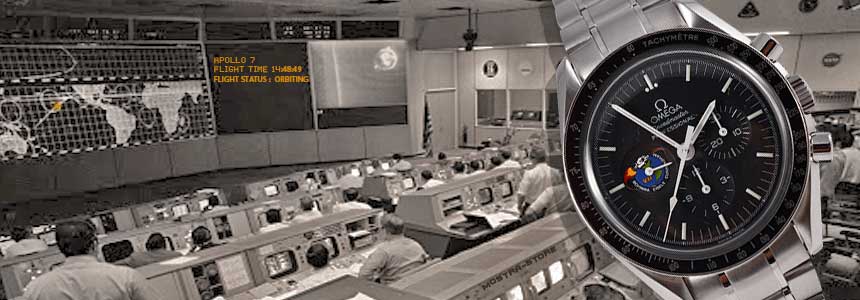
Collector Watch full set Omega Speedmaster special edition limited to 150 pieces — Apollo 7 (1997). This model belongs to the lineage of NASA moonwatch special editions released by Omega to commemorate space conquest through the Apollo program. Given the historical importance of the event it celebrates, the unique “Apollo 7” dial version, and its exceptional preservation condition with original box and papers, its appeal to collectors is outstanding. This stainless steel collector’s chronograph features a screw-down caseback (42 mm), 5 ATM water resistance, and an exclusive Apollo VII silkscreen — specific to this edition.
Apollo 7 was the first manned mission of the Apollo program. Launched aboard a Saturn IB rocket on October 11, 1968, from Launch Complex 34 at Kennedy Space Center in Florida, it carried astronauts Walter Schirra (commander and veteran of the Mercury program), Don Eisele (command module pilot), and Walter Cunningham (lunar module pilot). Over 11 days and 163 orbits, they became the first to transmit TV images from space. As symbolized by the Apollo 7 mission logo printed on the dial, one of the mission’s goals was to test the command module in spaceflight conditions and to perform docking maneuvers with the lunar module.
The hand-wound mechanical movement of this commemorative chronograph is the Omega calibre 1861. This movement underwent NASA’s rigorous qualification tests to be chosen as the watch worn by astronauts on the Apollo, Skylab, and Space Shuttle programs. During its development, it was equipped with a “Delrin” brake to withstand shocks, protect it from magnetic fields, humidity, solvents, and chemicals, and ensure rigidity, durability, and resistance to zero-gravity deformation. Starting in 1994, to reduce weight, the movement received rhodium plating and an additional ruby on the chronograph wheel to reach 18 jewels, allowing continuous chronograph use without degrading performance.
The calibre 1861 operates at 21,600 vibrations per hour, powered by a flat “Glucydur” balance spring, moving the central second hand at 6 beats per second. Based on the Lemania 1873, this Omega-developed movement includes a “hack” seconds feature, enabling precise time-setting — an essential function for synchronizing with onboard instruments or reference signals during space missions.
This three-register cam-actuated chronograph operates in “Start & Stop” mode: the chronograph starts with the upper pusher (2 o'clock), stops with the lower pusher (4 o'clock), resumes if the top pusher is pressed again, or resets if the bottom one is used after stopping. The tri-compax counters allow a total time measurement of 12 hours, 59 minutes, and 59 seconds. The left subdial features a continuous running small second hand and the Apollo VII logo, the right subdial counts 30 minutes, and the bottom one tracks 12 hours — all on a matte black dial.
Winding starts the movement from the very first turn of the crown, and a full wind (around 20 turns) provides a 42-hour power reserve. The central seconds hand is a “Flat second” type, while the hour and minute hands are baton-shaped with white Luminova accents. The tachymeter bezel is fixed, of type B5 - Dot Beneath 70 - Style 1, surrounding the plexiglass crystal. The three auxiliary counters are matte black “moonwatch” style, and the left-hand small seconds dial displays the Apollo VII mission logo.
The Speedmaster chronograph is a versatile and sporty watch suitable for aviation, motorsports, and nautical use. Its vintage chic aesthetic has also made it a star on screen, appearing in many hit TV series. It was notably featured in Tom Hanks’ 1998 series *From the Earth to the Moon*, which chronicles the NASA Apollo missions between 1961 and 1975. Discover the full history of watch brands and their iconic models on our "Watch History" page.
You will also like
-
-
-
-
-
-
-
-


