The fascinating history of Omega De Ville watches: elegance and innovation
Which will span across eras to conquer women's wrists.

A timeless blend of elegance and innovation
The Omega De Ville collection has stood for over six decades as a symbol of refined watchmaking. From its origins as part of the Seamaster line to becoming an independent icon, De Ville blends classic design with groundbreaking technology, such as the Co-Axial movement and central tourbillon. Its history reflects Omega’s dedication to precision, elegance, and innovation, making it a favorite among discerning collectors worldwide.
Origins of Omega and the Birth of the De Ville Collection
Omega’s story began in 1848 when Louis Brandt opened a watchmaking workshop in La Chaux-de-Fonds, Switzerland. Initially assembling watches from locally crafted parts, Brandt gained success in markets like England. After his death in 1879, his sons Louis-Paul and César moved the company to Bienne in 1880 and established a modern factory. In 1894, they launched the revolutionary Omega caliber, so successful that the company officially adopted the name Omega in 1903.
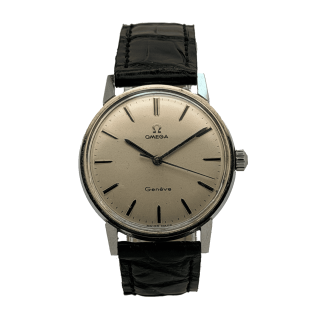
Throughout the 20th century, Omega became a leader in precision timekeeping. It was appointed official timekeeper of the Olympic Games in 1932, set numerous accuracy records, and was selected by NASA for the Apollo missions. The De Ville collection debuted in 1960 as a refined, elegant sub-line of the Omega Seamaster, contrasting with its sportier sibling. By 1967, De Ville became an independent collection, marking a new chapter in Omega’s history.

Design Evolution and the Quartz Era
The first De Ville watches stood out for their minimalist elegance: gold or stainless steel cases, clean dials, and fine indexes. Their urban sophistication resonated with 1960s style trends. The 1970s brought the quartz crisis, threatening traditional mechanical watchmaking. Omega responded with quartz models, including the De Ville Quartz, which blended the line’s classic aesthetics with the precision of quartz movements.
This era also saw bolder, more experimental designs, reflecting the decade’s creative spirit. In 1994, Omega launched the De Ville Prestige, a collection that became a flagship for its timeless design—featuring gold or steel cases, clean dials, and high-precision automatic or quartz movements.
The Return of Mechanical Movements and the Co-Axial Innovation
The 1990s marked a resurgence in appreciation for mechanical craftsmanship. Omega embraced this shift by reintroducing mechanical calibers to De Ville. In 1999, it unveiled the Co-Axial movement, a groundbreaking development that improved durability and accuracy. The De Ville Co-Axial, launched the same year, became an emblem of Omega’s technical excellence, retaining the elegant design DNA of the collection.

21st Century Masterpieces
De Ville Hour Vision
Introduced in 2007, the De Ville Hour Vision married classic elegance with innovation. Powered by the in-house Co-Axial 8500 caliber with a 60-hour power reserve, it featured a transparent case allowing a full view of the movement.
De Ville Trésor
In 2014, Omega revived the De Ville Trésor, first launched in the 1940s. The modern version included the Master Co-Axial movement, enhanced magnetic resistance, a slim case, clean dials, and leather straps.
De Ville Prestige Orbis
Omega’s partnership with Orbis International led to the De Ville Prestige Orbis collection, supporting global eye care initiatives. Recognizable by their blue dials and teddy bear motifs, these watches symbolized Omega’s philanthropic commitment.
De Ville Tourbillon
In 2020, Omega introduced the De Ville Tourbillon with a central tourbillon, combining traditional craftsmanship with high-end innovation. The central tourbillon compensated for gravity’s effects on accuracy, showcasing Omega’s technical mastery.
Legacy and Enduring Appeal
For over 60 years, the De Ville collection has embodied elegance, precision, and innovation. Chosen by celebrities and watch enthusiasts for its discreet sophistication, it seamlessly merges tradition with technology—from Co-Axial movements to tourbillons. Today, as the 36mm case is embraced as a unisex size, many women opt for vintage De Ville models from the 1960s, keeping the collection’s heritage alive.
The Omega De Ville remains an icon of refined watchmaking, a lasting influence on the industry, and a testament to Omega’s unwavering pursuit of excellence. Discover our pre-owned women's watches collection.
These products might interest you


Share this content