Rolex Daytona: history, references and collector’s guide
From the Rolex Daytona 6239 to the 126500LN: history, Paul Newman, 6263, Zenith 16520, Patrizzi, 116520, 116500LN, calibres 4030, 4130 and 4131, Thierry Serna archive, and the Mostra guide to assessing, buying and collecting a pre-owned Daytona.
The Daytona did not become an icon because it was rare. It became rare because a succession of references, dials, movements and stories gradually transformed a chronograph that was once difficult to sell into one of the most collectible watches in the world.
By Thierry Serna — historical, heritage and market perspective. With the technical contribution of the Mostra workshop.
From the Rolex Daytona 6239 to the 126500LN: history, Paul Newman, 6263, Zenith 16520, Patrizzi, 116520, 116500LN, calibres 4030, 4130 and 4131, Thierry Serna archive, and the Mostra guide to assessing, buying and collecting a pre-owned Daytona.
RECOGNISING A DAYTONA IS EASY. UNDERSTANDING THE ONE IN FRONT OF YOU IS FAR LESS SO.
A few seconds are enough to recognise the silhouette of a Rolex Cosmograph Daytona: three registers, two pushers framing the crown, a tachymeter bezel and an architecture that has become one of Rolex’s most familiar signatures. Precisely identifying the watch in front of you, however, can require considerably more time.
A reference identifies a family. It does not always tell you which dial should be present, which luminous material corresponds to the period, whether the hands belong to the same generation, whether the bezel has been replaced, whether the case retains its original proportions, whether the bracelet is contemporary with the watch or whether the movement has undergone significant previous intervention.
On a Daytona 16520, only a few years of production are enough to reveal several generations of dials, Floating Cosmograph or Inverted 6 configurations, the transition from tritium to Luminova and, on certain black dials, the chromatic evolutions now grouped under the Patrizzi name. On a manual Daytona, a correctly attributed exotic dial can place a watch in an entirely different collecting category. On a 116520, case condition, set, bracelet and early production years are already beginning to create meaningful differences between individual examples.
This distinction lies at the heart of the Mostra approach: recognising a Daytona takes only a few seconds. Understanding exactly which Daytona you are looking at can take years. The reference defines the family; the dial, movement, case, condition and history define the true identity of the individual watch.
This historical, technical and patrimonial reading guides the entire dossier: beginning with the earliest references, then learning how to examine a real Daytona, why two watches carrying the same reference number can have very different values and which elements deserve to be checked before a purchase, appraisal or sale.
The Essentials: Understanding the Rolex Daytona in Two Minutes
The Rolex Cosmograph Daytona was born in 1963 with reference 6239, a manually wound chronograph with pump pushers whose tachymeter scale moved from the dial to the bezel. The first generations used movements derived from the Valjoux 72 architecture, progressively adapted by Rolex until the arrival of calibre 727 running at 21,600 vibrations per hour.
The so-called Paul Newman dials are exotic dials that became highly sought after long after they were first sold: Paul Newman is therefore neither a Rolex reference nor a special edition. Reference 6240 introduced screw-down pushers before the 6263 and 6265 came to embody the maturity of the manual-wind Daytona.
In 1988, reference 16520 changed everything: 40 mm case, sapphire crystal, automatic winding and Rolex calibre 4030 developed from the Zenith El Primero, deeply modified and slowed from 36,000 to 28,800 vibrations per hour. Floating Cosmograph, Inverted 6 and certain black dials that later became known as Patrizzi now form an entire field of collecting.
In 2000, the 116520 received Rolex manufacture calibre 4130 with column wheel, vertical clutch, 44 jewels and approximately 72 hours of power reserve. In 2016, the 116500LN added a black Cerachrom bezel. Since 2023, the 126500LN has used calibre 4131.
When buying or valuing a pre-owned Daytona, the reference is never enough: dial, luminous material, hands, bezel, pushers, case geometry, bracelet, movement, service parts, set and provenance can all have a major impact on the interest and value of an individual example.
The Rolex Daytona in four major generations
Sixty years of Daytona history become much easier to understand when reduced to four major mechanical families. Behind the multiplication of references, dials and nicknames, the fundamental evolution follows a remarkably clear logic: manual winding, calibre 4030 derived from the Zenith El Primero, Rolex manufacture calibre 4130, and finally calibre 4131.
| Major era | Period | Key references | Movements | What changes |
|---|---|---|---|---|
| Manual Daytona | 1963–1988 | 6239 → 6265 | 722 / 722-1 / 727 | Acrylic crystal, manual winding, pump then screw-down pushers |
| “Zenith” Daytona | 1988–2000 | 16520 | 4030 | 40 mm, sapphire crystal, automatic winding, deeply modified El Primero base |
| Manufacture Daytona | 2000–2023 | 116520 / 116500LN | 4130 | First automatic chronograph entirely developed by Rolex, followed by Cerachrom in 2016 |
| Current Daytona | Since 2023 | 126500LN | 4131 | New generation, revised proportions and contemporary Rolex technologies |
If you remember only one structure for understanding sixty years of Daytona history, remember this one: manual → Zenith → 4130 → 4131.
To compare the generations currently available at Mostra, browse our selection of pre-owned Rolex Cosmograph Daytona watches.
IN THIS ARTICLE
Understanding the Daytona in a few minutes
The Rolex Daytona in four major generations
Before the Daytona: 6034, 6234 and 6238
1963: reference 6239 and the birth of the Cosmograph
Why the name Daytona?
The manual-wind Daytonas and the birth of the legend
Paul Newman: the watch, the dial and the nickname
6241 and 6240: black bezel and screw-down pushers
6263 and 6265: the maturity of the manual-wind Daytona
Valjoux 72, Rolex 722, 722-1 and 727 calibres
1988: the Daytona 16520 revolution
Mostra Archive: Thierry Serna and the Daytona at the beginning of the 1990s
1988: the Daytona 16520 and Rolex calibre 4030
Why is the Rolex Daytona 16520 called a “Zenith”?
Floating Cosmograph, Inverted 6 and dial generations
How can a Rolex Daytona 16520 be dated and placed within its production?
Patrizzi: when ageing becomes a collecting category
The 16520 seen by Mostra
Mostra case study: reading a 1996 T-series Daytona 16520 with white dial
A Daytona 16520 seen by Mostra: what we examine and why
Why can two Daytona 16520 watches have very different values?
From calibre 4130 to the current Daytona
2000: Daytona 116520 and Rolex calibre 4130
2016: Daytona 116500LN and the Cerachrom bezel
2023: Daytona 126500LN and calibre 4131
16520, 116520, 116500LN or 126500LN: four Daytonas, four eras
Daytona Le Mans: when motor-racing history returns to the movement
The Rolex Daytona has never been only a steel watch
The main Rolex Daytona references at a glance
Authenticating and buying a Rolex Daytona
Why two Daytonas that look identical in photographs can have very different values
Polishing: understanding what the case tells us
Rolex service parts: original, genuine or period-correct?
The full set: important, but never more important than the watch
Buying a pre-owned Daytona: 8 mistakes to avoid
The 12 Mostra checks before buying a Rolex Daytona
Wearing, maintaining and collecting a Daytona
Can a vintage Rolex Daytona really be worn every day?
Before restoring a vintage Rolex Daytona
Which Rolex Daytona should you choose today?
What really determines the value of a Rolex Daytona?
The Daytona market: rarity, availability and speculation
Mostra: expertise, workshop and the pre-owned market
Why buy a pre-owned Rolex Daytona from Mostra?
Buying, having appraised, maintaining or selling a Rolex Daytona
Explore further: Mostra dossiers related to the Daytona
Rolex Daytona FAQ: the most frequently asked questions
Some watches seem to have had their history written in advance. The Rolex Cosmograph Daytona belongs to another family: that of objects whose destiny eventually far exceeded their initial purpose. When Rolex presented its new chronograph in 1963, nothing suggested that some of its variants would, a few decades later, become absolute benchmarks of watch collecting. The first Cosmographs were neither deliberately scarce limited editions nor speculative products. They were first and foremost mechanical instruments intended to measure short periods of time, created in an era when motor racing, speed and precision embodied a new idea of modernity.
What makes this story so fascinating is precisely that transformation. It begins well before 1963 with Rolex chronographs of the 1940s and 1950s, takes shape when the tachymeter scale moves onto the bezel, encounters the American world of motor racing, adopts exotic dials that buyers were not yet fighting over, introduces screw-down pushers, increases the frequency of its manual movements, then enters a new era in 1988 with a Zenith architecture deeply reworked by Rolex. Twelve years later came calibre 4130, the first automatic chronograph movement entirely developed by the manufacture. Finally, in 2023, calibre 4131 opened a new generation without breaking with the features that make the watch instantly recognisable.
Across these major stages, a vocabulary gradually emerged that can seem almost esoteric at first: Paul Newman, Big Red, Floating Cosmograph, Inverted 6, Patrizzi, Zenith Daytona, Panda, Cerachrom, Le Mans. These names make identification easier, but they can also obscure the essential point. In collecting, the nickname attracts attention; the coherence of the individual watch determines its depth.
This is precisely the watch we are going to examine here: not an abstract Daytona reduced to a few dates or a succession of celebrities, but a family of chronographs whose references, movements, dials, cases, service parts and states of preservation tell more than sixty years of Rolex history.
Before the Daytona: Rolex learns the language of the chronograph
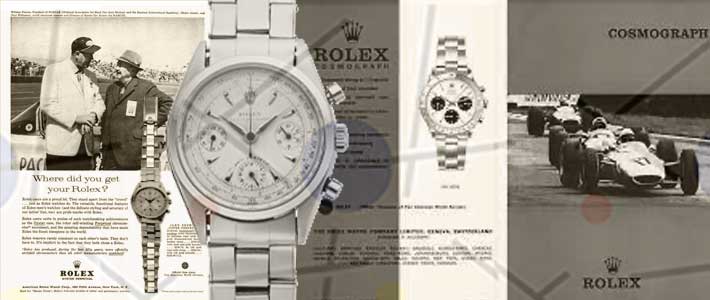
The Rolex 6034 chronograph, a classic from the 1950s
The Daytona lineage begins neither in Florida nor on an actor’s wrist. It begins within a much more discreet family of manually wound Rolex chronographs. During the 1930s, 1940s and 1950s, the manufacture produced different watches capable of measuring short intervals of time, sometimes equipped with tachymeter or telemeter scales, generally integrated directly into the dial. Their architecture remained typical of classical chronographs of the period: round pushers, relatively sober bezels, compact diameters and dials filled with graduations intended to deliver several types of information at once.
Reference 6034 belongs to this generation of Rolex chronographs that remains much less familiar to the general public than the Submariner or GMT-Master models of the same era. Yet it illustrates this first period perfectly: the chronograph is still a specialised instrument within the Rolex range and has not yet been given an independent visual identity.
Reference 6234 takes this logic further. Its three-register display is already remarkably close to what the Cosmograph will become. Some versions carry several scales printed around the dial and its movement belongs to the great Valjoux 72 family. Visually, however, the watch still belongs to the 1950s: most of the information is concentrated in the centre, between the rehaut and the counters.
Reference 6238 is the true connecting link. Collectors later nicknamed it the “Pre-Daytona”, a phrase absent from Rolex catalogues of the period but particularly evocative. It uses a case of approximately 36 mm, three counters, pump pushers and a cleaner construction. Above all, the tachymeter scale remains printed around the edge of the dial while the bezel stays smooth.
This 6238 allows us to understand the next revolution. The change that will create the Daytona is not, at first, the invention of a new complication. It lies in an almost architectural graphic decision: moving the tachymeter scale out of the dial and onto the bezel. The centre of the watch becomes lighter, the three registers gain presence and the case immediately takes on a more sporting character.
The Daytona therefore takes shape through displacement before it develops through rupture. This is often how great watches are born: a modification that appears simple reorganises everything around it.
1963: reference 6239 and the birth of the Cosmograph
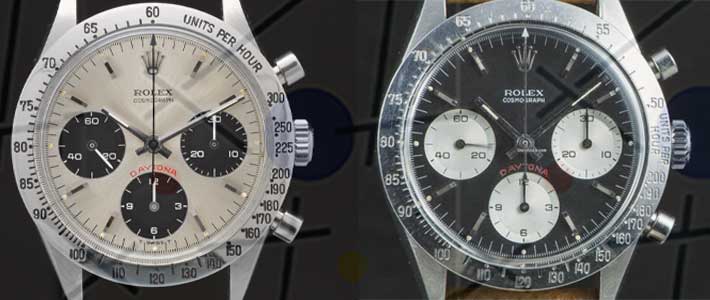
Rolex Cosmograph 6239 Daytona
In 1963, Rolex introduced reference 6239. The new chronograph received the name Cosmograph. The word Daytona would appear progressively on dials, with variations depending on early series and the markets for which the watches were intended.
The 6239 adopted an approximately 36 to 37 mm case, an acrylic crystal, pump chronograph pushers and a metal bezel now engraved with a tachymeter scale. Over a known distance, this graduation made it possible to calculate average speed. Its presence on the bezel immediately became one of the most recognisable signatures of the future Daytona.
The movement remained manually wound and originated in the Valjoux 72, one of the most respected chronograph architectures of its time. Rolex progressively adapted this base under the designations 72B, 722 and then 722-1. Calibres 722 and 722-1 run at approximately 18,000 vibrations per hour and generally contain 17 jewels.
The 6239 matters for another reason: it was never completely frozen. Bezel graduations, dial graphics, the position of the Daytona inscription, movements and typographic details changed throughout production. This is an essential characteristic of vintage Rolex watchmaking: a reference is never a static photograph of its first year of production. It has an internal life, made up of successive modifications that must be compared with the serial number and the period in which the watch was produced.
For today’s collector, this principle is fundamental. Identifying a 6239 does not simply mean reading its number between the lugs. The next task is to determine which type of dial, bezel, pushers and movement is coherent with the moment in which that particular watch was made.
Why the name Daytona?
Florida had a history closely associated with speed long before Rolex entered the picture. At the beginning of the twentieth century, Daytona Beach offered a long strip of hard-packed sand used for attempts at automobile speed records. The site became one of the American symbols of the pursuit of speed even before the construction of the modern racetrack.
In 1959, the Daytona International Speedway opened. Rolex became associated with this environment from the early years of the circuit. When the Cosmograph appeared in 1963, the connection between the chronograph and Daytona developed naturally. The name appeared on certain dials intended for the American market before progressively becoming the familiar and then official designation of the family.
The detail matters because it corrects an overly simplified version of the story. The Cosmograph did not appear as a product whose “Daytona” name had come first. The chronograph appeared first, its automotive identity became clearer afterwards, and Daytona eventually absorbed the name Cosmograph in everyday language.
Paul Newman: separating the watch, the dial and the nickname
The Paul Newman Era
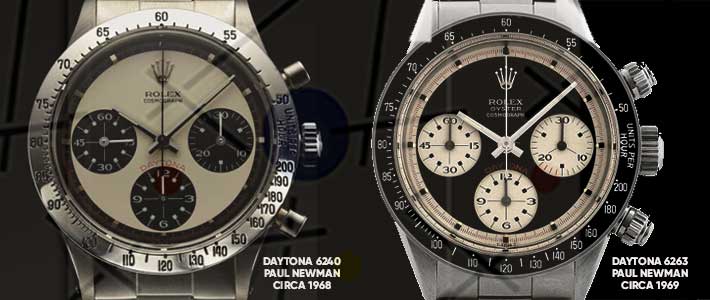
Rolex Cosmograph Daytona Paul Newman – The year 1969 marks a new era
Between 1969 and 1971, Rolex launched four new references. Marketing began to center around motorsport, with Paul Newman leading the charge. His popularity helped skyrocket the Daytona’s appeal. Technically, Rolex improved the movement with Caliber 727 in the Daytona 6262, and added screw-down pushers for water resistance in references 6263 and 6265.
No serious Daytona dossier can avoid Paul Newman. But the best way to discuss him is precisely to begin by putting the terminology back in order.
A “Paul Newman Daytona” is not a special edition created by Rolex for the actor. Nor does it correspond to a single reference. The expression was created retrospectively by collectors to describe a particular family of dials, once referred to as exotic.
These dials are distinguished from standard versions by a different aesthetic: highly graphic numerals within the subsidiary registers, distinctive typography, stronger contrasts, coloured details and, depending on the version, small square elements at the ends of certain minute markers. Their personality now appears immediately attractive, but it did not necessarily generate the same enthusiasm when the watches were sold new.
Dials from this family can be found on several manual references: 6239, 6241, 6262, 6264, 6263 and 6265. A simple “Paul Newman” mention in an advertisement therefore has no documentary value by itself. The exact dial type, its configuration, its coherence with the reference, its period and, naturally, its authenticity must all be established.
This distinction explains the enormous gap that can exist between two manual Daytonas that look broadly similar. On certain references, the dial can represent a decisive part of the watch’s collector interest. Its typography, construction, ageing and absence of restoration therefore become essential areas of expertise.
The trajectory of these dials also offers a striking lesson about the way markets work. They were long less popular than conventional dials. Several decades later, they became one of the strongest symbols of Rolex collecting.
Watch collecting sometimes turns the option nobody wanted into the configuration everybody is looking for.
Paul Newman’s personal Daytona: when provenance changes scale

Paul Newman himself owned a Daytona 6239 with an exotic dial. A major American actor, he also became a committed racing driver whose relationship with competition went far beyond product placement. His watch is said to have been given to him by his wife Joanne Woodward and carries the inscription “Drive Carefully Me” on the caseback.
Photographs of Newman wearing the watch gradually helped associate his name with this particular family of dials. When his personal example returned to the market decades later, the object brought together every element capable of moving a watch into another dimension: an important reference, a sought-after dial, a world-famous owner, a documented story and a direct relationship between the person and the nickname later given to the configuration.
In October 2017, the Daytona sold for US$17,752,500. The figure travelled around the world, but its lesson is even more useful than the record itself: the value of a historic watch can arise from the convergence of the object, its configuration and its provenance.
A celebrity alone is not enough. An important reference is not enough either. When all the elements converge, provenance can change the entire scale of the piece.
6241 and 6240: black bezel and screw-down pushers
After the 6239, Rolex worked on two aspects that would strongly shape the Daytona’s identity: the bezel and the protection of the case.
Reference 6241 retained pump pushers but adopted a black bezel, giving the chronograph a more contrasted personality. Visually, it already foreshadowed what the future 6263 would become.
Reference 6240 went much further. In the mid-1960s, Rolex introduced screw-down chronograph pushers on this reference. The system increased protection against accidental operation and against the risk of water entering the case when the pushers were locked. The watch therefore moved more fully into the Oyster philosophy.
This reference is one of the most important links in the entire lineage. It still has the size, crystal and spirit of the early Daytonas, but its right-hand side already announces the visual architecture of modern models: a large central crown framed by two pushers whose screw-down collars give the case a much more technical silhouette.
For the collector, the 6240 is therefore much more than an intermediate reference. It is the laboratory in which one of the most enduring signatures of the Daytona first appeared.
6262 and 6264: the mechanical transition
Around the turn of the 1970s, Rolex evolved the movement inside its chronograph. Calibre 727 progressively replaced the 722-1. Its frequency increased from 18,000 to 21,600 vibrations per hour, or 3 Hz. This evolution was intended to improve rate stability and represents the final major transformation of the manual-wind family.
Reference 6262 returned to the idea of the 6239: metal bezel and pump pushers. Reference 6264 moved closer to the 6241 with a dark bezel and the same non-screw-down pushers. Their relatively short production period makes them unusual references today, often less immediately familiar than the 6263 and 6265.
Yet they are fascinating because they combine the new calibre 727 with the case codes of the first generations. In the Daytona chronology, they occupy that rare position of watches that mechanically belong to the next era while physically retaining part of the previous one.
6263 and 6265: maturity of the manual Daytona
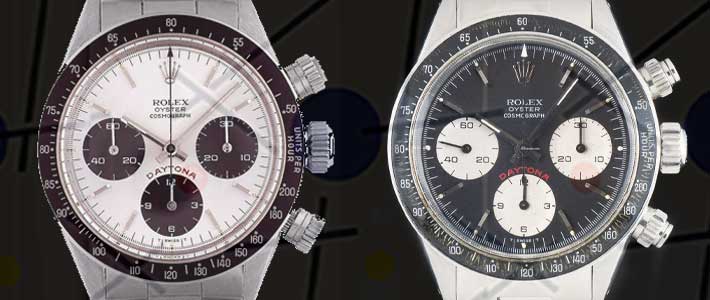
Rolex Cosmograph Daytona ref. 6263 Big Red, Bakelite bezel and screw-down pushers
With references 6263 and 6265, the manual Daytona reaches its most accomplished form. Both references use screw-down pushers and calibre 727, but are mainly distinguished by their bezel.
The 6263 uses a black bezel. The 6265 retains an engraved metal bezel. Both use an approximately 37 mm case, an acrylic crystal, a screw-down crown and calibre 727 running at 21,600 vibrations per hour with 17 jewels.
During their long careers, various highly sought-after dials appeared, including the famous Big Red versions, recognisable by the red DAYTONA inscription above the register at 6 o’clock. Sigma dials, gold configurations, typographic variations and other details can also help place a watch more accurately in time.
At this stage, Daytona expertise becomes a discipline in its own right. A rare dial may be exceptional, but its interest depends on its coherence with the case and period. An authentic Rolex bezel may belong to a later production run. Pushers replaced during service may function perfectly while altering the historical reading of the watch. A bracelet that is correct for a 6263 is not necessarily correct for every 6263.
Vintage therefore requires moving beyond binary vocabulary. A watch can be authentic while containing service parts. It can be coherent without retaining every component from its original delivery. It can be mechanically excellent while having lost some of its aesthetic appeal through repeated polishing.
On a manual Daytona, the right question always becomes: what does this watch have today, and how do these elements fit with its history?
The manual calibres: Valjoux 72, Rolex 722, 722-1 and 727
| Calibre | Architecture | Frequency | Jewels | Main references |
|---|---|---|---|---|
| 72B / 722 | Valjoux 72 architecture adapted to Rolex specifications | 18,000 vph | 17 | Early 6239, 6240, 6241 |
| 722-1 | Evolution of the 722 family | 18,000 vph | 17 | 6239, 6240, 6241 |
| 727 | Final Rolex manual evolution of this architecture | 21,600 vph | 17 | 6262, 6264, 6263, 6265 |
Reducing these movements to the expression “Valjoux 72” is therefore insufficient. Their lineage is obvious, but Rolex evolved the architecture, regulation and frequency throughout the Daytona’s life. The move to 21,600 vibrations per hour with calibre 727 represents a significant development.
These calibres are now several decades old. Their collector interest must never obscure their mechanical reality. A watch can start, stop and reset its chronograph while still showing insufficient amplitude, old lubrication, wear on certain components or traces of poorly executed previous intervention.
On a manual Daytona, the watchmaker therefore looks as closely at the state of the movement as at its number. Bridges, screws, springs, wheels, clutch, hammers, levers and lubrication points must all be examined according to one simple philosophy: preserve before beautifying.
MOSTRA ARCHIVE — LA REVUE DES MONTRES, ISSUE NO. 7

Mostra Archive: Thierry Serna and the Daytona at the Beginning of the 1990s
There are two ways of writing the history of a watch: reconstructing it several decades later or having had the opportunity to observe it while it was still new. In the case of the Daytona, Mostra can now confront these two perspectives.
At the beginning of the 1990s, around the arrival of the new automatic Rolex Daytona reference 16520, Thierry Serna co-authored in issue no. 7 of La Revue des Montres the first French article devoted to this new generation of the Cosmograph.
The difference in perspective is considerable. At the time, nobody yet routinely spoke of the “Zenith Daytona”, Floating Cosmograph, Inverted 6, Patrizzi or neo-vintage. Tritium was not a heritage material: it was simply the luminous material used by Rolex. Calibre 4030 was not yet a collectible movement: it was the contemporary engine of the new automatic Daytona.
The 40 mm case, sapphire crystal, crown guards, automatic winding and transformation of the El Primero architecture were then viewed as innovations. More than three decades later, those same characteristics have become historical markers capable of differentiating generations and, sometimes, the value of individual examples.

Thierry Serna archive — La Revue des Montres issue no. 7. Article devoted to the arrival of the automatic Rolex Cosmograph Daytona reference 16520. The original pages make it possible to compare the way the watch was seen when new with the collector’s perspective more than thirty years later.
This archive gives the present dossier something that a reconstructed chronology cannot provide: the perspective of the period itself. It makes it possible to distinguish what was then considered an innovation from what the market later transformed into a collecting characteristic.
A dial did not yet have a nickname. A typographic change did not yet have a price. A T-series watch was not “neo-vintage”. The 16520 was simply the new Daytona.
This new Mostra Daytona Atlas therefore extends a body of work begun more than thirty years ago: looking at the same watch at two moments in its existence, when it enters history and when it becomes history itself.
This archive has a usefulness that goes beyond memory. A collector always understands a watch better when two timelines can be compared: what was said about it when it was launched and what we know about it several decades later. The 16520 is particularly suited to this exercise because almost every detail that makes it collectible today was, at the time, simply a production characteristic.
1988: the Daytona 16520 and the great automatic transformation
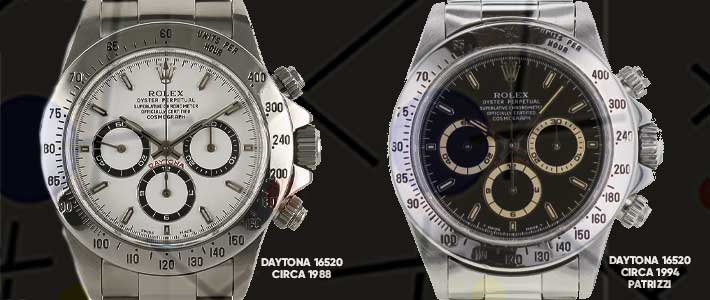
In 1988, Rolex transformed the Daytona more profoundly than at any other point in its history. The new reference 16520 did more than replace the 6263 and 6265. It changed the physical, aesthetic and mechanical scale of the watch.
The case grew to approximately 40 mm. Acrylic gave way to sapphire. Crown guards appeared. The dial received large applied and framed hour markers. The bracelet evolved. Above all, for the first time, the Daytona became an automatic chronograph.
Rolex turned to the Zenith El Primero calibre 400, an architecture already recognised for its integrated design and high frequency of 36,000 vibrations per hour. But the Geneva manufacture did not use it unchanged. It reworked it extensively to create Rolex calibre 4030.
The frequency was reduced to 28,800 vibrations per hour. The date was removed. The oscillator, escapement, winding system and various other elements were adapted to Rolex specifications. The movement contains 31 jewels and offers approximately 52 hours of power reserve.
This architecture must therefore be described precisely. Calibre 4030 is neither simply an El Primero in a Rolex case nor a movement entirely designed in Geneva. It represents a very deep reinterpretation of a great existing calibre.
It is precisely this intermediate position that gives it so much interest today. It tells the story of a period in which Rolex wanted a high-level automatic chronograph before having completed the development of its own in-house architecture.
Why is the Rolex Daytona 16520 called a “Zenith”?
The expression “Zenith Daytona” has become so common that it can give an overly simple impression of the mechanical reality. Yes, the Rolex Daytona 16520 owes its nickname to the Zenith El Primero movement used as the starting point for calibre 4030. No, Rolex did not simply install an existing El Primero inside its case.
The original Zenith movement runs at 36,000 vibrations per hour. Rolex reduced this frequency to 28,800 vibrations per hour, removed the date function and extensively modified the architecture to meet its own requirements for reliability, winding and regulation. A significant proportion of the components therefore differ from those of the Zenith calibre from which the 4030 originated.
The result represents an almost unique situation in modern Rolex history: a movement whose fundamental architecture originated outside the manufacture but whose execution was transformed sufficiently to become a Rolex calibre in its own right.
It is precisely this intermediate position that explains part of the fascination surrounding the 16520 today. It is both the first automatic Daytona and the last major Daytona to use a movement architecture originating from another manufacturer before the arrival of calibre 4130 in 2000.
Calling it a “Zenith Daytona” is historically convenient. Describing it as an El Primero simply cased by Rolex is technically incorrect.
Why did the 16520 become so important?
The 16520 arrived in a watch world undergoing rapid change. Quartz had transformed the Swiss industry. Interest in mechanical watches was beginning to rebuild. Rolex already had an extremely strong image, but the Daytona had not yet reached the commercial stature it would enjoy twenty or thirty years later.
The arrival of automatic winding changed the way the model was perceived. The 40 mm diameter gave it greater wrist presence. Sapphire modernised daily use. The design matched the sporting aesthetic of the late 1980s. Above all, constrained availability gradually helped turn the model into an object of desire.
The 16520 therefore marks a particularly clear boundary within Rolex collecting. On one side are the manual Daytonas: smaller, acrylic, firmly rooted in the 1960s and 1970s. On the other is a 40 mm chronograph whose silhouette is already modern enough to be worn today without feeling like an old watch.
This is exactly why the 16520 has become one of the great entry points into neo-vintage Rolex: old enough to offer dial variations, tritium luminous material and a true production history; modern enough to offer sapphire, automatic winding and a 40 mm presence.
Floating Cosmograph, Inverted 6 and 16520 dial generations
The 16520 production run between 1988 and 2000 saw several dial evolutions that are now heavily studied. This is where the vocabulary of collectors becomes particularly abundant.
On certain early versions, the word COSMOGRAPH is visually separated from the other lines of text beneath Rolex. This arrangement makes the word appear to float lower on the dial, hence the nickname Floating Cosmograph.
On certain generations, the numeral 6 in the hour counter at 6 o’clock is drawn in such a way that it almost looks like a 9. Collectors refer to this as the Inverted 6.
Other changes affect the numerals, thickness of certain inscriptions, line arrangement, register design and eventually the luminous material. Mark I to Mark V classifications have been developed to organise this progression, with some differences in terminology depending on the author.
The essential point lies elsewhere: these nicknames never constitute expertise by themselves. A Floating Cosmograph is only meaningful if its dial is coherent with the production period of the case. An Inverted 6 must be placed within the correct generation. Vocabulary helps analysis; it does not replace the serial number or examination of the dial.
Tritium, Luminova and the late 1990s
During most of the 16520 production run, Rolex used tritium for the hour markers and hands. This material, entirely normal at the time, evolves naturally as it ages. It may yellow, turn cream, remain very pale or show variations between dial and hands depending on exposure and storage conditions.
At the end of the 1990s, Rolex progressively abandoned tritium in favour of newer luminous materials. This transition now creates significant differences among the final 16520 watches.
A watch delivered in the mid-1990s with a tritium dial may later have received a Luminova dial during a Rolex service. That dial may be entirely authentic. The watch remains a genuine Rolex. But its historical configuration has changed.
This distinction is fundamental in the Daytona world: authentic does not necessarily mean faithful to the watch’s original delivery configuration. For a user, a newer dial may offer better night visibility. For a collector, a period-correct tritium dial may be far more interesting.
How can a Rolex Daytona 16520 be dated and placed within its production?
Reference 16520 remained unchanged for approximately twelve years, but its dial did not remain static. This is precisely what makes the generation so interesting to collect. The serial number provides a first chronological marker; the dial, luminous material, typography and certain register details can then be used to determine whether the complete watch tells the same period story.
| Indicative period | Dial markers | 6 o’clock register | Luminous material | Collector reading |
|---|---|---|---|---|
| 1988–approx. 1989 | Earliest generations, including Floating Cosmograph | Inverted 6 | Tritium | Early series particularly studied by collectors |
| Early 1990s | Intermediate evolutions in typography and dial text | Inverted 6 on several generations | Tritium | Compare dial, serial and bracelet |
| Late 1993–approx. 1997/98 | Broader and more angular subsidiary-register typography | Straight / regular 6 | Tritium | Period associated with certain black Patrizzi dials |
| 1998–1999 | Final tritium configurations followed by transition | Regular 6 | Tritium then Luminova | Transition period to be examined watch by watch |
| 1999–2000 | Final dial evolution | Regular 6 | Luminova, SWISS MADE signature | Final 16520 watches before calibre 4130 |
These periods are collecting guidelines rather than a stand-alone authentication tool. Rolex transitions do not always follow a perfectly defined calendar boundary. A dial must be compared with the serial number, bracelet, documents and the watch as a whole.
This precaution is essential: a watch may have received a perfectly genuine Rolex service dial during its life. A chronological discrepancy therefore does not automatically indicate a counterfeit; it may reveal a service intervention that needs to be identified and incorporated into the history of the individual watch.
Patrizzi: ageing that becomes a collecting category
The term Patrizzi is probably one of the most misunderstood expressions in the modern Daytona world. It refers neither to a Rolex reference, nor to a dial option, nor to a finish that could be ordered at the time.
Certain black 16520 dials produced mainly during the mid-1990s may see the silver-coloured rings around their subsidiary registers evolve towards beige, chocolate or brown tones. The market associated this phenomenon with the name Osvaldo Patrizzi.
On the most attractive examples, the transformation is progressive and harmonious. The rings gain warmth while retaining the sharpness of the printing. Each dial evolves differently, which explains the fascination these variations now generate.
It would nevertheless be a mistake to call every brown mark around a register Patrizzi. The evolution must be natural, coherent, compatible with the period and free from retouching. A dial damaged by moisture or poorly restored does not gain value simply because its colour has changed.
Patrizzi is not a Rolex finish. It is the name given by the market to a particular chromatic evolution of certain dials.
Mostra case study: reading a 1996 series T Daytona 16520 with white dial
This is where the article changes nature. It is no longer simply about telling the story of the Daytona; it is about understanding how to read a real example.
A 1996 series T Rolex Daytona 16520 with white dial is a particularly interesting watch. It belongs to the final years of the great tritium period, naturally uses calibre 4030 and sits exactly in that zone where the Daytona is still a late twentieth-century contemporary watch while now becoming a neo-vintage collector piece.
At first glance, everything seems simple: steel, white dial, three registers, metal tachymeter bezel, Oyster bracelet. But expertise begins precisely when the watch stops being viewed as a whole and each detail starts to be read individually.
The serial number must be compared with the announced year. The dial must correspond to the expected generation. Tritium must be coherent. The hands must be examined for their luminous material and period. The tachymeter bezel must correspond to the generation. The pushers and crown must be of the correct type and operate normally.
The case requires particular attention. On a 16520 now approaching thirty years of age, previous polishing may have altered lug thickness, symmetry or the transition between polished and brushed surfaces. A very shiny watch is therefore not necessarily better preserved than one carrying a few marks from use.
The bracelet and clasp are then compared with the period. Their reference, end links, wear and any replacement must be understood. A more recent Rolex bracelet remains authentic; its influence on collector value depends on the buyer’s objective.
Finally comes calibre 4030. The workshop checks rate, amplitude where relevant, winding, power reserve and chronograph operation. Start, stop, totalisation and zero reset must be crisp. On a collectible chronograph, a hand that does not return exactly to its marker should always be understood.
This Daytona 16520 perfectly illustrates a central Mostra conviction: the reference gives the watch its name; examining the individual example reveals its true quality.
A Daytona 16520 seen by Mostra: what we examine and why
| What we examine | What we are trying to understand | What it can change |
|---|---|---|
| T series / period | Chronological coherence of the individual watch | Identification and heritage interest |
| White dial | Generation, typography, condition and possible replacement | Originality and collector value |
| Tritium | Compatibility with the period and ageing | Historical coherence |
| Hands | Period, luminous material and consistency | Original or service interpretation |
| Bezel | Generation, engravings and condition | Coherence and preservation |
| Case | Volumes, lugs, edges and polishing | Preservation quality and value |
| Bracelet / clasp | Reference, period, play and possible replacement | Coherence, use and value |
| Calibre 4030 | Condition, rate, winding and intervention history | Reliability and future servicing cost |
| Chronograph | Start, stop, totalisation and zero reset | Real functional condition |
| Set and provenance | Documentary continuity of the watch | Traceability and heritage value |
None of these criteria should be considered in isolation. The interest of an individual example appears when several pieces of information converge. This convergence is what allows us to move from simply identifying a reference to genuinely understanding the watch.
To analyse a specific example, its configuration, components and historical coherence, discover our Rolex and collector’s watch appraisal service.
Why do two Daytona 16520 watches not have the same value?
Take two watches with the same reference, the same approximate year and the same dial colour.
The first retains its period-correct tritium dial, hands from the same generation, a bezel consistent with the period, a case with well-preserved volumes, a correct bracelet, a healthy calibre 4030 and enough documentation to understand its history.
The second carries a more recent Rolex service dial, Luminova hands, a replacement bezel, a case that has undergone several polishes, a later bracelet and a movement requiring a major overhaul.
Both are authentic Rolex Daytona 16520 watches. Both use the same base calibre. Both may be presented in a photograph as perfectly desirable Zenith Daytonas.
Their interest is nevertheless not the same.
This difference explains why an average market price found online is never enough to determine the real value of a Daytona. Price must be placed within a broader matrix: reference, series, dial, condition, coherence, movement, bracelet, set, service history, provenance and overall quality.
Mostra develops this method further in its guide What Is My Watch Really Worth? The Twelve Criteria That Determine Its Value on the Pre-Owned Market.
2000: the Daytona 116520 and Rolex calibre 4130
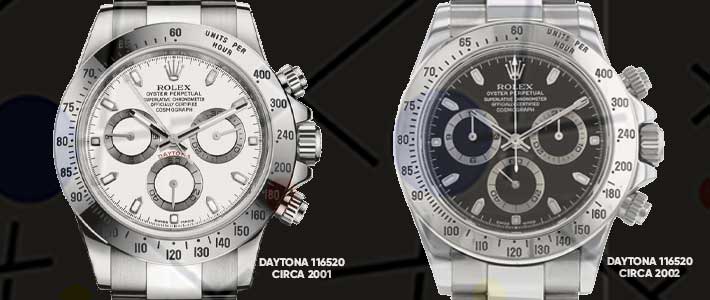
At Baselworld 2000, Rolex unveiled the *Daytona 116520* with the in-house Caliber 4130 movement: only 201 components, longer power reserve (72 hours), improved winding efficiency (+68%), and COSC certification. It featured a *Parachrom* hairspring and *Paraflex* shock protection, with ceramic bearings for smoother operation and reduced maintenance.
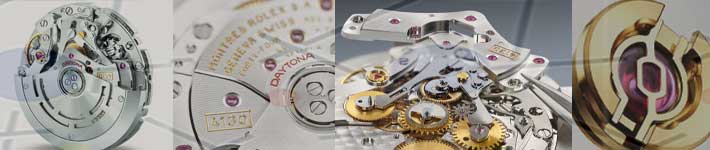
In 2000, Rolex crossed another frontier with reference 116520. Externally, the watch retained the main codes established by the 16520: 40 mm case, sapphire crystal, screw-down pushers, metal tachymeter bezel and Oyster bracelet. Inside, almost everything changed.
The new calibre 4130 was entirely developed by Rolex. The manufacture finally had its own integrated automatic chronograph architecture. The movement runs at 28,800 vibrations per hour, contains 44 jewels and offers approximately 72 hours of power reserve after a full wind.
The chronograph uses a column wheel and a vertical clutch. This architecture promotes a clean start of the central seconds hand and allows the chronograph to be used with great fluidity. Rolex also reduced the number of components dedicated to the chronograph function, simplifying the architecture and making certain adjustment and servicing operations easier.
The dial layout gives the knowledgeable eye an immediate clue. On the 16520, running seconds are at 9 o’clock and the 12-hour counter at 6 o’clock. On the 116520, running seconds move to 6 o’clock and the chronograph hour counter shifts to 9 o’clock.
The change appears modest. Yet it reveals a radically different movement.
16520 and 116520: two Rolex philosophies face to face

Placing a 16520 and a 116520 side by side allows almost fifteen years of Rolex evolution to be read in a matter of seconds.
The 16520 has the particular visual lightness of Rolex watches from the late 1980s and 1990s. The registers, markers and proportions retain a certain delicacy. Its calibre 4030 tells the story of a transitional period in which Rolex took a great existing architecture and reshaped it to its own standards.
The 116520 appears denser. Its dial is reorganised, its markers gain presence and calibre 4130 expresses another industrial philosophy: the manufacture now controls the entire architecture of its automatic chronograph.
On the pre-owned market, these two watches therefore attract collectors who are sometimes looking for very different things. The 16520 appeals through its neo-vintage character, dial variations and Zenith movement history. The 116520 attracts the buyer seeking an already modern Daytona that is easy to wear while still offering the first generation of calibre 4130 and the final great era of the steel bezel.
Unisex Icon of the 21st Century
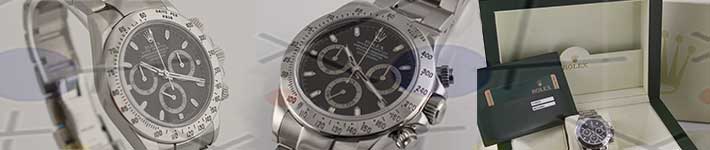
The 40mm case of the Daytona 116520 redefined luxury watches for both men and women. Since Sharon Stone wore a 40mm Sea-Dweller in Sphere, the unisex trend had taken off—Daytonas became a fashion statement beyond gender.

The 116520: a future neo-vintage already changing status
Produced until 2016, the 116520 now occupies a particularly interesting zone. The earliest examples are more than a quarter of a century old. The way they are read is therefore beginning to change.
Details that once seemed secondary are gradually becoming more important: clasp type, bracelet generation, condition of the steel bezel, dial configuration, complete set, original sales documents and service history.
A 2004 series F 116520 full set, for example, is no longer read exactly like a recent Daytona. It belongs to the first part of the calibre 4130 era and documents a period when Rolex was still far removed from the black ceramic bezel that would later become one of the most recognisable signatures of the steel Daytona.
2016: the 116500LN and the arrival of the Cerachrom bezel
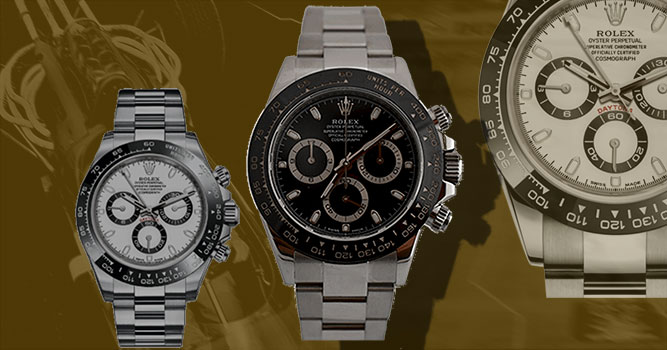
In 2016, Rolex introduced reference 116500LN. Calibre 4130 remained, the official diameter stayed at 40 mm and the overall dial arrangement evolved relatively little. But one element radically changed the perception of the watch: the metal bezel was replaced by a black Cerachrom bezel.
This ceramic offers strong resistance to scratches and colour alteration. Visually, it mainly gives the steel Daytona a much more contrasted identity. On the white dial, the result loosely evokes the great panda chronographs of the past. On the black dial, the watch takes on a more homogeneous and sporting presence.
The difference between the two generations becomes extremely easy to remember: 116520, steel bezel; 116500LN, black Cerachrom bezel.
The commercial success of the 116500LN amplified a phenomenon already established over several generations: the steel Daytona became extremely difficult to obtain through the primary retail network. On the secondary market, premiums reached extraordinary levels during the speculative phase that peaked around 2021 and 2022 before correcting.
This sequence is a reminder of an essential rule: the desirability of a model and the evolution of its price never follow a perfectly straight line. A watch can remain extraordinarily sought after while its secondary-market price falls after a period of excess.
Commercial scarcity and patrimonial rarity: do not confuse the two
The modern Daytona has largely popularised a confusion between two forms of rarity.
A watch can be difficult to obtain at retail. This commercial scarcity results from a gap between demand and availability. It can create a premium on the secondary market and considerable frustration among buyers.
An older watch can be rare by survival. Few examples may have been produced in a precise configuration, even fewer may have passed through fifty years without major alteration, and fewer still may retain dial, case and components in a state sought by collectors.
A difficult-to-buy 116500LN and an authentic 6239 Paul Newman can therefore both be called rare in everyday conversation even though they belong to two completely different phenomena.
Commercial scarcity measures difficulty of access. Patrimonial rarity measures the small size of a coherent surviving population.
2023: the Daytona 126500LN and calibre 4131
In 2023, for the sixtieth anniversary of the Cosmograph, Rolex renewed the Daytona family. The steel reference became 126500LN.
At first glance, continuity dominates. The official diameter remains 40 mm, the black Cerachrom bezel stays in place, and the two main black and white dial options continue to structure the steel range. Yet almost every proportion has been subtly reworked: case, hour markers, hands, counter rings and the visual relationship between dial and bezel.
Inside appears calibre 4131. The movement retains the fundamental architecture that made calibre 4130 so successful: automatic winding, column wheel and vertical clutch. Rolex nevertheless adds the Chronergy escapement, blue Parachrom hairspring, Paraflex shock absorbers, an openworked oscillating weight and a specific decoration known as Rolex Côtes de Genève.
The calibre runs at 28,800 vibrations per hour and retains approximately 72 hours of power reserve. The steel Daytona 126500LN remains water-resistant to 100 metres and keeps its screwed metal caseback.
The 2023 generation therefore represents a subtler evolution than 1988 or 2000. Rolex does not reinvent the Daytona; the manufacture refines an object that has reached a very high level of maturity.
16520, 116520, 116500LN or 126500LN: four Daytonas, four eras
These four references can appear to belong to one continuous aesthetic lineage. Yet they represent three mechanical breaks and one major transformation of the bezel. For anyone choosing between several generations of pre-owned Daytona, this table makes the differences immediately understandable.
| Characteristic | 16520 | 116520 | 116500LN | 126500LN |
|---|---|---|---|---|
| Period | 1988–2000 | 2000–2016 | 2016–2023 | Since 2023 |
| Calibre | 4030 | 4130 | 4130 | 4131 |
| Mechanical origin | Deeply transformed Zenith base | Rolex manufacture | Rolex manufacture | Rolex manufacture |
| Frequency | 28,800 vph | 28,800 vph | 28,800 vph | 28,800 vph |
| Power reserve | Approx. 52 h | Approx. 72 h | Approx. 72 h | Approx. 72 h |
| Running seconds | 9 o’clock | 6 o’clock | 6 o’clock | 6 o’clock |
| Steel bezel | Yes | Yes | No | No |
| Cerachrom | No | No | Yes | Yes |
| Collector position | Neo-vintage / Zenith | First 4130 generation | Modern ceramic icon | Current generation |
The 16520 appeals to collectors looking for dial history and a transitional movement. The 116520 retains the steel bezel while introducing calibre 4130. The 116500LN definitively brings the steel Daytona into the Cerachrom era. The 126500LN continues this aesthetic with the 4131 mechanical generation.
The transparent caseback: a feature that does not apply to every new Daytona
The 2023 generation also introduced a feature long unusual at Rolex: on certain versions, the movement becomes visible through a transparent sapphire caseback.
It would nevertheless be inaccurate to generalise this characteristic to every Daytona of the new generation. The steel 126500LN retains a screwed metal Oyster caseback, while certain platinum references reveal calibre 4131 through a transparent back.
This type of detail may seem secondary. Yet it perfectly illustrates the level of precision required when writing about the Daytona: a feature that is true on one version can become false when applied to the entire family.
Daytona Le Mans: when automotive history returns inside the movement
In 2023, Rolex also created a particular Daytona to celebrate the centenary of the 24 Hours of Le Mans. Reference 126529LN in white gold adopted graphic codes recalling certain historic dials and displayed a red 100 on its tachymeter scale.
Its most interesting feature, however, lies in the movement. Calibre 4132 modifies the chronograph hour counter so that it can totalise 24 hours, directly referencing the duration of the Le Mans race.
It is a particularly successful detail because the relationship with motorsport is no longer based solely on a colour or inscription. It becomes mechanical: the movement itself adopts the duration of the race it celebrates.
The Rolex Daytona has never been only a steel watch
Daytona history is generally told through the steel references because they concentrate much of the attention of collectors: 6239, 6263, 16520, 116520, 116500LN and then 126500LN. Yet reducing the Cosmograph to this single lineage would give an incomplete picture of its history.
From the automatic generation introduced in 1988, Rolex offered the new architecture in several metals. Alongside the steel 16520 appeared the 16523 in yellow-gold-and-steel Rolesor and the 16528 in yellow gold. Other precious-metal and leather-strap versions also enriched the Zenith generation.
With calibre 4130, the range broadened further. Alongside the steel Daytonas came Rolesor, yellow gold, white gold and later Everose versions. Certain configurations received particularly sophisticated dials, gem-set markers or bracelets different from the traditional Oyster.
The arrival of ceramic and then the Oysterflex bracelet opened another branch of the contemporary Cosmograph. Yellow-gold, white-gold and Everose references combined the sporting character of the Daytona with a more precious approach, while platinum occupied the summit of the family.
This diversity also changes the way the market must be read. A gold Daytona does not necessarily follow the same liquidity criteria as a steel Daytona. Some precious-metal dial configurations were produced in small numbers and can become extremely desirable, while others remain more accessible than their steel equivalents despite having a higher intrinsic material value.
| Generation | Steel | Rolesor | Precious metals |
|---|---|---|---|
| Zenith / 4030 | 16520 | 16523 | 16528 and other family variants |
| 4130 | 116520 / 116500LN | 11652x family | Yellow gold, white gold, Everose and platinum depending on generation |
| 4131 | 126500LN | Current Rolesor versions | Yellow gold, white gold, Everose, platinum and Oysterflex depending on reference |
For the collector, material is therefore never merely an additional element of luxury. It defines another branch of Daytona production, with its own dials, production volumes, uses and market dynamics.
The main Rolex Daytona references at a glance
| Reference | Indicative period | Calibre | Winding | Crystal | Pushers | Collector landmark |
|---|---|---|---|---|---|---|
| 6239 | 1963 – approx. 1969/70 | 72B / 722 / 722-1 | Manual | Acrylic | Pump | First Cosmograph |
| 6241 | 1960s | 722 / 722-1 | Manual | Acrylic | Pump | Black bezel |
| 6240 | Approx. 1965–1969 | 722 / 722-1 | Manual | Acrylic | Screw-down | Oyster precursor |
| 6262 | Approx. 1970–1972 | 727 | Manual | Acrylic | Pump | Transitional reference |
| 6264 | Approx. 1970–1972 | 727 | Manual | Acrylic | Pump | Black bezel, transitional reference |
| 6263 | 1970s–1980s | 727 | Manual | Acrylic | Screw-down | Black bezel, Big Red |
| 6265 | 1970s–1980s | 727 | Manual | Acrylic | Screw-down | Steel bezel |
| 16520 | 1988–2000 | 4030 | Automatic | Sapphire | Screw-down | Zenith, Floating, Inverted 6, Patrizzi |
| 116520 | 2000–2016 | 4130 | Automatic | Sapphire | Screw-down | First Rolex automatic chronograph calibre developed entirely in-house |
| 116500LN | 2016–2023 | 4130 | Automatic | Sapphire | Screw-down | Cerachrom bezel |
| 126500LN | Since 2023 | 4131 | Automatic | Sapphire | Screw-down | Current generation |
The production periods of the manual-wind Daytonas are deliberately presented as indicative. References overlap and certain configurations vary according to market and year. A date shown in a table should never be used on its own to authenticate a watch.
Appraising and Buying a Pre-Owned Rolex Daytona: Why Two Examples Can Have Very Different Values
This is probably the most important chapter for understanding modern collecting.
A front-facing photograph shows a dial, bezel, case and bracelet. It shows the exact geometry of the lugs very poorly, as well as the depth of polishing, condition of the caseback, internal bracelet reference, state of the movement and nature of certain replaced parts. It says nothing about rate, amplitude or power reserve. Nor does it reveal whether the chronograph hands return perfectly to zero after reset.
This is why buying a pre-owned Daytona should never be reduced to the formula “same reference = same value”.
The experienced collector often begins with what is not immediately visible. He or she looks at the amount of metal remaining on the case, the quality of the edges, coherence of the brushing, opening marks, bracelet play and compatibility of components with the period.
The dial is then examined. On some references, a simple variation in typography can completely change the degree of rarity. On a black 16520, an authentic Patrizzi evolution can become a decisive element. On a manual Daytona, an original and correctly attributed exotic dial may represent a considerable part of the value.
Finally comes the history. A full set with original guarantee, old invoice and service documentation can help reconstruct a trajectory. A watch without papers can naturally be exceptional, but it requires more documentary work.
Polishing: one of the most misunderstood questions surrounding the Daytona
A worn watch gets scratched. This is an obvious fact that the market sometimes forgot. For decades, owners naturally asked for their watches to be polished during service. They wanted to receive them back clean and bright.
Collector culture gradually reversed this perception. On an old Daytona, a lightly marked but well-preserved case may now be preferred to a visually perfect watch whose lugs have been rounded and original transitions erased by repeated polishing.
The reason rests on a simple physical rule: a scratch lies on the surface; metal removed during polishing never comes back.
This does not mean that a polished watch is automatically uninteresting. A light polish, correctly executed and respectful of the original geometry, can be perfectly acceptable. What matters is the amount of material removed and the quality of the work.
At Mostra, this criterion is always placed within the context of the watch as a whole. A lightly polished but highly coherent case may represent a much better purchase than a supposedly “unpolished” example whose description does not survive close examination.
This approach is consistent with the findings of the Mostra Observatory 2026, based on 100 pre-owned watches inspected by our workshop: a shiny case never tells the full story of its actual condition.
Rolex service parts: original, authentic, compliant… words matter
An old Daytona may have been serviced several times during its life. During these interventions, Rolex or a watchmaker may have replaced a crown, pushers, bezel, hands, dial, spring or another mechanical component.
These replacements can be entirely justified. A gasket or spring is a wear part. A damaged crown can compromise water resistance. A defective pusher can make the chronograph unsafe to use.
In collecting, the question changes depending on the part replaced. Replacing an internal spring usually does not alter the visual reading of the watch. Replacing a tritium dial with a Luminova dial, however, immediately changes its appearance and heritage interest.
This is why the terminology must remain precise:
Original: a part present from the first known configuration or coherent with the watch’s original delivery.
Authentic: a part genuinely produced by Rolex.
Service: a Rolex part installed later during maintenance.
Compliant: a part technically appropriate for the model even if it does not necessarily belong to the same period.
Non-compliant: a part incompatible with the reference, period or expected configuration.
A good description does not try to simplify this reality. It explains it.
The full set: important, but never more important than the watch
Box, certificate, punched guarantee or card, booklets, tags, service invoices and maintenance documents constitute the external memory of the watch. Their presence can naturally influence price, especially on a model as collectible as the Daytona.
But the full set should never become a screen. A poor watch surrounded by all its accessories remains a poor watch. A remarkable Daytona without its box can retain far more interest than a heavily altered example accompanied by all of its papers.
The set gains its true value when it completes a watch that is already coherent. It then becomes an element of provenance, sometimes capable of confirming a sale date, country of origin, owner or service chronology.
BUYING A PRE-OWNED ROLEX DAYTONA: 8 MISTAKES TO AVOID
1. Buying the nickname before buying the watch.
Paul Newman, Patrizzi, Floating Cosmograph or Inverted 6 never remove the need to examine the coherence of the individual example.
2. Considering every brown colour change to be Patrizzi.
A desirable chromatic evolution must be natural, coherent and compatible with the period. Dial deterioration does not automatically become collectible patina.
3. Confusing genuine Rolex with original configuration.
A Rolex service dial or bezel can be completely genuine while being more recent than the watch.
4. Believing that a full set compensates for a poor watch.
Papers complete a good example; they cannot recreate an original dial or replace the metal lost from an excessively polished case.
5. Confusing a shiny watch with a well-preserved watch.
A brilliant finish can sometimes conceal several previous polishes. On an older Daytona, case volumes often matter more than the absence of scratches.
6. Buying a 16520 from its year alone.
Dial, luminous material, bracelet and service parts must be compared with the serial number.
7. Checking the time but forgetting the chronograph.
A Daytona can keep correct time while still requiring work on its chronograph mechanism.
8. Failing to check zero reset.
After the chronograph has been activated, all hands must return precisely to their markers. Any misalignment should always be understood before purchase.
The 12 Mostra checks on a pre-owned Rolex Daytona
1. Reference and serial number
Precisely identify the generation and place the watch within its period.
2. Dial
Type, typography, luminous material, signature, condition, chronological coherence and possible service replacement.
3. Hands
Generation, luminous material, condition and coherence with the dial.
4. Tachymeter bezel
Type, engravings, wear, generation and possible replacement.
5. Crown
Type, screw-down action, function and period coherence.
6. Chronograph pushers
Correct version, screw-down operation, play, function and water resistance when relevant.
7. Case
Lugs, volumes, edges, symmetry, polished and brushed surfaces, impact marks and quality of any previous polishing.
8. Calibre
Movement reference, general condition, traces of previous intervention and technical coherence.
9. Chronograph function
Start, stop, totalisation, precise zero reset and pusher feel.
10. Mechanical condition
Rate, amplitude where measurable, winding and power reserve after a full wind.
11. Bracelet and clasp
References, end links, generation, wear, play and coherence.
12. Set, documents and provenance
Guarantee, box, invoices, servicing, known history and documentary coherence.
On a Daytona, particular attention is always paid to the zero reset of the chronograph hands. A slight misalignment is not always dramatic, but it must be identified. On a valuable chronograph, the precision of this function forms part of the real mechanical condition.
These Daytona-specific checks form part of a broader method for documenting the condition of a pre-owned watch. Read the Mostra Watch Health Record and its 12 essential checks.
If the watch shows abnormal timekeeping, winding problems, chronograph malfunction or an irregular zero reset, a watch diagnosis can determine the appropriate intervention before any full service is considered.
Wearing, Servicing and Collecting a Rolex Daytona
Can a vintage Rolex Daytona really be worn every day?
The Daytona was born as a tool watch. Its chronograph was designed to measure short intervals of time, its tachymeter bezel to convert duration into average speed and its case to accompany the world of motor racing. But a natural question arises when the watch is thirty, fifty or sometimes more than sixty years old: can a vintage Daytona still be expected to fulfil today the programme for which it was originally designed?
The answer depends greatly on the generation, but even more on the individual example.
A 6239, 6241, 6240, 6262, 6264, 6263 or 6265 is now a historic watch. Its acrylic crystal, pushers, dial, chronograph components and, in some cases, the exceptional value of its configuration encourage thoughtful use. A perfectly checked 6263 can obviously be worn. That does not mean it is sensible to treat it like a modern Daytona, expose it regularly to water or activate its chronograph dozens of times every day without knowing the condition of the movement.
The 16520 changes the situation considerably. Its sapphire crystal, 40 mm diameter, automatic winding and Oyster architecture still give it remarkable ease of use today. A mechanically healthy 16520 whose crown, pushers and water resistance have been checked can make an outstanding daily watch. One simply has to remember that a watch from 1988 is now approaching forty years old and that a 1996 example is close to thirty. The word “modern” describes its architecture here, not its actual age.
The 116520, 116500LN and 126500LN are naturally better suited to intensive everyday wear. Their automatic calibres, sapphire crystals, Oyster construction and significant power reserve allow them to be worn as true contemporary sports watches.
The Mostra rule nonetheless remains the same whatever the generation: a Daytona’s ability to be worn is never deduced from its reference alone. It is verified on the watch itself.
IS A VINTAGE DAYTONA STILL WATER-RESISTANT?
The presence of a screw-down crown and screw-down pushers never guarantees current water resistance. Gaskets age, the crown tube can wear, pushers may have been replaced or incorrectly refitted and the caseback may have been opened dozens of times.
Before any significant exposure to water, a vintage Daytona must be tested. On particularly rare or historically important pieces, the most rational decision may simply be not to immerse them anymore.
Using the Daytona chronograph: the complication is not merely decorative
The fame of the Daytona has sometimes ended up obscuring its function. A Cosmograph remains, above all, a chronograph.
The upper pusher starts and stops timing. The lower pusher resets the chronograph after it has been stopped. The registers record minutes and, depending on the generation, elapsed hours. The central seconds hand becomes the chronograph seconds hand when the function is activated.
In everyday life, this complication can measure a journey, parking time, cooking time, a meeting, a sporting interval or any other short duration. The tachymeter bezel can theoretically calculate average speed when the distance travelled is known.
On a vintage Daytona, however, this use must remain proportionate to the condition of the movement. A poorly maintained calibre 727 or 4030 may still “work” while showing wear or degraded lubricants. The fact that a chronograph starts and returns to zero therefore never constitutes a complete health check by itself.
Before restoring a vintage Rolex Daytona
BEFORE REMOVING A MARK, YOU NEED TO KNOW WHAT IT IS TELLING YOU
A lightly patinated dial, tritium that has turned cream, a marked bezel, a bracelet showing its age or a case carrying a few scratches are not necessarily defects that need to be corrected.
On a collectible Daytona, an irreversible cosmetic intervention can sometimes remove part of the history that the market was precisely looking for.
Before any restoration, Mostra therefore recommends identifying what is worn, what is damaged, what is simply old and what genuinely needs to be replaced to ensure the mechanical safety of the watch.
This distinction is particularly important for the dial and hands. Homogeneous and stable tritium should not be replaced simply because it no longer glows. The loss of luminosity is precisely one of the normal consequences of its age. On certain Daytonas, replacing an old dial with a new Rolex service dial improves night-time usability but radically changes the historical interest of the watch.
The same caution applies to the case. Polishing is not always necessary. A light scratch can be less important than a perfectly preserved edge. On a vintage watch, the pursuit of a new appearance should never become automatic.
Mechanical restoration follows a different logic. A tired spring, damaged wheel, dried gasket or worn chronograph component should be treated when necessary for the operation and long-term preservation of the movement. Preserving a watch does not mean refusing to maintain it; it means intervening with discernment.
For a vintage or collectible Daytona, this preservation-first approach is central to our work with vintage and antique watches. When the movement requires a complete overhaul, you can also consult our watch servicing service.
Which Rolex Daytona should you choose today?
The question seems simple, but it covers very different uses and collecting cultures. There is no universally “best” Daytona. There is a Daytona that is more coherent with the way each collector wants to collect and wear his or her watch.
For the vintage Rolex collector
The 6239, 6241, 6240, 6262, 6264, 6263 and 6265 form the historical heart of the family. Acrylic crystals, manual winding, calibres 722 or 727, multiple dials, pump or screw-down pushers, metal or black bezels: their diversity is extraordinary.
In return, they require the highest level of knowledge before purchase. On these references, a dial, bezel or case can radically alter the value of the watch. An authentic and coherent Paul Newman is not simply a more desirable variation: it belongs to another layer of the collector market.
For someone entering the Rolex neo-vintage world
The 16520 is probably one of the most fascinating propositions in the entire range. It retains tritium through most of its production, has a real chronology of dials, a historically important movement and an aesthetic modern enough to be worn very easily.
It also offers remarkable collecting depth: early series, Floating Cosmograph, Inverted 6, dial variations, luminous-material transition, Patrizzi on certain black versions, successive bracelets and clasps. A single reference can therefore become an almost autonomous collecting field.
For someone who wants to collect and wear very regularly
The 116520 may represent the best balance. It retains the historic steel bezel while using Rolex calibre 4130. Its sapphire crystal, approximately 72-hour power reserve and modern construction make it extremely easy to live with.
Its earliest production years are gradually entering the neo-vintage world. Set, series, bracelet, clasp and case quality are already beginning to differentiate examples more clearly.
For someone looking for the modern Daytona that became instantly recognisable
The 116500LN combines calibre 4130 with the black Cerachrom bezel. It is probably the silhouette that most strongly established the contemporary image of the steel Daytona among a new generation of enthusiasts.
For someone who wants the current generation
The 126500LN offers calibre 4131, a slightly redesigned architecture and Rolex’s current technical developments. It remains visually very close to the 116500LN, but differences in proportions, registers, hour markers and movement give each its own identity.
The right Daytona is not necessarily the most expensive or the rarest. It is the one whose era, configuration and condition match the collector’s project.
To compare references and configurations currently available, browse our selection of pre-owned Rolex Daytona watches, then explore all our pre-owned Rolex watches.
What really determines the value of a Rolex Daytona?
The Daytona is probably one of the watches for which the idea of a “market price” is most misleading. Two identical references can trade at significantly different levels, and two Daytonas that look very similar can belong to almost unrelated collector markets.
The reference forms the first level. A 6239, a 16520 and a 116500LN obviously do not belong to the same market. But within a reference, the configuration quickly takes over.
On a manual Daytona, the dial can become decisive. On a 16520, its generation, luminous material and certain chromatic evolutions can create significant differences. On a 116520, year, set, bracelet and level of preservation are gradually structuring a more segmented market.
The case is then one of the most important criteria. Well-preserved geometry reflects the conservation of the watch. Excessive polishing is irreversible and can strongly affect the interest of an older piece.
The movement must be correct for the reference and present a condition compatible with calm use and preservation. A recent service is not automatically an advantage if it was accompanied by significant undocumented replacements. Conversely, a supposedly “never opened” watch may conceal several decades of dried lubricants and wear.
Finally come the bracelet, documents, set, service history and provenance. Their importance increases when the watch itself already possesses strong coherence.
To explore this method in greater depth, Mostra has dedicated a complete dossier to the real value of a watch and the twelve criteria that determine it on the pre-owned market.
The Daytona market: rarity, availability and speculation
The Daytona now has a particular characteristic: it belongs simultaneously to the history of collecting and to the history of the contemporary watch market.
Rare manual Daytonas follow a logic of historical survival. Their population is limited not only by original production but also by the decades that have passed, transformations, dial replacements and polishing. The more a desirable configuration has been preserved, the smaller the genuinely comparable population becomes.
Modern steel Daytonas have experienced another form of rarity: commercial availability far below demand. This tension fuelled substantial premiums on the secondary market, particularly visible during the strong growth of the watch market from the late 2010s to 2022.
These phenomena should not be confused. A recent Daytona can be difficult to obtain without being rare in the historical sense. An old Daytona can be relatively accessible in a standard configuration and extremely rare in another.
The secondary market also offers another lesson: no watch rises mechanically and continuously in value. Price levels respond to supply, demand, economic context, collecting trends and the quality of the examples available.
The Daytona remains one of the most desirable watches in its category. That desirability is a market fact. It should never be confused with a promise of return.
Is the Rolex Daytona an investment?
The question arises almost inevitably whenever the Daytona is discussed. Its perceived rarity, auction records, the spectacular rise of certain vintage references and the premiums observed on several modern generations have helped establish the idea that a Daytona is naturally an investment. That interpretation is too simplistic.
The Daytona is first and foremost a watch, and then a collector’s object. Above all, not all Daytonas belong to one single market. An early 6239 in a rare and perfectly preserved configuration, a Zenith 16520 with a coherent dial, a neo-vintage 116520 and a recent 126500LN do not follow the same criteria of rarity, attract the same buyers or respond to the same price dynamics.
On older references, value depends heavily on the configuration, originality of the dial, preservation of the case, coherence of the components and provenance. A genuinely rare and well-preserved piece can evolve according to a long-term heritage logic because the number of truly comparable examples naturally tends to decrease.
On modern references, part of the price may instead reflect an availability premium, meaning the gap between demand and the possibility of obtaining the watch new through the official retail network. That premium can change rapidly with the market and should not be confused with historical rarity.
No future increase in value can therefore be guaranteed. The price of a Daytona depends on supply, demand, economic conditions, collecting trends and, above all, the quality of the individual example. A watch purchased at too high a price can remain an excellent Daytona while still being a poor investment.
At Mostra, we therefore prefer to speak of heritage value rather than return: buying the right reference, in the right configuration, in the right condition and at the right price remains more important than trying to predict the market’s next move.
Why buy a pre-owned Rolex Daytona from Mostra?
To view current stock, go directly to our selection of pre-owned Rolex Cosmograph Daytona watches.
Buying a pre-owned Daytona is not simply a matter of choosing a reference, a year and a dial colour. It means understanding precisely which watch is in front of you.
At Mostra in Aix-en-Provence, the historical and commercial reading of the watch is combined with the technical examination carried out by our workshop. This dual approach is particularly important with the Daytona, where a dial detail, replacement bezel, previous polishing or intervention on the chronograph can affect both usability and value.
A 1996 tritium 16520 is therefore not prepared with exactly the same philosophy as a recent 116500LN. On the former, preservation of the dial, hands and case geometry can take on considerable historical importance. On the latter, mechanical reliability, chronograph operation and overall condition respond more directly to the requirements of a contemporary daily watch.
Each Daytona selected by Mostra is therefore assessed according to its generation. Reference, dial, hands, case, bezel, bracelet, movement and documentation are compared with one another before the watch is offered for sale.
When the watch requires it, it is checked or serviced by the Mostra watchmaking workshop. The chronograph is tested, rate and winding are checked, power reserve can be measured and the mechanical condition is incorporated into the presentation of the watch.
Watches prepared and sold by Mostra benefit from a certificate of authenticity and a three-year warranty, together with follow-up from our workshop.
In the case of the Daytona, this approach also has a particular continuity. Thierry Serna was already writing about the new 16520 reference in La Revue des Montres at the beginning of the 1990s, when the model was still new and the terms Floating Cosmograph, Patrizzi or neo-vintage had not yet shaped today’s collecting vocabulary. More than three decades of market observation now make it possible to compare that first perspective with the view created by experience.
Buy, Appraise, Service or Sell a Rolex Daytona
Do you own a 6239, 6263, 6265, Zenith Daytona 16520, 116520, 116500LN, 126500LN or another Cosmograph configuration? Precise identification of the watch is always the first step before any decision involving purchase, servicing, insurance or sale.
Mostra can assist you in identifying a Daytona, checking its configuration, establishing its mechanical condition, understanding the possible presence of Rolex service parts, assessing its historical coherence and determining its value on the current pre-owned market.
If you are considering selling your Daytona, the real condition of the watch, its reference, dial, set and history must all be taken into account before an estimate is established. An apparently minor difference between two examples can represent a significant value gap.
Discover pre-owned Rolex Daytona watches | Have my Daytona appraised | Entrust my Daytona to the workshop | Sell my Rolex Daytona
You can also explore all our pre-owned Rolex watches or compare models in our Mostra boutique in Aix-en-Provence.
Explore further: Mostra dossiers related to the Daytona
Understanding a Daytona often means going beyond the history of the model itself. The value of an individual example, the quality of polishing, the importance of a service component or the real condition of the movement all belong to broader questions surrounding the pre-owned watch market.
Pre-Owned Rolex Cosmograph Daytona
Browse the references currently available at Mostra and move from the editorial guide to the dedicated business selection.
Pre-Owned Watch Health Record
Understand how Mostra documents the aesthetic, mechanical and historical condition of a pre-owned watch.
Rolex and Collector’s Watch Appraisal
Have a reference, configuration, provenance or value analysed when a specific watch requires expert examination.
What Is My Watch Really Worth? The Twelve Criteria That Determine Its Value on the Pre-Owned Market
Understand why the reference alone is not enough to determine value and how condition, set, provenance, coherence and the market interact.
Mostra Observatory 2026: What 100 Pre-Owned Watches Inspected by Our Workshop Really Revealed
A field study covering accuracy, water resistance, polishing, bracelets, authenticity and the real servicing needs of pre-owned watches.
The Mostra Watchmaker Workshop
Diagnosis, inspection, maintenance and servicing of modern, vintage and collectible watches in Aix-en-Provence.
Rolex: A Complete History from the Origins to the Classic & Professional Collections
Place the Daytona within the wider history of Rolex alongside the Submariner, GMT-Master, Explorer and classic collections.
Discover pre-owned Rolex watches selected by Mostra
Rolex Daytona FAQ: the most frequently asked questions
What is the first Rolex Daytona?
The reference 6239, introduced in 1963, is generally considered the first Rolex Cosmograph in the Daytona lineage. The Daytona name does not appear systematically on the earliest dials and becomes established progressively.
Is a Rolex Daytona Paul Newman a specific reference?
No. Paul Newman refers to a family of exotic dials found on several manual references, including 6239, 6241, 6262, 6264, 6263 and 6265. Rolex never officially marketed a reference called “Paul Newman”.
Why is the Rolex Daytona 16520 called Zenith?
Because its Rolex calibre 4030 was developed from the Zenith El Primero. Rolex nevertheless modified the architecture extensively: frequency reduced from 36,000 to 28,800 vibrations per hour, removal of the date and transformation of a significant number of components. The 4030 is therefore not simply an El Primero installed in a Rolex case.
What is a Patrizzi dial?
The term refers to the evolution towards brown or chocolate tones of the rings around certain subsidiary registers on black-dial Daytona 16520 watches, mainly associated with mid-1990s production. Patrizzi is neither a reference nor an official Rolex finish.
What is the difference between a Daytona 16520 and a 116520?
The 16520 uses calibre 4030 derived from the Zenith El Primero. The 116520, introduced in 2000, receives Rolex calibre 4130 entirely developed by the manufacture. The register layout also changes, notably with the running seconds moving from 9 o’clock on the 16520 to 6 o’clock on the 116520.
What is the difference between a 116520 and a 116500LN?
Both use calibre 4130, but the 116520 has a steel tachymeter bezel while the 116500LN introduced in 2016 uses a black Cerachrom bezel.
What is the difference between a 116500LN and a 126500LN?
The 126500LN appeared in 2023 with a slightly redesigned case and, above all, the new Rolex calibre 4131. The 116500LN uses calibre 4130.
Is a full set Daytona always worth more?
At comparable condition and configuration, a complete set can increase interest and improve traceability. But the set never compensates for an incoherent dial, a heavily polished case or a movement in poor condition. The watch itself always remains the primary element of value.
Should a polished Daytona always be avoided?
Not necessarily. A light and properly executed polish must be distinguished from repeated interventions that have strongly altered the case volumes. On vintage and neo-vintage models, preserved case geometry is an important collecting criterion.
Does a Rolex service part always reduce value?
No. It depends on the part, generation and intended use. Replacing a crown or mechanical component may be entirely desirable. By contrast, replacing a rare tritium dial with a later service dial can significantly alter the historical interest of a vintage Daytona.
Can the chronograph of a vintage Daytona still be used?
Yes, when its mechanical condition allows it. On an old calibre, it is preferable to have the movement checked if its service history is unknown. A chronograph that works is not necessarily a chronograph that has been properly maintained.
Which Daytona is the best choice for starting a collection?
There is no universal answer. The 16520 offers exceptional historical depth and a genuine neo-vintage culture; the 116520 combines a classic aesthetic with calibre 4130; the 116500LN corresponds more directly to the modern ceramic icon. The best choice depends on budget, intended use and the period one wishes to collect. To see the generations currently available, browse our selection of pre-owned Rolex Daytona watches.
Rolex Daytona: when time transforms a watch into history
The Daytona now possesses all the attributes of an icon: an instantly recognisable silhouette, a motor-racing history, references that have become legendary, Paul Newman, spectacular auction results and international demand that extends far beyond specialist collectors.
But this success should not obscure what really makes the watch interesting.
The first 6239 had no certainty of becoming a heritage object. Exotic dials were not the easiest versions to sell. The 6240 experimented with a technical solution before its screw-down pushers became a visual signature. Calibre 727 was first and foremost intended to improve the operation of a manual chronograph. When the 16520 appeared in 1988, it was a new automatic watch; its dials did not yet have established classifications or universally recognised nicknames.
It was precisely at that time, at the beginning of the 1990s, that Thierry Serna co-authored in issue no. 7 of La Revue des Montres one of the first major French articles devoted to the new automatic Daytona. Reading that archive today alongside a 16520 that has become a collector’s object makes it possible to measure the distance travelled: what was innovation became history, what was ordinary material became patina, what was a simple dial variation sometimes became a decisive criterion of value.
The Daytona therefore tells something broader than the history of Rolex. It shows how a watch moves through several lives: new product, instrument, desired object, pre-owned watch and then, sometimes, collector’s piece.
The role of expertise is precisely to understand where the individual example in hand sits within that story.
A Daytona is never reduced to its reference alone. The reference tells us what it is. The dial, movement, case, condition and history tell us what it has become.
After more than sixty years of production, the Daytona therefore retains a remarkable paradox. Its form is known to almost everyone, yet the differences that determine the interest of each individual example often remain invisible at first glance.
And that is probably the exact point at which collecting truly begins.
These products might interest you

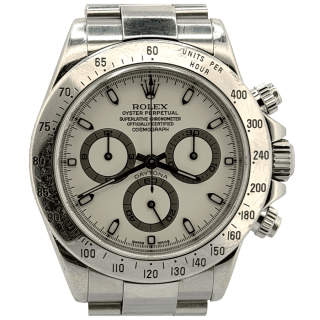
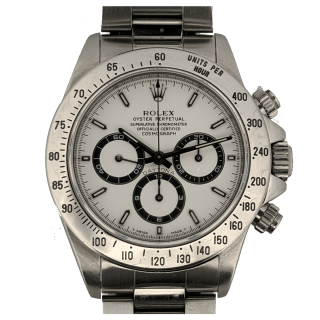
Share this content